by A. McAfee | Children with Exceptionalities, Family Resources, MFA, Mindfulness, Montessori Family Life, Montessori Parenting, Parent Education
Realizing that your child is not learning or growing as anticipated is one of life’s most daunting challenges. In this article, we explore ways of dealing with that challenge.
Coming to the realization that one’s child is not learning or growing as anticipated is truly one of life’s most daunting challenges. Each family’s experience of having a child with an exceptionality is completely unique. And yet, there are a few common threads that can make the journey a bit easier for teachers and for families to navigate.
STAGES AND PERSONAL NARRATIVES
Being the parent of a child with a special need is a deeply personal experience. Disability experts suggest that families go through the classic stages of grief. However, families may find this approach stereotypical and even insulting. To suggest that a family is ‘in denial’ or in any of the other stages of grief can feel dismissive and insensitive. On the other hand, being aware of a range of possible feelings can be helpful for both families and teachers.
Shock, denial, guilt, isolation, panic, anger, bargaining, acceptance and hope comprise the usual set of stages (Boushey, 2001). I am the mother of a very grownup daughter who is deaf. Alicia is 35, married, and part of her job involves lobbying on Capitol Hill for employment opportunities for people with disabilities. I can certainly remember each of these stages. I also remember feeling confused when several of these feelings (especially panic and anger) would reoccur. “I was already angry and scared last year. How could I be mad and fearful again this year?” Then I remembered a counselor explaining that this is not a checklist of sequential steps. It is a cyclical and often reoccurring process. And it plays out differently for every mother, father, grandmother, and grandfather, as well as each additional member of the child’s family.
An alternative view suggests that every family has their own narrative or story or journey (Lavani & Douglas, 2013). Early childhood specialists who employ this family-centered approach focus on each family’s concerns, their priorities, and their particular set of resources. As families and teachers work together, these three components drive conversations, planning sessions, and evaluations. Specific concerns, priorities, and resources (‘CPR’) of the family are honored and valued, along with professional recommendations. While keeping the stages of grief in mind can be helpful, placing the family’s unique set of ‘CPRs’ front and center is often more productive. These two approaches (stages and personal narratives) can be seen when families and teachers first begin talking about a child’s special need. They are not mutually exclusive; in fact, they can work well together.
HEARING “THE NEWS”
More often than not, families have a sense that something is not going right before their child’s teacher shares a concern. Families hear this statement (“Let’s find a time to meet. I’d like to talk with you about a concern I have regarding T’s reading… or behavior… or… ”) in a myriad of ways. It is not unusual for families to feel devastated or at least upset. It’s vitally important for teachers to understand this reaction. Some families sit quietly, appearing polite and ‘on board’ but not actually hearing anything stated after the word ‘concern.’ Others respond quickly that the teacher is mistaken and provide specific examples of why their child is just fine.
Most are somewhere between these two reactions. They try to understand the teacher’s concern and even try to engage in planning how to address the concern. But as they ask questions and share their own insights, their hearts are usually racing and their thoughts are tumbling into a confused jumble. Here, it is important for teachers to gently guide families toward identifying their concerns. What worries the family? Are they concerned that more information is needed? That they can’t afford an evaluation? That their child might have difficulty making and keeping friends? Or that he or she might start to feel ‘different’? Or … ? Every family is different; every conversation will take its own course.
Teachers need to provide time and support for families at this point. Hearing and understanding ‘the news’ can take weeks, months or even years. During this time, teachers can provide clear examples of both the child’s areas of difficulty and the child’s areas of strength. Sharing balanced, accurate information will help families begin to set a course of action.
COMMON GROUND
As teachers and families begin the process of working together, remembering their shared goal of supporting the child is crucial. This is the first of two golden keys to partnering with families. Questions about this first key include: What is in the child’s best
interest? What can we do to support the child’s learning? Is this the best we can do for the child? These questions can provide common ground during difficult conversations between teachers and families. They can also steady teachers and families during upsetting interactions with the child.
Returning to the initial conversation, it is important to remember that each family’s reaction to the teacher’s concern is a demonstration of their care for their child. Whether the family objects, agrees, or appears to not respond, all families want the best possible outcome for their child. During this very difficult conversation, families appreciate hearing that their child’s teacher also truly cares and is searching for ways to assist the child grow and learn.
“PLOP”
The second golden key for families, as well as for teachers, is to know and honor the child’s present level of performance (affectionately known as the PLOP.). This is tricky. Teachers and families both want the child to be moving forward (that vitally important common ground). But progress can be slow. At times, there may not be any progress at all; or worse, the child may regress. Knowing what the child is able to do (rather than focusing on what he or she cannot do) is key. Can the child stay focused for 5 minutes? Rather than lamenting that the child cannot focus for 6 minutes, begin planning ways to support reaching this goal. Can the child recognize three letter sounds? Hold this as the child’s present level of performance (rather than as a problem), and with the family, implement lessons to assist the child in recognizing four sounds.
PARTNERING FOR THE CHILD
This seems like a lot of alphabet soup and jargon (CPR, PLOP, stages, narratives, journeys, common ground). Dr. Montessori provided a simple, clear focus. She urged us to recognize each individual child’s potential. She also pointed out that teachers transform themselves by observing the child carefully. Finally, she considered families as the cornerstone of each child’s journey toward adulthood. This is true for all children. Our work as teachers
and parents, then, is to be partners on behalf of children, particularly children who learn and grown differently.
RESOURCES:
Boushey, A. (2001). The Grief Cycle – One Parent’s Trip Around. Focus on Autism and Other Developmental Disabilities, 16(1), 27-30.
Lalvani, P. & Douglas, L. P. (2013). Historical perspectives on studying families of children with disabilities: A case for critical research. Disability Studies Quarterly, 33(3), 9–9.
TOMORROW’S CHILD © ♦ APRIL 2014 ♦ WWW.MONTESSORI.ORG
by Claire Salkowski | Challenging Behaviors, Discipline, Early Adolescence (12-15), Educational Program Coordination, Emotional Intelligence (EQ), Emotionally Healthy Children, Empowerment, Faculty, Grace and Courtesy, Kindergarten, Lower Elementary (6-9), Mindfulness, Montessori Education, Montessori Secondary / High School, Montessori Teachers, Peace Education, Primary (3-6), School Leadership, The International Montessori Council, Uncategorized, Upper Elementary (9-12)
Montessorians are familiar with the daily “Circle” and use this important practice for starting or closing the day, but the Peacemaking Circle or Conferencing approach has become part of restorative practices in schools, workplaces, prisons, and Court systems around the country and throughout the world. Based on ancient practices of aboriginal peoples, this approach creates an intentional space with a particular process designed to:
- support participants in bringing forward their ‘core self”
- to help them conduct themselves based on the values that represent who they are when they are at their best
- make visible our interconnectedness even in the face of very serious differences
- recognize and access the gifts of every participant
- elicit individual and collective wisdom
- engage participants in all aspects of the human experience – mental, physical, emotional and spiritual or meaning-making
- practice ‘core self,’ value-based behavior when it might feel risky to do so.
The more people practice that behavior in circle, the more those habits are strengthened to carry that behavior into other parts of their lives. Create a space and time for participants to voice their thoughts and feelings, to take ownership for their behaviors, connect them to others, and learn from the collective wisdom of the group.
Peacemaking Circles: Creating Peace in Our Schools One Circle at a Time
Presented by Claire J. Salkowski IMC Peace Conference
ADR Specialist and Educational Consultant Nov 4, 2012
Planning the Specifics of the Circle – The Keeper puts together the circle plan answering the following questions:
• Who will be part of the circle?
• What time?
• Where?
• What will be the talking piece?
• If and what will be in the center?
• What opening ceremony will be used?
• What question will be used to generate values for the circle?
• What question will be used for an introduction or check-in round?
• Is there a need for further relationship building before getting into the issues? If so, how will that be done?
• What question(s) will be used to begin the dialog about the key issues?
• What further questions might be useful if the group is not getting deeply enough into the issues?
• What closing ceremony will be used?
Circle Outline
The detail in this outline is provided to offer concrete examples and stimulate creative thinking. It is not intended to be prescriptive. The circle is not a rigid process. It is always important to be responsive in the moment to the needs of the circle participants which may not follow the outline you planned. Nonetheless, it can be useful to have an outline to guide you as a keeper.
Welcome: Welcome everyone to the circle. Thank them for coming. Express appreciation for the willingness to work together in a shared space.
Opening: Openings mark the time and space of the Circle as a space apart from the pace and tone of everyday life. The opening ceremony is designed to help participants center themselves, be reminded of core values, clear negative energies, encourage optimism and honor the presence of everyone there. Lead the group in whatever opening ceremony you have chosen
Explain center: If you have created a centerpiece, identify any items in the center and why they are there.
Explain Talking Piece: Explain that the talking piece is a critical element of creating a space in which all participants can both speak and listen from a deep place of truth. The person holding the talking piece has the opportunity to speak without interruption while everyone else has the opportunity to listen without the need to respond. The talking piece will be passed around the circle from person to person. Only the person holding the talking piece may speak. It is always okay to pass the talking piece without speaking. The keeper may speak without the talking piece if necessary to facilitate the process. If the talking piece has a particular meaning explain that.
Purpose: Remind participants of the purpose of the circle
Introduction/Check-in Round: Tell participants that you are going to pass the talking piece around so that we can all hear how everyone is doing today. Invite participants to introduce themselves if they are not already acquainted. We suggest the keeper share first. People will most likely model their response after the keeper. Be authentic. Pass the talking piece and ask, “How are you feeling today?” “Is there anything you feel is important for us to know about how you are doing?” Sometimes it is useful to pose a question in this round that invites sharing about oneself so the participants get to know one another better.
Values/Guidelines: Before the circle starts place a paper plate or half sheet of paper and a marker at each seat. Ask participants to think of a value they feel would be important in order to feel safe to speak from the heart and listen from the heart. Ask them to write the value on the paper plate or sheet of paper. Pass the talking piece and ask them to share the value they chose, explain why it is important, and place their value in the center of the circle. Keeper models.
After establishing values, develop guidelines for the circle. The guidelines of the Circle are the agreements that participants make with one another about how to behave in the Circle. They establish clear expectations and common ground to provide a space where people feel safe to speak in their authentic voice, connect to others in a good way and ensure a space that is respectful for all. Pass the talking piece and ask participants to name one agreement important to their participation in Circle. (e.g. “Speak only for yourself.” or “Keep body language respectful.”) Write down the suggested guidelines on a sheet of paper or flip chart. When the talking piece has gone all the way around, read the list. Pass the talking piece and ask participants to indicate whether they accept these guidelines. If there are objections explore the objections and the original purpose of the person who proposed that guideline and work to find wording that is acceptable to everyone.
Extensive conversation about the guidelines can be good practice for working through a difference in opinion or perspective in a respectful way. In an on-going circle group the values and guidelines generated at the first circle are brought back to any subsequent circles.
Storytelling round: In some circles it is crucial to take the time for people to share stories from their own lives to increase understanding of one another or to build empathy. Stories often shatter stereotypes or assumptions people have about one another making it possible for them to hear one another more clearly when they discuss sensitive issues later in the circle. The Keeper generally goes first in a storytelling round.
Exploring the topic of the circle: Pass the talking piece, posing a question about the issue or topic that is the purpose of the circle. Alternatively, direct participants in an activity which helps participants connect with their thoughts and feelings on the topic. Follow with multiple rounds reflecting on the experience of the activity or exercise and reflections about the topic. Thank participants for the wisdom shared in the process. Acknowledge the courage that it takes to speak and listen from the heart.
Check-out Round: Pass the talking piece around and ask participants to share their thoughts about the Circle or one word that sums up how they are feeling right now as the Circle comes to a close.
Thanks: Thank everyone for coming and for their efforts to understand themselves and others in a way that allows everyone to be at peace with themselves.
Closing: Lead the circle in a closing ceremony. Closing activities bring closure to the circle, help participants feel centered and mark the ending so that everyone can transition from the reflective circle space back to the outer world. It maybe a poem, quote, song or music or it could be a ritual such as extinguishing a candle flame or ringing a soft bell.
Materials Needed: Determine from the outline all the materials you need to bring to the circle (e.g. paper plates for values, markers, talking piece, center items, readings or other opening materials, the circle outline, etc.)
Circle Prep Sheet for Longer Circles
Preparation
• Co-Keepers:
• Circle Purpose:
• Where and When:
• Talking Piece, center piece and what other things you need to bring:
• Who do you have to talk to and what prep do you do ahead of time:
Circle
• Opening Ceremony/Activity:
• Check-in question:
• Questions for going into guidelines (what you might be able to ask):
• Story telling/Trust Building Question:
• Guiding Questions on the Topic or Issue:
• Guiding question for consensus building, planning or summary round:
• Check-Out round question – what you might be able to ask:
• What “must” be addressed in the circle:
• What is the follow-up:
• Closing Ceremony/Activity:
Circle Prep Sheet for (Shorter) Classroom Circles
Preparation
• Co-Keepers:
• Topic:
• Talking Piece, center piece and what other things you need to bring:
Conducting the Circle
• Opening Ceremony/Activity:
• Quick Check-in round question:
• Guiding Questions on the Topic or Issue:
• Question to elicit Storytelling/Personal experience related to the Topic:
• Questions for Deepening Round(s):
• Question for consensus building/decision making/planning/summary:
• Check-Out round question:
• Closing Ceremony/Activity:
Follow-up
• Decisions/Insights that need to be shared with others:
• Work that needs to be implemented before the next Circle:
Revised and adapted by C.J. Salkowski from Heart of Hope Resource Guide by Kay Pranis and Carolyn Boyes-Watson
CONDUCTING THE CIRCLE
As keepers or facilitators you are responsible for creating and keeping the “form” of the circle. The basic manner of interacting in the circle generally involves use of a talking piece which is passed from member to member during sharing “rounds.” Only the person holding the talking piece may speak and they may do so as long as they have the talking piece. Typically the talking piece is passed around the circle, in order, although the keepers may choose to use a different form of passing the piece. The circle may also use other activities to move the group. These are described more fully below.
Keepers or facilitators act as guides to move the circle through the phases of circle it needs to experience. Note that these phases are flexible depending on the purpose for which a circle has been called. In a school setting, the circle can be used for many purposes. Circles can be used with the children in the classroom, faculties or parent groups. They can be the vehicle for discussions, resolving conflict, celebration, healing or learning about a particular topic.
It is important that all circles include an opening and closing, and that these two elements are always given time and depth.
Four phases of circles – Although the content or topical focus of circles may vary, all circles generally follow four phases. How you facilitate these phases is flexible. For example, a new group may need to spend more time on guidelines and on storytelling rounds. As keeper, trust your instincts on how to structure the circle, and be flexible enough to let the circle move in the way that it needs.
The four phases of circles are:
Phase One – Introductions
Phase Two – Building Trust
Phase Three – Issues
Phase Four – Solutions
Phase One – Introductions
The introductions phase of circle may include the following elements, all of which are designed to create safety and form and to begin to prepare participants for deeper sharing and understanding. This phase generally should include the following:
Welcoming – Make sure everyone is greeted warmly.
Opening ritual – All circles start with an opening ritual that helps us make the transition from the outer world and into the reflective circle space. Openings are designed to help us feel more centered and open to sharing. Openings may involve burning sage or incense which someone either places in the middle of the circle or passes over participants, using a feather to move the smoke around them – allowing people to cleanse themselves of negative energies and to prepare for sharing deeper emotions. They may include a poem, song or meditative music. Consider asking one of the participants (in advance), to offer the opening. With children and adults, I have found that using the Tibetan bells as an initial opening and a final closing, offers a quick way to a begin and end the circle when time is a perplexing concern. If they are used consistently in an on-going group it becomes a valuable ritual in itself. With children they will often ask to ring the bells in order to open or close the circle. We ring the bells three times with a sustained moment to let the sound move out into the group and find its own ending. It creates a reverence for what we are doing and brings us to that place of quiet and peace.
Introductions and check-in – In the first round, the keepers ask participants to introduce themselves by name (perhaps first name only), how they feel, why they are here in circle, and what they hope for.
Seeking consensus around guidelines – If it is a new group, then participants develop guidelines of how they want to be together while in circle (e.g. respect all opinions, confidentiality, etc.) Then, take a complete round of the circle to ensure that each person indicates support of the guidelines. If it is an ongoing circle, then the keeper might review the basic circle guidelines and if invite the group to add any additional guidelines if necessary. Take a full round to be sure everyone has a chance to comment on the guidelines and to demonstrate their support of the final list. Remember that the guidelines are a “living document” and may be revised in circle at any time.
Acknowledgment of those present – Remember to acknowledge those present in circle, especially if the circle is gathered to discuss a difficult topic or resolve a conflict or find healing and resolution for an incident of harm. It takes courage and commitment to participate in circle. Also be sure to acknowledge the volunteers who have helped make the circle happen.
Clarifying the purpose of circle – The keeper summarizes what has been experienced in phase one of the circle, using this summary to further set the tone of the circle and to clarify the purpose of the circle.
Phase Two – Building Trust
Next, the keepers move the circle into deeper sharing as a way of increasing the level of trust among members. This may take a variety of forms. Depending on the nature of the circle, keepers may guide it toward a single or multiple rounds of sharing, and may or may not choose to use other methods of sharing such as ice breakers, art work, individual reflection or small group activities depending on the amount of time available.
Ice breaking – With groups involving young people it might be useful to begin with individual reflection, or sharing in pairs or small groups. Consider using art supplies to having members (individually or as teams), draw representations related to themselves or the purpose of the circle. Or consider using icebreaking activities that are neutral to the purpose of the circle, but which help members to get to know one another as people.
Storytelling round – If the issue or purpose for the circle involves a difficult issue, it may be useful to have a storytelling round. Invite participants to share a personal life experience related to the issue offers (perhaps in a very indirect way.) Storytelling is a powerful way to move beyond masks and appearances and to develop a better understanding of one another. Story telling is a powerful way to share our wisdom with each other and allows us to take in what we might otherwise reject if we were simply “told” in some other form.
Deepening rounds – The circle may move into deepening rounds of sharing. These rounds get to the heart of why the circle was called or if time allows, a topic is explored in depth for further insight and deeper learning. Depending on why it was called, these rounds may include an expression of needs and interests (in the case of a conflict circle), sharing memories and grief (in the case of a healing circle). If small group activities or dyad sharing feels appropriate they may be used here, but always come back to the circle and to sharing in the full circle.
Phase Three – Issues
In this phase, the focus expands from what’s gone wrong or what’s hurting to what can be done to make things right, to promote healing, or to initiate positive change. In many circles, such as those focused on healing, listening may be what’s most needed – giving people a chance to tell their story and to have it received deeply. In other circles, though, exploring options helps break the sense of being stuck in either a painful experience or a self-destructive way of life.
Phase Four – Solutions
Some circles, such as those involved in healing or understanding, do not require decision making. In these circles, the focus of the keeper may be to work toward creating a sense of unity. Other circles do require decision making or resolution of conflict. In these circles the keeper attempts to build consensus by building on each circle participant’s input, until a decision is reached that all members are at least “able to live with.”
Consensus involves an agreement among all participants to “live with the outcome” – to accept a decision or course of action because it promises the best for everyone given the circumstances. Generating consensus involves patience, creativity, candor about interest and concerns, and a willingness to think outside the box. We are challenged to set aside our personal agendas and fixed notions about outcomes, so that something may emerge that is larger than any one person’s preconceived ideas. Consensus is about dialogue, listening and honesty.
To help the group move toward a consensus decision the keep
1. Help participants to identify areas of disagreement,
2. Encourage participants to explore and understand one another’s perspectives, and
3. Work with participants toward final consensus decisions that are as inclusive as possible, and that are respectful of differing viewpoints.
Reaching decisions by consensus often takes more time than other decision making models, such as voting. The strength of the process is that it assures that all participants will “own” and support the decision. In consensus there are no winners and losers, but rather everyone is in agreement and willing to move forward on whatever plan or decision has been devised. When using this process it is important that the group commit to addressing issues or concerns that may be raised on the way to achieving a consensus decision.
Closing
All circles end with a closing ceremony that helps us make the transition from the reflective circle space back to the outer world. Closings are designed to help us feel centered and to bring a sense of closure to the circle. They may include a poem, song or meditative music. Consider asking one of the participants (in advance), to offer the closing.
AFTER THE CIRCLE (FOLLOW UP)
Follow-up is one of the greatest challenges of the successful use of circles. Follow up may include:
• If strong emotions are shared in circle, affected individuals need to be contacted to see how they are doing and ensure that they are getting the support they need.
• Planning one or more follow up circles, if necessary.
• Discussions with people who were not in the circle, but who have relevant information or position to affect issues discussed in circle.
• If agreements are made in the circle, it is important that someone follow up to see if people are accountable to those agreements.
One of the responsibilities of the circle keepers is to attend to follow up. It is not necessary that the keepers handle all follow up activities, only that they ensure that members commit to specific follow up. It is the keepers’ responsibility to follow up with those individuals to ensure that follow up is in fact occurring.
Adapted by C.J. Salkowski From Circle Keepers Manual (draft) by Kay Pranis
For more information or to schedule a circle session or training contact:
Claire J. Salkowski
CJConsulting@comcast.net
410-593-9601
410-499-4732
by Christine Lowry | Challenging Behaviors, Children with Exceptionalities, Lower Elementary (6-9), School Resources, The International Montessori Council, Video, Webcasts / IMC
Join us for a sharing of conversation, wonderings, and your questions with guest panelist, Christine Lowry. Christine is a Montessori credentialed special educator with many years of experience working with children with diverse learning and behavior in Montessori classrooms. We’d love to hear from you as you work with children with challenges in your classrooms at every level.
by Sharon Caldwell | Children with Exceptionalities, MFA, Montessori Education
Darren (not his real name) has cerebral palsy. He was four years old when he came to our school. Although he was a pleasant child and tried to please, he had a very low level of concentration and had a tendency to wander off outside while holding pieces of materials. He also liked to chew things. This posed quite a challenge to us as our environment allowed free flow of children between indoors and out. Materials went missing (luckily most were found scattered around the lawn). He also tended to chew things, and tooth marks appeared on the Geometric Solids. We also discovered that Darren had a fascination for anything that turned, or could be swung. Our pencil sharpener couldn’t stand the use and eventually fell apart. He particularly enjoyed opening faucets (but strangely was not very interested in closing them!)
I was at my wits end when my brother, an Anthroposophic Art Therapist and guide at an Experiential Museum, suggested some special materials and activities. Among them materials we made available especially for Darren was a wind-up torch – a flashlight where the battery is recharged by winding. Darren loved this and would spend hours spinning the handle to get the light to shine. Another innovation was mounting a huge antique fishing reel vertically on a wall so that Darren could turn the handle with big sweeping movements, producing a wonderful cluck-cluck-cluck sound that was oddly soothing and didn’t seem to bother anyone in the environment. He taught Darren how to spin on the spot holding some object that he could watch going round and round. One day he painted a Chartres Labyrinth outside the classroom for Darren and the other children to walk, round and round – inwards and out. All of these activities seemed to quieten Darren and helped him concentrate.
After some time we realized that Darren was no longer spinning, but he was also no longer running outside with materials and had begun to choose work and was showing signs of, if not intense concentration, at least an ability to focus for a few minutes, and was no longer a disruption in the environment. We discovered that as long as we placed no demands at all on him, he would potter around all day, alternating between various practical life and sensorial activities, and exploring running water, stalking the chickens, watching birds in the tree outside, or very tentatively venturing up onto the climbing frame.
After he had been with us for about six months, Darren’s mother informed us that she could no longer keep him at our school as she did not have transport to bring him across town. He started at a regular day-care closer to home. Soon his mom emailed me that Darren was very unhappy and disruptive. He went to four different schools and was asked to leave all four because the teachers “found him impossible to handle.” At the last he was sitting on the floor for most of the day bashing his head (literally) against the wall and screaming. Then, six months after leaving, his mother was able to arrange transport and he came back to our school. We were worried that he had regressed to such an extend we would have to start again from scratch. I took out all the spinning work and prepared for a few weeks of disruption. We had a school meeting and the other children agreed that they would take turns to shadow Darren until he settled.
On his first day back, when I shook his hand and said “I’m so glad you’re back”’, Darren said “me also”, walked past me into the room and carried on as if he hadn’t left. Darren was able to find calm within, when he was in an environment which recognized him as an individual, and when he had adults and children who took the time to meet his needs rather than trying to find ways of making him meet theirs.
Why is it, that all too often, people who are strong, intelligent and endowed with all of natures gifts, feel that they need to force those who are weaker, for whom the world is most challenging, to comply with requirements and rules, meet objectives and standards which are not their own? Darren, and many other children whose lives are made miserable because they do not conform to some arbitrary definition of “normal” (not Dr. Montessori’s definition), because they cannot do the things expected for their age, have a right to happiness and peace. They have a right to be just who they are.
This story does not have a happy ending. When Nahoon Montessori closed at the end of 2007 Darren’s mom again had to search for a school. When I last spoke to her, told me he had been asked to leave two schools in three months as the teachers found him impossible to handle. I have since lost contact with a very special person who taught me so much.
I’m telling Darren’s story because he has counterparts in classrooms around the world. Dr. Montessori’s message gives us the tools to begin to understand how unrealistic demands cause many of the problems we see in children. It can help to remind us that although there will always be children with challenges we cannot solve, there are many who can be welcomed into our environments. We may not be able to teach them reading and writing and math, but maybe we can teach something more important, not only to these children but to all the others who are part of their lives. Every human being is valuable and deserves happiness – and we can give happiness. Every child in our school was enriched by their interactions with Darren and other children with exceptional needs and sometimes challenging behaviors. The children who were blessed by having intact neurological systems and anatomically near-perfect bodies learned about compassion and acceptance and humility. They learned that when you are blessed you need to share your ability and strength to gain the full value of those assets.
How do we measure outcomes such as these? Where does humanity rank against reading and numeracy? Are we prepared to look inward and see what defects of our own are preventing us from hearing the deep and authentic call from the child to give just that assistance which is truly needed, and then step back and make space for for each child to find his own answers?
Published in Tomorrow’s Child.
by Paul Epstein, PhD | Challenging Behaviors, Computers in the Classroom, Lower Elementary (6-9), MFA, Montessori Education, Montessori Teachers, Primary (3-6)
by Dr. Paul and Ann Epstein
Computers in Montessori early childhood classroom deserve careful study. Just as Dr. Maria Montessori scientifically observed children and developed her didactic materials, we must also completely examine a computer’s benefits and barriers to learning.
We believe that computers are tools for thinking and communication. We further believe that computers will augment or enhance the kinds of thinking and communication children now experience with the didactic materials. Young children are using computers to predict, problem solve, explore relationships, and design two or three-dimensional graphs. Children can also develop spatial relationships by selecting directions. For example, should I go two blocks east or two blocks north to reach my destination? Young children use programs to create their own stories. They select settings (perhaps an island) and appropriate equipment (boats and snorkels, instead of rockets and space suits). Other software includes video and music. Animal behaviors and seasonal migrations are the subject of still another developmentally appropriate computer program.
Computers appear to help young children with early signs of attention deficit disorder. These children often demonstrate difficulty maintaining concentration with activities on rugs and tables. They struggle to follow through, even though the materials are carefully designed and the teacher’s demonstrations are clear and precise. In contrast, children who are otherwise off task concentrate for longer periods with educational computer programs. Knowing they will be successful, they excitedly look forward to their computer experiences. Their behavior is not an issue when they learn with computers.
However, these scenarios are not yet fully documented by research. We are reminded of Dr. Maria Montessori’s earliest days with young children. Living in an emerging industrial era she was called upon in 1907 to open a day care center for some sixty children left alone in a suburb of Rome while their parents worked in factories. The “secrets of childhood” Montessori discovered there astonished the world. Montessori held her audiences spellbound as she articulated a vision of childhood that differed from the prevailing belief that children were miniature adults. What new secrets of childhood will computers reveal?
Nearly one hundred years ago, Montessori observed the children of San Lorenzo. She formulated hypotheses and experimented. Determined to develop sets of hands-on learning materials that would engage children in investigation and discovery, she designed one after another. Each was presented to children, and Montessori closely observed their responses. Eventually, she discovered how many items to put on a tray, in a basket or in a box. She noted what children did with the objects, how long they were occupied, and how often they returned for further explorations. She made refinements to the sizes, colors, shapes, and quantities of objects. Some of Montessori’s decisions involved chance – a certain color of paint or type of wood was available at the time. Montessori finally determined the materials were “right” when children displayed a meditative-like concentration as they repeatedly explored the learning material.
In the same spirit, we must ask, what is the optimal size of a computer screen for young children? How should a keyboard and mouse be designed to best fit a young child’s emerging fine-motor and eye-hand coordination? More importantly, can children use more of their natural learning abilities with computers?
Children require multiple experiences that allow them to move and engage all of their senses. Computers will not replace a child’s interest in the didactic materials. We should not think of computers in terms of “either/or”: either a child will prefer the computer or the child will prefer the didactic materials. It is simply premature to foreclose on computers in the classroom because we fear some children might prefer computers screens to carrying and stacking pink cubes or brown prisms. Carrying cubes or prisms is of course a very different learning experience. But using a mouse to drag cubes and prisms is also a learning experience. Children sequence sizes visually. In a computer environment, children organize a larger, perhaps more interesting, variety of objects.
There is no compelling evidence to conclude learning, for example, addition facts with a computer program will replace the addition strip board. The research is lacking: Will young children abandon the didactic materials in favor of computer software? Many young children do not prefer computers. But there are also children who do not care for either the addition strip board or the addition charts. These materials offer one way of learning. We know children’s styles of learning vary. Some are tactile, and learn through the hand; others prefer a visual mode of learning. Computer programs offer alternative ways to learn. A computer, like any of the didactic materials, is a tool with which to think, investigate, explore, communicate, express ideas, and solve problems.
We should, then, welcome computers in the spirit of Montessori. The computer offers a unique opportunity to engage in the legacy of scientific pedagogy. Just as we would with any new piece of material introduced into the classroom, we need to observe and study children’s responses to computers.
A computer introduces both hardware and software issues of management and pedagogy into the classroom. These issues are similar to the concerns raised whenever any new piece of material is placed into the classroom. How will children access the computer? How long will their turns last? Children need presentations on how to turn the computer on and how to shut down. They need lessons on how to use the mouse and keyboard. And, they need lessons on how to access software programs.
We should develop a set of software selection criteria. While selection criteria are readily available on the Internet at, for example, state departments of education and school district web sites, these may not apply to Montessori settings and needs. Curiously, software accepted by other approaches to early childhood education could be rejected by a set of criteria developed for Montessori early childhood programs. Some computer programs offer creative simulations and interesting explorations requiring reasoning, planning, and solving problems. Others are competitive, explosive, and violent; these themes have no place in our schools.
We are not placing computers into classrooms of the 19th century industrial era in which Montessori lived and worked. The 21st century is a world Montessori could not anticipate. There were few digital computers in the 1940s and early 1950s. They occupied large rooms, required large numbers of vacuum tubes and electricity, and could complete only the simplest of calculations. The desktop computer we are using to write this article simultaneously runs word processing, database, spreadsheet, presentation, and multimedia programs. While working with these tools, we can listen to CD recordings or watch a DVD movie. We are also connected to the Internet accessing a vast library of information and communications.
The larger question is, then, can children use computers to think and learn in new ways? Montessori’s didactic materials bring a specific body of knowledge and method of learning to young children. Recent brain research suggests new theories and possibilities for facilitating young children’s learning. It may be that observing and studying how young children learn with computers will reveal new secrets of childhood.
by Tim Seldin Paul Epstein | Children with Exceptionalities, Montessori Education, Montessori Family Life, Montessori Parenting, Montessori Teachers, The Montessori Way
Download the chapter on how Montessori schools attempt to meet the needs of children with exceptional needs and challenges, from the book The Montessori Way by Tim Seldin and Dr. Paul Epstein.
Download File
by The Montessori Foundation Staff | Children with Exceptionalities, Language & Reading, Montessori Family Life, Montessori Parenting, Montessori Teachers, Parent Education, Reading, Writing
Katya was the youngest of the three sisters. She was about to become seven years old that coming Christmas time. Her birthday was December 26. She was a Christmas present that came a day late, her father used to say.
Katya had a pretty face and delicate hands but was crippled with bones that grew crooked rather than straight. She was loved greatly by her parents and protected from the harshness of the world.
Anna and Marion, her sisters, loved her, too, but in an appreciative rather than simply an affectionate way. They pitied the unfortunate Katya as one would pity a bird with a broken wing. When seeing Katya they would think: “Poor, unfortunate thing. I’m glad it’s not me.”
They gave her small gifts almost weekly as payment for bearing such a heavy curse of misery and shame on her shoulders. Like the wind which is known only in what it does,
Katya’s unbearable load was invisible to the eye, but was recognized in how severely the great weight bent her back and legs.
Something unseen but massive had been buckling her since birth. She never could crawl when she was a baby but only lie on the floor and slither like a worm when she
Her two older sisters in a way were paying Katya off for being the cursed one of the family. I do not believe Anna or Marion could ever reveal this truth openly to even their own conscious minds, but down below in the darker depths of their hearts they surely felt grateful that it was on Katya and not on themselves that this cruel affliction had fallen. Katya would sit for hour after hour curled up on the cottage’s west window seat with the family cat, both still as statues. The cat’s eyes were mostly shut, but not Katya’s. Her hazel eyes were wide open all day, for Katya wanted to see everything that existed in the world embraced by that window’s view. Although not as busy as her older sisters, Katya had so much to see. Her absorbent mind took in daily feasts of friendly familiar things like the old apple tree planted by her great grandfather, the thick bushes where the rabbits lived, the gray wooden fence in the distance that separated their yard from the cow pasture, the rolling rye fields that never ended but became the blue sky of God’s heavenly ocean which was above everything else forever.
And then there were the varied clouds that sailed throughout the day, ships of all sizes. There was always something absolutely brand new that would come walking or flying into view for a wonder filled while.
Katya saw everything and by the power of her seeing simply took everything into her bright mind and then deeper, deeper into her soul, there to be kept as the stuff her dreams were made of in the much later sacred and secret life of her sleep. You and I cannot appreciate what a blessing the night was to Katya.
Her whole life expanded in the night. It was as if she were magically changed into a rare moth and set free by the evening breeze to fly on beautiful wings within the midnight forest. During the day she was a humble caterpillar feeding her hungry soul by chewing and chewing every person and every thing her eyes came upon in that small but interesting world of the cottage yard. But in the night, sleep would come with its dream world where Katya’s bones were straight, and she could walk and run and dance for hours and hours. Her joy in being there in this land where wishes fly like doves was unbounded, and she would sense her feet leave the ground completely whether she was dancing, or running, or walking. In her heart’s heart, so alive within the magical world of her dreams,
Katya knew what it was like to be one of the free things of this world—what it was like to be a winged one. In the dark of night, Katya would dream her dreams—-dreams in which she always became just a little bit less than an angel. When the hidden passages of a mountain become superabundantly filled with the seep water of many rains and melting snows, a spring will burst forth into our world, a virgin spring of sweet, pure water. What a surprising blessing it is for the wild animals of the forest. The same happened for Katya after seven years of experiencing life. On the day after the great holiday of Christmas, she suddenly produced a virgin spring of written words.
The letters of these first words were at once so beautifully shaped that Katya astounded her parents and sisters. It seemed a miracle for no one had ever schooled Katya. Her parents never considered allowing Katya to go to the village school as did her sisters. Although her mind was the brightest of the three children, her grotesque and twisted body condemned her to home life. All that Katya learned, she learned from seeing and listening to what went on within the familiar but defined circle of her experiencing. She learned unconsciously yet constantly as did the feral kittens that lived in the hay barn. It all happened naturally, wonderfully, without formal schooling.
Katya was a keen listener and learned just from absorption how to talk with perfect pronunciation and unusual clarity of thought. Katya was perhaps even more keen at seeing details, and she mastered the meanings of those little black squiggly shapes printed on the pages of story books when she was but six and one half years old. Yes, she learned how to read even though she was never taught. She learned how to decipher written words by embracing each of them with her mind/heart/soul in a very intimate way. You see, her mother would place Katya curled up like a little rag doll in her comfortable lap whenever she would read stories to Anna and Marion.
The two big sisters would sit on the hearth rug looking up into their mothers sweet face as she read aloud. Katya, however, would be looking right at the open pages of the storybook, and as each word was spoken she would imagine that word coming right out of the black joined shape of the letters. She was probably helped at this by the fact that her mother read while moving her index finger along under each word to help her keep track while reading by the candlelight. Every next day when she was left alone in the house, Katya would gimp her way clumsily but surely to find the storybook. And then sitting wrapped up with it on the window sill, she would take her pleasure with the words, focusing on each of them intently, moving her thin finger slowly under them, remembering the spoken word that mysteriously came out of each configuration. It was a wonderful game to Katya. It was magical, for it seemed that her finger was like the needle of a phonograph moving on a record, and as it passed under each printed word she would hear it said aloud deep within her self.
And what was best of all, she would hear it spoken in her mothers’ sweet voice. Then, like an echo, she would repeat the word in a tender whisper to herself and to her angel listening. Each word so mastered by Katya was almost as personal to her as were her very sisters. This secret read language was just like all her other experience of words: it was profoundly personal and real. Words became familiar to Katya in this so basic family way to the total amazement of her own family! It was the best of schooling. It was as natural and as surprising as sneezing for Katya to then take up a thick black crayon on the day after Christmas and begin to draw the letter word configurations on a sheet of white paper. She was a pretty, crumpled up little girl of seven who now had discovered how to write words! It was as natural a happening for her as was learning how to read.
Writing words for Katya was from the start an act of pure artistry. She had long ago drawn pictures of the outside tree and the hills behind the fence. Why, she had even drawn a wonderful picture of the cat asleep in a spot of sunlight on the cottage floor. There seems to be this great desire within the heart/mind/soul of every person to capture the fleeting moment of an experience and then to represent it somehow later on to others as if asking the question: “Do you see what I see? ”
When personal seeing becomes passionate it becomes perceiving. You really take hold of something so that it will not fade away but last. When you perceive something especially good, true, or beautiful you want to make it a “keeper” and so you copy it, you draw it, or photograph it, or translate it into a poem, or even sing it as a song! Well, crippled and hunchbacked Katya had become just such an artist. A day never went by without her drawing the line of something. And she would not be satisfied until the lines she was drawing created the whatever more beautiful than ever.
She had discovered the magic about art that makes the drawing more special than the thing drawn. When she finished drawing a bird on a branch, somehow that bird took on something more ? it now contained her soul within it, and that made it peculiar in a perfected kind of way. The first time that Katya moved to draw words, she was not simply learning how to write like you or I did once upon a time. No, the first time she took up pencil and paper to copy words from a story book onto a sheet of blank white paper, she did so as an artist. She drew the letters and so also the words. She would make every letter shape a beautiful thing and therefore every completed word a gorgeous creature. The ancient word for such art is calligraphy which is Greek for beautiful writing. And so it was that Katya’s family discovered to their astonishment at Christmas time, that this little misshapen unschooled sister had not only learned how to read and write by herself, she had become an absolute master of such linguistics. Katya revealed herself to be not merely a reader and writer of words. She was an absolute genius, a magician with words. More than her big sisters, and more than her parents, it was plain for all to see that Katya delighted in making words come out of the tips of her fingers right on to plain paper as little works of art. Yes, it was pure magic when Katya began writing her own words that Christmas time. And best of all, as she wrote each dear word, she would read it aloud with a voice that sounded like that of a bird. Her face glowed with great joy as she did this before her wondering family. Katya had become all by herself a creator and a lover of words. And so she would always be.
Peace To you all — my brothers and sisters who love the Children of the World —
by Christine Lowry | Challenging Behaviors, Children with Exceptionalities, Lower Elementary (6-9), School Resources, The International Montessori Council, Video, Webcasts / IMC
Join us for a sharing of conversation, wonderings, and your questions with guest panelist, Christine Lowry. Christine is a Montessori credentialed special educator with many years of experience working with children with diverse learning and behavior in Montessori classrooms. We’d love to hear from you as you work with children with challenges in your classrooms at every level.
by The Montessori Foundation Staff | Brain Development, Challenging Behaviors, Children with Exceptionalities, Communication, MFA, Montessori Education, Montessori Parenting, Montessori Teachers
Download Image
Helping Children Who Learn Differently: The Shelton Way By Joyce Pickering, Ph.D.
The Shelton School in Dallas, Texas is school, an evaluation center, and a speech-language clinic. In the early years, the school grew to offer classes through the 6th grade and then expanded to the 8th grade. Dr. Shelton was the Director until 1985. Another Director followed, and when she resigned in 1989, an interim director ran the school for one year. In 1990, Dr. Joyce Pickering became the Executive Director. Dr. Pickering brought the same training as Dr. Shelton, who had been one of her teachers. The school grew from 170 to the present 870 students. In 1991, the Outreach Center was added to the operation of Shelton. The Upper School was added in 2000. Shelton is now the largest school in the world for students with learning differences, offering services for children from early childhood through high school.
by Tim Seldin | Challenging Behaviors, Children with Exceptionalities, Discipline, MFA, Montessori Education, Montessori Teachers, Webinars / MFA
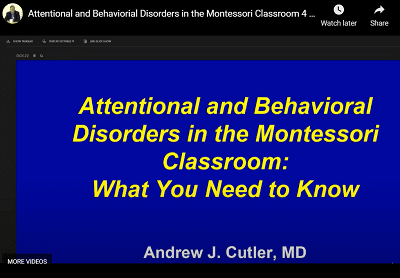
This is a recording of the webinar held on Thursday, April 30th, 2015.
Our guest was Dr. Andrew Cutler and the topic was Attentional and Behavioral Disorders in the Montessori Classroom.
by Brynn Rangel | Children with Exceptionalities, Communication, Montessori Administrators, Montessori Teachers, School Leadership, School Resources, The International Montessori Council, Video, Webcasts / IMC
What happens when a student needs additional services? How do we best collaborate with professionals that may not be familiar with Montessori? How do we implement recommendations from service providers in our classrooms? In this webinar we will be discussing how to successfully integrate therapeutic resources (ex. Speech Therapy, Occupational Therapy, ABA, etc.) into our school environment and community. This will be an interactive session; we encourage questions, comments, and sharing of stories and resources. See you Wednesday! Brynn Rangel is a Board Certified and Licensed Behavior Analyst that has been working with individuals, families, schools and organizations since 2006. She is currently the Resource Specialist at Oneness Family School in Chevy Chase, MD and teaches for The Chicago School of Professional Psychology in Washington, DC. Brynn has developed and taught courses for Montessori educators and administrators through the Montessori Foundation, The Center for Guided Montessori Studies, Westminster College and Sarasota University.
by Christine Lowry | Challenging Behaviors, Communication, Emotionally Healthy Children, MFA, Montessori Family Life, Montessori Parenting, Webinars / MFA
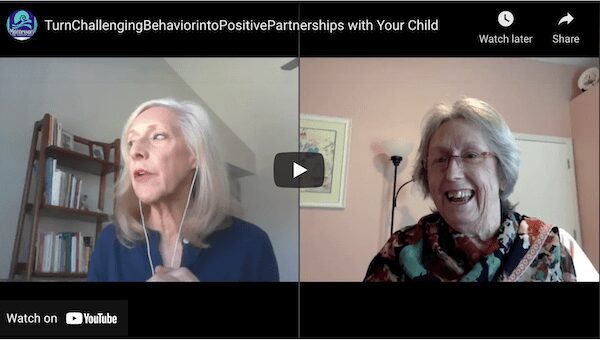
Behavior challenges to our parenting can be stressful in the best of times, but now that we are with our children almost all the time, even smaller challenges can sometimes feel overwhelming. Here’s a conversation with Lorna and Christine as they talk about ways you can find solutions with your child as you partner for positive behaviors.
by Simone Davis | Challenging Behaviors, Discipline, Emotionally Healthy Children, Family Resources, Free Reads, Infant, Infant-Toddler (0 to 3), MFA, Montessori Family Life, Montessori Parenting, Parent Education, Parenting on the Same Page, Primary (3-6), Toddler (18 months-3 years)

I’m going to dive right in to discuss a very tricky area for parents and children alike: tantrums.
I hope you find this article useful so you can start applying Montessori principles in your home too.
Dealing with Tantrums
Tantrums are a pretty normal part of life with children from around one to five years old. Maybe they’ll start a little later than one year and will end earlier, but anything in this range is fairly normal. Your child is learning that things don’t always go their way. And, as parents, we are helping them learn how to deal with these emotions and to make amends.
It can be upsetting for a parent. It’s hard to realize that your child is actually asking for your help. They are overwhelmed by the situation and need your support to calm down. It’s not the time to take it personally.
How to Avoid Tantrums
It can be possible to avoid tantrums before your child loses control. Here are some ideas to ward off tantrums when you see the first signs of your child losing control.
1. Be prepared: take a small bag with some simple games and some favorite snacks if you expect your child to wait patiently in a doctor’s office or a cafe.
2. Label their feelings: “Boy, you really wish you could stay longer”; “You really wanted some orange juice right now!”
3. Redirect them: “I can’t let you hit your brother, but you can hit this drum/pillow.”
4. Get down to their level: “You sound frustrated. Can you tell me why?”
5. If they are struggling, ask them if they would like some help: give them just as much help as they need and then step back.
6. Give them a choice: “Would you like to put on your shoes or your scarf first?”
7. Establish routines: “… and after lunch, we’ll go to the toilet, read a book, and tuck in for a rest.”
8. Let them show their anger creatively, “Show me how angry you are. Here is some paper and a pencil. Wow. They are big circles. You are really mad!”
Triggers
Events can often escalate to a full-blown tantrum. Sometimes it’s from your child’s frustration; other times their anger or rage; sometimes because they want to be in control; their communication may still be limited; or because they are tired, hungry, or overstimulated. They can throw themselves on the floor, push us away, try to hit us, a sibling, another child, or even break something.
It can be useful to note things that cause tantrums in your child: over-scheduling can be common; a new baby; moving to a new house; or certain children may trigger them.
Sometimes the tantrum is even caused by us as we deliver the news that it is time to leave the park, or we serve some food they don’t like for dinner, or that we would like them to get dressed to leave the house.
It’s OK for your child to have a tantrum. You can acknowledge their displeasure at what is going on. You can help them to do the thing that they don’t like. However, when we back down and give in to them, you will find they shout even louder next time.
It’s difficult to be the parent and stay strong. But your hard work will pay off in the long term. They will learn that when you say no, you mean no; and when you say yes, you mean it too.
I like the advice from Positive Discipline for Preschoolers (by Nelsen EdD, Jane, Erwin M.A., Cheryl, et al. Jul 9, 2019). “If you say it, mean it; and if you mean it, follow through with kind and firm action.”
Action may be, for example, leaving the park with a sad toddler, acknowledging that they really wish they could stay longer.
Alternatives to Time Out: How to Help Your Child Calm Down
When your child is having a tantrum, some experts advise putting them into time out. I find this difficult as your child is asking for help to calm down, and you are removing your support and punishing them instead.
When we punish our children, they often get angry at us rather than being sorry for what they have done. Or they try to work out a way to get away with it next time without being caught.
Instead, I look for ways that I can support my child to calm down. I’m not saying that their behavior is OK, but when they are in the middle of the tantrum, it is not the time to teach them anything. They cannot hear you. They have lost control. So let’s help them calm down.
Some children will respond to a cuddle during a tantrum. You can rub their back, cuddle them, and sing to them as they go through all the range of emotions from anger, to intense frustration, to sadness, and sometimes regret. I once held my son for 40 minutes as he refused to get dressed. And I watched him go through all these emotions. In the end, he announced he was ready to get dressed. He told me he loved me. He wasn’t angry with me. He was grateful that I had just been there for him. I know sometimes you have to leave, but in this case, we just changed our plans.
Other children will push you away and don’t want to be touched. In this case, I make sure they are safe and cannot hurt themselves or others. I stand nearby and keep offering my help, “I’m here if you need some help to calm down. Or we can have a cuddle when you are ready.” After the tantrum, I like to offer a cuddle. “That was tough. And now you have calmed yourself down. Would you like a hug?”
If they are throwing toys at their sibling or trying to hit me, I would remove them so that everyone is safe. “I can’t let you hit me. My safety is important to me. Would you like to hit these pillows instead?” If your child is trying to hurt the baby, you can place yourself physically between them to keep the baby safe as you help your older child calm down.
For a child over three years old, you can set up a “calm place,” which they can use when they are upset. It may be a tent with some pillows and favorite things. It may be a corner with some trains. You can ask your child if she would like to go to her calm place.
This is different than ‘time out,’ as the older child is in control; she can come out when she feels calm. If she comes back still in a rage, I would gently tell her that she looks like she still needs to calm down and can come back when she is ready.
Making Amends
Maybe you are thinking that if I support my children while they calm down, I’m saying that their behavior is OK, and I’m encouraging them to get angry. When they are upset, indeed, my objective is to help them calm down.
Once they are calm, I then help them to make amends. If they drew on the walls, I would get them to help me clean up. If they broke their brother’s toy, they can help to fix it. I’ve asked the kids to help scrub their sheets when they used marker pens in bed and made a mess.
In this way, they learn to take responsibility when things go wrong. And when it’s over, it’s over. The good thing about young children is that they can move quickly from deep anger and sadness back to their happy selves. We need to move on too and not let this upset the whole day by referring back to it or keeping on about it. Once they have made amends, it’s OK for everyone to move on. •
TANTRUM FAQs
Shouldn’t we just ignore their tantrum?
I don’t like to ignore children when they are having a tantrum. They may not let me touch them, but I keep offering support and letting them know I am available when they need me. If you were super upset and your partner just left the room for you to get over it, you would likely find them unsupportive. We are showing our kids that, good or bad, we will be there for them.
What do I do if we are out in public when they have a tantrum?
There are basically two options:
First: Go home—if you find it difficult to have people watching you, it’s best to just leave. This may mean parking a full shopping cart and following the above ideas once you are home.
Second: Stay and support them—my preferred option is to hang in there and do what you would do even though you are out of the house. If you have more than one child with you, make sure they are safe. And then offer as much help as you can to help your child calm down. People watching will more likely think about what a lovely, patient parent you are, rather than what a horrible noise your child is making.
I find it difficult to stay calm myself. What can I do?
If your child has triggered you, it is indeed difficult to help them calm down.
• If your partner is available, it can be easiest to get them to step in instead.
• You may want to make sure the kids are safe and go to the bathroom to catch your breath.
• Find a mantra that you can repeat, “I breathe in calm, I breathe out anger.”
• Remember not to take it personally. Perhaps visualize putting on a bullet-proof suit that will resist everything (including words) that your child throws at you.
These tips should help you remain calm and give your child the support they need to regain control.
Learn from Simone Davies, an AMI Montessori teacher with15+ years’ experience working with 0-3-year olds, owner of Jacaranda TreeMontessori in Amsterdam since 2008, mother of two teenagers, and author of the book The Montessori Toddler. Visit her blog at themontessorinotebook.com
This article is from the November 2019 issue of Tomorrow’s Child magazine. Reprinted with the author’s permission.
by Christine Lowry | Challenging Behaviors, Children with Exceptionalities, Montessori Education, Montessori Teachers, The International Montessori Council, Webcasts / IMC
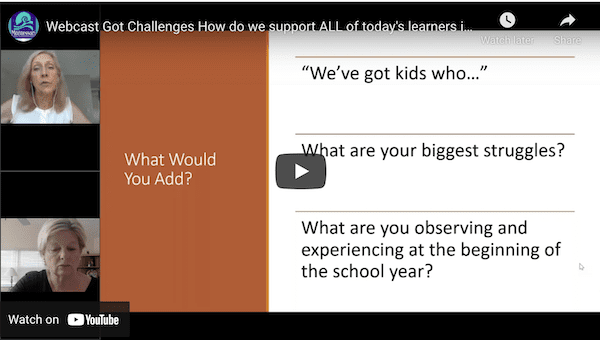
Webcast: Got Challenges? How Do We Support All Of Today’s Learners In Our Montessori Classrooms
by Joe Newman | Children with Exceptionalities, Communication, Empowerment, Mixed Ages, Montessori Education, Psychology, The International Montessori Council, Webcasts / IMC
Creating A Culture Of Self Mastery In The Classroom
by Christine Lowry | Children with Exceptionalities, Communication, Empowerment, Language, Mixed Ages, Montessori Education, Montessori students, Peace Education, Planes of Development, Sensorial, The International Montessori Council, Webcasts / IMC
by Christine Lowry | Children with Exceptionalities, Montessori Education, Montessori students, Montessori Teachers, Planes of Development, Prepared Environment, The International Montessori Council
More and more students with a diversity of unique behavior and learning needs are enrolling in Montessori classrooms in independent, public, and charter Montessori schools. And, more and more Montessori school leaders and classroom teachers are expressing their concerns:
“I don’t know how to work with these kids.”
“There are just too many challenges in my classroom.”
“My teachers will just quit if I put these students in their classrooms.”
“Is Montessori a good fit, the right place for these kids?”
As Montessori educators, we are not alone. According to the National Center for Education Statistics, students 3-21 years of age receiving special education services under the Individuals with Disabilities Education Act (IDEA) rose to 14% between 2012- 2019. A full percentage increase across all public education settings.
This statistic, however, does not report on the largest group of students who challenge us: those students not formally identified through the IEP process. It is this group that leads teachers to report “50% of my class is special needs.” This large group of diverse, unique learners, at every level, raises questions for the educational community including Montessori.
A brief history
Requirements for free, appropriate public education, or FAPE, and least restrictive environment, or LRE, expanded in IDEA (2004) (Individuals with Disabilities Education Act). This law, combined with increased funding and Head Start mandates for serving a percentage of students with disabilities, led to an increase in inclusive education programs. In 2009, a joint statement released by The Council for Exceptional Children: Division for Early Childhood (DEC) and the National Association for the Education of Young Children (NAEYC) identified three components of inclusion: access, participation, and supports for all children. The latest statement from the DEC lists five priority issues needing attention in its Priority Issues Agenda 2018.
High-quality inclusion
Overcoming implicit bias
An appropriate response to behavior
Creation of strong family partnerships
Preparation of a highly effective workforce
What does Inclusion mean?
Inclusion is more than a place… Inclusion means that all young children, regardless of ability, are given an authentic opportunity to fully participate in the experiences any child might have. The evidence clearly shows that all children developing within intentionally inclusive cultures simultaneously acquire a sense of belonging and membership, cultivate positive social relationships and friendships, and more comfortably reach their full potential (DEC 2018).
An inclusive classroom can benefit all students at every level. Universal best practices:
Differentiated instruction that increases student engagement
Academic supports that help each student access the curriculum
Behavioral supports that help maintain a positive learning environment for everyone
Respect for diversity that creates a welcoming environment for all
(Inclusive schools, 2015) serve, support, and educate every student, regardless of formal designation of “special needs,” as well as the many students who challenge us for all variety of reasons (economic status, trauma, sensory issues, cultural differences, English learners, etc.).
With the increase in students who challenge us, the trend toward inclusive classrooms, the move toward most students being served most of the time in the general education classroom, and the use of multi-tiered systems of support in these classrooms, a closer look at the obstacles to implementation might provide some guidelines for serving these students.
The Obstacles
A review of the literature points to the two greatest obstacles: attitudes of school leaders and classroom teachers, and teachers who are not adequately prepared with the education, knowledge, training, or skills to feel confident in their ability to competently meet the needs of all of their students.
Studies over the past thirty years demonstrate the significance of teachers’ attitudes in the implementation of inclusive classroom practices. An examination of variables is consistent regardless of setting, levels taught, years of classroom experience, and acceptance
of the model.
Across studies, teacher attitude has been found to determine willingness to work with diverse learners, use instructional practices that would benefit all students, an attitude correlated with student achievement.
Firmly held beliefs, attitude, bias, and preconceived notions about diverse learners are being compounded by a lack of expectation for self-reflection. Commonly held misconceptions include: students with differences in behavior and learning should be taught by special education staff outside of the regular classroom; that curriculum must be modified, and supporting students with behavior difficulties takes too much time away from other students. Negative attitudes and beliefs contribute to a lack of confidence or self-efficacy, feelings of not knowing how to provide for a variety of learners, lack of support from school administrators, as well as greater stress and “burn-out.”
One study of interest to the Montessori community compared Montessori and non-Montessori early childhood teachers’ attitudes toward inclusion (Danner). Although both groups indicated a similar value and support for inclusive education, the non-Montessori credentialed teachers felt they had a greater understanding and knowledge of the variety of diverse learners, with most having completed some special education coursework as part of their teacher preparation program. The Montessori credentialed teachers, however, felt less able to provide an inclusive environment, to modify materials, (if needed), and to contribute to a sense of belonging for each student. With little prior knowledge and limited or no exposure to teaching an inclusive classroom during Montessori teacher preparation, it was hypothesized by the authors that Montessori teachers may not recognize the alignment between Montessori education and recommended best practices for inclusive classrooms.
Montessori Could Be a Perfect Model for Inclusive Classrooms
If we reflect on our history as Montessori educators, let’s remember what set Dr. Montessori on the path of scientific pedagogy. Her response to her early work with students considered to be ‘deficient’ was curiosity and inquiry. She searched for answers and with knowledge, observation, experimentation, and patience, she developed an education system founded on respect for each individual child.
With further reflection on the foundations of this system of education meant to respond to the needs of all children, we see:
A child-centered system that “follows the child” with the child’s needs before all else.
An environment prepared to meet students’ needs in all aspects.
A three-year curriculum using manipulative multi-sensory materials.
A mixed-age group of students meant to learn each at their own pace.
A differentiated instruction with expectations, goals, and plans for each student.
A classroom community built on trust, support, social-skills, and belonging for all.
This is a system, a philosophy, a curriculum, and practice that naturally includes all the best of special education and inclusive classroom practices. Those practices that are our 100+ year tradition are now being implemented in inclusive classrooms at every level and in every setting in non-Montessori classrooms all over the world. The language might be slightly different but, in practice, it is the same.
Montessori IS the Model of Inclusion
It starts with attitude. Dr. Montessori calls on us to regularly engage in self-reflection. How many of us are willing to take a long, hard look at our attitudes toward students who challenge us, to question our beliefs, our biases, our preconceived notions. Maybe, most difficult of all, is our willingness to look at our expectations about who our students should be and what our Montessori classrooms need to be looking at?
Can we come to see differences rather than disabilities and deficits? Can we see neurodiversity as naturally occurring and contributing to the richness of our Montessori classrooms?
The need for increased teacher education and professional development for working in inclusive classrooms is well established. Montessori and non-Montessori educators alike need greater knowledge, greater skills, and supports to be successful in their classrooms. (Gaines). School leaders need to see the value and benefit of inclusive classrooms and support teachers with the ongoing professional development and coaching they need to create a school-wide culture of inclusion using Universal Design Learning and a Multi-tiered System of Support to provide universal best practices for all students, focused supports for behavior and learning, and a team approach for systematic, individualized interventions as needed.
Many in the broader education world are calling for improved teacher preparation programs that prepare teachers to create a responsive social-emotional environment of belonging for all, provide differentiated instruction as a matter of course, and understand and use responsive guidance in managing their classrooms. Is it time for Montessori teacher preparation programs to look at their instruction? Perhaps integration of universal teaching practices and techniques for differentiating instruction while learning Montessori materials’ presentations would give new teachers greater confidence in their ability to support diversity. With child development, observation, and positive, respectful classroom management as priorities, would we have an opportunity to re-examine the foundations of the Montessori system and implement them in inclusive
Montessori classroom?
The Future
As we contemplate our place in education, there is much we can learn from outside of the Montessori community. But there is so very much we have to share as inclusive classrooms become the norm. An exchange of knowledge, research, understanding, and experience can support all of us on the path of honoring and respecting differences and seeing all individuals as unique and valuable members of our community. In our collaborative efforts, we can work toward a peaceful world where everyone belongs.′
References
Danner, N. (2015). Montessori and non-Montessori early childhood teachers’ attitudes toward inclusion and access.
Journal of Montessori Research, 27-41.
Division of Early Children. (n.d.). https://www.dec-sped.org/priorityissues.
Gaines, T. (2017). Perceptions and attitudes about inclusion: Findings across grade levels and years of teaching experience. Cogent Education, 1-11.
Shanks, P. (2014). Building the Inclusive Montessori School. NAMTA Journal, 5-36.
Stauble, K. (2009). Teacher attitudes toward inclusion and the impact of teacher and school variables. https://doi.org/10.18297/etd/1375: Theses and Dissertations Paper 1375.
ML/ August 2019/ pg 17
by Ann Epstein Ph.D | Brain Development, Children with Exceptionalities, Empowerment, Mindfulness, Mixed Ages, Montessori Education, Montessori Teachers, Planes of Development, Prepared Environment, Sensorial, The International Montessori Council
Supports for children who have special needs have been legally mandated for several decades in the United States. The Individuals with Disabilities Education Act became law in 1990 and was updated in 2004. Public schools must provide Individualized Education Programs (IEPs) for students with documented needs that meet the law’s specified criteria. IEPs identify needed accommodations, special education services, and supplementary aids as well as their frequency and duration. Montessori guides who teach in public school settings typically collaborate with special educators and service providers (for example, occupational therapists) within their district to provide appropriate services for children who have exceptionalities. Children who attend independent Montessori schools are also entitled to federally supported services through IDEA provisions.
In addition to accommodations (services and supplementary aids specified in children’s IEPs), Montessori guides often need to adjust classroom practices. Depending on each child’s individual needs and strengths, adjustments can affect how guides teach lessons, demonstrate materials, design the classroom environment, assist children during transitions, facilitate conflicts, and address a myriad of other day-to-day interactions. The following chapter provides examples of how Montessori guides support children with exceptionalities in primary (ages three through six) and lower elementary (ages six through nine) classrooms. Supports address Montessori developmental aims of concentration, independence and order, as well as fine-and-gross motor skills, cognition, and social/emotional growth.
Some guides and administrators hold the view that adjusting classic presentations or changing aspects of the work period conflict with their training and are ‘not Montessori.’ However,
changes can make the difference between a child being a successful, joyful learner or being frustrated and even miserable. The following recommendations are either current evidence-based practices or suggested by Montessori guides experienced in working with children who have exceptionalities. Every guide and school head needs to decide if these suggestions fit with her/his view of Dr. Montessori’s philosophy. Hopefully, the strategies will offer possible solutions and perhaps expand the Montessori community’s view of following each individual child.
Observation, the present level of performance, and goal setting
Before examining specific supports for learners with exceptionalities, attention must be given to determining the child’s strengths and needs. Dr. Montessori implored teachers to observe children carefully (Montessori, 1964). While pointing out that “…the teacher shall observe whether the child interests himself in the object, how he is interested in it, for how long, etc., even noticing the expression on his face…” (pp. 108 – 109), Montessori did not provide specific observational formats. Rather, she emphasized the importance of both capturing details of how children work with materials and honoring “principles of liberty” (p. 109). Montessori warned against insisting a child pursue an activity, noting this can cloud whether or not the child is truly ready to engage in exploring and learning specific concepts.
A possible translation of Montessori’s recommendations into today’s special education landscape is that teachers need to document the child’s present level of performance (Individualized Education Program, 2006). Anecdotal records (brief objective snapshot statements of a child’s performance), running records (more in-depth accounts of how a child carries out an activity or an interaction), and checklists (noting whether or not a child carried out a particular activity or behavioral expectation) are all helpful. The aim is to document as much detail as possible regarding the child’s current level of understanding and/or behavior.
If, for example, a guide is concerned that a three-year-old child concentrates for short periods of time, documentation of start and stop times of the child working with various materials will provide a clear starting point. The guide may learn that the child spends more time with practical life activities and less with sensorial materials. The guide could further note whether the child concentrates longer when working with a peer if there are differences in the child’s concentration at the beginning of the work period versus the middle or the end and if the child sustains attention for longer periods of time when playing outdoors. Careful observations and documentation will assist guides in determining, in as much detail as possible, the child’s present level of concentration.
Once the child’s present level of performance (sometimes referred to as the PLOP) is clear, guides may find it helpful to check developmentally appropriate expectations. The American Academy of Pediatrics (n.d.) partners with Healthychildren.org to provide expected milestones in the areas of movement, fine-and-gross motor skills, language, cognition, and social and emotional development. Using the above example, perhaps the guide notes that the child does not consistently follow three-part commands nor recall parts of a story. This could suggest the child is having difficulty understanding verbal explanations and reminders, leading to another round of observations.
In addition to the American Academy of Pediatrics, the Center for Disease Control (CDC) also provides information regarding expected milestones in a resource titled, “Learn the Signs – Act Early.” When Montessori guides wonder if a child is on track in any developmental domain, it is helpful to refer to several recent, professionally vetted milestones. Keeping in mind that teachers’, as well as parents’ expectations, can be either high or low, milestone ranges can be helpful guidelines.
Lower elementary guides may find academic standards helpful. State departments of education provide expectations in language arts and math for each grade level, as does the Common Core (n.d.). While the Montessori curriculum does not align completely1 with traditional reading, writing, and math expectations, guides can use academic standards to better understand a child’s level of performance. Both the National Center for Montessori Education in the Public Sector (http://www.public-montessori.org/resources/common-core-state-standards) and the Association Montessori Internationale provide suggestions for aligning Montessori with elementary standards (https://amiusa.org/ami-montessori-and-the-common-core-state-standards/).
The final—and crucial—step in determining a child’s present level of performance is to fully accept it. Guides truly need to be at peace with a child, for example, working with an activity for an average of three minutes across settings, times of the day, and with or without peers. Supporting this child in increasing his or her concentration occurs much more easily if teachers are not resisting the child’s current length of time. Thinking, “ just can’t concentrate. How can I manage our classroom when only concentrates for 3 minutes?!” adds stress for both the guide and the learner. Alternatively, accepting that the child can consistently focus for three minutes is more likely to result in planning for and then implementing a
successful change.
Once the learner’s PLOP is clearly documented, goal setting should be carried out with families. Before meeting with a family, the guide drafts a manageable, achievable goal. Then the guide listens carefully to whether or not family members agree and adjust the goal to fit the family’s needs and priorities. Working in a respectful partnership is essential to the child’s success. Ongoing, frequent communication between families and guides is especially important if a goal needs to be altered once interventions are implemented.
The guide then shares evidence of the child’s learning with parents. A portfolio of photos, videos, and work samples helps families understand what the child is able to do and where the child is struggling. Again, it is important to consider the range of ages when children reach milestones. For example, it is typical for children to produce clear /r/ sounds in their expressive speech any time between age 3 and (particularly for boys) age 7. At this point, it is important for parents to observe the classroom, not only to perhaps catch a glimpse of the concern but to view the range of skills across age levels.
Goals are discussed and agreed upon with family members. Next, determine specific ways to reach the goal. It is important to reflect upon and begin planning interventions before meeting with families. When sharing possible approaches, invite families to discuss both your suggestions and their own recommendations. Agree on a clear plan, and explore changes that could also support the child at home. Both guides and families find it helpful to document the agreed-upon plans, whether with a quick email or a simple hard copy.
Strengthening concentration
The previous example addressed helping a three-year-old child increase the average length of time working with an activity. It is important to note that difficulty concentrating is not considered a special need according to IDEA criteria. However, it is often a component of a language disorder, an intellectual disability, or even an emotional disorder. And difficulty focusing on a task or activity can ‘simply’ be associated with a child’s temperament. Since concentration is a key component of Montessori learning and difficulty sustaining attention can be associated with an exceptionality, it serves as the premise for an example of how to implement effective supports.
Perhaps the family and guide agreed that concentrating for five minutes (on average) is an achievable goal. The guide observed that the child stayed with an activity longer as the morning work period progressed. However, arrival, settling in, and choosing an initial activity appeared to be particularly difficult. The guide also observed that the child enjoyed the book reading area of the classroom and often looked at books for up to five minutes. The guide suggested (and the family agreed) that an adult (either himself or his assistant) read a story that the child selected for at least two minutes at the beginning of the work period. The adult would then lead the child to either practical life or sensorial (preferred areas), offer the child two choices (for example a knobbed cylinder block or the demonstration tray of the geometric cabinet), and gently remind the child to complete the work before returning it to the shelf.
Several components of a potentially successful outcome are present in this scenario:
1. Beginning the work period with adult support of a preferred activity (story reading)
2. Making a choice between two specific preferred activities (rather than choosing from the whole array of activities in practical life or sensorial)
3. Listening to a gentle reminder of expected behavior (complete either the demo tray or the cylinder block before returning it to the shelf)
Children in lower elementary classrooms who struggle with concentration issues require supports suited to their developmental levels. They are typically able to monitor their own time with a personal watch or a classroom clock. Often, they enjoy beating their time by, seeing if they can concentrate for an additional five minutes. Lower elementary students are also able to use self-talk more effectively. For example, reading or reciting a statement similar to the following can be helpful.
“I am learning to focus longer and longer on my work. Today I am aiming for 15 minutes. I know I can do it!”
Lower elementary students also enjoy visual displays of their progress. Guides can assist them in making their own daily and weekly graphs, showing the number of minutes they focused successfully on their work. Guides can either send families a hard copy or an electronic file of the learner’s graph each evening.
Rochester (MN) Montessori School lower elementary guide, Andy Sawyer, stated his single most effective support for students working to stay focused has been offering an opportunity to run several laps around the school soccer field first thing in the morning. “Over half of the students in my class took advantage of our offer and ran four or five laps if the weather cooperated. This provided social time as well as a way to wake up their brains (synapse activation). It really did help everyone begin their day ready to learn.” (Sawyer, personal communication, July 2016).
The success of particular support depends on how well suited it is for an individual learner. Table 1 notes support that could prove helpful for children in Montessori primary and lower elementary classrooms who are working to strengthen concentration if careful observation reveals them to be appropriate matches for individual needs and strengths.
Encouraging independence
Montessori recognized the child’s inner drive to “do it myself” (Montessori, 1967). She urged guides (and parents) to refrain from “helping” children with any task or activity they could carry out on their own. Montessori also designed each learning material with an inherent control of error, eliminating the need for an adult to check or correct children’s work.
Occasionally, children need support in carrying out procedures independently. Photo booklets, similar in design to Social StoriesTM (Gray, 2004) can be helpful. If, for example, a child has difficulty remembering each of the steps involved with using the restroom, a guide can display sequential photos on the bathroom wall. Sequential photos can also assist children who struggle with putting on and taking off snow clothes, as well as cleaning up after lunch, or putting away work and joining classmates for a community gathering. (Please see Figure 1 for an example of a social story regarding appropriate touch.)
Assisting the development of children’s sense of order and self-discipline
Early childhood educators assist children in learning to regulate their behaviors and develop self-discipline (de la Riva & Riva, 2015). Montessori (1966) addressed a component of self-discipline by recognizing the importance of respecting children’s sense of order. She noted that “Order is one of the needs of life which, when it is satisfied, produces real happiness.” (p. 52) Montessori believed that children have an inner sense of order that is nurtured when their surroundings and routines are predictable, consistent and orderly. If this is so, and children are still not able to regulate their behaviors, guides may need to provide additional supports.
Strategies regarding multi-sensory integration can prove effective in helping children manage their behaviors and, ultimately, develop self-discipline. While not formally recognized by the U.S. Department of Education (2015) as a special need, difficulty integrating sensory input can result in learning and behavioral challenges. Recently termed “sensory processing disorder” (SPD), difficulties include unsteady balance, hypo or hypersensitivity to touch (can vary from day to day), fine-motor weakness, and poor muscle tone or coordination (Sensory Processing Disorder, n.d.). Occupational therapists typically provide services for children with SPD. There is controversy regarding the effectiveness of SPD strategies. However, occupational therapists (Sweet, 2010), special educators, and pediatricians note successful outcomes (Gourley, Wind, Hennigher, & Chinitz, 2013; Noddings, 2017). Montessorians have found success helping children regulate their behaviors (for example, impulsively touching—or shoving or hitting—a peer) by calming themselves through the use of weighted lap pads and therapy balls (with lower elementary students) for short periods of time. The use of sensory integration materials and equipment should be supervised by a knowledgeable professional (for example, a special educator serving as a consultant to the Montessori school).
Practical life and art activities such as pouring rice or water, working with play dough, and handwashing (perhaps with the option of applying a small bit of lotion) can help young children with challenging behaviors to develop self-discipline. The length of the activity is a key point. Children working to regulate their behaviors often need long works (such as polishing or dishwashing) to be shortened. Reducing the number of steps provides them with the opportunity to repeat soothing steps and not lose track of what to do next. For example, table scrubbing can be modified to include only dampening a small brush, running it over a bar of soap, scrubbing, and then drying the table with a hand towel. This allows children to repeat circular scrubbing strokes over and over, often bringing them to a calm state. Providing a variety of interesting items to scrub (large seashells, car tires, large pumpkins) and modifying the number of steps can provide children with successful self-regulation experiences that also honor and strengthen their sense of order.
Both children’s house and lower elementary guides may find it helpful to design a small area of the classroom (or even a single shelf) to house sensory items. Rainsticks, soft hand puppets, snow globes, unlit scented candles, scented hand lotion, earphones for listening to sounds in nature, and kaleidoscopes can provide relaxing sensory input. Children can have the option of selecting one of these items and ‘taking a sensory break,’ for a specified amount of time. Or, several items can be placed in a basket for children to select, take to a rug or table, and then explore as they would any other material.
Teaching young children to use specific verbalizations can also help develop self-regulation. Rochester Montessori School special educator, Diane Betzold, describes her success in working with a highly active three-year-old:
“I had worked with Sam for around a month, modeling slow movements and quiet voice levels. We worked on puzzles and read stories together in my classroom (resource room) several times a week. I also modeled the phrase, “I am calming my body” while we pursued various activities. One day, Sam’s teacher brought him to my room for unscheduled work time. Sam had been running in his classroom and was unable to focus on any activities. Red-faced and a bit out of breath, he declared, “Miss Diane, I am calming my body!” While I modeled taking a slow, deep breath, Sam repeated this phrase and did calm his body. We worked together for just another few minutes until he was ready to return to his classroom. I reminded his teacher to use this strategy with him. She later shared that modeling and encouraging Sam to calm his body was effective. (Betzold, personal communication, July 2016).
Similarly, older children may have success in repeating self-affirmations. Coupled with taking one or two deep breaths, reminders to use phrases such as “I can be calm again” and “I feel myself calming down” can help learners return to a calm state.
Supports for strengthening motor skills, cognition and memory, and social/emotional skills
Children with exceptionalities in specific developmental areas may have services documented on their IEP. Often, though, Montessori guides observe the need for supports within and across developmental domains before IEPs are developed. Fine motor supports can take the form of pencil grips and adaptive scissors. Attaching magnets to three-part cards and providing a magnetic whiteboard (or a simple aluminum cookie sheet) can offer security to a child with weak eye-hand coordination. Time riding on stationary bikes (child-sized), jumping on mini-trampolines, and walking across very low (4 to 6 inches off the floor) balance beams (children remove shoes and socks) can help children strengthen and coordinate large muscles. In addition, these activities often help children develop order, concentration, and independence.
A wide array of strategies is available to Montessori guides working with children who struggle to remember information. Reflection approaches such as SQ4R (Hartlep & Forsyth, 2000) can help children remember specific concepts and definitions. Guides can model the five components—survey, question, read, recite, writer. Self-talk (repeating definitions to oneself) and pneumonic devices can be helpful. Graphic organizers, from standard Venn diagrams to fish skeletons (Figure 2), can assist children in understanding and remembering over-lapping characteristics and relationships, including cause and effect and ‘if/then.’
Dr. Montessori identified effective cognitive strategies that have withstood the test of time while working with children who struggled with early reading, writing, and math concepts (Montessori, 1965). She modeled a multi-sensory approach by showing children how to gently stroke sandpaper letters while repeating their sounds (/a/, /a/, /a/). Guides can offer children similar opportunities with puff paint as well as felt letters and numerals. Tracing letters in farina (milled wheat) sprinkled on a tray or over zip lock bags filled with hair gel offer additional tactile experiences.
Perhaps the most effective cognitive support is careful error analysis followed by modeling and guided practice. Where does the learner become confused? If the primary-aged child cannot follow all the steps of dynamic addition, return to static addition and re-teach the process more slowly. If a silent demonstration is not effective, verbalize the steps. “I have 11 unit beads. I will exchange ten of my beads for a ten bar. Now I have one ten bar and one unit bead.” Ask the child to repeat your actions and your verbalization. Then stay with the child as he/she practices. Provide this assistance for several days. Do not step back until the child demonstrates understanding. Scaffolding instruction (Berk & Winsler, 1995) is important for all learners but is often critical for children who struggle with cognitive processing.
Supporting children who are upset, frustrated, and perhaps even aggressive can be particularly wearing for Montessori guides. Just as math and literacy skills need to be modeled, social skills must be overtly taught for some children. Grace and courtesy lessons typically include inviting a peer to work together, passing in front of another (“excuse me”), and waiting for a busy teacher’s attention (placing one’s hand on a guide’s shoulder). Addressing one’s own strong emotions and learning to resolve conflicts require step-by-step demonstrations followed by opportunities for practice. These practice lessons should take place with a willing peer when children are calm. When an actual upset occurs, guides need to calmly step in and remind children of each step.
For example, if a child (Mattie) appears to kick another child’s (Sara) pink tower, the guide first helps the kicking child identify intentions and feelings. “Are you mad at Sara?” “Would you like to work with Sara?” “Are you upset that Sara did not ask you to build the tower with her?” Then the guide asks Sara to share her feelings. “How did you feel when Mattie kicked over your tower?” Once feelings and intentions are identified, the guide facilitates a resolution. “What do you think we should do now?” Guides are often surprised at how quickly children offer the next step. Occasionally, children need ideas, but the resolution is much more effective if it is generated by participants rather than by guides.
Again, the critical component of providing supports for children who struggle with social and emotional challenges is that guides must teach these skills directly. Just as lessons are given to help children learn rhyming words and subtraction, guides need to demonstrate and then help children practice and learn conflict resolution. That said, the design of the learning environment could assist in fostering a peaceful atmosphere. Inviting work areas with small lamps, gentle miniature waterfalls, soft fabric wall hangings, quiet music, and aromatherapy suffusions add soothing sights, sounds, textures and smells to classrooms.
Dr. Montessori began her pedagogical work with children who did not learn easily. Over a hundred years later, Montessori guides continue her legacy of providing individualized instruction. Whether children have IEPs with specific services or they are in the grey area of “struggling learners,” guides have the opportunity and responsibility to provide assistance. Once the child’s present level of performance is determined, a plethora of support is available to Montessori guides. In collaboration with families and specialists, strategies are carefully selected, implemented, and monitored. If the child does not achieve the targeted goal, another support is implemented. Throughout this process, guides, are, indeed, adhering to Dr. Montessori’s original directive to respect and honor each individual child’s strengths and areas of need (Lillard, 1972; Montessori, 1964). ′
References
American Academy of Pediatrics (n.d.). Retrieved from https://www.healthychildren.org/English/ages-stages/toddler/Pages/Developmental-Milestones-3-to-4-Years-Old.aspx
Berk, L. E., & Winsler, A. (1995). Scaffolding children’s learning: Vygotsky and early childhood education. Washington, D.C.: National Association for the Education of Young Children.
De la Riva, S., & Ryan, T. G. (2015). Effect of self-regulating behavior on young children’s academic success. International Journal of Early Childhood Special Education, 7(1), 69-96.
Common Core Standards Initiative (n.d.) Retrieved from http://www.corestandards.org/read-the-standards/
Gourley, L., Wind, C., Henninger, E. M., & Chinitz, S. (2013). Sensory processing difficulties, behavioral problems, and parental stress in a clinical population of young children. Journal of Child and Family Studies, 22, 912-922.
Gray, C. (2004). Social StoriesTM10.0 The new defining criteria & guidelines. Jennison Autism Journal, 15(4), 2-21.
Hartlep, K. L., & Forsythe, G. A. (2000). The effect of self-reference on learning and retention. The teaching of Psychology, 27(4), 269-271.
Individualized Education Program. (2006). Retrieved from http://idea.ed.gov/explore/view/p/TopicalArea2C.
Individuals with Disabilities Education Act of 2004, Pub. L. No. 108-446. (2004). Retrieved from http://idea.ed.gov/explore/view/p/statute.
Individuals With Disabilities Education Act 20 U.S.C. § 1400 et seq. (2006).
Lillard, P. (1972). Montessori: a modern approach. New York City, NY: Schocken Books.
Montessori, M. (1964). The Montessori method. New York City, NY: Schocken Books, Inc.
Montessori, M. (1965). Dr. Montessori’s own handbook: A short guide to her ideas and materials. New York City, NY: Schocken Books, Inc.
Montessori, M. (1966). The secret of childhood. New York City, NY: Ballantine Books.
Montessori, M. (1967). The discovery of the child. New York City, NY: Ballantine Books.
Noddings, A. (2017). Classroom solutions for sensory-sensitive students. Montessori Life, Summer 2017, 45-49.
Sensory Processing Disorder, n.d. Retrieved from http://www.sensory-processing-disorder.com/sensory-processing-disorder-checklist.html.
Sweet, M. (2010). Helping children with sensory processing disorders: The role of occupational therapy. Odyssey, Spr/Sum 2010, 19-22.
U.S. Department of Education, National Center for Education Statistics. (2015). Digest of Education Statistics, 2013 (NCES 2015-011), Table 204.30. Retrieved from http://nces.ed.gov/fastfacts/display.asp?id=64
ML/ August 2019/ Pg 9