by Biological Diversity | Archived Issues / Tomorrow's Child, Early Adolescence (12-15), Empowerment, Family Resources, Health / Nutrition, Later Adolescence (15-18), MFA, Montessori Family Life, Nature, Outdoor Education / Resources, Peace Education, Tomorrow's Child
Every day we make choices in our lives that affect the environment, the climate, and other species. Here’s how you can ‘choose wild’ and reduce your environmental footprint to leave more room for wild animals and plants.
1. Think twice when shopping. Before you buy something new, ask yourself if you really need it. If so, consider buying gently used and look for minimal packaging.
2. Boycott products that endanger wildlife. Avoid places that sell products from threatened species, such as sushi restaurants that sell bluefin tuna, and look for products made from sustainable materials that don’t endanger the habitat.
3. Take extinction off your plate. You have three chances a day to reduce your environmental footprint by eating less or no meat. Eating locally sourced fruits and vegetables also lowers the amount of fossil fuel used to transport food over long distances.
4. Pay attention to labels. Choose Fair Trade certified goods and buy organic food whenever possible. If you’re a coffee drinker, look for “shade-grown” coffee.
5. Make sure big purchases have big environmental benefits. Look for the Energy Star label on home appliances and look for more fuel-efficient car models.
6. Be water-wise. Skip the bottled water. Conserve water by taking shorter showers, fixing leaky toilets, and choosing low-flow or low-water appliances.
7. Ditch the plastic. Cut down on plastic waste by shopping with reusable bags, ditching one-time-use water bottles, and avoiding products made from, or packaged in, plastic.
8. Drive less, drive green. Walk, bike, carpool, or use public transportation whenever possible. Combine errands to make fewer trips and keep your car in shape with regular tune-ups and tire inflations.
9. Choose a smaller family. With more than 7 billion people in the world, we’re not leaving much room for wildlife. We need to talk about human rights, overconsumption, and choosing a better future for wildlife, the planet—and us.
10. Green your home. Improve your home’s energy efficiency with adequate insulation, energy-saving windows, and a programmable thermostat. Call your energy provider to see if it offers free energy audits and efficiency incentives or knows of a company that does.
11. Choose renewable energy. If your state allows you to pick your electricity supplier, use a Green-e certified company. Explore the options—and tax credits—for installing solar in your home.
12. Use your voice and your vote. Vote for candidates with strong environmental platforms and urge them to pass policies that protect the environment and wildlife. Sign and share action alerts, and talk to your friends about endangered species protection and the need to address human population growth and overconsumption.
Learn more:
www.biologicaldiversity.org/population_sustainability
Facebook: Facebook.com/PopulationSustainability
Twitter: @choosewild
Instagram: @CrowdedPlanet
Retrieved from http://www.biologicaldiversity.org/programs/population_and_sustainability/sustainability/pdfs/12WaysToLiveMoreSustainably_factsheet.pdf
Tomorrow’s Child/ November 2017/ Pg 26
by Kath Kvols | Archived Issues / Tomorrow's Child, Challenging Behaviors, Discipline, Emotional Intelligence (EQ), Emotionally Healthy Children, Empowerment, Grace and Courtesy, MFA, Mixed Ages, Montessori Family Life, Montessori Grandparenting, Montessori Parenting, Psychology, Tomorrow's Child
What Are Limits?
Limits tell your family under what condition you are willing or unwilling to do something. They tell your family where you “draw the line.” They tell what you will or will not tolerate. Their purpose is to take care of you. Limits are not designed to control or manipulate someone else’s behavior. Here are three examples:
Example 1. A mother was playing basketball with her two teenage sons. The boys were getting competitive and soon the game wasn’t fun. Mother announced, “It is not fun for me when you two fight. When you are ready to make it fun again, come and get me. I’d love to play again.”
Example 2. Children need you to set limits so that they can recognize and respect other people’s limits. I was holding hands roller-skating with my daughter. She said in a very demanding tone of voice, “Skate faster!” This wasn’t the first time I had noticed that she was being demanded, so I said, “I am unwilling to have you talk like that to me. It makes me feel like not cooperating with you, and if you continue, I will skate by myself.”
Example 3. A daughter asked her mother to take her to the video store and rent a movie. Her daughter had already spent her allowance that week. Mom said, “I’d be willing to take you to the video store, but I am unwilling to rent a movie for you.” Limits give others important information about you to help them know what they can or cannot expect from you. They are about you, not about criticizing someone else’s behavior or about trying to make them act in a certain way.
Why Do Children Need Limits?
Children need you to set limits so that they can recognize and respect other people’s limits.
Limits provide a sense of security. When children don’t know your limits, they feel lost in an abyss. They feel confused and sometimes literally bounce around trying to find some.
Limits make children feel that we care about them. Children that are raised without limits often feel abandoned.
Children need limits to learn how to deal with conflict. What happens when someone tells me I have overstepped their limits? What happens when someone disrespects mine?
Children need limits to help them define themselves. Limits set by parents help children clarify their own limits because they have seen your model.
Limits help them to learn what is socially acceptable and what is not.
Children need to learn that if they go past a certain point, there will be consequences. Some of
them may be serious.
What Issues Need Limits?
You may want to set limits on the use of your belongings, TV watching, bedtime, your time, the use of profanity, mealtime, chores, care of pets. This is not a conclusive list. Make a list of your important issues.
How Do We Know When Our Limits Are Being Violated?
The best clue to determine whether or not your limits are being violated is by being in touch with your feelings.
If any of the following feelings sound familiar, you know that your limits are being dishonored or that you are not being clear about them:
I feel anger, resentment, imposed upon, smothered, taken advantage of, and/or abused.
I feel as if I am pulling more than my fair share of the weight.
I feel unappreciated.
I feel as if I am being divided between two people I love.
I feel taken for granted.
I feel like a taxi cab driver.
What about me?
Why Do We Have A Difficult Time Setting Limits?
Our ability to set and follow through with limit setting will be largely determined by how we were parented as a child. Setting limits may be difficult for you if you were in any of the following situations:
Not having any limits as a child, being unsupervised.
Being given messages, such as: Don’t make waves; Children are to be seen and not heard; You are being selfish.
If you were told it wasn’t “nice” to assert yourself.
If there was abuse in the home or at work that was mental, physical, emotional, sexual, drug or alcohol related.
If there was someone in your family that you had to give up your needs for because they were sick or disabled.
If self-sacrifice was modeled and expected of you.
If intimidation was used to motivate you.
If you don’t set limits because you don’t feel you deserve them.
If you feel guilty about your own actions such as, working too much or getting a divorce.
What We Do Instead Of Setting Limits?
Because we are afraid of creating conflict, we often choose one of the following behaviors rather than setting limits We are afraid the other person will get angry, leave us, or reject us. We may even feel that what we say or do will not make a difference anyway. Instead of directly setting limits, we sometimes indirectly handle these situations by:
Deny it (act or pretend as though it didn’t happen).
Ignore it and hope it’ll go away.
Talk yourself out of how you are feeling (I shouldn’t feel that way because of … ).
Make excuses for the other person’s behavior (he only said that because he was tired).
Ruminate about the issue (Going over and over the event in your mind, trying to make sense of it).
Blame someone else.
Blame yourself (if I had only done … he wouldn’t act this way).
Get even.
Hide behind righteousness (I’m above having those feelings).
Pretend that you don’t care.
Withhold your love or your communication.
What Can We Expect When We Start Setting Limits?
When you first start setting limits, you can expect that your children’s behavior will get worse. They will test you. They will try everything in their power to get you to go back to the way you used to be. So, make sure your seatbelt is fastened. You may be going for a ride!
Steps For Setting Limits
1. Honor your feelings. Remember, feelings are neither right nor wrong.
They just are.
2. Get clear about what you want. What you are and are not willing to do.
3. Present the information to your family member using an “I” statement. For example, “I am unwilling to wash clothes that are not in the hamper.” There should be no blame, shame, guilt, exaggerations, or complaining. Do this step as soon as possible to prevent an unnecessary build-up of resentment.
4. Be ready to ‘stick to your guns.’ Be consistent and follow through.
Tomorrow’s Child/ November 2017
by Tim Seldin | Archived Issues / Tomorrow's Child, Challenging Behaviors, Discipline, Emotionally Healthy Children, Empowerment, Grace and Courtesy, Maria Montessori, MFA, Mixed Ages, Montessori Family Life, Montessori Grandparenting, Montessori Parenting, Parenting on the Same Page, Peace Education, Tomorrow's Child
Many parents believe that the word discipline means to punish. In reality, it means to teach.
In a Montessori-inspired home, parents are empathetic, caring, and respect children as real and separate human beings. However, children also need to develop a sense of empathy for others and must learn the rules of courteous everyday behavior.
To accomplish this, we need to help them develop a sense of self-respect with both compassion and respect for others. Since we cannot always be with them, we need to teach them to act with honor and integrity whether or not someone is watching. Since we can’t prepare them for every situation that they will face over the years, we need to teach them how to apply general rules of kind behavior to new situations.
Babies and Toddlers
Infants and toddlers don’t respond to discipline, rules, and punishments, but they do respond to unconditional love. They are not yet at a stage where they know right from wrong. They live in the moment, when they want something, they want it right now!
One secret to living happily with very young children is to go out of your way to attempt to understand what they are trying to communicate when they cry. Certainly, don’t take it personally! Even though, in the heat of the moment, it may feel as if your baby is being deliberately defiant, crying is one of the very few ways that young children can use to communicate. It can mean that they are hungry or that they need to be burped, they may be in an uncomfortable position, or they may need a diaper change.
Remember, babies are people too! They can become frightened. They may be bored or lonely. They may have had a bad dream. Watch and listen carefully. If you pay attention to your children, even when they are very young, ultimately, you will be able to determine what they are trying to tell you. Just as most parents learn to recognize the sound of their baby’s cry, we can learn to recognize the way they cry to communicate different emotions.
At this stage, their behavior is impulse-driven, with a limited ability to make the choice to follow ground rules. While you always want to model good behavior and explain why a given behavior is okay or not okay, don’t be surprised when your words go in one ear and out the other.
In a climate of love and respect, toddlers slowly develop the ability to understand our words and will begin consciously to respond to them. Eventually, they begin to imitate our actions when we model polite behavior and will begin to cooperate, in part, to make us happy. Most toddlers have good days when they are cooperative and angelic, and days when they seem to be testing us constantly.
We want to take our children beyond simple obedience, where they do what we ask in hope of a reward or to avoid something unpleasant. We want to help them to develop an internalized sense of right and wrong and courteous behavior. This requires that they eventually develop a social conscience and a sense of self-discipline. This develops slowly as children mature. For better or worse, all parents are moral educators. Our goal is to teach our children the values that we hold dear and teach them in such a way that our children live by them.
Children that achieve this goal develop a high level of self-respect. They also tend to find it much easier to establish strong friendships. They tend to respect the rights of others and are generally pleasant to be around.
Don’t Punish, Teach!
As children get older, do not take it for granted that they will automatically know how to handle a new situation. It’s always better to teach them the right way to act rather than to wait for them to misbehave and then scold, threaten, or punish. If your children do act inappropriately, stop their misbehavior calmly, but firmly, and show them how to handle the situation in a socially acceptable way.
Children have the same emotions as adults, but they don’t instinctively know how to express frustration and anger appropriately, nor do they automatically know how to solve conflicts. As parents, we have to teach our children how to get along with other people.
Montessori teachers call these the ‘Lessons in Grace and Courtesy.’ These lessons set a tone of respect and kindness. We teach our children how to shake hands, greet a friend, and say goodbye. We teach them how to ask politely to join other friends who are playing and how to respond if they are rejected.
We teach them how to interrupt someone who is busy and how to tell someone ‘no thank you’ politely. We teach them how to speak indoors, so their shouts don’t hurt our ears, and how to play without damaging anything or hurting someone. We show them how to offer a sincere apology and how to resolve conflicts peacefully.
To teach a lesson in grace and courtesy we explain a situation in simple terms and demonstrate the right way to handle it. Then we have our children practice with us, role-playing the sequence of events. Most children enjoy these lessons if they are kept short and sweet, and if they have not been embarrassed or threatened because they made a mistake.
For example, if your children tend to yell at the top of their lungs inside the house, you obviously need to give them a lesson in how to keep the indoor noise to a level that does not disturb other people.
First, as it is happening, instead of scolding, instruct them firmly, but politely, to please speak softly in the house.
Wait for a moment when the situation is not emotionally charged and neither you nor the children are upset about the behavior. Then, give them the lesson on the right way to speak indoors.
Rather than giving them a lecture, speak to them in very simple language and show them what you mean. For example, you might say:
“I want to talk to you about indoor voices. When we are outdoors, it’s so big, and sometimes we need to yell so we can hear each other when we’re far away. Outdoors, it does not hurt our ears when someone talks loudly, unless they do it right in our ear. That hurts! So outdoors, we can use our outdoor voices.
But when we are indoors, it hurts our ears and bothers the neighbors, too, if we talk too loudly. Indoors, we use our indoor voices.”
Now show them what you mean. Talk very loudly, and ask, “Was I using my indoor voice or my outdoor voice?” Talk normally. “What do you think? Was I using my indoor or my outdoor voice? Indoors, we use our indoor voices. Outdoors, we use our outdoor voices.”
You can teach all sorts of lessons this way, such as saying “please” and “thank you” or closing doors without slamming.
Practice with each other. Some families have the ‘manner of the week’. They introduce a new rule of everyday courtesy and practice it with one another over meals and around the house.
Other Children and Adults Are Role Models, Too
To teach your children good manners, they need to see that their parents, older siblings, and friends follow them consistently as well. The example that we set through our own behavior is more powerful than anything we say. Especially when they are very young, children are absorbing everything they see us do, and soon they begin to talk and act just like us. We are their role models.
Their brothers and sisters, grandparents, friends and playmates, babysitters, and preschool teachers play a similar and very powerful role as well. Knowing that your children will be influenced profoundly by the people around them, choose wisely the children and adults with whom your children will spend time.
Especially with children under age six, avoid loud, chaotic situations where large groups of children are over-stimulated and generally behave rudely, such as indoor children’s amusement parks with lots of expensive and noisy games and rides.
Choose your child’s play-dates thoughtfully. If your children spend time with a family that allows them to create havoc in their home, tearing up the living room, knocking over lamps, and shoving one another around in rough-and-tumble play, don’t be surprised when your children bring that behavior home with them. Pay attention to the way prospective play-date parents supervise their children. Do they ignore them or talk on the phone amidst chaos? It is not your place to judge other families, but it is your obligation to make good choices for your children.
Positive Discipline: Establishing a Climate of Love
Children are actually so sensitive and impressionable that we should monitor everything we say and do, for everything we say and do will be engraved in their memories forever.
Our children love us with a profound affection. When they go to bed, they want us to stay with them as they go to sleep. When we work in the kitchen, they often want to help. When we sit down to dinner, they want to join us. We may worry that we’ll spoil them if we listen to their pleas, but we shouldn’t. They only want us to pay attention to them. They want to be part of the group.
Children are extremely sensitive to the emotional climate within the family. They love us and basically want us to be pleased with them. This doesn’t mean that they will always behave.
Why Children Test Our Limits
Every child will test the rules to some degree. In fact, most acts of testing parents are a normal part of the child’s process of growing up.
When children test adults, it is often their way of expressing feelings that they don’t understand, and from our responses, they gradually learn how to handle their emotions appropriately. By testing the limits, they learn that we really care about certain ground rules of grace and courtesy in our relationship. In acting out, they are taking their first tentative steps toward independence, attempting to demonstrate that we don’t control them completely.
Agree on your family ground rules and get them written down, where both parents can refer to them. Teach your children how to do the right thing rather than focusing on their infractions.
Family Ground Rules
In the Montessori-inspired home, there are normally just a few basic ground rules:
Be kind and gentle.
Treat everyone with respect.
If you use something, put it back correctly when you are done.
If you break something, clean it up.
Tell the truth and don’t be afraid to admit when you make a mistake.
You should be absolutely clear in your mind about your family ground rules.
Explain your family ground rules positively, rather than as prohibitions. Instead of saying, “Don’t do that!” ground rules should tell children what should be done.
Teach your children how to follow the family ground rules as if you were teaching any lesson in everyday living skills and grace and courtesy.
Model the same behaviors that you are trying to encourage in your children.
Consciously try to catch your children doing something right—reinforce and acknowledge even small steps in the right direction. Don’t wait until they have mastered every new skill. Encourage them along the way.
When your child is breaking a ground rule, there are several things you can do other than scold, threaten, or punish.
You can redirect them by suggesting a more appropriate choice.
You can remind them of the ground rule and politely, but firmly, ask them to stop.
If the event is not emotionally charged, you can calmly re-teach the basic lesson about how to handle such situations.
Be consistent!
If you can’t bring yourself to reinforce a rule again and again, it shouldn’t be a ground rule at your house.
A few good rules are much better than dozens of rules that are often ignored.
Why We Don’t Use Threats or Punishments
Threats and punishments are not good tools to get children to behave. While they tend to produce immediate results, they are rarely long-lasting. They only work as long as the person being threatened cares. Many children who respond to threats and are shaken by punishments are anxious to please us and win back our love. On the other hand, when children are angry or are asserting their independence, they often act out and don’t care if they are punished. Punishment is simply not as effective as people tend to believe.
Teach children to do things correctly and emphasize the positive rather than using insults and anger. It’s not always easy. Above all else, try never to ask your children unanswerable questions, such as, “How many times do I have to tell you … ?” to which the appropriate response would be, “I don’t know, Dad! How many times do you have to tell me?” If you ask a silly question, you’re likely to get a silly answer.
Children can correct their own mistakes
Many parents and teachers believe that they can shape a child’s personality and future through strict discipline, but children carry within themselves the key to their own development. Their early attempts to express their individuality are hesitant and tentative. Our children think that adults are all-wise and all-powerful. They are easily overwhelmed by our best intentions. Our efforts to protect children from mistakes that seem so obvious from our perspective tend to frustrate children about the process of learning for themselves about life.
Our goal should be to help children become mature, independent, and responsible. Unfortunately, as parents, we sometimes tend to overprotect our children, not realizing that they can only learn about life through experience, just as we did.
We want to help our children learn to live in peace and harmony with themselves, with all people, and with the environment. We work to create a home in which our children can learn to function as independent, thinking people. To succeed, we need to treat them with respect as full and complete human beings, who happen to be in our care. Our children need to feel that it is okay to be themselves.
Children must feel our respect; it is not simply enough to say the words. If children believe that they are not living up to their parents’ expectations, that their parents are disappointed in the people that they are becoming, there is a very good chance that their lives will be emotionally scarred.
Cutting down on the word “no”
Sooner or later, every child will stubbornly say No, I don’t want to! This is the classic power struggle that starts in the toddler years and, in many cases, continues through adolescence. Many people call the toddler stage the ‘terrible twos,’ but they don’t have to be—not with two-year-olds nor with older children.
Power struggles start in situations where parents and children are each determined to get their own way and are not willing to back down. Underneath, each feels frustrated and threatened. Parents feel that their children are directly challenging their authority. Children, on the other hand, in situations like this, are feeling generally powerless and are attempting to assert their autonomy and establish more of a balance of power in their relationship.
Here are some strategies that may work for you to reduce the number of power struggles and the word No! in your relationships with your children.
Give your children choices. Children desperately long to feel powerful and resent feeling powerless. Whenever you can, look for ways to let your children make a choice between two equally acceptable alternatives. Would you like water or apple juice with dinner tonight?
Teach your children to say no politely. Mom, I really do not feel like doing
that now.
Remember that the secret is to speak to them firmly and kindly.
Remember Robert Heinlein’s golden rule of family life: “Kindness and courtesy are even more important between husbands and wives, and parents and children, than between total strangers.”
Look for ways that allow you to back down gracefully from a power struggle without simply giving in. Often, through compromise, both you and your children can get most, if not all, of what you want. “Mom, I have so much homework and an essay to write. Do I have to help with the dishes?” Mom responds, “Yes darling, we all have to help clean up, but working together, it will only take a few minutes. Would you like my help in planning the outline of your essay before you begin?”
Many power struggles seen in some homes are cut down to a minimum simply by teaching your children how to be more independent and giving them meaningful levels of independence and responsibility. This tends to make children feel powerful and grown-up.
Preventing some of the stress in children’s lives
Do not over-schedule your children
Many families try to do too much. Sometimes it is unavoidable, but think long and hard before you sign your child up for dance lessons, baby gym, or any other prescheduled classes for young children. Racing from one scheduled activity to another raises everyone’s stress level and sets the stage for temper tantrums. Allow enough time so that you will not have to race to meet a deadline.
Look for patterns in your children’s behavior
Often there are patterns in family life. If your child tends to have a tantrum when you go shopping, why not leave her with her other parent, a grandparent, or a babysitter?
Talk things through in advance
Children do best when they know their limits in advance. For example, if you are going to the store and your children want to buy a toy, tell them in advance what you will agree to and stick with it.
Resolving Conflicts
In Montessori classrooms, the Peace Table is a child-sized table, a plant, a bell, an artificial rose, and possibly a candle. Two children who are having a disagreement decide to retreat to the Peace Table to solve their problem. This can take place at home as well.
Sometimes, children may not remember, and the suggestion might come from the parent or an older brother or sister who, observing the disagreement, might bring them a peace rose (an artificial long-stemmed rose) with the suggestion that they solve their problem at the Peace Table.
Once arrived at the table, a certain procedure ensues. The one who feels wronged places her hand on the table, indicating that she wants to have her say uninterruptedly. The other hand she places on her heart, indicating that she speaks the truth. She then looks her classmate in the eye, speaks her name, and proceeds to explain how she feels, “Sarah, I felt very angry because…” and continues to state why she feels that way, e.g., “because you didn’t let me play with you!”
She then proceeds to state what she wants to see happen to resolve the conflict: “And I don’t want you to do that ever again if you want to be my friend!”
Now that she has stated her case and opened the door for further discussion, she withdraws her hand from the table and from her heart and gives the other child a chance to respond.
The second child proceeds that same way, placing her hands on table and heart, looking the first in the eye, and responds:
“Emily, I feel unhappy that you are angry. I did not mean to hurt your feelings.”
With that, she is finished and withdraws her hands. Now it is the first child’s turn to agree or disagree, in any case, to continue the dialogue until they reach some kind of agreement, even if that means that they disagree. At least they are talking, without yelling, screaming, and blaming. They want to solve the problem. When they have reached an agreement, they ring the bell to let the rest of the class or family know.
In case they cannot come to a positive conclusion, they may ask for a mediator. This may be an older sibling/classmate or a parent/teacher, who has to remain impartial and to listen well.
However, if the problem or conflict is too involved, then one of them may ask for a class or family council, where the entire class or family sit down in a circle, listens to first one, then the other person’s side of the story contributes what they can to it either as facts of what they have seen or heard, or as ethics, right and wrong, or in perspective to rules upon which all have agreed upon previously.
The core experience the children gain from these procedures is that it is necessary to resolve disturbances honestly and with goodwill to maintain an authentically harmonious and cooperative atmosphere. n
Tomorrow’s Child/ November 2017
by Meghan Orman | Infant, Infant-Toddler (0 to 3), Kindergarten, MFA, Montessori Family Life, Prepared Environment, Primary (3-6), Upper Elementary (9-12), Webinars / MFA
Honey bees in our world are facing a similar crisis as the children in our communities. We often put our own human preferences above those of the bee, much like we tend to put adult preferences above the needs of the child. In this webcast we will use the honey bee hive as a model for preparing our home environments in ways which meet the needs of both the child and adult, all the while stimulating an awe of both the child and the bee within the grandeur of life’s wonder.
by Christine Lowry | Infant, Infant-Toddler (0 to 3), Kindergarten, Language, Language & Reading, MFA, Montessori Family Life, Montessori Parenting, Practical Life, Primary (3-6), Sensitive Periods, Webinars / MFA
Children experience “sensitive periods” when they are consumed with a natural desire to develop certain skills or grow in specific areas. This webinar will explore these periods and how you can support your child’s natural, spontaneous development in each domain.
by Lorna McGrath | Book Reviews, Montessori Family Life, Montessori Parenting, Primary (3-6)
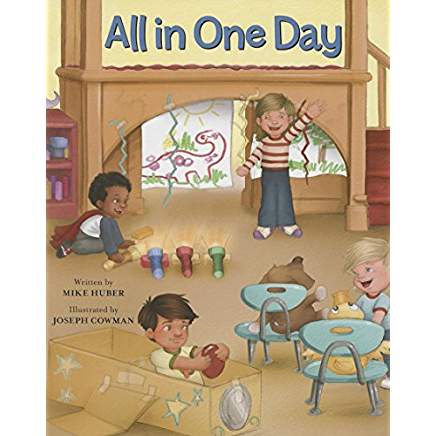
All in One Day
by Mike Huber
illustrated by Joseph Cowman
All in One Day is one of a series of six books. It’s quite a nice set! Mike Huber is actually a preschool teacher, and it shows in his books. He ‘gets’ children in the early childhood level! The illustrations are colorful and life-like. They include children from many races. The teachers are also of different genders and races. Another thing that I like about the books in this series is that, at the end of each book, the authors tell the readers what their main idea is and how that benefits young children.
All in One Day takes the reader through a day at traditional preschool school and describes the activities during the day. The children came up with the idea of creating a skit. They were allowed to work on it throughout the day, and they invited others in the class to join them and contribute ideas. It turned out to be quite a collaborative and creative activity, planned by the children. It also gave the reader a sense of routine to the day, as well as the room to be creative and have fun.
Other books in the series deal with emotions, finding friends, being included in imaginary play, missing one’s parents while at school, and inviting everyone to parties. I think you and your children will enjoy this series.
Reviewed by Lorna McGrath
by Lorna McGrath | Book Reviews, Brain Development, Infant, Infant-Toddler (0 to 3), MFA, Montessori Family Life, Montessori Parenting
Baby Massage: The Calming Power of Touch
By Dr. Alan Heath and
Nicki Bainbridge
This a great little book for parents of newborn babies and older. It’s the kind of book I wish I had when my children were born. I actually did have a baby massage book but it wasn’t as easy to learn the steps to the massages. This book has helpful photographs that illustrate how to put the words into actions.
I really appreciate the section that explains how to adjust your massage for different ages: newborn; older baby; toddler. It also has a section for babies with special needs and another section about some of the common problems that babies may have like colic or teething.
You don’t have to be a licensed massage therapist to use these massage techniques to bond and calm yourself and your baby. It is available for purchase online.
Reviewed by Lorna McGrath
by Lorna McGrath | Kindergarten, Later Adolescence (15-18), MFA, Montessori Family Life, Montessori Parenting, Montessori students, Primary (3-6), Upper Elementary (9-12)
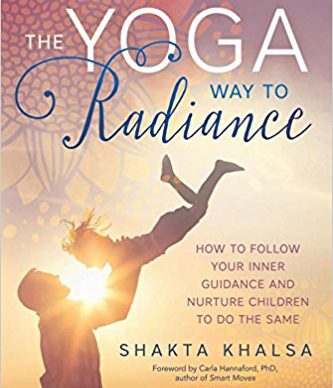
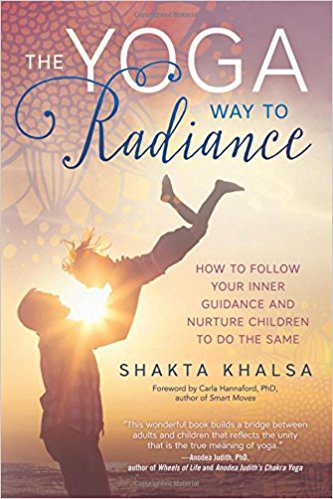
By Shakta Khalsa
As an educator and parent, I have always looked for ways to engage with children that model calm, focus, trust, respect, and cooperation. I learned early on that children are by nature more sensitive to and grounded in those characteristics than most adults. Khalsa writes, “When we look objectively at ourselves, we can usually see how we have developed tendencies toward children based on our beliefs about them that mirror our beliefs about ourselves.”
This book incorporates meditation, breathing techniques, and yoga poses for adults and children to develop and refine their abilities to listen to their authentic selves. Because the author is not only a master yoga professional but also a former Montessori teacher, she comes from a perspective that really works for the adult/child relationship. There are wonderful parenting ideas, as well, in this book.
I would recommend this book for parents and teachers who are interested in grounding or re-grounding in a world that sometimes seems as if it’s come undone. Breathe.
Reviewed by Lorna McGrath
by Lorna McGrath | Autism, Book Reviews, Children with Exceptionalities, Communication, Empowerment, MFA, Montessori Family Life, Montessori Parenting, Montessori students, Psychology
I do in Autismland:
Climbing Out of Autism’s Silent Person
Written by Ido Kedar
Ido’s essays have had a profound effect on me–as an educator, a parent, a friend of parents who have mute children with Autism, deafness, or Down Syndrome, and a daughter of a mute stroke victim. So many times, we make assumptions about people because of their outward presence whether it be behaviors and/or the inabilities to communicate through speech that is different from the ‘norm.’
Ido began writing the essays for his book when he was twelve years old, after years of being imprisoned in his body because he could not speak. The ‘experts’ would not accept that Ido was not only capable of communicating his basic needs, but that he had taught himself to read, had a huge vocabulary, and could express his feelings, ideas, and experiences more clearly and articulately than many children his age.
Fortunately for Ido, his parents never gave up on him and never settled for what the ‘experts’ believed. Ido and his parents had the good fortune to find Soma Mukhopadhyay, who discovered a teaching method that she called Rapid Prompting (RPM). Ido and Soma worked together for six months. During that time, “Ido
progressed from multiple choice to answering questions to expressing his own thoughts.”
This is a fascinating account of how it feels to be trapped inside a body that has so many challenges to overcome. It was not simply that Ido couldn’t speak. He had much more to overcome – stim [self-stimuilating behavior], impulsivity, making his body work with his mind instead of against it.
Ido’s intention for writing this book is to help other mute people with autism to be seen as capable, caring individuals, who have a lot to say and contribute, if only the speaking world can think outside of the box and help others to communicate with us. I recommend that you take some time and read this amazing story of one
amazing, tenacious young man!
Reviewed by Lorna McGrath
by Laura Bakosh, PhD | Family Resources, Health / Nutrition, MFA, Mindfulness, Montessori Family Life, Montessori Parenting, Montessori Teachers, Peace Education
Does it surprise you to know that sitting with eyes closed, focusing on inner experiences does more to promote well-being and inner peace than nearly any other activity? It surprises most parents and non-parents alike, yet study after study shows these outcomes.
Many of us have embraced the culture of doing. We keep our children busy with academics, athletics, and various after-school and community activities, all valuable pursuits in their development. Yet, in our technology-driven culture, downtime has shifted to become “gadget gaze.” Our children seem to be relaxing in front of their gadgets; however, neuroscientists demonstrate that the constant buzzing and beeping of games and instant messages causes a chronic stress response in the brain and body. Beyond the damaging effects on cognitive development, this busyness leaves no time for ‘non-doing.’
It’s important to note that non-doing is different than doing nothing. Non-doing is purposeful, albeit counter-intuitive. It is sometimes called ‘mindfulness,’ and it involves the cultivation of moment-to-moment awareness.
Often, our focus is on the past (what has happened) or on the future (what will happen). While it is useful to learn from the past and plan for the future, paying close attention to this moment now is the most direct and full experience of life.
Bringing awareness to all that is happening, as it is happening, allows us to become intimately familiar with our inner world. By simply paying attention, without judgment to our thoughts, senses, feelings, and emotions, we begin to come into direct contact with our deepest values, essence, and purpose. The practice does not rush at us or hijack us like ‘gaming’ does. It nudges us from our core. It amplifies the whisper of our soul. This is not an external pursuit of doing; it is an internal pursuit of being.
Montessori children are exposed to many awareness practices as part of their normal school day. The works, activities, and interactions with each other are all designed to require purposeful attention to a task, to the surroundings, and to the community. Maria Montessori innately knew what scientists are now discovering.
There is a growing body of evidence that mindful awareness skills foster healthy development in children and can be strengthened with practice. Awareness practices have been shown to reduce the negative effects of stress, anxiety, and depression while enhancing cognitive performance, self-control, resilience and a sense of well-being. They also have been shown to increase academic performance and reduce behavior problems in the classroom (Bakosh, et al., 2014 in review).
As a result of these findings, both public and private schools around the country and around the world are beginning to offer mindfulness programs to their students. These programs provide formal practices, like sitting with eyes closed, to help students develop and strengthen the skills of awareness and inner peace.
These practices, often for only 5-10 minutes per day, prepare students to bring a sense of awareness and peace to more moments throughout the day. The cultivation of awareness also offers a space between stimulus and response. Children learn to become more responsive and less reactive, leading to better decision-making and less conflict. Parents and educators often tell us they wish they had learned these skills as children!
Non-doing can inspire a generation of children to bring forth this sense of well-being and inner peace into the world. Imagine the impact!
Tomorrow’s Child / September 2014 / p 21
by Maren Stark Schmidt | Family Resources, Health / Nutrition, Infant, Infant-Toddler (0 to 3), Kindergarten, MFA, Montessori Family Life, Montessori Parenting, Montessori students, Montessori Teachers, Primary (3-6)
At a teachers’ conference a couple of years ago, we broke into groups to answer the following question: What are the most important ideas you’d like to communicate to parents of the children you teach?
Here are the thoughts from over one hundred teachers and school administrators.
- Respect the work of your child. Children are involved in a huge task of trying to build an adult to live in a world that we cannot begin to imagine.
- Be a help to life. When we assist children by creating a place where children can grow to be unique individuals, we not only help that particular child but we help all life on our planet.
- Any unnecessary help is a hindrance. Use it or lose it. When we offer to do for our children anything they can do for themselves we slow down their progress of building strong independent people.
- You don’t have to react to popular culture. Step back and think about what your child really needs. Does the pop world of toys, movies, and teen celebrities support the developmental needs or personality of your child and your family? For example, are cartoons the best way to spend Saturday morning? Is a certain video game important to your family’s long-term goals?
- Parents need to be the adult in the relationship. Parenting is not about being your child’s best buddy. It’s about leadership and guiding your child to adulthood.
Don’t be afraid to set boundaries. Sometimes we have to be the bad guy by calling our children back to a safe path. Setting firm expectations for behavior helps our children learn to be responsible and understand the relationship between freedom and responsibility.
- Have children take responsibility. Our children are much more capable than we give them credit. Give your children responsibility and the freedom to make mistakes within the boundaries that you’ve set.
Let kids be kids. On the other hand, children aren’t little adults. Their needs are much different. Understand, developmentally, what your child needs, and let your children be kids, not miniature grown-ups.
- Understand sleep and nutrition for children. Children need more than eight hours of sleep per night, more in the range of 10 to 14 hours. Children’s diets require complex
carbohydrates versus simple sugars. Invest some time to understand dietary and sleep needs of children and how they differ from adults.
- Kids need quiet and transition times. Modern-day children seem to have their days, weeks, months, and years programmed from getting up to bedtime. ‘Do nothing’ time and adequate time to move from one activity to another helps make for a happier, healthier child.
- Give your child your quality time. And lots of it! Children require one-on-one adult time to thrive and survive. Today our children have to compete with cell phones, computers, jobs, etc. for parent attention. Block off time each day to focus only on your child’s and your relationship. Amazingly ten minutes of focused time per day can make a huge difference in both your lives.
- Teachers have an outside window into the parent/child relationship. As parents, we should think about these points and change our thinking and behavior to help our children become the unique human beings they are working hard to build minute by minute, activity by activity, day by day.
Tomorrow’s Child / January 2015 / p 21
by Miilnh Ha Villanueva | Brain Development, Health / Nutrition, Infant, Infant-Toddler (0 to 3), MFA, Montessori Family Life, Sensitive Periods
Children are astonishing in the sense that their minds are like an ever-growing, expanding, and curious wonder. When parents think of education for their child, it is a surprise that education can start as soon as right after birth! Even more surprising is that education can expand beyond the ABC’s and 123’s. Education, such as the Montessori Method, provides an amazing wealth of education for life! Why wait until your child reaches the preschool or Kindergarten age before thinking about what type of education you want for your children?
Dr. Maria Montessori, the creator of the Montessori Method, refers to the young child’s mind as a sponge, also known as the Absorbent Mind. Because of the young child’s brain, especially during the infancy years, is very much like a sponge, he or she effortlessly absorbs information and feedback from all around them. Children begin to gain an understanding of the world, develop themselves, and bring out their spirit as a result.
The Montessori Method can be applied almost immediately! Whether your family decides to start by going to a Montessori school that has a Montessori infant program or by implementing Montessori at home, your choice is beneficial to the overall development of your child. What does that mean to develop the child as a whole? Well, let’s first think about the word education. What is the purpose of education? Most parents would agree that education is supposed to teach children the knowledge they need to thrive in our society. So, what’s the point of educating a baby?
It is unfortunate, yet not uncommon, that some adults would question and underestimate the capabilities of an infant. In actuality, when given the right environment, materials, and support, babies develop intelligence that will help them blossom in creating an understanding of how the world works, while simultaneously nurturing their independence and confidence.
The Montessori approach towards educating children takes into account their physical, social, emotional, and cognitive growth. It is understood that not everyone learns or develops at the same pace, which is why it is important to follow the child as respected, unique individuals. The earlier children are supported in their development by the environment and adults, the surer they are free to express themselves and pursue their interests and curiosity. This surely assists the child’s progression in growth as a whole.
The earlier children begin feeling supported through their development in Montessori, whether it is at school or home, the bigger the difference it will make in the young child’s life. There are many things parents can do to add a little bit of Montessori at home! I’m sure that once you try these few adjustments, you will see your child’s spirit of unique individuality emerge!
Let’s give this a try:
Rescue is robbery. This is the most important reminder for parents It is ok for mistakes to happen. It’s actually a big part of learning! Parents often do things for their child, rather than allowing them time and practice to develop mastery. If he is trying to feed himself, let him try it out. He might miss his mouth, or food will spill onto his clothes or the ground. But just remember to give him time; he will get the spoon to his mouth.
Let her touch things. During infancy, children are learning and absorbing the world using their senses: sight, touch, taste, hearing, and smell. Give them something they can explore using their senses, along with a couple other objects so that they can discriminate and formulate their own observations of what they are experiencing.
It’s never too early for some responsibilities. Children, even the very young child, develop a sense of independence and confidence when they feel they can contribute to the community using their practical life skills. Feel free to give them a job that is important, such as watering the plants, and at the same time, chat with them about how they are not only helping the plants grow but adding beauty to your home. They’ll love feeling like they are helping and, in turn, will want to do more for themselves.
Montessori education is an education for life. Infant and early toddler aged children are very capable individuals, and if given the right environment, they can really surprise you!
Tomorrow’s Child / April 2015 / pg 24
by Christine Lowry | Empowerment, Infant-Toddler (0 to 3), Kindergarten, Lower Elementary (6-9), MFA, Montessori Family Life, Montessori Parenting, Planes of Development, Practical Life, Prepared Environment, Primary (3-6), Webinars / MFA
The Montessori early childhood classroom provides materials, activities, and a structured “freedom” that gives children what they need to develop to their full potential. In this webinar, Christine Lowry and Lorna McGrath explore how you can support your child’s Montessori experiences at home.
by Kath Kvols | Communication, MFA, Montessori Family Life, Montessori Parenting, Uncategorized
Mom waits eagerly in the car to pick up her middle school daughter after school. As Andrea opens the door, Mom asks cheerfully, “How was your day, Honey”
I hate it when you tell me to “Have a good day” when I leave in the morning.You jinxed my day!” Andrea lashes out.
Mom retaliates,”Don’t give me that attitude. I don’t know what’s gotten into you but, when we get home, you are going to your room young lady! ..
What we have here is a failure to communicate!
Commune means to experience a deep emotional or spiritual relationship with someone or something. How do we create a deeper emotional experience with our children? Here are a several ways.
- Set aside physical and mental tasks when you are talking with them. Give your child your full attention when you wane to communicate with your child. Quit peeling the potatoes, folding the clothes, or reading the paper. Stop thinking about your priority list, your visit from the in-laws or the phone call you have got to make. Be with your child 100 percent.
- Assume their innocence – not their guilt. How many times has a mess been created or something been missing and you yelled at the child that you thought was guilty only to find out they were innocent? Or, your children were fighting and you blamed one child without even hearing their side of the story.Always assume that they are doing the best they can with the skills they have.
- Discover the need. Instead of being frustrated by their behavior have compassion for them. Fine tune your skill at asking yourself or them, “What do you need?” Respond by giving them what they need. However, your job is to eventually help them understand what they need and discover ways to meet their own needs.
- Don’t take things personally Andrea’s explosion at Mom had nothing to do with Mom. She had just had a bad day at school. It is difficult not to retaliate when we take things personally.
- Be Careful of ‘add-on’ phrases. Parents frequently damage children’s spirits unknowingly by using negative ‘add-on phrases’ to their discipline.
- Allow your child to feel what she feels. Feelings are neither right nor wrong – they just are (however, this doesn’t mean you have to agree with her). We shut down communication when we try to take away our child’s feelings.
- Empathize with your child. Take time to hear the feelings behind the words. How might you be feeling if you were your child. Then feed it back to them using phrases like; “It sounds like,” or, “It looks like.
Using the above principles, the example may have sounded like this:
Mom waits eagerly in the car to pick up her middle-school daughter after school. As Andrea opens the door, Mom asks cheerfully, “How was your clay, Honey”
“I hate it when you tell me to ‘Have a good day”’ when I leave in the morning. You jinxed my day” Andrea lashes out.
Mom asks calmly, “You seem very frustrated. What do you need?”
“I had a really bad day; I guess I just need some quiet time,” replies Andrea, calming.
“I understand. Let me know when you want to talk,” offers Mom as she strokes Andrea’s hair gently:
Mom has created a deeper emotional experience with her daughter. We all long for more meaningful relationships in our lives. It is our job to teach our children how to create them. Parenting classes or a local therapist are great resources to help you create the relationships you want.
Tomorrow’s Child / Fall 2016 / p 67
by Cathie Perolman | Discipline, Infant-Toddler (0 to 3), MFA, Montessori Family Life, Montessori Parenting, Primary (3-6)
Dear Cathie,
Our daughter has entered a new stage, where she whines and pouts when she does not get her way. She is quite dramatic, and some of these incidents last a fairly long time. What can I do to help her snap out of it more quickly? Why is this happening? Her younger sister now joins in when big sister pouts, and I worry it is becoming a habit.
– A WORRIED MOM
It is always challenging and puzzling when children begin to exhibit a behavior that is new and less than positive. Our first goal is to seek to understand it. Your daughter is learning to handle her emotions. She has not had as much experience with this skill as children who are older. Therefore, her reactions and responses are immature and varied. She is trying out different responses and seeing how they go. Part of her continued pouting may be that she perceives that she is getting attention from this behavior. Pouting is a common reaction, and many children (both boys and girls) use this behavior to handle their disappointment. The goal is to help her identify and handle her feelings in a more positive and socially acceptable way.
What can you do to help her? I would encourage you to “look to the child, who is not yet there and see her as she will unfold.” So envision your daughter a bit older and having learned how to handle not getting her way more maturely. How will it look? How will she act? Then work towards identifying and growing those behaviors. Until then, it helps to remember that she is just learning and practicing a new skill. This helps you be less involved emotionally. All parents want their child to be happy, but that does not mean every child is happy every minute. And for some children, this type of learning to handle disappointment comes easier than for others.
I recommend that you distract your younger child with an invitation to do something with you. “Come on, Rachel! Let’s go play with play dough.” Samantha will join us when she is feeling better.
Be empathetic. While the situations that cause pouting may seem minimally important and even silly to you, they are very real for your child. Try to envision the situation from your child’s point of view.
Name her feelings for her. “You are so disappointed that we do not have any peaches for lunch. You wanted to have peaches, and now you have to choose a different fruit. You are getting used to that idea. You will feel better in a minute. Would you like a hug? No? You want to be sad on the stairs? OK! Come on back to lunch when you are ready.”
Speak confidently about her ability to handle this situation and recover from it. “I know you wanted to choose the first book, but it is your sister’s turn today. You will get to choose tomorrow.” Avoid too much discussion and analysis. Just be as calm and matter fact as you are able.
Give her attention when she displays behaviors that you want to encourage and ignore behavior that you want to discourage. While no feelings are ‘bad’ or unacceptable, a child’s reaction to those feelings can be encouraged or discouraged by the amount of attention you give to them and to her when she is displaying them. Acknowledge the feelings, name them, and move on.
Give her time and a structured way to adjust to her feelings. “You may sit on the stairs (or wherever seems appropriate) until you feel better.” And when she is finished pouting you might comment, “I’m glad you are feeling better and are ready to join us.” In the case of the book-reading incident above, it is fine to begin reading to the younger child while the older child is pouting in the corner. If the story-reading time is ended and nap time has begun, she simply misses story time for today. Predictability is comforting to children, even when they are arguing about it.
Model the handling of things that do not go your way in an appropriate manner. “I was so looking forward to having my friend Madeleine come to visit. But now she is sick, and the plan is cancelled. I am so disappointed!” Pause dramatically! “I think I will… make a special treat for dinner. That will help me feel better.”
As you read books, discuss how the children handle their emotions. Here are some examples of books that are appropriate: The Pout-Pout Fish by Deborah Diesen and Dan Hanna, The Kissing Hand by Audrey Penn, and The Berenstein Bears by Stan and Jan Berenstein. Your children’s librarian can
recommend many, many others.
Breathe and believe in the power of time and the growth that will occur in your child.
A new behavior and stage in a child’s development can feel overwhelming for a parent. This is especially true when the behavior is not something we want to encourage! But remember that many of these behaviors will naturally dissipate with time and maturity! Once a child has tried out the pouting reaction to disappointment and sees that it does not yield any attention from her parents, she may begin to explore other ways to handle her disappointment. Try to understand her feelings and her reaction and see past it! May this stage end quickly for your family!
Much luck!
Cathie
Tomorrow’s Child / November 2014 / p 28
by Cathie Perolman | Montessori Family Life, Montessori Parenting, Tomorrow's Child, Uncategorized
Dear Cathie— Our oldest child will begin attending the Montessori school in our area in just a few weeks. We are new to the neighborhood, the philosophy and the school. We are anxious to meet the faculty, other families and children and others in the community as we begin this experience. But we are not exactly sure how to go about doing that. It seems like there is a lot of information coming out now, and it feels pretty overwhelming. Send us some wisdom please! — New Montessori Parents
Dear Parents,
Welcome to this wonderful new world! You are, indeed, in a time of adjustment. Moving is significant in the life of a young child as well in the lives of a family and it may take you awhile to feel settled and acclimated. As you do that though, you want to take advantage of the opportunities that the school offers.
Be sure to attend any “back-to-school” meetings, picnics, or “meet-and-greet” activities that they have scheduled. These will help you learn about the school and what you and your child need to bring (and do) in the first few weeks; it is also a chance for you, as parents, to get to meet other parents in the community.
Read all the material that the school provides. It may seem like a lot but it is indeed valuable and thought through carefully. Ask questions about the things that seem unclear. The Montessori Method is based on scientific evidence, and everything in the classroom is done with a purpose. It may seem silly or unnecessary in the beginning, but it all fits together to aid in your child’s development. Often, there are articles available on the bulletin board. These can also help you learn about the Method and how it works. Material will come out regularly from your school as the year progresses, and you will want to be sure to stay abreast of all of this! Read the school newsletter, as well as any articles or magazines provided. The more you know about the Montessori Method, the more you can help foster the Method at home and create a smooth transition between home and school, allowing your child as much independence as possible.
Look for potential friends for your child, yourself, and your family. Notice which families are picking up at the same time as you are. Families with similar schedules are great potential new friends, and playdates after school are a nice way to get to know each other. These can happen at a local park or playground while the weather is still nice and can be fun and informal for both parents and children. Often, families of children who attend school only half day include a picnic lunch or meet after lunch if your school includes a lunch program. If you are a full-time working family, these activities still work well on the weekend. This can include both parents and even other siblings, giving the entire family an outing. Once you start to meet people, they can help you find family-friendly activities in the area that match your family’s interests. It won’t take long to feel a part of the school community. And the best part is that these new friends will probably have like-minded views about education and child rearing.
Children will also begin to talk about their classmates. Listen to their discussion and see who your child is finding the most appealing. That might be a child to invite over for a playdate or a family to join for an outing. When children are young, playdates generally happen with their parents included. In time, when the children become comfortable with each other’s parents, children may be comfortable to play at each other’s homes without all parents present. It is generally a process for a child and family evolving to become comfortable with each other. The timing varies from family to family and situation to situation.
Enjoy getting to know your new Montessori school and families, new neighbors, and your greater new community!
Tomorrow’s Child/Sept 2017/pg 35
by Lorna McGrath | Book Reviews, Language & Reading, MFA, Montessori Family Life, Montessori Parenting, Reading, Toddler (18 months-3 years)
A Handful of Numbers
Written by Christinia Cheung & Han Tran
illustrated by Tong Wu
This is a great little board book. The counting and numbers are all related to things about the Earth and our universe. Example: 2 poles (north and south); 5 geologic layers; etc. The illustrations are beautiful!
On the left page is the number written in large type. Then, there is a description of what the illustration shows, and in the bottom left corner of that page is the corresponding number rod. On the opposite page is a beautiful illustration. Example: 3; three oceans; description of the oceans and what they do; the third number rod.
It is especially nice in the way that it is connecting counting and numbers with our geography studies. Children at the primary level and older toddlers will enjoy this book.
A Montessori Workbook:
Volume 1
by Dr. Punum Bhatia
Dr. Bhatia has created three volumes in this set. She designed these workbooks as a resource for parents of three-to-six-year-olds. Her intention, as she described it to me, was to give parents and children something fun to do during the summer to keep ideas and concepts from the Montessori classroom fresh in the child’s mind during the time away from the classroom.
Since most parents are not trained Montessorians, Dr. Bhatia has a two-page introduction in how to use these books. Many of the illustrations in the book are of classroom materials such as: the Pink Tower; the Metal Insets; parts of plants and continents; etc. She has also included a section on sounds to reinforce the symbol and the sound. There is also a math section for counting skills.
While I congratulate Dr. Bhatia for the clear and crisp illustrations in her workbook and her idea to help parents keep children engaged and reminded of their Montessori learning materials during times when school is out, I must pose the following questions to her and to other teachers and parents:
Are workbooks in alignment with what we know about child development and the needs of young children?
Would other activities such as nature walks, picnics, gardening, cooking, going to Gramma’s, making puppets, doing a skit, building a fort, drawing a map of the backyard, caring for animals, etc. use the same skills and support the child’s continued development, while building relationships in a concrete, meaningful way for the young child and family?
Would a workbook be more appropriate for a child in the elementary years?
Please use your answers to these questions as a guide when considering activities for children during the early childhood years.
California the Magic Island
Written and illustrated by
Doug Hansen
This is a beautifully illustrated, mythical history of California. Each vignette highlights a part of California history using a letter of the alphabet. The legendary Queen Calafia was outraged at first, when some people from a place far away began to use the name of her island for their land. When the emotion passed and she could think more clearly, she commanded, “Go and find 26 creatures who will tell me the story of their land from far past to present. If their stories are worthy of my name, then they will not be punished but will be able to use my name, and I will watch over them forever.” Each creature represented a letter from the alphabet like “B” was the monarch butterfly.
This is a fun, fantastical history of California and would capture the imagination of elementary children. If California is not the state where you live, you and your children may be inspired to write and illustrate a creative, magical story of your state.
Do Unto Animals: A Friendly Guide to How Animals Live, and How We Can Make Their Lives Better
by Tracey Stewart
illustrated by Lisel Ashlock
If you are an animal lover and want to encourage and support children in their development of love for animals, this is an especially good book for children in the middle elementary years. Tracey divides the book into three sections: Animals at Home; Backyard Wildlife; and Falling in Love on the Farm, and she uses catchy titles for sub-sections, such as: The Perfect Pig Palace; Be Nice to the Bugs; or Meow-sage Me.
Tracey has a nice sense of humor coupled with lots of good information about animal behavior, ways humans can better the lives of animals, and crafts such as a “t-shirt tug toy” for dogs or ideas for enhancing a cat’s home by planting cat grass.
The illustrations are very realistic drawings with color rather than cartoons or photographs. They are very pleasant depictions of the animals the author is spotlighting. The illustrations make you want to love any and all of the animals in this book and more. It is a good resource for home or school.
Moving With Numbers
written by Christinia Cheung illustrated by Tong Wu
Wow! This is a gorgeous book! It can be used to learn about Chinese calligraphy, counting, and movement. Once again, Christinia and Tong have teamed up to create a lovely board book.
This time, they are illustrating each number on the left page with calligraphy, red dots similar to the cards and counters (upper right corner of page), and the corresponding number rod (bottom left corner of page). On the opposite page, there are people dressed in beautiful costumes doing movements from walking on a tight rope, riding a unicycle, acrobatic poses, and more.
The numbers are textured so that the child can feel them similar to Sandpaper Numerals from the classroom. There is a map of China in the back of the book, and it shows where each of the 55 minorities live in China.
Young children will be fascinated by the illustrations, will learn about a country and language in Asia, and practice their counting skills.
The Big Disconnect
by Catherine Steiner-Adair, EdD with Teresa H. Barker
In the fall of 2015, I had the distinct privilege of attending a talk given by Catherine Steiner-Adair, Ed.D. She is a dynamic, humorous, and informative speaker. The 90-minute talk was done in what seemed like only a few minutes. Her topic was that of her book, The Big Disconnect. Her concerns are the same as the concerns of many parents and educators. They are about the effects of technology on our ability to communicate and to form relationships. Dr. Steiner-Adair does not just point out the dark side of technology but actually gives her readers ideas and suggestions to deal with our new technological lives.
For example, in her book, she sites texting as a huge communication problem because it takes away not only our auditory cues (tone of voice) but also our visual cues (facial expressions, hand gestures, posturing). The two or more people involved in the ‘conversation’ can easily misinterpret the message being sent and find themselves in a text war. Also, people are much more likely to say things that they would not dare say face to face. She suggests that parents never engage with their children (or their spouse) in an emotional conversation by text. When it begins to feel touchy, just say something like, “This sounds important and like something that we should talk about in person. Are you on your way home?”
In her book she discusses the effects of technology on children at different developmental stages. We are beginning to see how parent screen time is damaging the building of relationships and gives the message that “this gadget is more important than you,” however unintentional it is. Children are feeling abandoned. Look around at any restaurant where families gather. What do you see?
When you read this book you will find out Dr. Steiner-Adair’s seven suggestions for sustainable families in the 21st century. It is a must read for every parent!
PS. You can listen to a live interview that I recorded with Catherine Steiner-Adair on the Montessori Family Alliance resource center. If you don’t know how to access it, talk to your Head of School. If you receive Tomorrow’s Child magazine you’re already a member!
Tomorrow’s Child/Nov 2016/pg 32
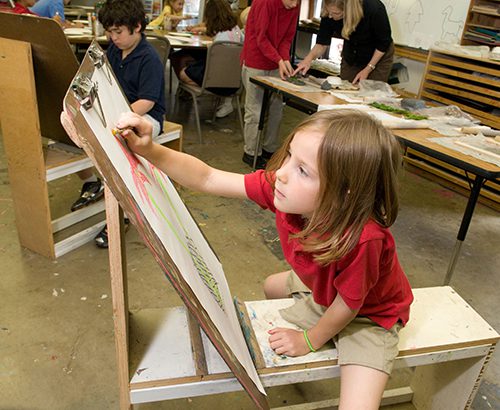
by Joyce St. Giermaine | MFA, Montessori Family Life, Montessori Parenting, Montessori students, Primary (3-6), Psychology
Editor’s Note: In the January 2016 issue of Tomorrow’s Child’, in the“Dear Cathie” column, a parent expressed concern about opportunities for artistic expression in a child’s Montessori classroom.
As I edited this article for print, I couldn’t help mutter to myself: Huh? My Montessori children and grandchildren require a contractor-size, heavy-duty trash bag just to pick up their weekly artwork. Their cubbies overfloweth. Seriously, I have concluded that there is such a thing as artistic diarrhea!
Fortunately, as children age and mature, art becomes more recognizable as ‘art,’ but, in the meantime… hmmm. What’s a parent to do? Here’s a few options:
- Display it on the refrigerator and rotate the collection with new offerings.
- Review it and ask your child to tell you about each piece and then (based on your child’s interest in any particular piece) triage accordingly: save, post, frame, make it disappear.
- Throw it out (discretely) if the child shows no interest and you absolutely cannot stand one more pile of colorful paper in your kitchen, basement, floor of your car, or wherever. Note: If you are a committed environmental activist, this is NOT the time to put ‘artwork’ in the recycle bin—at least not in YOUR recycle bin. I PROMISE you that your child WILL find it. Make a deal with your neighbors.
- And last but not least: Save everything! Put everything in giant Rubbermaid™ containers. Label them if you are into that. Pay to move these bins should you change houses over the years. Pay to store them in a rental facility when you run out of room at your house. And then… wait for it…rent a truck and deliver it to your child when he/she gets his/her first home. I’ve got to say, I kind of like this last option. It seems to create a fulfilling emotional collage of guilt, love, resentment, and karma.
On that note… a few years ago, my mother sent me a present for my 60th birthday: a framed picture of a horse I drew when I was about seven. Not to brag (well, maybe a little) but it was pretty good and actually looks like the Icelandic pony I just bought for myself this year. Ironically, that was the pony I asked for repeatedly as a child and never received, which just goes to show that you can sometimes fix your dysfunctional childhood, even if you have to do it yourself… decades later.
Maybe this is only me, but when I think about children’s art, I’ve had a nagging question for years: What kind of artwork did Pablo Picasso bring home from school? Did anybody recognize his genius or were his parents advised to seek therapy?
Here’s what I found out at www.pablopicasso.org/picasso-facts.jsp:
Picasso’s First Word: Pencil / Picasso was born an artist; his first word was piz, short of lápiz the Spanish word for ‘pencil.’ His father Ruiz, an artist and art professor, gave him a formal education in art starting from the age of seven. By thirteen, Ruiz vowed to give up painting as he felt that Pablo had surpassed him.
Picasso’s First Drawing / At the tender young age of nine, Picasso completed his first painting: Le picador, a man riding a horse in a bullfight. His first major painting, an ‘academic’ work is First Communion, featuring a portrait of his father, mother, and younger sister kneeling before an altar. Picasso was fifteen when he finished it.
And this is what I suspected… (FIST PUMP!) … Picasso was a terrible student in his ‘traditional’ classroom.
No doubt about it, Picasso was brilliant: artistically; he was years ahead of his classmates who were all five to six years older than him. But Picasso chafed at being told what to do and he was often thrown into ‘detention’ for being a bad student. He later wrote:
“I was banished to the ‘calaboose’—a bare cell with whitewashed walls and a bench to sit on. I liked it there, because I took along a sketch pad and drew incessantly … I could have stayed there forever drawing without stopping.”
Looking back, I’m kind of relieved. I don’t think I casually threw away any of my children’s ‘masterpieces,’ and I don’t think you should feel too guilty about discretely disposing of the mounds of art that your child may bring home. Scribble scrabble has value, as the young child works to perfect her fine-motor skills, but it is usually just ‘practice’ work… not ‘art.’
Personally, I would recommend glancing at everything that comes home; keep some, toss some, but regardless of the choice, I would take note of the tone of the art. Even if it’s scribble scrabble (often with a bit of snot added for good measure), are the colors ‘happy’ colors? Are the lines drawn with an ‘angry’ tone? If it’s a family portrait, is anybody missing? Do the faces have expressions?
Unassigned, freely chosen art, no matter how simple in nature, is an expression of what’s going on inside the artist. Unless you’re an art therapist or psychologist, I’m not suggesting that you spend too much time interpreting children’s art. If you observe a disturbing trend, by all means, have a discussion with an expert. A Montessori guide is a good place to start.
In any event, I have found that, sometimes, art speaks volumes. “Jason, can you tell me about this picture?” may provide much more information than the usual “What did you do in school today” question with the usual “Nothing” response. Try it and see.
Tomorrow’s Child / January 2016 / p 37