by Robin Howe, EdD | Brain Development, Imagination, Lower Elementary (6-9), MFA, Montessori Curriculum, Montessori Family Life, Montessori Parenting, Upper Elementary (9-12), Webinars / MFA
In this session Robin Howe completes a presentation for parents on The Great Lessons as a foundational piece to the Elementary curriculum. He explains each of the five lessons in more detail and describes how parents can support their child’s learning.
by Jonathan Wolff | Empowerment, Infant-Toddler (0 to 3), Kindergarten, Lower Elementary (6-9), MFA, Montessori Family Life, Montessori Parenting, Practical Life, Webinars / MFA
Jonathan Wolff shares ideas and insights for parents when teaching children new skills at home. Whether it’s how to fold the laundry, set the table or comb their hair, Jonathan offers parents helpful suggestions that are in alignment with how Montessori teachers present new lessons at school.
by Margot Garfield-Anderson | Communication, Family Resources, Montessori Family Life, Montessori Parenting, Parent Education, Parent-Teacher Communication, Tomorrow's Child, Tomorrow's Child Online Issue, Uncategorized
Years ago a dear friend of mine enrolled her child in a local Montessori school. This child was very near and dear to me, so when I asked his parents if I could to go and observe him in class, I was most excited.
The school used an observation sheet that guides visitors in the process (see page 25). It also helps visitors to remember to be mindful of Montessori classroom etiquette. Sheet in hand and excitement high, I went into the classroom and tried to be as unobtrusive as possible.
In this particular Montessori school, I was allowed to sit in the classroom, and I was delighted with what I observed; however, I found out later that my visit had some unexpected results. When I quietly left the classroom, my three-year-old friend did not understand that he was not leaving with me. He was quite upset and, lacking the verbal skills to clearly articulate his confusion, it took his Montessori guides some time to reassure him that his parents would, indeed, pick him up later in the day.
My granddaughter Blakely’s school has a one-way observation mirror. Her parents chose not to tell her that I would be there at her school until it was time to go home for the day. This way she was not thinking about me watching her. But this is just one of many possible ways a school might offer a parent (or grandparent) the opportunity of observing in the classroom. Some schools, as the one I described earlier, allow adults in the room but require very quiet and unobtrusive involvement, so that the normal routines of the class are not altered nor disrupted. With proper understanding, visitors can observe the children’s routines and get a sense of what goes on in the classroom during the day.
Whether you are behind a one-way mirror or seated in a Montessori classroom, now what? Why are children taking things off of shelves and then working alone? Where is the teacher in all of this? How is it that these children are so totally engrossed in what they are doing that they don’t even sense a foreign presence in the room?
Since you will probably visit in the morning, it is important to remember that the morning is the time for what is referred to as the “children’s uninterrupted work cycle” (typically, the first 2.5 -3 hours of the day). This is the time of day when children (who have eaten a good breakfast) are at their best levels of attention and very focused on their ‘work.’ Since not all children move or are motivated to learn at the same pace, this time provides them an opportunity to concentrate on the task or project they have chosen. This learned ability to focus will help them throughout life. This is why Montessori discourages the interruption of a child who is hard at work, unless it is very necessary to do so. Interruptions include questioning a child; so when you are observing, you are not there to engage in conversation.
While you are observing your own student, take time to look at others in the environment to get a sense of what else might take place during this time. Take notes so that you can ask more specific questions of the child later in the day. Instead of asking, “What did you do in school today?” to which the answer is usually, “Nothing,” ask something like, “What was it like working with the Pink Tower or Metal Insets or Brown Stair?” You will probably get a much different answer.
Observing in the classroom is a wonderful way for parents and grandparents to connect deeper, understand greater, and reinforce more of the Montessori way of life. Enjoy each experience with them because before you know it, they grow up!
Tomorrow’s Child/Oct 2016/ pg 24
by Margot Garfield-Anderson | Child's Work, Discipline, Empowerment, Family Resources, Infant-Toddler (0 to 3), MFA, Montessori Family Life, Montessori Parenting, Toddler (18 months-3 years), Tomorrow's Child, Tomorrow's Child Online Issue, Uncategorized
Harper will be my last grandchild. At 20-months old, the world of language opened its floodgates. She’s actually quite verbal for her age. At her 18-month check-up, the pediatrician asked if she had a vocabulary of at least three words. At that point she probably had close to one-hundred words, and now, a few months later, it’s more than doubled with her talking in two- and three-word sentences on a regular basis.
This becomes a double-edged sword because, when young children are this verbal, we tend to confuse vocabulary with comprehension. This can lead to frustration and fits of some temper and crying. In some, it may also manifest as a biting phase.
When Harper can’t do something on her own, she’ll plaintively call to me and say, “Help, help me, Gammie.” While my heart goes out to her, the best help I can offer is to give her time to figure something out on her own. Of course, it’s important to first make sure she’s safe from whatever she’s trying to manage. Sometimes, it works to ask her simple questions to figure out how she can be guided to work through her own situation. This is not always easy because parents are busy and often they do not have the luxury of extra time. And, let’s face it, we all reach our limits on certain days with patience.
Someone wise once told me that the best guidance she could give to me was to provide me with a toolbox of skills to help me navigate my way. I’ve never forgotten that piece of sage advice and have tried to hold back that overwhelming urge to rush in and solve all the little things challenging my grandchildren. I try to consciously hold myself back from doing that and, instead, help them use the tools in their boxes to solve their own problems. I must continually remind myself that it’s not about me but about fostering the child’s independence. It’s not about my ‘wants’ to keep them small and dependent upon me but to make sure they become confident and independent.
Another ‘tool’ in the box is the ability to master a skill. Have you ever seen your child or grandchild sit and repeat doing something endlessly? Have they ever asked you to repeat a story over and over again? While it can often become tiresome for the adult, it’s the way children learn and master a skill. In their classrooms, children are given the time, especially during the uninterrupted work cycle of two to three hours in the morning, when most are at their best, to repeat an activity over and over again.
It’s fine to make suggestions, question, or even demonstrate, but when we do something for them each and every time they ask, we aren’t helping them reach their full potential. Dr. Montessori’s Method and materials help toddlers and young children learn from concrete to abstract. Each part of the practical life lessons adds new tools to their personal boxes. By reinforcing this method at home (or at grandparents’ houses) on a consistent basis, it helps keep young children on the path to independence. Remember, holding your grandchild on your lap to read, pushing them in a stroller, and comforting and loving them with hugs and kisses is more vital than rushing in to do something for them that they are totally capable of doing for themselves. Enjoy each moment. It’s just amazing how fast they grow up!
Tomorrow’s Child/ Sept 2017/ pg 32
by Margot Garfield-Anderson | Health / Nutrition, MFA, Montessori Family Life, Montessori Parenting

Let’s all make a pact this school year. Let’s try to become more proactive in the foods we serve to our children and other family members. We know, it’s convenient to open up that box, tear open the seasoning packet, and pour it into the “whatever” you have to boil. These foods are loaded with salt (sodium), fats, carbohydrates (and not the slow-burning good- for-you kind) and artificial everything. Eating a consistent diet of these kinds of foods will set up the people in your house with future health and eating issues; we assure you of that.
You and your spouse may work full time or have other obligations that don’t allow you the luxury of making soups and breads from scratch, so what can you do to get some healthier foods into those brown bags?
We recommend evaluating the good foods your children will eat (sit down with them and make the list together and take them food shopping) and create a menu for the week. This will not only make the shopping easier; it will invest your child in the process. If they are old enough, let them help prepare the items or at least help.
Many items can be made in bulk, frozen, and then defrosted as needed.
Many fresh fruits and vegetables can be cut and stored in air-tight bags for two to three days.
Fruit cups in fruit juice only or apple sauce without sugar can be bought in bulk sizes to always have on hand.
Many store’s deli departments will slice fresh-baked bread right there for you. The bread on the shelves is made with lots of preservatives, hidden sugars, and other ingredients we should not be ingesting. Try introducing multi-grain breads that don’t use bleached flour.
While individual-portion foods, such as hummus or guacamole cups, aren’t our favorite thing (all that plastic in our landfills), these are two of the most nutritious foods you can include in a meal. Try introducing your children to these two wonderful foods when they are small; chances are, they will continue to love them.
Many children love olives. They are loaded with healthy fats and salty enough that they can satisfy that taste need many enjoy.
Try using freshly ground nut butters. Usually, they will be sold without adding sugar, palm oil, or salt. If you start your children early, they won’t miss the sugar. Also, try using a product such as Polners™ instead of jelly, jams, or preserves. Again, these products are loaded with sugar, and the Polners™ brand uses fruit juice to sweeten. Try to avoid labels that claim they don’t use “added sugar.” This usually means they’ve used an artificial sweetener and that, too, should be avoided.
Try making a pot of home-made soup, stew, or chili on the weekend. Again, these are easy things you can prepare with your children and introduce them to the joys of cooking at the same time. Many schools have microwaves that can be used to heat the soup for you child.
Try to avoid at all costs: soda; fruit juices; yogurt sweetened with tons of sugary additives; and flavor products such as Kool-Aid.™ More and more research is being done every year, showing that the amount of sugar most people consume is off the charts and needs to be reduced tremendously.
Simple changes, done over time, will help your children not feel you’ve rotated their worlds. Save the sweets for truly special occasions.
Here’s a list of mix and match items to try for your next shopping trip and lunch planning. Just give some of them a try and see if you can determine the difference in your child’s attention, concentration, allergies (known or unknown) and energy levels.
- Hummus now comes in many different variations, some made the traditional way with chick peas and some made with beans or other vegetables. Watch the additives.
- Guacamole is made from avocados, which are one of the single most valuable food to feed a growing brain. There are now even cookbooks that use the avocado in dozens of non-traditional ways to ‘sneak’ this miracle food into the diet, including desserts.
- If you don’t have access or the budget to purchase organic fruit and vegetables, at least spray and thoroughly wash all with an all-natural cleaning agent. Dry all thoroughly as well.
- Cut up carrots and celery; sweet little red, orange, and yellow peppers; cherry tomatoes, cucumbers; olives, or Jicayma for an assortment of colors, textures and tastes. If you must, send a small container of a salad dressing for them to use as a dip.
- Seasonal fruits are great snacks: watermelon cut up into bite-size pieces; a single piece of fruit; a bunch of grapes; just about any fresh fruit is preferred. If limited by taste to just a few likes, try the single-serve cups, but only those packed in natural fruit juices.
- Peanut butter and jelly (the natural and non-sugar varieties we listed above.) Try slicing a banana and adding or try raisins, dates or figs. Remember that some schools may not allow peanut butter or any nut butter or snack due to allergies. If so, please respect this rule and save your ‘nut’ snacks for home.
Children love and need carbohydrates to fuel their energy levels throughout the day; however, items such as pretzels, chips, and crackers are not the healthy way to go. Try baking, with a small amount of olive oil, thinly sliced sweet potatoes or beets and sprinkle with a small amount of salt. One medium sweet potato makes enough for two portions. Try using that Mandolin utensil that’s been in your kitchen drawer all these years, waiting for you to figure out what to do with it!
Try lentils. They come in a variety of colors and tastes. They can be prepared in dozens of ways. They can even be used to make hummas. Our family loves them stewed with garlic and a little olive oil. They can be put in the crock pot and cooked overnight. One bag makes a huge amount, and they can be frozen.
Sliced deli meats are not the best option, because items such as bologna, and salami, and all their cousins are loaded with fat, salt, and chemicals. If you need to resort to such foods, try low-salt turkey breast or low-fat ham (although lots of chemicals in this one). Try sending roll-ups of a piece of turkey with a hard cheese such as Swiss or Lorraine. Mustard or a bit of mayonnaise can be sent for dipping as well.
Most younger children don’t love fish, so we’ll not try to sell you on this one. HOWEVER, fish such as Salmon, Herring and other oily fishes are loaded with nutrition. Try some salmon cakes, if you can find ones that don’t have lots of added ingredients. Try rolling some cheese and spinach to make pinwheels. Cheeses such as feta are yummy when made this way.
Bake extra chicken breasts or thighs or even slices of lean steak. Both can be eaten hot or cold.
Make some popcorn the old-fashioned way on top of the stove or buy the unsalted, unbuttered kind. Add your own ingredients to limit the amount of salt and artificial butter. When using butter, we love the Irish butter made from cows that are grass fed. A full cup of popcorn makes a great dessert or snack instead of the chips.
Plain, unsweetened yogurt can be portioned out and sweetened with slightly over-ripe fruit or a small amount of honey or even Agave, some cinnamon, or even a small amount of pure vanilla extract.
The point is, don’t think of this as a punishment. The real punishment comes after a lifetime of poor eating habits and poor health as the ‘payoff’ when just a few modifications done at younger ages will help avoid many illnesses. Happy eating everyone.
Tomorrow’s Child / September 2017/ p 26
by Jocelyn Bell Swanson, MEd | Adolescence, Brain Development, Early Adolescence (12-15), Later Adolescence (15-18), MFA, Montessori Education, Montessori Family Life, Montessori Middle School, Montessori Parenting, Montessori Secondary / High School, Montessori students, Psychology
Just when parents think they have it down—that their child is gracious and engaged, academically sound if not accelerated, physically coordinated and mature—the kid goes and turns into an adolescent! Sometimes coming of age is a slow boil. And other times it’s like adding rice stick noodles into a wok full of oil. I absolutely love the quizzical look on the faces of the most well-meaning parents who thought that, for some reason, the wave might miss them.
Well, I tell them, take heart! You are not alone. And you have done it before. Yes, even if this is the first adolescent you have raised, you have done this work before!
While in a much tinier package, that kid was once an infant person—awkward, scared, fussy, beautiful, knowing what she wanted but not knowing how to get it. And parents usually do just fine. Everyone remains alive to tell the story. If the description of the infant sounds like the adolescent you are now wondering what to do with, then you understand the connection. Adolescents, at their best or worst, are really infant adults. They are entering a world that is changing for them. It doesn’t feel like the safe “womb” of their elementary years because they naturally are adopting and adapting to a new purpose. That might be alarming to some kids. It might not be that big of a deal to others. Regardless, our brand-new adults need a new understanding of themselves and their world. They need to know how they fit into family and society with a new and maybe, as yet, fuzzy purpose. Like it or not, their changing mental viewpoint is often accompanied by some pretty dramatic physical changes. You remember puberty. Phew! There is a lot going on when someone is transforming.
So how is a Montessori secondary program so valuable in this transformation?
I’ve observed that a Montessori education becomes as valuable to the adolescent student and his family as it is in the early years. If so much in life is new for a tween or teen as it is for a baby, why wouldn’t that person need a cosmic education just as much when they are hitting their early adult chapter. And while each generation has its share of challenges, today’s child is growing up in an era of such hyper change, it’s difficult to know how to prepare them for future success. Therefore, we must give them the gift of critical thinking, an ability to achieve and manage independence and self awareness, and a proper sense of how they fit in society. There is no better educational platform for an adolescent than one supported by Montessori, where work is authentic, satisfying, and tailored to strengthen not only the academic ego but also the soul-filled character.
Today’s educational world is abuzz with concepts such as project-based learning, hands-on education, choice experiences, global awareness. But these have been essentials of a Montessori education since the early 1900s. At every stage of development, skilled Montessori guides are trained and focused on essential elements that define what we call a cosmic education: the carefully prepared environment that promotes independence, critical thinking and character education; the practice of building a community, from the classroom to the world, based on courtesy and respect and observation that is fundamental to understanding how to meet the unique needs of each student. In this fragile third plane of development, ages 12 -18, we see justice, valorization, and authenticity as crucial. A Montessori secondary education not only includes these as components but prioritizes them. They aren’t consequences or bi-products; they are goals. Learning in a Montessori environment prepares the individual for whatever is ahead, and what’s ahead for the adolescent is big stuff that can’t all be learned by sitting in a classroom.
In her book, The Soul of Education, Rachel Kessler identifies seven basic needs, which she calls gateways, of an adolescent. Not one of her seven includes getting into a good college, making the football team, getting a job. Montessori educators by no means diminish the importance of these or any other outcomes of a rounded education, but we do acknowledge that adolescents need to get through the gateways first before anything else can matter. By looking closely at these gateways, Kessler offers a blueprint for structuring the ideal Montessori adolescent program. Setting up our programs to enable passage through these gateways equates to preparing the environment in a way that offers safety, independence, joy—even thrill—and meaning. What more could a student or guide want out of the daily learning experience? Picture that first smile on your infant’s face when he recognizes something as pleasing. Picture the smile you want to see on your teen’s face when she recognizes she is pleased with herself.
Take a look at these gateways and perhaps that wonderful infant adult will make more sense.
Gateway #1
The yearning for deep connection describes a quality of relationship that is profoundly caring, is resonant with meaning, and involves feelings of belonging or of being truly seen and known. Students may experience deep connection to themselves, to others, to nature, or to a higher power.
Gateway #2
The longing for silence and solitude, often an ambivalent domain, is fraught with both fear and urgent need. As a respite from the tyranny of “busyness” and noise, silence may be a realm of reflection, of calm or fertile chaos, an avenue of stillness and rest for some, prayer or contemplation for others.
Gateway #3
The search for meaning and purpose concerns the exploration of big questions, such as “Why am I here?” “Does my life have a purpose? How do I find out what it is?” “What is life for?” “What is my destiny?” “What does my future hold?” and “Is there a God?”
Gateway #4
The hunger for joy and delight can be satisfied through experiences of great simplicity, such as play, celebration, or gratitude. It also describes the exaltation students feel when encountering beauty, power, grace, brilliance, love, or the sheer joy of being alive.
Gateway #5
The drive for creativity, perhaps the most familiar domain for nourishing the spirit in school, is part of all the gateways. Whether developing a new idea, a work of art, a scientific discovery, or an entirely new lens on life, students feel the awe and mystery of creating.
Gateway #6
The urge for transcendence describes the desire of young people to go beyond their perceived limits. It includes not only the mystical realm, but experiences of the extraordinary in the arts, athletics, academics, or human relations. By naming and honoring this universal human need, educators can help students constructively channel this powerful urge.
Gateway #7
The need for initiation deals with rites of passage for the young—guiding adolescents to become more conscious about the irrevocable transition from childhood to adulthood. Adults can give young people tools for dealing with all of life’s transitions and farewells. Meeting this need for initiation often involves ceremonies with parents and faculty that welcome them into the community of adults.
While Dr. Montessori left no prescribed materials nor curriculum design beyond the elementary level, she did write about the needs of adolescents and essentials to include in a Montessori secondary program. Read her Appendix A and B in From Childhood to Adolescence, specifically the section titled “Erdkinder.” Compelling research since her writings indicates she was correct and is still advanced beyond where education is today. The transformation in education is still going on. The rise in Montessori secondary training programs and secondary school programs indicates that, while nothing is new when it comes to adolescence, we are making progress in how to help them root deeply as thinkers and humanitarians—with skills and an independent spirit that is vital to success in the 21st century.
A secondary program, so true to Montessori education at all levels, most certainly includes but is not restricted to the classroom. We know that when we pull together our understanding of this wonderful third plane of development with the creative application of Dr. Montessori’s vision for a secondary program—rigorous academics, community building, the running of a business, outdoor education, field experiences, project-based learning, and service learning—we will help our adolescents through the gateways and usher them into their rightful role as an adult.
Tomorrow’s Child / September 2017 / p 16
by Esther Ripley | MFA, Montessori Family Life, Montessori Parenting, Primary (3-6)
Once you have chosen the school (and do that without bringing your child along on all those preliminary visits, because visits to several schools can be confusing and upsetting to small children), visit together on the day set aside for first visits and talk the experience through later on.
Whenever the subject crops up, chat about the children you saw, what they were doing, when they had their drink and biscuit (cookie), where they went out to play. The child who understands the structure of a morning or day at school is much better equipped than the one thrown into the deep end on the first day with just hazy memories of a visit.
Ask the Directress (teacher/administrator) for the names of the children starting school at the same time, or make contact at the introduction day. Ask someone home to play; one recognizable face can mean so much to a new child.
Try, occasionally, to pass the school when the children are coming out, clutching their art work and greeting their parents after a busy morning or at the end of the day. If you have cared for your child at home by yourself, arrange short separations. Have your child spend a morning with a trusted friend or grandparent. Do your best to ensure that these visits away from you are enjoyable and predictable. As you leave, always say good-bye and return promptly as promised. Your child will learn that separations are for a finite time and always end happily.
Help your child develop the social graces that will enable her to make friends, but also give her practical information. “Here are the coat pegs, where you hang your coat and school bag; this is the book corner where you can sit quietly if you want,” etc. The message is that school will not be a roomful of strangers and unfamiliar equipment but a place lovingly prepared for her use.
Dress your child in easy, comfortable clothes, such as T-shirts, pull-on pants, and shoes with velcro fasteners that she can manage by herself. Consult her about lunch if she is to stay all day, and make that easy for her to manage on her own as well.
Most Montessori schools will set aside some time to orient the new children entering the class. This varies from school to school but may range from one morning to a gradual phasing-in of the new little ones into the class for an hour a day until they feel comfortable.
Here are some typical questions parents have asked over the years.
My son is so attached to his grubby old piece of blanket that I am sure he will want to take it to school. Should I try to wean him off it now that he is growing up?
Growing up happens gradually, not on the day you are first separated from your mom or dad for a whole morning or a day at a time. Wash the blanket and, if permitted by the school, put it cheerfully in his bag and ask him to choose a favorite cuddly toy and book to go along with it. Your child will feel that he is being allowed to exercise control over his new situation and that precious links between home and school are permissible and encouraged. One day soon, he will decide to leave his blanket at home because it gets in the way. Many Montessori schools will ask that favorite items from home be small enough to fit into the child’s cubby. That way, the child will know that his special items are close by and waiting for him at the end of the day.
My daughter was so excited about her new school and sailed in on the first few mornings. Now, it’s Monday and she refuses point blank to go. She says she’s “just tired of it.”
Not tired of it as much as just plain tired. However much a child is prepared for what goes on at her new school, the actual experience can come as a surprise. New routines can be exhausting. She may also be missing some of the cozier aspects of life at home, so try to make time in the morning for a cuddle in bed with a story and a leisurely breakfast. Don’t bombard her with questions about school when she comes home. Let her relax or flop around for a bit, and keep extras like swimming and dance lessons to a minimum in these early days.
If Monday mornings are a hurdle, spend time on Sunday sorting out something to take to school: a flower that has opened in the garden, a postcard from Grandma, a story that she would like to share with her new friends.
My son is very shy with strangers, and I worry that he won’t ask if he needs something. He’s toilet trained at home, but often has accidents at other people’s homes. I’m worried about how he will do when he starts school.
Give this little boy plenty of time to get to know his surroundings, perhaps extra visits to the school before the first day and slow, careful familiarization with the layout of the classroom each morning. On his first day, go with him to the Directress (teacher/guide) and ask where the bathrooms are located. Go find them together, pointing out landmarks along the way. Be sure that the Directress understands your concerns and how you have been helping him prepare for school. Prepare at least one extra set of clothes to leave at school, and give them to your little boy and the Directress so that she can find the right place to store them, just in case he has an accident at school. Having his own clothes to put on is less embarrassing
and upsetting.
I’ve stayed with him for the first few days and gradually taken my leave, but he still screams when I go. He is fine after a few minutes, but it makes me feel upset to leave him and apprehensive when we get ready in the morning.
Like many children, this little boy finds the moment of parting hardest to bear. Perhaps he hasn’t been left with other people much before or has had to put up with an an anxiety-provoking situation for which he was not prepared. Avoid the build-up of tension by chatting to him along the way to school about the dull things that you will be doing while he is away (exaggerate the dreariness), the nice lunch or dinner you will make together when you pick him up, along with your ‘together’ plans for the rest of the day. Talk about one or two enticing things about his new school and the first thing he might do when he arrives. If he mentions something, be sure to pass his comment along to the Directress so she can get him started swiftly. Don’t be afraid to talk about his tears and fears. Acknowledge that you both feel a bit sad to say good-bye but you can both be brave and try not to cry.
I feel I should be allowed to stay with my child for the first week while he gets used to school, but they discourage it. Who is right?
Schools differ on the subject. Some will allow parents to sit in on the first few days as long as they are prepared to keep a very low profile. The aim is to get your child settled in a school environment, which will not include the presence of her parents, so you may be asked to sit in another room, make small excursions to shop, or even stay in your car while your child gets used to the idea that you are close at hand for the time being—but only if needed.
You will almost certainly have been given the chance to see the school for a morning earlier on, and I hope that you will be well-informed about the work of the classroom and principles of Montessori education. Delightful as watching is, parents have to accept that their presence is superfluous and can be an intrusion if they overstay their welcome.
My child has been at school for half a term and doesn’t seem to be learning anything about reading and writing. Some of the pre-prep schools seem to push them much faster, and I worry that he will be at a disadvantage.
Montessori schools do not push children into early success but, rather, lead them to achieve to their utmost potential when they are ready. In the first weeks and months at school, the new Montessori child will be learning how to gain control over his body and mastering Practical Life skills, which will feed his growing sense of independence. Sensorial activities then pave the path to literacy. Readiness comes after sound preparation. If your child is practicing using tweezers, for example, he is strengthening his writing fingers.
Recognizing, sorting, and matching geometric shapes, along with similar tasks, are all essential pre-reading readiness skills. Learning to be silent in the Silence Game develops self-discipline and teaches the young child how to listen. And while your child may not be displaying it at home, Montessori children are learning an amazing vocabulary that serves them beautifully in the years to come. Don’t worry. The Montessori approach to reading, writing, and mathematics is wonderful and highly regarded around the world. Just allow the process to work it out in its own time. Try to be patient and, please, don’t push. It is not how early a child begins to read that is important but how much he loves reading and how thoroughly he grasps the skills that build up to literacy that truly matter.
Tomorrow’s Child/ Sept 2017/pg 7
by Jonathan Wolff | Family Resources, Imagination, Infant, Infant-Toddler (0 to 3), Lower Elementary (6-9), MFA, Montessori Family Life, Webinars / MFA
Have you ever tried to have some play time with your child and it turned into a nightmare? Jonathan Wolff guides viewers in making it a fun experience for everyone.
by Lorna McGrath | Discipline, Early Adolescence (12-15), Infant, Infant-Toddler (0 to 3), Kindergarten, Lower Elementary (6-9), MFA, Montessori Family Life, Montessori Parenting, Montessori Teachers, Primary (3-6), Start of School Year, Webinars / MFA
Do you struggle everyday with getting ready and out of the house on time for school, work, religious services, visiting friends and relatives? From her years of parenting, teaching, and administering a school Lorna McGrath has lots of tips for parents and teachers to make any getting ready time less of a struggle and more of an empowering experience for the whole family!
by Lorna McGrath | Discipline, Infant-Toddler (0 to 3), Lower Elementary (6-9), MFA, Montessori Family Life, Webinars / MFA
Lorna McGrath will guide parents who are experiencing the “Gimmie, gimmie, gimmie’s” every time they go into a store. It doesn’t matter if it’s a grocery store, a department store, a toy store, etc. This webinar is loaded with helpful hints!
by Cheryl Allen | Imagination, MFA, Montessori Family Life, Sensitive Periods, Webinars / MFA
From her many years of teaching and parenting Cheryl Allen will share what the special characteristics of elementary age children are. Join her to find out how you can best support this developmental stage at home and at school.
by Kelly Johnson | Kindergarten, Lower Elementary (6-9), MFA, Montessori Family Life, Montessori Parenting, Outdoor Education / Resources, Parent Education, Primary (3-6), Webinars / MFA
Kelly Johnson is an expert on connecting families and nature. From her experience as a Montessori teacher she has developed activities for families to create nature journals to carry with them and record their observations, explorations, and drawings.
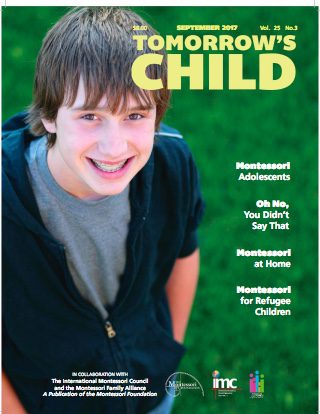
by The Montessori Foundation | Adolescence, Archived Issues / Tomorrow's Child, Early Adolescence (12-15), MFA, Montessori Education, Montessori Family Life, Montessori Middle School, Montessori Parenting, Montessori Secondary / High School, Tomorrow's Child, Tomorrow's Child Online Issue
Click the cover image to read this issue online
by Tim Seldin | Adolescence, Brain Development, Early Adolescence (12-15), Emotional Intelligence (EQ), Later Adolescence (15-18), Lower Elementary (6-9), MFA, Montessori Education, Montessori Family Life, Montessori Middle School, Montessori Secondary / High School, Montessori students, Parent Education, Planes of Development, Primary (3-6), Psychology, Research, Sensitive Periods, The International Montessori Council, Upper Elementary (9-12), Webcasts / IMC
On September 25th, 2014, neurologist and Montessori researcher Steve Hughes and Montessori Foundation President, Tim Seldin, sat down to discuss his work and how modern brain science supports Montessori education worldwide. As Steve puts it, Montessori builds better brains.
v
by Tim Seldin | Discipline, Emotional Intelligence (EQ), MFA, Montessori Family Life, Montessori Parenting, Parent Education
The following tips are from Parents Magazine Online www.parents.com (not based on Montessori, but a great, free, online resource on parenting in general. Check it out!)
Keep Your Cool
Yes, it can get frustrating when your child debates nearly everything you do or say. However, getting angry, raising your voice, or being defensive won’t ease the conflict and may lead to a power struggle, says Annie Fox, author of Teaching Kids to Be Good People: Progressive Parenting for the 21st Century. Or worse, your child may shut down and feel he should never disagree with you or express his feelings. If you notice your emotions starting to rise, give yourself a few minutes to calm down, take a deep breath, and collect your thoughts. Then construct a level-headed way to address the situation at hand.
Make “Yes” Easy
Instead of asking open-ended questions, such as, “What do you want for a snack?” or “When do you want to take your bath?” offer two specific options like, “You can choose either yogurt or fruit” or “You can take your bath now or in 30 minutes. Which would you prefer?” Using this approach will make your child feel as if she has a choice in the matter — plus, she’ll go along with a Mom-approved pick with little or no fuss.
Be Firm
It’s important to be firm and consistent when letting your child know that certain things, such as wearing a seat belt, brushing his teeth, and taking prescribed medication, are non-negotiable. If your child tries to argue about something that you have already explained is a firm rule, Fox suggests that you simply repeat the original instructions and not get into a debate about it. When an issue isn’t as serious but you still don’t want the back-and-forth bickering, Dr. Paone recommends using the ACT limit-setting technique: Acknowledge the feeling (“I know you want to go to the park”), Communicate the limit (“but it’s too cold to play outside today”), and Target the alternatives (“so you can read a book or we can play a board game together instead”).
Encourage Compromise
Although you may feel your child gets enough practice trying to get you to do things her way, helping her practice negotiation skills at home can increase the chance that she will use them with peers, teachers, and other adults in her life, explains Erik A. Fisher, Ph.D., a psychologist and the author of The Art of Empowered Parenting: The Manual You Wish Your Kids Came With. For instance, if she wants to take her favorite toy along on vacation but you’re afraid she’ll lose or break it, ask her to state her case before you’ll agree. Gently guide her by asking her to explain why she wants to take the toy, how she’ll keep it safe, and what other solution she can think of to satisfy both of you. As she gets more experience, she’ll be able to work through the negotiation process without your lead.
Originally published in the September 2013 issue of Parents magazine.
by Lauren Speed | Infant-Toddler (0 to 3), MFA, Montessori Family Life, Montessori Parenting, The International Montessori Council
[
dropcap]E[/dropcap]ach fall, during our professional weeks, we go on ‘home visits’ for all of our newly enrolled toddler students. The visit lasts for approximately 20 minutes. During this time, we deliver our classroom info packet to the parents, and we are available to answer any questions that they may have.
We can learn a lot about the family dynamic during our visit, which is very valuable to us. Our main focus, however, is the children. For many toddlers, this is the first time that they will be in school and away from their homes and parents.
We want the children to meet us in their space and on their terms, where they feel comfortable and safe. Typically, the toddlers greet us at the door and welcome us into their homes. They proceed to show us where they sleep, where they play, their favorite books, and their favorite toys.
Most of the visit we spend sitting on the floor engaged with the children. The visit ends, and we are escorted to the door with the promise of seeing the children again very soon. The goal is that when school starts, they will join us feeling welcomed, comfortable, and safe in their new environment: the classroom.
Montessori Leadership / 2013/ pg 5
by Kathy Stenger Marcus Brutlag Larry Cecio | MFA, Montessori Administrators, Montessori Education, Montessori Family Life, Montessori Middle School, Montessori Parenting, Montessori Teachers, Parent Education, The International Montessori Council
For many families facing the transition from elementary to middle school, a common belief persists that it is time for the fish to enter a bigger pond. This has indeed become the norm in the path for most American adolescents, continuing their social development by navigating the open waters of traditional middle school. Although largely accepted as the natural step for adolescents, as they begin to yearn for more freedom and responsibility, mounting research and experience continue to question the social environment of traditional middle school and the timing of this transition.
As educators and parents who have directly witnessed both paths, we wholeheartedly support taking a deeper look at the social factors when deciding between traditional and Montessori middle school. Greater concentration on how we swim and the water we swim in is proving more influential than the size of the pond and a highly beneficial developmental step before venturing into larger and uncharted bodies of water.
There is no questioning the inherent urge for increased independence and emergence into a larger social setting among early adolescents. This desire serves as necessary motivation for the acceptance of responsibility and greater maturity. It is important, however, to differentiate this desire from actual readiness for this transition. The perception and self-awareness of an adolescent is, by definition, still in development.
This is a time when a child’s brain is going through the most changes since infancy. For the most part, traditional middle school gives little attention to these still developing social abilities and assumes preparedness for a large relinquishing of guidance; however, a Montessori environment is not only socially in-line with adolescent concerns and interests, but also actively addresses and embeds social awareness into the programming and curriculum. With smaller, more communal Montessori middle schools, what is often perceived as a social ‘sacrifice’ is, in actuality, a more fitting and potentially enriching social experience.
We are a collective of teachers, fascinated with educational research and encouraged by the findings on the outcomes of a Montessori adolescent education. We have consequently created an environment that fosters the ability to live in relationship with others and work through human problems, to experience what it means to make a contribution, and to recognize human interdependence and the need to cooperate. We aim for graduates to go to the next level equipped with a social consciousness, understanding the benefits of an active role in society, balancing individual needs with communal ones, and appreciating the value of rules and their importance for harmonious living. Even before espousing the research on the effectiveness of these pursuits, we have already seen, first hand, the development of these skills within our own program.
The beauty of jumping into the role as creators of Village Gate Middle School is that it has given us the opportunity not just to read about, but to experience, what it means to guide adolescents in the way Maria Montessori envisioned. What we have witnessed has, quite gratifyingly, corresponded brilliantly with the empirical data found through our research. One of numerous anecdotes of our students’ successful social dynamics has come in the form of play. For a while, a couple of boys wanted to play wildly crazy imaginative games; a few others wanted to play structured group games; and the girls would rather just wander the playground and observe for the most part. Now, through guidance, patience, and trial and error, the group consistently plays, most often in some sort of combination of the above. They love basketball, and recently kickball, and they give the games their own rules to add the necessary silly quotient. They also break out to sit and watch when they feel like it. All of this happens fluidly with disputes handled quickly and respectfully, with encouragement given whenever necessary.
Montessori’s focus for secondary education as a “school of experience in the elements of social life” (Kahn) is echoed in David Hutchinson’s principle of developing a “spirit of place” for adolescents. This spirit of place is “rooted in community relationships” and defines place as “a community to which the adolescent feels he or she both belongs and contributes” (Kahn).
We have seen that our students have learned to be in relationship with each other. Each does his or her part to work through disagreements and hurt feelings, building on peace table skills carried with them from elementary but now taking on conflict resolution with a more sophisticated and nuanced dialogue.
They feel their interdependence deeply, aware that without every member’s cooperation, no compromise can be reached. As a result of our close classroom community dynamic, they have become autonomous in reaching agreement. It is now far more effective to leave the room and permit the kids to figure out a new classroom arrangement or daily schedule than to stay and try to lead them. Through early guidance and encouragement to stay committed to the community, the fruits of responsibility and accountability are nourished within this interdependent social landscape, where each is finding a healthy place and role.
The benefits of developing a personal sense of place and importance at this critical age cannot be touted enough. Self-esteem is based upon how children view themselves within an environment, so to be placed into an uncontrolled arena without the tools or guidance to navigate their way seems counter intuitive to nurturing this valuable element of development. Susan Harter presents this conflict in her article “Self and Identity Development,” a contribution to the Harvard University Press publication, At the Threshold: The Developing Adolescent.
Findings suggest that self-esteem begins to decline at age 11 and reaches its low point between the ages 12 and 13. As our prototypical adolescent recounts, she changed (“I felt terrible”) when she went to junior high school. The extent of change depends, in large part, on shifts in the school environment, as well as on pubertal change. Children making the shift to junior high school in the seventh grade show greater losses of self-esteem than those who make the school transition later, after eighth grade. Moreover, students making the earlier change, particularly girls, do not recover these losses in self-esteem during the high school years. A development-readiness hypothesis has been proposed to explain this pattern, suggesting that children can be thrust into an environment before they are psychologically equipped to deal with the social and academic demands of the new school structure (Harter).
Middle school is simultaneously a time of self-discovery and expression and a time of increased pressure to conform. The result is that adolescents feel intense discomfort and ambivalence about revealing their burgeoning personalities. The goal, therefore, should be to create a place where students feel at ease exploring who they are, able to take risks and try new experiences,
all the while being seen and accepted by a supportive community.
Researcher and writer Kevin Rathunde also supports the Montessori environment as conducive to not only adolescent academic development but social as well. Rathunde, in association with The NAMTA Journal (North American Montessori Teacher’s Association), has conducted extensive research on Montessori middle school. He explores the social context in a 2003 study, while looking at the roots of reports of negative experiences and lack of motivation from traditional middle school students.
The study points to three social findings:
- a growing distance in teacher-student relations at a time in early adolescence when adult support is crucial; fewer opportunities for meaningful peer interaction at a time when peers are becoming more highly valued; and
- fewer opportunities for meaningful peer interaction at a time when peers are becoming more highly valued; and a growing emphasis placed on one-directional communication (e.g., lectures, seat work, and viewing media) just as young adolescents are becoming more capable of more complex thought and communication (Rathunde 32).
- a growing emphasis placed on one-directional communication (e.g., lectures, seat work, and viewing media) just as young adolescents are becoming more capable of more complex thought and communication (Rathunde 32).
Montessori students expressed greater connections and support from their teachers, reporting that they felt that their teachers were fair and interested in them. This is most likely a result of the structure of the Montessori middle school program. The time the Montessori teacher has to observe and work with a given student is intentionally designed to provide this sense of security. Perhaps equally important is the drastically different social context Montessori and traditional students perceived with respect to their peers. While traditional students predominantly saw their peers as classmates, “Montessori students more often perceived their peers as friends-and-classmates” (Kahn 37).
Montessori groups are often structured by shared interests rather than students’ ability levels, and a significantly less amount of class time is spent in one-directional lectures. These are both elements that aid in forming closer relationships among students while engaged in work time. The Montessori work environment provides continual opportunities to participate socially and create community instead of delineating factions between class and social time. Group and class discussion and exploration are integral components of the Montessori classroom and serve as safe experiences for students to express their questions, concerns, and opinions amongst both trusted instructors and peers.
Our final piece of evidentiary support comes from a more general look at wisdom and how it is attained in a recent New York Times article, “The Science of Older and Wiser.” The ultimate aim of any educational journey is arguably to achieve wisdom, as wisdom is not only the possession of knowledge but the practice of applying knowledge as well as “maintaining positive well-being and kindness in the face of challenges” (Korkki).
In developing a socially equipped and happy student, we look to a few of the major tenets of wisdom offered by Professor Ursula M. Staudinger, including: “self-insight; the ability to demonstrate personal growth; self-awareness; and an understanding that priorities and values, including your own, are not absolute” (Korkki). Laying the groundwork for this type of wisdom is a foremost objective of our program and of a Montessori adolescent education because these are the skills necessary to live happily and contribute positively to a greater community. The social factor is at the root of our program, guiding the academic development since we see the two as absolutely inseparable.
The students within the Village Gate Middle School program take part in a heroic journey of self-reflection and discovery based upon Joseph Campbell’s universal archetypes. The journey requires students to recognize their personal challenges and to see how they not only influence their own lives but how these challenges affect the community as well.
The heroic journey recognizes the natural desire for each student to venture away from the comforts of home and into a larger setting, this being the call; however, this developmental construct also acknowledges that a right of passage must be undertaken to first ready oneself for this transition. Although the adolescent impatiently desires to enter the new setting upon receiving the call, it is the role of the “threshold guardian” to create an environment where the developing youth can test him or herself safely and to know when each trial has been met before incrementally opening each gate upon the way.
We must not forget our roles as the threshold guardians for our children. It is the role of the threshold guardian to help them recognize not only themselves but also the water that they swim within. Equipped with an understanding of the water and how they swim will enable them to find success and happiness no matter how big or small a pond they find themselves. This is the pursuit of the Montessori adolescent education: to provide an opportunity for our children to not only recognize their place within the greater community but to trust themselves to confidently forge their own path within it.
Montessori Leadership / June 2015 / p 14
by Jacqueline Cossentino Ed.D | MFA, Montessori Administrators, Montessori Family Life, Montessori Parenting, The International Montessori Council
Editor’s Note: The following is an excerpt from Following the Family: Practical Lessons for Educating Human Potential, a new book by Jacqueline Cossentino, Ed.D., Senior Associate and Director of Research at the National Center for Montessori in the Public Sector.* Following the Family, along with the US Montessori Census, is the result of a collaborative research project: What, Why and How: Establishing a Framework for Researching Montessori.
Chapter 1: Introduction
Following the Family is about relationships. It’s also about poverty, early learning, community development, and education policy. But mostly it’s about relationships.
Told through the stories of four pioneering programs that serve young children and their families, Following the Family explores how these programs have succeeded in transforming the life paths of thousands of families in some of our nation’s most vulnerable neighborhoods. Each program is unique in its organizational culture and, at the same time, all four are intimately linked through a common set of principles that guide their practice.
Crossway Montessori Communities in Kensington, Maryland, builds social capital through intergenerational learning focused on single mothers and their young children. Family Star Montessori, in Denver Colorado, uses Early Head Start and Head Start funding to provide continuous, family-centered education starting at three months of age. Lumin Education, in Dallas Texas, links multiple funding streams, including Early Head Start, to provide a pathway leading from the toddler years all the way through third grade. And Montessori Partners Serving All Children in St. Paul, Minnesota, is building a network of providers, all committed to high standards of Montessori practice, all serving vulnerable populations, and all engaged in
strengthening their local communities.
While Montessori education has been part of the American educational landscape for more than a century, it is not commonly understood as an approach to ameliorating poverty or social transformation—at least not by the general public or policymakers. This is because Montessori education in the US has, since the 1960s, tended to be most visible in affluent communities. Rising out of a post-war economic boom, which led to a new population of college educated mothers searching for better solutions for their children, Montessori surged as a boutique pre-school option in the leafy suburbs of major US cities.
In the sixties, better education meant student-centered, hands-on, constructivist classrooms, which nurtured children’s natural tendencies to explore and develop. Today, a similar trend is visible. After nearly two decades of efforts to close a stark and persistent achievement gap through back-to-basics teaching driven by high-stakes testing, teachers, funders, policymakers, and, most of all, parents are fed up with the impact of a narrowed curriculum: the stress caused by excessive testing and the general joylessness that characterizes many public schools today. Calls for deep learning, ideal learning, big-picture learning, and re-imagined learning driven by play, projects, and personalization are growing louder and more frequent by the day.
Moreover, these calls, which are part of a predicable pendulum swing in the culture of education, are now buttressed by science. And not just science, but brain science. Neuropsychologists now offer evidence proving that healthy brain development requires things such as: free movement; varied social interactions: multi-sensory experiences; complex learning environments; and lots of opportunities to focus, experiment, and learn from mistakes. Cognitive scientists are also addressing the timing of human development, affirming that early childhood constitutes a major period of rapid and consequential brain development.
Birth to six, indeed, is no longer understood to be the period before real learning begins. Rather, study after study supported by brain scan after brain scan demonstrates that 85 percent of the human brain’s development is complete by age five. Not only is growth rapid during this period, but the brain’s plasticity makes the acquisition of important executive function skills such as inhibition, working memory, and cognitive flexibility especially robust at this time. Taken together, this research confirms not only that these years are most significant in determining future success, but that investing in the very young produces dramatic economic as well as developmental returns.
Perhaps, not surprisingly, the proliferation of new research on neurodevelopment, early learning, and cognition has, in part, fueled significant policy initiatives at all levels. Recent federal investments, such as the Race to the Top – Early Learning Challenge, combined with legislation enabling state-supported pre-Kindergarten in 44 states have made early learning much more common for many more people. In 2015, almost 1.4 million US four-year-olds were enrolled in a state-funded pre-Kindergarten program, a jump of about 37,000 from the prior year.
Within this convergence of research, public opinion, and political will, a new and expanding consensus has emerged on what “better education” entails. It should start early. It should support the development of executive functions and social-emotional skills. It should be personalized, hands-on, and deeply engaging to students. It should prepare students not just to pass tests, but to participate in an increasingly complex social, political, and economic world, a world in which creativity and innovation are necessary not just for economic participation, but for human flourishing. And within this environment, Montessori is slowly but surely drawing attention to itself as a model of education that not only does all these things but has been doing them steadily for the past hundred years.
And not just for affluent families. Despite public perception, Montessori is firmly established as a public school option for more than 125,000 US children, and that number grows by approximately 5 percent annually. Slightly under half of the children who attend public Montessori schools live in poverty, and many are located in urban centers with especially high concentrations of racial and economic isolation. In cities like Milwaukee, Chicago, Dallas, Denver, Baltimore, Memphis, St. Louis, Hartford, St. Paul, and Washington, DC, public Montessori schools not only serve low-income families, they are integrated communities, serving rich and poor, side by side.
How—and Why—This Book Came to Be
The programs described here represent distillations of the very best that Montessori has to offer American society. They show us what “better education” can look like for very young children and their families. Just as important, they show us how to do it.
I began following these programs in 2011, when I first became engaged with the work of Crossway Montessori Communities. Within the Montessori community, all four programs have been celebrated as exemplars of social reform, and, within their local communities, each has been recognized for its contributions to the social and civic life of its respective city. But the larger story of family-centered, multi-generational, place-based learning, grounded in an ambitious theory of action had not been told. Moreover, just as news of these programs began to spread within the Montessori community, the world outside was beginning
to take deeper notice of early learning and its potential impact on larger issues of social and educational policy.
In 2012 I spent several months embedded at Crossway Montessori Communities, which Executive Director, Kathleen Guinan, describes as “Montessori boarding school for mothers and their children,” aiming to discern the elements of what I came to understand as the Crossway Model. Spending time with Crossway staff and residents was my introduction to the way relationships determine individual and family destiny. The following vignette is drawn from a tour conducted by Guinan inside one of the 46 apartments occupied by Crossway residents.
Abeba
The first thing I notice about the two-bedroom apartment that Abeba and her two daughters (Malia, age 2 and Selassi, age 5) share is how spotlessly clean it is. As we step inside, we are asked to remove our shoes. We pad across the beige-carpeted living room, flooded with natural light from a large window overlooking a garden, and are invited first to inspect the girls’ bedroom, which contains two twin beds, a single white chest of drawers and small table with two child-sized chairs. There are bright calico curtains that match the bedding and family photos of mother and daughters on the chest. Next door, Abeba’s bedroom, the smaller of the two, is also decorated simply and includes more photos of the family trio along with samples of the girls’ art work tacked neatly on the wall.
Abeba has lived at Crossway for two years, and she is likely to stay for at least a year longer. When she arrived, she was pregnant with Malia, seeking refuge from an abusive relationship with Malia’s father. At the urging of a local women’s shelter, Abeba attended one of Crossway’s “Prevention” classes: two-hour workshops focused on explaining how Crossway works and what is necessary to be part of the community. She was inspired by the approach and possibilities described, and soon after the class, Abeba applied to become a resident.
On the stove, a pot of chicken curry is simmering, and Abeba smiles patiently as we coo over the order, the light, the delicious smells, the peacefulness of this home. We have interrupted her as she studies for an upcoming test at the University of Maryland, where she is taking courses leading to a degree in Computer Science. Her books and computer are open on a desk in the living room, where, next to the adult-sized sofa, there is a child-sized seating area and a shelf neatly arranged with books and toys.
We are conscious of Abeba’s time and eager to move on to the next stop on the tour, but Guinan, who is serving as our guide, can’t let us leave without seeing “the closet.” “You won’t believe this,” she says, barely containing her glee. She opens the door to reveal a study in space design. What once was a linen closet has been transformed into meticulously arranged storage space for the girls’ clothes, toys, and books. It looks like an advertisement for a professional organizing service. Items are color coded, with every inch of space maximized. Items still in use by the girls are placed at child level so that both children can share responsibility for keeping the space neat and usable. Abeba explains that she has attempted to imitate the manner in which the children’s classrooms, located on the ground floor of the building, are organized. Since becoming part of the Crossway community, she has come to see a direct relationship between an orderly physical space and a more peaceful emotional life. Guinan softly shakes her head and smiles. This is what keeps her coming to work each day.
Lines and Circles
For Abeba, along with all the other mothers who live at Crossway, the line between poverty and prosperity is both thin and stark. Guinan explains that Crossway is “not a homeless shelter; it’s not for people who are unable to help themselves.” To be admitted, women must demonstrate that they have both the will and the resources to change their lives. Sometimes programs like this are criticized for not “saving” the neediest. Guinan, however, sees it differently. “For these women,” she explains, “this program is the difference between making it and spiraling permanently into poverty.”
Joining the community also means agreeing to a strict set of expectations: signing in and out, observing a curfew, registering any visitors, observing daily rituals, attending weekly meetings and semi-monthly progress reviews. Along with these expectations is a wide and varied set of practical supports. When residents move in, for instance, they are assisted by Crossway staff in setting up their apartments, including locating furniture and living supplies. Communal meals are shared at least bi-weekly, technology and other job training resources are provided in what looks like a hotel business center, and Crossway staff members are available around the clock to respond to challenges residents may be experiencing. This unique blend of structure and support is what distinguishes, not just Crossway, but all four of the programs described in these pages.
Abeba’s closet, in many ways, exemplifies the importance as well as the complexity of structure in supporting families. It is an oasis of order in the midst of what, prior to her arrival at Crossway, had been a chaotic life. Just as important, Abeba, with the assistance of Crossway’s Practical Life Coordinator, was recreating the precise tidiness that characterizes her children’s Montessori classroom. She made this closet as much for them as for her. When Abeba directs her attention to bringing order to her physical environment, she not only produces a space that is functional for her family, she is practicing a skill that is central to gaining control of her life path. Delineating the boundary between what is within and what is beyond her control constitutes a powerful step toward agency and self-efficacy.
Lines, indeed, have multiple meanings for all four programs described here. In addition to serving families that live either on or very close to the poverty line, all four programs aim to offer stability, in part, through clear limits. Finally, all four programs are devoted to supporting people who, in many cases, dwell on the margins of society: immigrants, single mothers, infants and toddlers. These audiences not only represent the highest rates of poverty in the US, they are notoriously under-funded within the non-profit realm, and, as a result, all four programs walk a constant tightrope of financial survival.
But lines are only part of the story. Just as important are the circles of support and relationship that define the way communities are created, nurtured, and enlarged. These programs all operate within in complex constellations of partners, stakeholders, and audiences. They are constantly cultivating relationships between and among disparate circles—housing and community development agencies, health providers, universities, public and independent schools, Montessori trainers, and private funders. They are constantly working to parlay basic, transactional needs, such as childcare, into larger, more encompassing interventions in order to provide transformative opportunities for families and children.
A Way of Thinking About our Work: Montessori as a Theory of Action
“What’s different about us compared to other programs that try to do what we do,” explains Kathleen Guinan,“ is that we have a way of thinking about our work.” She is talking about the way in which the entire Crossway
environment is prepared to meet the needs of its residents, from infants to women in their late teens and twenties. She is talking about the simple, natural beauty of both the interior and exterior space; the gardens, art work, and lighting that make the entire campus look more like a high-end condominium complex than a residential program for single mothers. She is talking about the blend of freedom and limits that characterizes the expectations of both the campus as a whole and the Montessori classrooms on the building’s first floor. She is talking about a constant emphasis on the practical details of living: how to keep your room clean; how to prepare and share a meal; how to write a thank-you note; how to have a conversation; how to be a friend.
This way of thinking is the theory of action that governs everything that happens, not just at Crossway, but at all four programs. Though rooted in Maria Montessori’s theories of child development, these core concepts of beauty, freedom within limits, practical life, and work are applied not just to children, but to all aspects of the organization. When Connie Black describes the core work of her organization as “leading with our ears, listening to what parents and families think, dream, and worry about, so that we can most appropriately respond to needs,” she is articulating core Montessori concepts that are as much about attitude as skills. This stance defines what these organizations are about.
They are about honoring human development as a natural process that requires patience and modeling as much as instruction, and that occurs best in community. They are about building trust one interaction at a time, through intentional listening and careful observation. And, perhaps most of all, they are about respecting all people, especially parents, regardless of their circumstances, as agents of their own destiny, with gifts to offer to their children as well as their communities.
This focus on responsive rather than directive interaction is a signature feature of Montessori education, whose tagline “follow the child,” refers to the way adults are trained to organize all learning around individual children’s needs and interests rather than pre-determined curriculum mandates. All four programs are deeply committed to following the child, yet they understand and organize themselves around the belief that children are always connected to families.
Following the family, therefore, means moving relationships with families to the center of the enterprise of education. It means intentionally creating space-physical, emotional, social, and intellectual—for families to learn how children develop, both at home and at school, and creating meaningful opportunities for families to engage with the program, with one another and with their children.
Montessori Leadership / September 2016 / p 10