by Tim Seldin | Adolescence, Early Adolescence (12-15), Later Adolescence (15-18), MFA, Montessori Curriculum, Montessori Family Life, Montessori Parenting, Montessori Secondary / High School
 Thanks to people just like us, my grandchildren (and your children) will have the opportunity to graduate from a Montessori high school. Our youngest grandchild, Hudson, is only 15 months old. He has been a Montessori student since he was 10-weeks-old, and he is blossoming.
Fifteen months old? Why are we thinking about his high school education now? For that matter, why should you?
The answer is simple.
Today, there are only about 100 Montessori high schools in the US, compared to more than 5,000 Montessori schools in America as a whole. This means that most Montessori students will have to transfer to a conventional public or private middle or high school when they ‘outgrow’ the programs offered in their Montessori schools.
Will they be successful? Yes, in terms of grades, but for most, before long, the light in their eyes will fade away and school will become what many educational professionals refer to as a ‘race to nowhere.’ Assignments and tests will come, be done, and soon be forgotten in an endless blur.
Many ‘good’ students get tired of running on a treadmill, burn out, and ask, “Why am I working so hard to get a job that I may not even enjoy?” Burnout may happen in high school; it could come in college; or it may show up in mid-life. Burnout happens for many bright and supposedly ‘successful’ young people much more often than most of us want to admit.
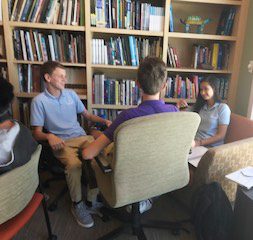
On the other hand, in more and more schools, like the NewGate School in Sarasota, Florida, students have a choice. [Editor’s Note: NewGate is The Montessori Foundation’s Lab School.] Students at NewGate can start in Montessori as toddlers and go all the way to graduation in 12th grade. Nationally and around the world, students who are able to remain in Montessori seem to never lose their sense of wonder and love for learning, creating, and building. They innovate. They collaborate. They celebrate their lives. If you’ve known any Montessori graduates, you’ve probably seen this for yourself.
In Montessori high schools like NewGate, we are working to revolutionize the way we educate teenagers in America and abroad.
Here’s a shockingly simple concept: Secondary education does not need to dehumanize adolescents any more than early childhood and elementary programs need to destroy children’s creativity and joy for learning!
That’s why we spend so much time and energy working to ensure that, when he is ready for high school, there will be a Montessori high school program ready for Hudson and for all our Montessori children, across America and around the world.
A growing number of Montessori schools have gone a step further and also offer Montessori high school programs that are integrated with the International Baccalaureate (IB) Diploma Programs, giving students the opportunity to receive an IB diploma that is recognized and welcomed around the world.
A bit of historical perspective …
The first Montessori secondary schools were founded in Europe in the 1930s. In the United States, a number of secondary programs organized along Montessori principles developed as early as the 1940s, but they did not openly use Montessori’s name.
In the 1970s, a number of early adolescent programs, openly identified as being “Montessori influenced,” were established in the United States, including: The Barrie School in Silver Spring, Maryland; Near North Montessori in Chicago, Illinois; the Ruffing Montessori School and Hershey Montessori School outside Cleveland, Ohio; Lake Country Montessori School in Minneapolis, Minnesota; and the Columbus Montessori School in Columbus, Ohio. Two early Montessori secondary programs are no longer in operation: the Montessori Farm School in Half Moon Bay (California) and the Erdkinder School near Atlanta (Georgia).
In 1982, my alma mater, the Barrie School outside Washington, DC, became the first Montessori High School program to be officially recognized by the American Montessori Society. That year, the Institute for Advanced Montessori Studies in Silver Spring (MD) and the Dallas Montessori Teacher Education Program in Dallas (TX) opened the first Montessori Secondary teacher education programs.
During the 1980s, a number of other programs for young adolescents opened in the United States and Canada, including: the Franciscan Earth School in Portland (Oregon); the School of the Woods in Houston (Texas); St. Joseph’s Montessori in Columbus (Ohio); the Toronto Montessori School in Ontario, Canada; and the Athens Montessori School in Athens (Georgia).
Today Montessori Secondary programs have developed in hundreds of public, charter, and independent Montessori schools in the United States and Canada.
Redefining Adolescent Education
Montessori education is the fastest growing organized system of education in the world. Even though Montessori is best known for its success with younger students, Montessori Secondary educators are working to design replicable programs that will spread around the world. We are literally re-writing the playbook on how middle and high schools may look tomorrow, and we are doing it our way … the Montessori way!
One of the most basic principles of Montessori education is the call to design schools that truly meet the developmental needs and personality of children at each stage of human development. We believe that schools should be centered around their students as
people, rather than organized around the demands of administrative efficiency.
As a physician doing pioneering work on brain development and child psychology, Dr. Montessori recognized that the primary developmental tasks of adolescence are social, emotional, and spiritual. She observed that teenagers often find it difficult to concentrate on their studies; their lives are not centered on school work, but on learning how to be comfortable around one another. If you have any doubt of the truth of that premise, observe the importance of social media in the lives of our teens.
She proposed that the ultimate objective of secondary education must not be limited to preparing students to enter college or the workforce; instead, we need to give them an ‘education for life.’ The primary goal of middle and high school education must, therefore, be to help teenagers to discover, accept, and confirm their self-worth as individuals.
Brain Development
Contemporary insights into adolescent brain development show that, in teenagers, the prefrontal cortex (the brain region responsible for making complex judgments and considering outcomes) is not yet mature, which explains why many teenagers can be so impulsive and illogical. The poor judgment and impulse control of teenagers can be explained by normal processes of adolescent brain development. In addition, compound the situation with adolescent hormonal changes, and it is easy to see why adolescents are profoundly influenced by peer-group pressure.
If they fall in with the wrong crowd, young people may find themselves making some very poor choices. This is much more common than most parents of teenagers realize or want to accept; however, in small, close-knit, and supportive settings during this very vulnerable period, adolescents are given a better opportunity to grow into confident, warm, accepting, and supportive adults.
Montessori Secondary programs can take many forms. In general, most tend to have a few hundred students at most. The defining element is the creation of a protected community of students and adults, a social laboratory in which adolescents can clarify their values, build strong interpersonal relationships, and learn to communicate their thoughts and feelings articulately and maturely to one another.
Why Large High Schools Are Not Designed to Meet the Needs of Adolescents
Most people assume that large high schools are a basic part of growing up. I disagree.
Even though most Americans take them for granted, large contemporary middle and high schools are poorly designed to meet the developmental needs of adolescents. Adolescence is a period of life, where the primary challenge is to become much more independent, mature, emotionally balanced, socially skilled, and responsible.
The schools in which we place teenagers tend to be large, impersonal, and filled with bored, apathetic, over-worked, and over-stressed, students. We ignore teenagers’ developmental needs and focus as if they were already in college—ready for serious academic life. We try to motivate them with the fear of not getting into good schools, while attempting to distract them with athletics.
The Marriage of Two Good Ideas: Montessori and the International Baccalaureate Diploma Program
The International Baccalaureate Diploma Program is recognized worldwide for academic excellence. It provides structure, credibility, accountability, and flexibility. Montessorians understand the needs for providing the environment and guidance necessary for adolescents to flourish, giving students the tools that speak to them in human terms at times and in ways when they are developmentally ready to process and make the most of their secondary educational experience. Merging the best of what both programs have to offer results in a transformative experience.
The Montessori Foundation is committed to finding a better way to meet the needs of our adolescents. We know that we need to prepare them for the future, but we are also committed to preserving what their early years in Montessori have given them to help them develop into the human beings we so desperately need for our next generation of innovative leaders and peacemakers.
At our lab school (NewGate) we are literally re-writing the curriculum. We are almost there and hope to announce our accreditation as a Montessori-IB Diploma program this year. When that happens, we will share the challenges and outcomes with readers of Tomorrow’s Child and Montessori educators around the world.
At NewGate, and more and more Montessori schools across the United States, Canada, and the world, there is an answer to the question that Montessori parents ask us every day: “Our children’s Montessori school ends at the eighth grade. Where do we go from here?”
Montessori High School, of course!
Tomorrow’s Child /January 2014 / p 29
by Joyce St. Giermaine | Family Resources, MFA, Montessori Family Life, Montessori Parenting
Yay! It’s time to visit friends and relatives for the holidays!
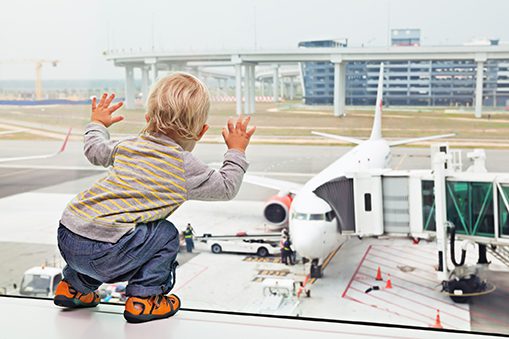
The thing is, though, that you’ve got young children, and a plane flight looms on the horizon. The only thing worse than sitting in front of a fussy child on a plane is the parent who is trying so hard not to have THAT child! No matter how well behaved your child might be in other situations, all bets are off when it comes to air travel.
While we all dread having THAT child, it’s worth remembering that most of your fellow passengers have probably had the same experience at some time in their life with their own children. Young children are excited and cranky and too tired to sleep. While there’s no sure-fire fix to eliminate the stress of plane travel with young children, there are some ways to make it easier.
Before we talk about fun, let’s remember some basic ‘housekeeping’ issues.
Bathroom/Diapers: Use the restroom facilities in the airport before boarding the plane. Even when your newly diaper-free child says a bathroom break is not necessary, now is the time to learn one of the basic life lessons: Never turn down a free lunch or a chance to go to the bathroom! If you have ever tried to change a messy diaper in an airplane bathroom or had to stand in line with a crying toddler grabbing his pants as you wait for someone to exit the lavatory, you know the importance of this step.
Wipes: Bring wipes of all kinds: diaper wipes, face wipes, hand wipes, disinfectant wipes (for the plane tray and basically everything your child is going to touch… or has touched), and glass wipes if you wear glasses, because they will probably get smeared with something.
Popping Ears: All children (and adults) feel pressure in their ears as the plane gains altitude. For children, it is more painful. If you’re traveling with a baby, now is the time for breast, bottle, or ‘binkie.’ Many adults chew gum for the same reason. For toddlers, this might be the time to treat them to a lollipop (sugar free preferably). Swallowing is the key!
Now that you’ve attained lift-off, here are some other suggestions that won’t break the bank or waste valuable carry-on space, plus you will find them useful for occupying children in restaurants while on vacation and when you return home.
PAPER & CRAYONS
Cut some small pieces of colorful paper and allow the children to make their own little book. Crayons are better than markers. You don’t need all 500 colors; a small pack of basics will do! Let children create a story about their trip or anything else that interests them. If they want to dictate a story to go along with pictures, be a scribe. If you are really organized, make all the pages of equal size, punch two holes along the sides of the paper and bring a strand of yarn to bind the ‘book’ when it is finished. Let your child ‘read’ the book to grandparents or friends upon arrival.
PLAY DOUGH™
Maybe you have never allowed your children to play with this stuff at home. If so, this will be an absolute revelation! (Silly Putty™ is another choice). There are plenty of great recipes online if you want to make your own, or just buy some small containers of Play Doh™. Small containers are really inexpensive (about $1 each). Allow your child to remove the dough, smell it, feel the texture, and dig in. You can show your child how to make snakes and bowls and all the dough art you made when you were a child. Just don’t let them eat it. It does smell delicious! When you are done, be sure to wipe down the tray for the next passenger.
BLOCKS
A small Lego™ set can occupy a young builder for … minutes? It’s also a good opportunity to teach or engage children in identifying the block colors. Tegu™ blocks are another fun possibility. Tegu’s Pocket Pouch includes 8 magnetic wooden blocks and is packaged in a felt pouch. Tegu has reinvented the wooden block, and, by safely embedding magnets into each piece, these blocks are “curiously
attractive” for both kids and adults. The pouch sells for about $25.
ETCH A SKETCH™
This old favorite is making a comeback in a small, portable model. The Pocket Etch a Sketch™ should not cost more than $10 and is pretty entertaining for busy hands.
STOCKING STUFFERS/ GRAB BAG
Little presents that can be doled out on an hourly basis give bored children something to look forward to and represent passage of time if done on an hourly basis. Wrap each ‘present’ to prolong the experience. Little inexpensive items are all you need.
STICKY NOTES
Buy a multi-colored pack of Post-It Notes™ and let your child decorate his tray, seat, window. Be sure to retrieve them upon landing so that they can be used later.
SNACKS
Be sure to bring an assortment of snacks. The Cheerio Play Book allows your child to combine snacking with reading. On every page, there are pictures that need to be completed by adding Cheerios™ to just the right places. Pages are recessed to help children successfully place their own dry cereal pieces within the scenes. The book costs about $8. Remember to bring a sandwich bag full of Cheerios™!
In addition to your child’s favorites, we’ve got some snack suggestions in the box on the next page.
PEZ™ DISPENSER
Yes, it is candy, but it is very small and might be something your children haven’t experienced. This product has been around since the 1920s and now apparently comes in many theme-oriented dispensers. Popping the top is actually more fun than eating the treat. Just watch your children to make sure they eat the candies properly. If you can’t find these items in your local stores, just go online!
TABLETS [Editor’s Note: This is not an endorsement of tablets, computer, or phones; however, when used sparingly at home, this is a great way to make a travel experience a whole lot easier!]
When all else fails, loading books and movies onto an iPad may be your best bet. Remember to bring kid-friendly earphones. The whole plane doesn’t necessarily want to hear the soundtrack from Frozen over and over and over. Kidz Gear™ has headphones in a variety of fun colors. The cost is about $20 and well worth it! Many wonderful children’s books are also available on Kindle™.
Healthy Travel Snacks
HIGH-FIBER/LOW-SUGAR GRANOLA BARS
Low-sugar, high-fiber granola bars are a great way to boost your kids’ nutrient intake. Plus, they’re a lot easier to eat than regular granola.
Yogurt with Toppings Crumble™ granola bars into a yogurt cup for a smooth and crunchy snack. Travel with pre-packaged, store-bought bars and yogurt cups to combine together while on the go or pack already-crumbled granola in a resealable plastic bag and portion yogurt in a travel-size container.
Granola trail mix makes a sweet and salty trail mix by breaking apart one or two granola bars into a bowl and combining with 1 tablespoon of raisins and 1/3 cup of small pretzels. Toss together and store in a re-sealable plastic bag.
HIGH-FIBER/LOW-SUGAR CEREAL
Think outside the box by taking a favorite breakfast food to the next level.
O-Cereal Necklaces String any “O”-shaped cereal onto a piece of yarn, 12 to 18 inches, depending on the size of your child’s head; tie the ends to make a necklace. This is a fun activity to do ahead of time, and kids will have a blast munching rings from their neck.
Sweet and Salty Trail Mixes Combine ½ cup of cereal with ¼ cup of yogurt-covered raisins and ¼ cup chopped walnuts. Mix well and store in an airtight container or a resealable plastic bag.
Cereal Truffles Mix together ½ cup almond butter (or any nut butter), ½ cup honey, ½ teaspoon cinnamon, 2 cups brown rice cereal (or Rice Krispies™), and ½ cup unsweetened coconut. Shape into 1-inch balls and roll in ¾ cup chopped sunflower seeds. Place the truffles on a baking sheet lined with wax paper and freeze until firm. Pop truffles into an airtight container and allow them to thaw while traveling.
ALMOND BUTTER (OR ANY NUT BUTTER)*
Nut butters are a super way to add protein to snack time, and you can make portability a breeze by purchasing the single-serving packages.
Ants on a Log Cut small sticks of celery (the log) and fill the indentations with almond butter. Place some raisins or dried cranberries (the ants) on top of the butter in a straight line. Store in an airtight container.
Kids always get a kick out of this classic snack and it’s a perfect fruit, veggie, and protein combo.
Almond Butter, Honey, and Banana Sandwich Spread some almond butter on two slices of whole-grain bread. Top with a few slices of banana and drizzle on honey. Cut the sandwiches in half, and store in a re-sealable plastic bag.
*Do not serve to children with nut allergies!
MINI PANCAKES OR WAFFLES
Frozen versions are the perfect size for little hands; they also make the best toasted ‘bread’ for small sandwiches.
PB&J Pancake ‘Sammies’ Defrost mini pancakes in the microwave. Spread half the pancakes with a layer of peanut butter (or favorite nut butter) and the other half with a layer of grape jelly (or another fruit jelly). Put the halves together and pack in resealable plastic bags.
WHOLE-WHEAT WRAPS
These handheld treats travel well and are filling and finger-friendly.
Cream Cheese and Jelly Pinwheels Spread a wrap with layers of cream cheese and your favorite jelly, roll up, and cut into one-inch pieces that look like pinwheels from the side. Pack inside an airtight container.
Spinach and Feta Quesadillas Melt some feta cheese and chopped spinach between two wraps in a pan heated with oil. Then cut into wedges. Store in an airtight container with a small cup of mild salsa for dipping.
STRING CHEESE
Fun to eat while keeping kids busy, a single serving provides 10 to 20 percent of the daily calcium recommended by the USDA.
Ham and Cheese Roll-Ups No bread is needed for this tasty alternative to a pig-in-a-blanket snack. Simply roll thinly sliced deli turkey or ham around a half or a full stick of string cheese. Securing with a toothpick would be dangerous for little ones; instead, store the roll-ups seam side down in an airtight container to keep fresh.
Cheesy Pizza Rolls Cut up a whole stick into little pieces and arrange them on a whole-wheat wrap. Cover the cheese with two tablespoons of marinara sauce. Roll up the wrap and microwave for 30 seconds until the cheese is slightly melted. For short trips, keep warm in a piece of aluminum foil or store in an airtight container.
FRESH FRUIT
Sweet fruit makes for a refreshing and healthy snack that’s full of fiber and vitamins.
Mini Fruit-and-Cheese Plate Peel and dice fruit (like apples and pears) into ½-inch chunks and serve along with cubes of your child’s favorite cheese and wedges of whole-wheat pita. Everything can be stored easily in airtight containers.
Frozen Banana Bonbons Cut banana into 1-inch rounds, dip in a favorite flavor of yogurt, and roll in crushed graham crackers. Place the slices in an airtight container and store it in the freezer until you’re ready to travel. These bonbons are best served on car trips because they defrost pretty quickly.
Minty Sweet Salad Cut watermelon, cantaloupe, and honeydew into 1-inch cubes (you should have 2 cups total). In a small bowl, whisk together the juice of 1 lime, 2 tablespoons honey, and ¼ cup finely chopped mint. Toss ½ cup of grapes into the melon mixture, pour over the dressing, and toss. Pack in an airtight container and put in the fridge to maintain freshness.
APPLESAUCE CUPS
Mashed, cooked apples give kids a serving of fruit while satisfying a craving for something sweet.
Apple Dip Pack individual snack cups alongside resealable bags filled with carrot sticks or baby carrots and celery sticks for easy dipping. Or, instead of cups, portion out applesauce into airtight containers.
Apple “Pie” Cups Crush pieces of graham crackers over a cup of applesauce to create a tasty and super healthy mock apple pie. For maximum crunch, store the crackers in an airtight container and then crumble pieces into a cup of applesauce before eating; otherwise, the crackers will get soggy.
FROZEN EDAMAME
Veggies aren’t always an easy sell, but edamame is a smart on-the-go munchie that’s packed with iron, omega-3 fatty acids, and protein.
Edamame Poppers Steam up a batch of frozen edamame in pods and store in an airtight container in the fridge for up to three days. Before you hit the road, sprinkle them with a touch of salt and watch the kids have a blast popping them from the shells right into their mouths.
Edamame Hummus In a food processor, puree 1 cup of frozen edamame (steamed and shelled) with 1 small clove of garlic, 2 tablespoons of olive oil, ¼ teaspoon salt, and juice of ½ lemon. Process until smooth and serve with cut veggies or pita chips. Store everything in an airtight container. Edamame hummus is full of fiber and a terrific alternative to high calorie packaged dips.
HUMMUS
Loaded with vitamin B6, folate, and iron, creamy hummus is no ordinary dip. Plus, its thick consistency means less chance of messy spills.
Super Dip Pack hummus inside a small airtight container along with some pita chips, baby carrots, red pepper slices, and celery sticks for dipping.
Pita Pocket Stuff small whole-wheat pitas with hummus and thinly sliced cucumbers (or another sliced vegetable) for a pocket sandwich packed with protein and fiber. Store in an airtight container or resealable plastic bag to keep fresh.
Tomorrow’s Child / November 2014 / p 37
by Chelsea Vicek | Family Resources, Health / Nutrition, MFA, Montessori Administrators, Montessori Education, Montessori Family Life, Montessori Parenting, Peace Education, Primary (3-6)
We have been able to implement a number of strategies already into our school, including yoga, sensory-integration techniques, emotional expression through art, and creative relaxation through breathing and visualization.
Maria Montessori advocated the critical importance of early childhood development. We recognize this in the structure of her philosophy in classrooms and in life outside school walls. Fueled by this main tenet, Robin Johnson, Director of River Song School in Bend, Oregon, has made it her mission to support the youngest members of her community. River Song School has recently piloted a whole-child wellness initiative called Happy Families. This program is targeting the primary age group (3-6 years old) of children in the community of Bend and stressing the importance of early screening on the facets of behavioral, social, and physical health. During its first three years, River Song School was part of Project LAUNCH through Deschutes County to promote wellness in early childhood.
Through Project LAUNCH, a specialist was engaged in observation of our classrooms and subsequent consultation with teachers. The observations provided information and training for classroom teachers on handling individual differences or challenges that arose. This project turned into a catalyst for Happy Families’ inception and bringing River Song School into the community to raise awareness for early-childhood healthcare. It is no coincidence that the first developmental plane is also the most crucial period in which to recognize and treat mental or physical health challenges.
The staff at River Song School has found that there is a local deficit in programming, screening, and intervention resources available to preschoolers in an educational setting. Although there is a basic screening system available, the follow-through and support during the process of referral is limited. As well, the community resources for pediatric behavioral health are in such great demand that there are waiting lists and limits to availability. Any intervention or services that do exist tend to be reserved for children at infant and toddler age and at the elementary school age of five to six years old.
Many of our students attend River Song School, beginning at age three until kindergarten or first grade and then move to public school. Because this may be their first experience in an academic setting, it is often where behavior or social problems are initially displayed. By providing Happy Families at our school, we are proactively targeting this age group before they make the transition elsewhere. If we can do behavioral health screenings early on, our hope is that unnecessary diagnosis may be avoided and the potential to help in areas of challenge can be done sooner. It seems that once children come out of the primary stage, they can more easily become overlooked for individual differences and needs.
The basic structure of Happy Families will involve continuing partnerships with other nonprofits in the community that work with this age group and families. We will be establishing a network of professionals in the mental and physical health fields that are able to provide screening and referral at a low cost. Beyond screening, the referrals we make will direct families to the proper personnel to help with issues they may have. The staff at River Song School is highly skilled and trained, but adding Happy Families training will further establish a safety net around the students.
River Song is fortunate to have parents that are specialists in the field of mental health and are dedicated to cultivating the concept even more. We have been able to implement a number of strategies already into our school, including yoga, sensory-integration techniques, emotional expression through art, and creative relaxation through breathing and visualization.
River Song School has been approached many times by families seeking academics for their preschool student who may require additional support. Because Montessori education is conducive to children with individual needs, we believe that supporting the whole person with Happy Families will create the most success in and out of school. Happy Families was born out of the belief that children should thrive mentally and physically in school while enjoying their education.
Based on this foundation, the pieces of our initiative have been built. We have two parents of River Song School graduates who are also mental health specialists and have contributed to the implementation of Happy Families. With the help of these parent volunteers, River Song has created “soft landing pads” in each of our three classrooms, where students can bring their bodies to rest and prepare themselves to work. In those areas are small reminders of peace, such as calming pictures, hand-held fidgets, and stress-reduction items. We have seen such a positive response from the children, as they often go on their own to sit for a short time and be restful.
Another related component to Happy Families is River Song’s involvement in The Dalai Lama Foundation’s Peace Curriculum, which teaches compassion, peace, and living a meditative life. Through The Dalai Lama Foundation, we were fortunate to receive a visit from The Monks of Gaden Shartse Dokhang Monastery in June 2014 on their tour promoting the spread of peace. The children were able to share their peace song and be witness to the Monks chanting and praying for world peace.
River Song School is proud to share our wellness initiative, Happy Families. We feel that there is no better opportunity to encourage this type of early childhood program than in the Montessori tradition. Combining the safe structure of education while targeting basic needs will result in healthier children. As we nurture younger populations into healthy living and whole wellness by natural progression, our communities become stronger and healthier as well. Our hope with the Happy Families Initiative is to be a model for other schools to bring this whole child healthcare strategy into their own environment.
Tomorrow’s Child / November 2014 / p 32
by Marsha Matheson | Family Resources, MFA, Montessori Family Life, Montessori Parenting, Montessori Teachers, Outdoor Education / Resources
THE INSPIRATION
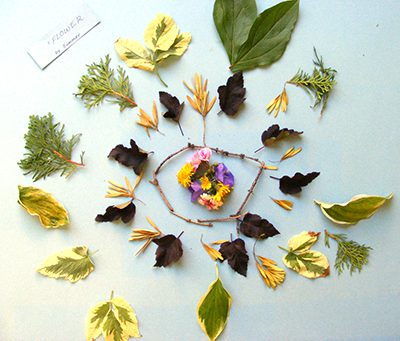
Just outside the art studio, fall was filling the hearts and minds of my elementary students. Many of them would collect the fallen leaves, pine cones, and seeds and bring me their treasures. Lining them up on my nature shelf, they were fascinated by the colors, shapes, and even the smells of them! When I saw the way the students arranged the leaves, it reminded me of a Mandala, and so began our creation and exploration of the ancient sacred symbol.
THE OPENING CIRCLE:
‘THE SEDUCTION’
Before the students entered the studio, I created a large Nature Mandala on black bristol board placed on the carpet to capture their attention. As the students entered the studio and sat down on the carpet, they were drawn to the beauty of the design and the natural materials.
An inquiry followed into what they observed about the artwork, and I gave them a brief history of the Mandala, its significance in nature and in ancient societies. We focused on four main features of the Mandala: the Circle, the Center, the Symmetry, and the Pattern. We talked about the symbolism of a circle and how it is endless, with no beginning and no end. I also told them about the way that some Mandalas are created as part of a ceremony and that at the end of that ceremony the Mandalas are destroyed and returned to nature. More than a few eyebrows were raised at this point, and I assured the students that I understood that this would take great courage. I reassured them not to worry, as I would photograph their Mandalas and display them electronically on the monitor in the main hallway of our school for all to see!
THE ARTISTS’ CHALLENGE
Students would create a Mandala using items found in nature, being sure to observe the guidelines. A Mandala is a circle; it has a center; it is symmetrical; and it has a pattern. (Students also needed to come up with a title for their artwork to complete the project.)
THE MATERIALS
22” X 28” Poster Board (various colors) to build the Mandalas.
A materials table for baskets of nature items, such as small sticks, evergreen strands, stones, pine cones, leaves, seeds, flowers, etc. (Note: students also had access to an outdoor courtyard if they couldn’t find what they wanted on the materials table).
2” X 4” name and title tags (to be photographed)
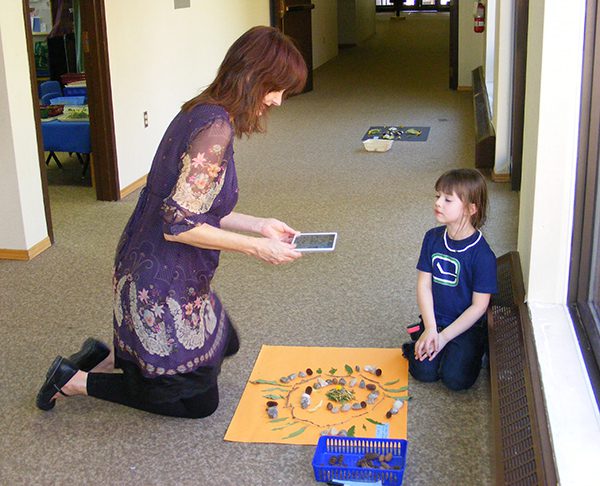
A tablet for photographing the student’s Mandalas for display on the hallway monitor. (The photographs were also shared during Closing Circle.)
THE CREATION
The students worked in the hallway outside the art studio with access to an outdoor courtyard with plenty of natural light. The materials table was also set up in the hallway along with the colored sheets of poster board. Each student had their own basket to collect items from the materials table.
Starting with the center, the students began “building” their Mandala on the poster board. Working outward, they focused on using the items from nature to create a circle, a pattern, and symmetry. When they had completed their Mandala, I asked them to come up with a title, which was printed on a tag. The Mandala’s were photographed, and then I asked the students to take their Mandalas apart and put the materials back into the baskets on the materials table.
THE CLOSING CIRCLE
I quickly created a slideshow with the photographs of their Mandalas. They were transfixed by seeing their artwork as part of a slideshow. They shared their artist’s observations about each other’s designs. Later that week, the hall monitor became their “Art
Gallery” filled with all the colors and creativity that fall can muster.
THE EXTENSIONS
This art lesson can be extended with the addition of some simple materials and concepts. Adding wooden beads, craft sticks, and chalk pastels to create a background, the Mandalas can take on a more
colorful geometric look.
The students also enjoyed working on this project outside, creating the Mandalas on the sidewalk or on the grass. Being outside also enabled them to collect whatever caught their eye in the natural area around the school and returning the items back to nature once they were finished—a nice touch staying true to the Zen concept of the Mandala.
Nature portraits is another idea that the students enjoyed. Using items from nature to create a face opened up discussions about art history, details of the face, and facial proportions and expression. There were quite a few chuckles during the closing circles, as some of the portraits turned out quite comical.
Tomorrow’s Child / November 2014 / p16
by Chelsea Howe, PsyD | Brain Development, Children with Exceptionalities, Health / Nutrition, MFA, Montessori Administrators, Montessori Education, Montessori Family Life, Montessori Parenting, Montessori students, Montessori Teachers, Psychology
I was recently asked to do a psychological evaluation for a child at a Montessori school. Many believe that it is incongruent for one to get testing while going to a Montessori school. After all, the myth is that Montessori schools have no curriculum and don’t even require tests in their school. But, this is actually just that—a myth! More and more, schools are implementing psychological testing to help provide answers and recommendations to best help the child. Psychologists can help provide information that might not be observed in a classroom by a teacher or at home by a parent; we are trained to look holistically at all information (personal, academic, intellectual, behavioral, and mental) to provide a conceptualization to help the child best function.
If a teacher asks for a psychological assessment for your child, don’t assume that it is for a negative reason. In fact, giftedness evaluations are done with as much frequency as problem behavior to help ensure that the child is being as academically stimulated as possible.
Take Emma, for example (her name has been changed for confidentiality purposes). Emma presented in school with “behavioral problems.” She was often distracted during lessons, took longer than peers to complete assignments, and would often “goof off.” The parents were increasingly frustrated by the notes home asking for “extra attention” to homework and providing a detailed description of “problematic behaviors” in the classroom. The school was increasingly frustrated because the parents were not overly concerned and seemed minimally responsive.
In situations such as Emma’s, subsequent parent-teacher conferences are met with increased frustration because the child is not functioning as well as others. If behavioral issues are a concern, parent and teacher frustration can exacerbate the situation. If the child starts to be labeled as “that child,” it’s easy for her to start falling into that role. What happens all to often is that the parents grow more frustrated with their own child and the school, rather than being curious about what is really happening. I always encourage parents to “be curious” rather than jump to the conclusion that their child has attention or opposition problems.
Emma came to me for a psychological evaluation. When I told the parents the cost, they originally gasped at the price. Tests are expensive! As a fellow parent, I would feel the same. As a psychologist, I will share that I am typically spending two hours at the child’s school for observation of the student, interviewing parents and teachers for at least several hours, and then doing two days of testing. Then I’m writing a 10-15 page report. Many parents fail to recognize that it is generally a week’s worth of information gathering and result writing that truly needs to be completed. So, it’s expensive for a reason. Please, try not to be dissuaded by the cost, if you really want the help for your child. I can say with certainty that testing typically does give answers—many of which were never even considered.
Emma was a delight. She was wonderful in my office. She was pleasant and polite and, while initially nervous, very excited to come for testing. I asked her all kinds of questions, some of which were totally benign and some of which really provided me a glimpse of her life. Her parents were constantly fighting. One parent had lost his job. Emma was feeling emotionally bullied by a peer at school. And, finally, she felt bored with the schoolwork. Then I started with the testing …
I quickly learned that Emma is completely under-stimulated and bored. She kept telling me that she loved doing this testing because she liked to see what she could really do and it was “fun!” (How thrilled would I be if my kids described intelligence, achievement, and memory testing as fun.) And, as the results came in, I realized that Emma is actually functioning at least two grade levels above what she is being taught! Put all of this together, including the home challenges, and you see a better picture of how she is attempting to cope, which, in Emma’s case, is actually backfiring.
The beautiful aspect of this is that, by doing this testing, I was able to give a glimpse into her personal and academic life to both parents and teachers. Neither party needed to be defensive. It wasn’t any one person’s fault. The facts that were revealed through the data showed that neither school nor home life was truly providing the most optimal environment for Emma to thrive.
The irony is that, despite common knowledge, Montessori schools are the perfect places for children to get psychological evaluations (particularly if there is a good referral question). As you probably know, Montessori is different from other private and public schools, as evidenced in their mixed-age classrooms. Thus, the rate at which a child advances through the Montessori curriculum can actually be adjusted for each child. Emma, in this case, could be given more stimulating lessons without being overly frustrated; in fact, this is what she was asking for without knowing how to ask for it. Additionally, if a child needs more structure or more breaks, that can be implemented. I also discovered that Emma learns best from visual cues and through manual
manipulation, so that was provided as a recommendation.
Similarly, the parents didn’t realize how much Emma was picking up about their marital discord. We, as parents, often assume that, although children are present, they are unaware of the non-verbal cues that we provide to our spouse with whom we are fighting. Not only did she notice, she didn’t have the words to ask if they were okay. Emma also explained to me that she didn’t want to tell her parents about her peers bullying her because “they are already angry at each other.” What a beautiful little girl with incredible emotional intelligence and sensitivity. There were issues at school and at home. Emma was truly just trying to do the best she could, while carrying the weight of the world on her shoulders.
As an outside party, I came in and met with all parties, including Emma. I was able to talk about the troubles that she reported, the difficulties that she was experiencing, and we collectively came up with a plan. There was no blaming or frustration. It also helped teachers and parents incorporate changes into their own environments. Emma could and would succeed now that there was an understanding of the source of these behaviors. As a result, there was less frustration from the teachers, the parents, and most especially Emma. Now, Emma had a voice and learned how to say what was truly bothering her, knowing that she had an active audience. Emma also learned to take responsibility for how she might be contributing to the situation (as she admitted that sometimes she goofs off, knowing that she will get in trouble, just to get attention).
Generally, problems and difficulties arise at various points throughout a child’s life (whether it’s potty training, test anxiety, performance problems). While teachers are well trained at identifying problems and implementing solutions, sometimes there is a need for something more.
Don’t be afraid to ask for help; early intervention is best. It’s an investment in your child to help them succeed.
Tomorrow’s Child / November 2014 / p 26
by Tim Seldin | MFA, Montessori Education, Montessori Family Life, Montessori Parenting, Montessori students
All of the usual arguments that parents and mainstream teachers use to justify homework miss the point. Homework does not teach children responsibility, time-management skills, self-discipline, or more of what they should be learning during the day. What it teaches is how to put up with a job that they dislike.
Far too many schools have transformed the process of learning and discovery, which comes naturally to children at birth, into a stressful and often unpleasant experience. We tend to think about schools from a business perspective. We talk incessantly about high standards, competition, and holding children accountable. Somewhere along the way, we forgot that schools are meant to nurture children’s natural development, not manufacture a product.
Montessori schools are different from traditional education. But the use of hands-on materials and multi-age classes are just some of the most obvious surface differences. What really sets Montessori apart from conventional education is the outcome that we seek in our children.
Montessori’s goal is to prepare students for life, not just for admission to college. All over the world, our schools work to empower, liberate, and encourage young people to become self-confident individuals, who think for themselves, creatively solve problems, and who possess the emotional and spiritual balance, interpersonal skills, compassion, and moral courage that will prepare them to lead lives filled with purpose, meaning, and joy.
Children learn at their own pace, and they learn in different ways. Learning to read, write, and use mathematics is not a race!
In general, the more we, as parents or educators, push children to do things against their will, the more likely it is that many will learn to quietly or openly resist. Today, it has become common to find parents who feel the need to help their children excel. They seem to fear that if they do not provide this external ‘push,’ their children will not succeed.
Montessori demonstrates that children are normally born intelligent, curious, and creative. Without the need for external structure or encouragement, they will learn and explore whatever captures their attention. Keep in mind, though, that they want to learn what they find interesting, not what their parents or teachers choose for them.
Without realizing it, when parents and teachers put pressure on children to perform to adult standards, they are showing them great disrespect. They do this by using external rewards and pressure in an attempt to get children to do things they would not choose for themselves.
If a child ends up quietly resentful of lessons, tutors, workbooks, and tests, what have we really accomplished?
Montessori urges parents to allow children to develop at their own pace, within an environment that sets a good example and provides all the right stimulation and support. In an atmosphere that truly respects children as people, we have to allow them to master new skills when they are ready, not when it says they should be ready in a curriculum guide. Some children may begin to show interest at a very early age; others will not show the slightest interest until they are older. But with the right approach, we can increase the odds that, when they are ready, our children will want to learn with natural enthusiasm.
As a result, Montessori schools traditionally do not assign homework until the upper-elementary grades or middle school, and even then, it rarely looks like the homework many parents remember from their own school years.
Why don’t we assign homework like everyone else? Don’t we want children to get into good colleges? The answer is: of course, we do! We do, however, ask a simple question: Why do we believe that assigning hours of homework to children after a long school day is the right way to go about it?
My vision of the future is no longer of people taking exams and proceeding on that certificate from the secondary schools to the university, but of individuals passing from one stage of independence to a higher, by means of their own activity, through their own effort of will, which constitutes the inner evolution of the individual.” – Dr. Maria Montessori
School is only one part of a child’s day. Children work hard in school, just as their parents do at the office. All of the usual arguments that parents and mainstream teachers use to justify homework miss the point. Homework does not teach children responsibility, time management skills, self-discipline, or more of what they should be learning during the day. What it teaches is how to put up with a job that they dislike. Many teachers seem to think that they can help their students become better educated by requiring them to do tasks that few would ever do voluntarily. Gifted teachers get the job done in a normal school day by inspiring a sense of interest, curiosity, and enthusiasm among their students.
Our goal in Montessori is to inspire in children a sense of purpose in their lives, a sense of their own individual minds. We want them to pursue things that interest them, pursuing information, skills, and insights on their own; we do not want them to be spoon-fed by adults.
Homework can easily become a power struggle between children and adults. And the sad thing is that there would be no need to struggle if schools were to instill a love of learning, rather than a sense of obligation and fear. Whenever children voluntarily decide to learn something, they tend to engage in their work with a passion and attention that few students will ever invest in tasks that have been assigned. Our goal is to inspire joyful thinking, not compliance.
Tomorrow’s Child / November 2014 / p 7
by Tim Seldin | MFA, Montessori Education, Montessori Family Life, Montessori Parenting, Montessori Teachers
Americans tend to believe that children who are successful at school are smart and assume that intelligence is something with which one is born. In the United States, parents often say something along the lines of, “I may be biased, but I really believe my child is very smart.” Many a mother and father hope that their children’s exceptional talents will be recognized by admission to a school program for the gifted.
It is common to hear American parents praise their children’s success with a compliment on how smart they are. This is a mistake, and it tends to backfire. I’ll come back to this concept in a moment, but first, let’s consider the concept of intelligence.
Intelligence is measured by looking at how well a child approaches certain kinds of problems, both mathematical and logical, and at how strong is his or her vocabulary, especially in comparison with other children of the same age. In other words, both verbal and mathematical reasoning and familiarity with the meaning of a wide range of words in a child’s native language are traditionally used as major means of assessment. Conventionally, these intelligence tests yield a final score known as one’s intelligence quotient or IQ.
But as Dr. Howard Gardner and others have shown, there are many forms of intelligence that are not measured on traditional IQ tests and have been traditionally neglected to a large extent in schools, including abilities in music, visual/spatial perception, and kinesthetics (movement, such as dance and sports) to name just a few in addition to verbal/linguistic and logical/mathematical ability.
Also, contrary to widely held perceptions, intelligence does not seem to be simply genetically predetermined at birth, although there may be a genetic predisposition towards specific talents and gifts.
Obviously, in addition to the genetic inheritance that children bring into the world from their parents, their ability to learn and master new academic concepts and skills is also shaped by their physical health and well-being and by everything that they experience, especially in their first six years.
There is another way to understand and think about ‘success’ in school that is shared by many cultures around the world. It is fundamental to the Montessori perspective on children’s development.
We believe that success comes from a combination of meaningful experiences, practice, exploration, discovery, and persistence. Parents whose worldview is shaped by this perspective tend to praise their children’s diligence and effort rather than their innate intelligence.
Many parents have come to think of intelligence as being innate (something with which their children were born) but also to believe that we should encourage children to higher self-esteem and achievement by letting them know that we think they’re intelligent. Not that long ago, most Americans would have thought that this was a really bad idea. Today it’s become part of the everyday conversation within many families.
This sort of thinking is simply wrong-headed. It’s inaccurate from a perspective of what we know from both research and everyday experience. It also tends to encourage children to assume that their success is somehow connected to the way their brain works, rather than a blend of their native intelligence and their diligent effort.
There are many things about the way school has evolved that I believe are unfortunate. I believe that children learn in different ways and at different paces. I believe that children learn much more effectively (and tend to retain what they’ve learned), when they feel safe, respected, appreciated for their differences, and when they have a concrete sense of what they are actually learning. In most cases, people learn best from direct and repeated experience. As Dr. Maria Montessori often said, “It is the hand that shapes the child’s mind,” or in other words, children learn best by doing not by listening to someone else talk.
Children who are praised for their success because they are ‘smart,’ rather than because of the time they took to master the skill, tend to assume that everything in school will come easily. They tend to be confused and upset when they first begin to find that some subjects are no longer as simple as they experienced in the past.
These same students tend to focus on getting good grades and winning compliments on each piece of work, project, or exam. What’s wrong with that? When students, young or old, are more focused on the grade a teacher gives them, rather than on the actual concept and skill they are exploring, learning itself begins to become mindless and meaningless.
While it’s true that some children may actually breeze through every course they ever take with little or no visible effort, the norm for almost all of us is that learning takes time, attention, and energy.
By the way, this is not meant to excuse the tendency to assign hours and hours of meaningless homework to children as they get older. Much of the homework schools tend to give is busy work or simply unnecessary. Today, many schools in America give far more homework than any other schools in the world, and yet many students in other countries significantly outperform American students.
When school becomes a burden, and children find themselves mindlessly going from one assignment or test to another, forgetting much of what they learned along the way to prepare themselves for the next challenge, then the light tends to go out of their eyes. In order to keep up or earn high grades, they often become anxious and/or depressed. The documentary film Race To Nowhere illustrates the all-too-real mental health challenges created when we believe that education is, and should be, a race and not a journey of discovery.
Every teacher and every successful student of the truly gifted teachers of the world will tell you that something magical happens when a particular learning activity (whether it’s a project, an internship, field experience, or even a particularly brilliant and fascinating lecture) ignites children’s interest to a level of intellectual passion. Every child deserves as many moments of truly passionate interest and deep learning as possible.
Tomorrow’s Child / November 2014 / p 5
by Joyce St. Giermaine | Book Reviews, Emotional Intelligence (EQ), Health / Nutrition, MFA, Montessori Education, Montessori Family Life, Montessori Parenting
We all know that play is good for children. But research shows that it is integral to the development of their brains and that human beings are, in fact, designed by nature, to flourish through play.
One Montessori myth is that Montessori students are not encouraged to ‘play’ and that they have an overly structured curriculum. In fact, if asked about her day at school, a Montessori four-year-old would proudly recount all the ‘works’ she accomplished: a little Type A personality in training! To compound this myth, early-childhood Montessori students do, in fact, spend a substantial amount of classroom time sweeping floors and washing tables, tasks that we, as adults, would describe as ‘work.’
A Montessori Children’s House is very different from typical preschool programs for young children. You will not find books about fantasy or fairy tales in Montessori classrooms. No dolls. No toy trucks. No make-believe stoves. No dress-up
corner. No garish bright colors.
Is Montessori too work oriented for young children?
Maybe it all comes down to a definition of play and work.
If you have ever observed a young child at play with his favorite toys, you can see that they are quite in tune with the world of fantasy and imagination. They do not need to be taught how to imagine that squirrels can talk or that a fairy princess can fly. They don’t need help with fantasy. When I recently interrupted my three-year-old grandson at play, he gave me an incredulous, frustrated look and responded, “I’m talking to Thomas!” Thomas being “Thomas the Train™.” He was, indeed, talking to a toy train.
Jackson was deeply engrossed in the very worthwhile work of play. He was honing his language skills and was role-playing dialogue, giving life to Thomas. He was practicing social interaction in a safe, non-judgmental environment of his own creation. I also watched him pick up my cell phone, hold it in place with his shoulder, so that he had both hands free to play, and begin to pretend he was talking to somebody about Thomas. He was in the zone and was at peace.
Disaster struck when his younger brother, Hudson, wandered into his ‘work’ zone and moved some train track. Jackson was clearly frustrated and upset that his carefully arranged work had suffered a mishap; however he wanted to continue his ‘work,’ so he asked Hudson to stop. “Hudson, stop!!!!!” Not surprising, Hudson didn’t stop, which caused Jackson to become angry, lashing out at his brother, first with words and then with a push, which ultimately resulted with both kids in tears and the imaginary Island of Sodor in total disarray.
I could have intervened, but I didn’t. Not because I didn’t care. In fact, it would have been in my short-term best interest to have at least tried to keep the peace and avoid the turmoil. But what would I have accomplished, and what would the children have learned from the experience?
We sat on the couch (me in the middle) and took a few minutes to calm down. With what I might refer to as “light intervention,” we returned to the disaster site and together restored the Island of Sodor. Playing and working together is not always easy. Even as adults, we need to feel our way through the complexities of working with others. Sometimes we need to compromise.
Play Is the Work of Childhood
Play is very much the ‘work’ of childhood. It is a time when they experiment with social etiquette and customs, their power over themselves and others, and what it means to be part of a community. One might look at play as practice for skills needed in the future.
In the animal world, play allows young animals to make sound judgments, a rehearsal in which life and death are not at stake. For children, playing with others allows them to learn the difference between friendly teasing and mean-spirited bullying. Research by John Byers (an animal behaviorist) has actually shown that the amount of play is correlated to the brain’s frontal cortex, which is important for the development of cognition. Byers speculates that “during play, the brain is making sense of itself through simulation and testing. Play activity is actually helping sculpt the brain.”
Dr. Stuart Brown, M.D., in his book Play: How it Shapes the Brain, Opens the Imagination, and Invigorates the Soul, describes becoming interested in play after studying a range of people from all walks of life (from murderers to scientists, socialites, artists, etc.). He studied their ‘play histories’ and how the role of play in childhood and adulthood affected their lives.
In studying murderers, he found that the absence of play in childhood was as important as any other factor in predicting their path of crime. He also found that the potential for anti-social behavior in abused, at-risk children was diminished through play.
In today’s culture, with our extreme worry over bullying and self-esteem, we have created a culture of over-protection that was not present thirty years ago. Rough and tumble play actually does have a place in childhood, as it does in nature. Watch two dogs play, gnashing teeth and body slamming with great gusto. While there is a lot of noise and it looks like somebody is going to get killed, all it usually takes is for one dog (or child) to express discomfort. At that point, the ‘play’ stops and the dog (or child) that was too rough recognizes that the play has stopped because it was too much for the other participant.
If it is really ‘play’ and not aggression, the child or dog will make amends to the wounded player and will encourage the resumption of play in some way. If it’s canine play, the stronger dog will bow and wag his tail or roll on his back to show that he can be submissive. If it’s a child, you might see one child offer a toy or hand to the ‘wounded’ child to encourage the play to continue. It’s not about winning. It’s about play.
Child’s Play Isn’t Just for Children
Dr. Brown describes the properties of play as having the following characteristics:
- Apparently purposeless(done for its own sake)
- Voluntary
- Inherent attraction
- Freedom from time
- Diminished consciousness of self
- Improvisational potential
- Continuation desire
Play provides us freedom from time and self-consciousness. We are fully in the moment, and outside thoughts are diminished. Play is its own reward.
Most of us can think of an instance where we have completely lost track of time, so deeply engrossed in whatever we were doing. It might have been a time when we were skiing, painting, gardening, baking cookies with our children, writing, or even finding a solution to a problem at work. Yes, at times, even work can meet the definition of play.
When a Montessori child is at ‘work’ in her classroom, a deliberate effort is made to allow her the time and space to delve deeply into her ‘work.’ Children are taught to speak and move quietly in order to respect each other’s workspace. Sometimes a Montessori child’s work will spill over into their home life as well. One time, I found that my four-year-old son had dumped our spare change jar onto the carpet and was busy polishing all the coins with a damp wash rag. When he finished, he put them all back into the jar and then started all over again. Work or play? I’m pretty sure it was play disguised as work.
The beauty of Montessori’s prepared environment is that it is filled with beautiful materials that encourage children to touch and discover their secrets. There are real child-sized tools that allow them to work with water, dig dirt in a garden, and clean their environment. If they were using toys instead of tools to do these actions, we’d all call it ‘play,’ In Montessori, we call it ‘work.’ Is there really a difference?
In the elementary years and beyond, Montessori students are encouraged to find a subject that interests them and to dig in with ‘big’ work, thematic work that transcends any one part of the curriculum. Is it work? Yes, but it may very well meet the ‘play test’ as well.
Family Play
Just as we model other aspects of behavior for our children, we need to model play. That’s a hard task for many of us. How many of us can go an hour without checking our
cell phone? When we are on vacation, are we really giving complete attention to our family, or are we worried about what’s going on at the office? How often do we do something as a family that is just pure fun?
Adults need play as much as children, but for different reasons. Children need play to help generate their rapidly developing brains. Adult brains have developed, so it is easy to push play aside on a short-term basis, giving priority to responsibilities and work demands; however, when play is denied too long, our mood darkens, our creativity disappears, we develop a sense of hopelessness, and lose our ability to sustain a feeling of well-being.
Dr. Brown uses the analogy of the oxygen masks in airplanes that deploy when there is a sudden loss of breathable air. The flight attendants’ pre-take-off speech always tells us that, when traveling with a child, in the event of an emergency, secure our own life-support first and then tend to the needs of the child. These are good words of advice, applicable to so many situations. “In order to help our children, we have to recover our memories of how we once played by retracing our own early play footprints. When we do that and create a playful household, everything from education to chores will go better.”
For every family, the definition of play is different. While one family may love to hike, another family may get the same pleasure from an afternoon in a bookstore. All of us need to find something that we love to do and give ourselves (and others) the permission to lose ourselves in the bliss of that activity. It restores our spirit and gives us the energy to do other very real work that, while worthy, may not give us as much pleasure as we might wish.
The Opposite of Play
In the opinion of Dr. Brown, the opposite of play is not work; it’s depression. Now that’s food for thought.
I highly recommend Dr. Brown’s book Play: How it Shapes the Brain, Opens the Imagination, and Invigorates the Soul. It is published by Avery and it is available through Amazon. You can even buy it for Kindle™.
Tomorrow’s Child //November 2014 / p 10
by Susan Tracy | Brain Development, Family Resources, Free Reads, Infant-Toddler (0 to 3), MFA, Montessori Curriculum, Montessori Family Life, Montessori Parenting
Editor’s Note: Several years ago, a Montessori parent wrote to us with concerns about the right way to help toddlers learn to use the toilet. She was quite frustrated and so was her child. We turned to our dear friend and toddler expert Susan Tracy, and we are reprinting this article after I went searching for it to help with my two toddler grandchildren. —Joyce St. Giermaine, Editor
Toileting is accomplished most easily with preparation that begins far in advance of the time when the child is ready.
I believe that most Montessorians who work with very young children would recommend that parents put their infants in cloth diapers from birth on. In addition to the obvious environmental reasons, natural cotton fiber is kindest to the baby’s tender skin. Also, in preparation for later toileting, children can easily sense that they are wet and discover the cause and effect of their urination and the resulting feeling of wetness. This is the first step in helping infants prepare themselves for toileting when they are developmentally ready.
Around the age of twelve months, children often become quite interested in the bathroom. They want to explore, play with the water in the toilet and may persistently follow their parents when they go into the bathroom. These are early signs of the child’s first interest in toileting.
By the age of fifteen months, children often show interest in wearing underpants. Many become fascinated with the process of dressing and undressing and may undress when it would be least expected. It is not uncommon for children of this age to try on their older siblings’ or parents’ underpants. What may seem to be simply cute or attention-getting behavior is probably just another indication that they are becoming curious about toileting.
Between thirteen and fifteen months, many children will want to sit on the toilet or potty chair in imitation of their parents’ and siblings’ use of the toilet, even though they may not yet have learned to control their bladder or bowel. At this point, parents can easily begin to introduce young children to the entire toileting routine: pulling down their pants; sitting on the toilet correctly; wiping their bottoms; pulling their pants up; flushing; and washing their hands. Most children will easily master this routine, just as they learn so many practical life skills in the Montessori classroom.
Their toddlers’ fascination with the toilet leads some parents to put a latch on the bathroom door or secure the toilet lid for fear that their youngsters will play in the toilet, potentially falling in and drowning. This gives the child the message that the bathroom and toilet are forbidden territory. They may simply be attracted to the toilet as a source of water play. It would be better to give them access to water in some other way, such as a preschool water table, a shallow basin, or from a low sink.
Allow children to experiment with flushing the toilet and when you sense that they are curious, explain body functions to them. Respond to their questions with clear, honest answers appropriate to their level of understanding. “Everybody poops. It’s normal. It’s our body’s way of getting rid of that part of our food that it doesn’t need.”
Myelinization is a process in infancy through which the nerves become coated with a fatty substance, myelin, which facilitates transmission of nerve impulses from cell to cell. As the nervous system becomes refined, the growing toddler begins to gain better and better coordination of their movements. This process works from the head down. The developing infant gains control of their head, then arms and the trunk of their body, and eventually their legs and feet. From random movements of the head, arms, and feet, the baby gradually gains the ability to move with conscious intent and control.
This process of Myelinization, or integration of the nervous system, which proceeds on an external level from the head down, is also taking place with the infant’s body. As the nerve cells become Myelinated, just as they gain control of the other voluntary muscles of the body, Myelinization allows control of the sphincter muscles that control the bladder and bowel. Theoretically, these muscles have become Myelinated before the muscles of the legs according to this head down progression. This is confirmed by our observation of young children.
Around eighteen months, children enter a sensitive period in which they can most easily gain control of their now much more developed and integrated nervous system. At this stage, most children have both the physical ability and the interest to control bladder and bowel. If they are given the opportunity to spend as much time as possible in underpants, rather than diapers, they gain a greater awareness of these bodily functions. The absorbency of disposable diapers prevents toddlers from sensing when they have urinated.
During this sensitive period, if the child is in underpants most, if not all, of the time, he will quickly learn to sense when his bladder is full and he needs to go to the bathroom. And there we have it. The child has developed the neuromuscular ability to control his body, his interest in using the potty chair or toilet is activated, and he is well under way in mastering the specific steps involved in using the toilet.
Parents should be comfortable and prepared for this process. They need to be calm when the child has an accident. They need to be very patient and reassuring when a child has an accident. Perhaps they can have some old towels available that they and the child can use to wipe up an accident. Underpants should be stored on a low shelf, in a cubby, or in an easily accessible drawer so the child can get them for herself as needed. A hamper should be provided for wet underpants and towels used for clean up.
Most children who are put into underpants at this age can be using the toilet consistently within a few weeks or months. They learn this out of their desire to be independent. It is a self-motivated process. The parent can be encouraging and can prepare the environment to support the child when he is ready: using the cotton training pants; allowing access to the bathroom; providing an appropriate way for the child to explore both the use of the toilet and to play with water; their patient explanation of body functions; the provision of old towels for cleaning up accidents; and their gentle understanding when accidents do occur.
Toileting is not something facilitated through the parent’s efforts; thus, we avoid the term “toilet training.” It is, or rather should be, a natural process that grows out of the child’s interest, desire for independence and self-respect, and gradually evolving neurological development. “I did it myself!” Toileting is the child’s work, not his mom or dad’s. They play a secondary and supportive role. Rewards and punishment are both unnecessary and inappropriate!
This sensitive period, in my observation, ends at about 24 months. As the child gets older, toileting becomes more difficult, and becomes more of an issue between child and parent. It is best to give the child more independence, provide underpants and, ideally, eliminate diapers. The child can then gain this skill and independence for himself.
Tomorrow’s Child November 2016 / p 28
by Tracey Hall | Brain Development, Family Resources, Infant-Toddler (0 to 3), MFA, Montessori Education, Montessori Family Life, Montessori Parenting, Montessori Teachers, Psychology
Most parents of toddlers have heard somewhere that their child is interested in being independent, or that developing a strong sense of autonomy is an important part of development for children between the ages of fifteen months and three. However, when your child is saying “NO!” to dressing, toileting, leaving an event, or anything else you suggest, it can be hard to think about supporting autonomy.
I think it is helpful to remember that toddlers love the word “No,” because it is so powerful. When a toddler says “NO!” or “ I don’t wanna!” or even when she shrieks and throws herself down, she is saying, “ I am a person, and I have an opinion that matters.” This is something we want them to grow up believing about themselves AND we still want to be able to leave the library peacefully. My suggestion is that you begin by acknowledging your child’s response, both what she said, and what you think she is feeling. Something like:
“I heard you say ‘no,’ and it seems to me that you are really sad about leaving the library. The library is really fun.”
Then, do not engage in the power struggle, instead of saying, “But we need to leave now,” try offering a choice that moves you toward leaving:
“Would you like to hold my hand or carry a book on the way to the coat rack?” It is still surprising to me that a combination of acknowledgment and choice can completely change the experience. I think it is because children both have a desire to be seen and to feel a sense of control via the choice.
If your child continues to say, “No,” you might suggest one more choice like, “We can tip-toe to the car or we can shuffle like a train on a track.” Still,“No”?
When you need to set a final limit, it is important to be clear and immediate. If you spend time negotiating with the child rather than offering clear, simple choices, she will quickly recognize how powerful she feels and try to keep you in negotiation offer a final choice, “You may walk with me, or I can help you.” If the child chooses to walk, you are on your way. Sometimes, even when you are offering really creative choices, your child will emotionally meltdown in the library or loudly refuse the offered options. When my boys were little and they fell apart somewhere, I would remind myself that when I chose to have children, I was also choosing to be embarrassed in public. As a mother of four boys, I know how tempting it can be to give in rather than be the loud family at the library. Investing in setting limits during one tantrum really will reduce the total number of tantrums down the line! (this is a mantra worth repeating.) But choices will not work with a child who is already very upset. It is important to stick with your expectation: it is still time to leave the library. In fact, within the leaving-the-library scenario, the ideal response is to quickly leave with the upset child. Tell her, “I am going to help you leave the library now.” Then, as firmly as necessary but as gently as possible, assist your child in leaving the library. Some children will come with you if you hold their hand; others will need to be carried out of the library.
Toddlers aren’t yet able to imagine what we are thinking, but they can sense what we are feeling and are great at recognizing cause and effect. (When I do this, Dad does that.) This works both for us and against us. With consistent limits, they learn where the boundaries are and stop pushing, with inconsistent limits they constantly check to see where the limit is today.
Theorists from Maria Montessori to Alison Gopnik state that children learn by doing. Toddlers are interested in understanding intentions, relationships, and limits, and just as they explore in the bathtub to learn about fluidity, they will explore within their interactions with you to learn how to be in a relationship. When your child says “No,” she may be wondering if it could really be true that you want something different than she does. Perhaps, she wants to know what grown-ups do when children protest, or she is simply asserting her right to have an opinion. Maybe, something like being tired or hungry is affecting her ability to manage impulses at all. If you pay attention, your child’s behavior may give you clues to her underlying motivations.
Toddlers have not yet developed the brain connections they need to inhibit their impulses or regulate emotion very much at all. Once a child feels a big emotion, her brain can be quickly swamped. Even for adults, it can be challenging to make rational choices when we are angry. Usually, though, we have mediating thoughts such as, “If I yell at my boss, I probably won’t get that promotion and maybe I’ll get fired,” or, “ If I yell at this frustrating toddler in the library, the librarians will be upset.” As adults, we moderate our emotional responses based on perceived consequences and social expectations. Toddlers have not yet internalized expectations and are unable to process even simple thoughts once they are really upset.
Once you have left the library, continue to help your child by guiding her toward soothing behaviors that will help her learn to calm herself. You know your child best and can use past experience to guide you. As long as you have maintained your limit, you can acknowledge how your child is feeling and offer a soothing hug. Some children do calm down driving quietly in their car seat.
Tomorrow’s Child / November 2016 / p 26
by Maren Stark Schmidt | Family Resources, MFA, Montessori Curriculum, Montessori Family Life, Montessori Parenting, Primary (3-6), Psychology
Children who are on-track with their development display ten specific behaviors and characteristics. In Montessori terms, we call this process of natural and normal development, normalization.
As parents and teachers, we are concerned about doing the right things with our children. When our children go through difficult periods, we can spend nights tossing and turning about what might be the matter.
As our tools can be friend or foe, depending on how we use them, it can be helpful if we understand the innate development characteristics of children under the age of seven.
Children are born with special affinities that aid their development. These particular characteristics of the young child help us know that a child is following normal development or is encountering difficulties where adult help is necessary. Children who are on-track with their development display all or most of the following: love of order; love of work; deep spontaneous concentration; attachment to reality; love of silence and working alone; sublimation of the possessive instinct; power to act from real choice not just curiosity or impulsivity; trust and obedience; independence and initiative; as well as spontaneous self-discipline. In Montessori terms, we call this process of natural and normal development, normalization.
Love of Order
The young child possesses a love of order that adults sometimes trample, because, as we become older, this sensitivity is less central to our lives and learning. Learning success for the young child, though, depends on this connection and understanding of order.
Brain research is showing that, during the first six years of life, the neural matter of the brain is growing at a tremendous rate. The brain creates neural pathways with the sensory information it is acquiring. We might liken this process to a footpath being created at a new school by students walking across campus. The most direct paths are created over time, becoming wider, deeper, and, at some point, are paved to make clear connections between buildings. As certain sensory pathways are trod in the brain, future access is being almost guaranteed by the children’s repetition of experiences, driven by a love of order.
Classification of objects and experiences in the child’s environment are also forming. Making connections of similar qualities among objects is an important skill for adult thinking. Here are some examples of the types of classifications the children are making: These are wooden objects; These are all the items we need to bake a cake; These are all the materials we need to build a house. Adults who lack critical-thinking skills also do not have an ability to classify objects effectively.
It is the child’s innate sense for finding and creating order that helps build later logical thinking. As adults, we disrupt a child’s sense of order mainly by being unaware of this order, by changing the child’s environment, which includes people, nature and ideas, as well as objects, and by not giving the child enough time to explore and orient him or herself.
For the child with a strong sense of order, changing a seemingly insignificant object in the child’s environment may create great anxiety. Rearranging the dining room furniture might provoke a crying jag in a two-year-old. When we are aware of the child’s sense of order we can be on the lookout for behavioral changes and try to connect them to changes in the child’s surroundings. Mom or Dad wearing a new outfit or new cologne may be enough to put a three-year-old out of sorts.
Not having enough time to explore prevents our children from tapping into their inborn sense of order that promotes positive brain development. Being taken from event to event or being distracted from exploration through television or computer usage are but a few of the many ways we disrupt our children’s sense of order.
Help your child’s natural development by being aware of the importance of a child’s innate love of order.
Love of Work
The young child’s love of work, or being involved in meaningful activities, is an inborn trait. With proper nourishment, this love survives a lifetime. Even in utero the child is involved in what can only be classified as work—growing and moving in a confined environment.
Movement defines a child’s activity from the first kick in the womb or grasp of a finger to learning to sit up, crawl, walk, talk, and thousands of other activities. The child has an innate need to move, and movement, in turn, aids development and learning in the human being.
Freedom to move, within the limits of safety, is essential to our positive growth. And do children love to move!
Children’s movements may not seem like purposeful work to us. If we could sit back and watch a child in an environment, where we didn’t have to worry about them getting into something they shouldn’t, we might observe the children’s natural impulses. With interesting objects in the environment and motives to be involved in activity, we should see children moving to explore and orient themselves and choosing to be involved in self-selected meaningful activities.
On the first day of school, three-year-old Andreas was constantly on the move. In the course of an hour, Andreas had touched almost a hundred different objects in the classroom. He climbed the bookshelves to reach framed pictures on the top shelves. His need for movement and need for creating order seemed to be at full speed. His activity was exhausting to watch, and his movements pushed the envelope of safety.
On the second day of class, Andreas’ teacher invited him to sit next to her and watch the other children in the classroom, who were working on self-selected activities. Andreas’ sense of order started to come into play as he watched how the other children where interacting with the objects and people in the classroom. When his teacher asked him what looked interesting to him, Andreas mentioned sweeping with a broom. After having a lesson on how to sweep wood shavings into a square outlined on the floor and then use a dust pan, Andreas spent 15 minutes sweeping up large wood shavings, re-scattering the shavings, and sweeping them up again.
Movement directed towards purposeful work created calmness in Andreas. In these moments of calm reflection, Andreas was able to choose another interesting activity, do it to his satisfaction, return the activity to order, and then choose the next activity. In this way Andreas created a cycle of work, lengthening his concentration and aiding his learning.
Andreas’ teacher helped him by connecting his innate love of work to choose an interesting and purposeful activity. His teacher’s understanding and support of the inborn characteristics of young children—love of order and love of work—calmed Andreas’ hyperactivity. Instead of seeing his behavior as impossibly chaotic, Andreas’ teacher understood a young boy trying to connect to his natural love of activity or work.
Deep Concentration
Children naturally come to an intense, self-generated ability to focus attention. It is how we are wired as human beings to learn.
The modern-day world offers many distractions and a variety of attractions that didn’t exist fifty or sixty years ago. Today, the amount of technological change we see in a year may well be more than many people saw in a lifetime a century ago.
Before I started kindergarten, my days were spent at home. The radio created a serene backdrop with quiet music. Television provided a rainy day diversion. My weekly car trip was on Sundays to go to church and drive to visit my grandparents 30 miles away.
The distractions in my life were few and, as I developed focus, I learned to ignore distractions. As I learned to read, I also learned to tune out the noise from my brothers and sisters. To this day it takes a tap on my shoulder to get my attention if I’m reading.
My childhood environment made it easy to develop deep self-generated concentration. I was given quiet, uninterrupted time and the objects in my environment were appropriate. The adults in my environment—my parents and grandparents—created structure by keeping regular meal, snack, and bed times. This protected my time and attention needed to develop concentration.
Our children’s brains are seeking opportunities to create this deep concentration by choosing activities that are interesting to them, that they have time to explore and complete, as well as the opportunity to repeat.
When these opportunities are not available to a child (and to adults also), frustration builds. Reactions to not being involved with interesting activities due to environmental and time constraints fall within the spectrum of anger on one end and apathy on the other.
Newly-enrolled Jocinta shuffled into her preschool classroom. There was no pep in her step. No enthusiasm in her smile. Jocinta showed little interest in any activity. Even songs like the Hokey Pokey didn’t engage her. Jocinta didn’t cause any problems. She was quietly unexcited about life. She complained daily about her stomach hurting.
After a couple of weeks trying to engage Jocinta in what are usually irresistible activities for preschoolers, her teacher visited with Jocinta’s parents. Asking about what a typical week looked like for Jocinta, her teacher discovered Jocinta’s disjointed days. On Mondays, Wednesdays and Fridays after morning preschool, Jocinta went to a babysitter with various caregivers and children. On Tuesdays and Thursdays, Jocinta stayed at her grandparents’ homes. Dinner was in different restaurants every night. Bedtime and dinner times were based on Jocinta’s parents’ work schedule.
Her parents viewed Jocinta’s personality as reserved and shy. What Jocinta’s teacher saw, instead, was a child who never had the time to learn to focus her attention and create natural spontaneous concentration.
Fortunately, Jocinta’s parents were open to the idea of creating a more predictable daily routine for Jocinta. Dinner and bedtimes were scheduled, and grandparents volunteered to create a consistent afternoon situation.
Within six weeks, Jocinta bounced out of her car in the mornings, ready to get busy with the day’s activities. Her eyes sparkled, her checks looked round and rosy, and she laughed easily as she sang, If You’re Happy and You Know It.
A consistent environment with clear expectations and transparent structure helped Jocinta develop deep, spontaneous concentration, a sign of healthy and normal development of the young child.
Attachment to Reality
The almost four-year-old boy visiting my classroom was wonderfully verbal. He had just given me a detailed explanation about his family’s move into their new home.
- “What’s your name?” I asked.
- “Batman,” he answered.
- “And what is your name when you’re not Batman?” I asked.
- “Bruce Wayne,” he answered.
- His mother chuckled. “Isn’t that cute? James thinks he’s Batman.”
James introduced himself to his classmates as Batman. Every activity became a Batman adventure for James. The wooden knobbed cylinders became grenades against the invisible bad guys on the other side of the room. James as Batman was dangerous and unpredictable.
An attachment to reality is one of several outward signs that healthy learning is occurring in a child. James’ behavior was a sign that his normal development had veered off track. James’ fantasy of being Batman and imagining learning materials into fanciful objects, such as the Batmobile and the Batcave, indicated that James had run into a developmental obstacle.
The nature of obstacles is such that they can be difficult to figure out. Fantasy is often a call for more vocabulary and enriching experiences. To help the child reattach to reality we need to feed the child’s mind with real objects and experiences that make the real more exciting than the imaginary.
Around the age of four-and-a-half, children experience a growth spurt and legs grow longer. There also is a growth in vocabulary and children, when given the opportunities, can learn upwards of 250 new words a week. At this age, as might be expected, a second language is usually of great interest to the child.
When the need for intensive language is not met, children often begin to create fantasy worlds and imaginary friends to help keep the mind engaged, taking a detour from normal development.
I took James’ fantasy object of Batman and connected it to a study of bats. A trip to the library armed me with lots of facts and pictures of bats. James and I studied bats, naming the parts of their bodies, delved into terms such as nocturnal, sound waves, amplitude, altitude, radar, insectivore, and more. This study of bats led us into learning about other flying animals—birds and insects. In a matter of days, visits from Batman began to occur with less frequency and intensity.
The need to feel safe may be a component of superhero fantasies. I invited a police officer to the classroom for a 15-minute visit. Officer Joe told us about his job of keeping children safe. Officer Joe looked around the classroom checking shelves and closets, then made the declaration that our classroom had no bad guys. I watched a look of relief come over James.
In a few weeks, I knew James was back on track when a new student entered the classroom and James extended his hand, saying, “Hello. My name is James. What’s yours?”
Being a four-year-old boy is a very fine thing to be indeed. Better than being Batman. James’ attachment to reality showed that his development was back on course.
Love of Silence & Working Alone
The nature of the young child following natural and normal development is one that loves silence and working alone. Until children enter into a different stage of development, around the time that they lose their first tooth, this love of silence and working alone remains. The desire to be out in the community and working with others are characteristics of the elementary-aged child. These elementary-aged qualities, in many ways, remain for the rest of our lives.
The young child is working on self-mastery of skills and “sharing” or doing an activity with other children may frustrate and hamper the child’s personal development. Young children appreciate quiet and are thrilled to hear the smallest sounds in silence—the drip of a faucet, a bird’s chirp through a closed window, the rustle of paper in a breeze.
Love of silence. The young child is in a period of development of refining the senses, along with language, movement, social relations, and understanding order. The child’s sense of hearing is learning to differentiate among a multitude of sounds, and the child delights in learning to name each sound.
Three-, four-, and five-year-olds enjoy the game, “What’s That Sound?” To play, gather up ten or so items that you can manipulate to create a noise, for example: clicking a pen; moving the teeth of a comb; crumbling a piece of paper; tapping a fork on a table; flicking a fingernail against a glass; opening and closing a clothespin; etc. Invite your children to turn their backs to you. Tell them you’re going to make a noise, and they should guess what it is. Make sure the room is as quiet as possible, with television and radio turned off. Make three or four sounds and have the children guess. Ask them to turn around and repeat the sound activities with the children watching, so they’ll be able to decide for themselves if their guesses were correct. Do another three or four sounds, including any sound that was not guessed previously. After this game, children are usually calm and ready to select another activity to extend the quiet.
Love of working alone. Working alone connotes that there are others nearby, but the child is working on an activity alone, without interruption or interference of others. Working alone allows the child to think and analyze the activity in a way that suits his or her specific learning needs. The child loves being able to work through an activity without being told what to do by others.
My clearest memories of being a two-year-old are of quietly working alone. Try as I might, I cannot conjure up an image of my parents in these memories, though I am certain they were in the next room. One memory contains a quiet room in the afternoon and the sun is coming low and golden through the windows. I pour a drink from a bottle into a glass and then pour the liquid back into the bottle, over and over again. In my memory, I feel a deep sense of satisfaction as I repeat the activity and don’t spill a drop. At some point, the activity feels complete, and I eat some crackers and drink from the glass I’ve poured. This is one of my happiest memories, sitting by myself in the quiet doing something that most adults would have stopped. Goodness, I might have spilled and made a mess!
We need to be alert and protect a child’s love and appreciation of silence and working alone. They are signs of healthy and natural development.
The Transformation of the Possessive Instinct
For the child under the age of seven, another indicator of on-track development is the sublimation of the possessive instinct. This transformation of the possessive instinct occurs when the child is given an environment, where he or she has the right to use the materials as long as he or she wishes, while respecting the rights of others to do the same.
In the next stage of a child’s development, from around six to twelve years, “mine” becomes an important concept as the child brings tools and toys for group activities. But for the younger child, the materials in the environment are seen as community property, much like the way we think of a library. When we check out a book, we can use it knowing that no one is going to ask for it back or take it from us until we are finished.
Our inner being knows when our needs are being met or unmet, as the case may be. When needs are being met in the young child, the possessive instinct modifies and we rarely hear the word “mine” coming from the young child.
The child’s love of working alone, as discussed previously, and being able to naturally develop the other qualities inherent in normal and healthy development, transform this instinct for the child to own individual items in the child’s environment.
Over the years, parents have asked me about the right age to get a pet for a child. My usual answer is that children are ready for a pet after they have kept a plant alive for a year.
In the initial stages of taking care of a plant, a young child is in the first stage of gaining knowledge by simply learning the facts of life about the plant, sometimes through mishandling (which at this point is ignorance) of the plant. The child learns, by taking care of a plant, some of these realities: plants need soil to grow; plants have roots that need to be kept in the soil; plants need water, sunshine and warmth. They need their leaves. They need their stems or trunks to be unbroken. They need to be protected from outside forces—rainstorms, snow, animals, insects, etc.
As the child gains knowledge of the plant, a true understanding of the needs of the plant develops within the child, an understanding that we might also see as love. From this love comes a desire to serve the needs of the plant. The plant then thrives with the care given by the child. From experience comes knowledge, then love and respect, and at last, a desire to be of service.
To the child, the plant goes from being “my plant” to “the plant” during this development of knowledge, love and service. The child doesn’t need to “own the plant” once the “need to know” the plant is being satisfied. In normal development, the child’s interest in an object becomes one of seeking knowledge of the object versus having possession of it.
Knowledge, understanding, love, and service create a sublimation of the possessive instinct in the child. That is the path of normal development for healthy human beings. When you see it in your children, you’ll know that they’ll be ready and able to take care of the dog and many other things, living and non-living.
The Power to Act from Real Choice
My husband likes to stop and indulge in an Italian dessert at our local gelato shop. On any given day, there may be thirty different varieties of gelato on display. New and untried flavors, such as mango/lime, are frequent. My husband usually asks to taste five or six flavors before deciding on two scoops. “How can I make a choice unless I know what I’m choosing?” he says when I wonder out loud why he feels a need to “try” so many flavors.
But it is true. Unless we have knowledge of what we are choosing, how can we choose? Without knowledge, a choice is more like a gamble or a lazy way to move to the next thing. Without knowledge, our decisions may place us in positions that we never imagined, and that we may not want to be. Ordering the mango/lime gelato without a sample might have you wishing you ordered chocolate instead or thinking that you threw your money away.
When we can choose something because we know we like it, we might even call the experience the beginnings of love.
Choice requires a series of experiences for all of us, child or adult. When working with children, we sometimes confuse the act of choosing to satisfy curiosity with the act of choosing, based on knowledge and experience.
Choosing out of curiosity—like tasting samples at the gelateria—helps create knowledge and experience. Once we have knowledge and experience, we have a new-found power, the power to act from real choice. When we know that we like mango/lime, chocolate, strawberry and caramel pecan, we can act from a vantage point that allows true choice. Curiosity is factored out of our decision.
We should offer our children experiences as just that: experiences that can create knowledge that will allow them the power to act from real choice. Otherwise, our children’s behavior may appear to be like running from toy to toy in a huge store, or like taking a bite of every chocolate in the box and never eating one.
Experience doesn’t have to be a long drawn-out affair. It can be like a taste sample at the ice cream store. We need to offer our children a wide variety of simple experiences with clear and accurate information so that they gain knowledge. Using the correct word for items, for example, cardinal instead of red birdie, is one way to help. Offering small tastes of new foods is another. Giving a short demonstration on how to do a task, such as turning a page is another. Smells, textures, shapes, movement, sounds, temperatures are only a few areas of experience, where small bits of information will help children gain precision.
The power to act from real choice begins with curiosity being satisfied with clear and accurate experiences. The knowledge gleaned from that will allow our children to truly choose what they like and like what they choose, in all aspects of their life, from activities to friends, to careers to vacations. As well as in selecting a scoop of gelato.
Listening & Following the Adult
Children naturally want to connect with the adults in their lives. Obedience to these adults is a sign of natural and normal development in a child. Obedience, though, does not refer to an automatic and unthinking response to an order. Obedience, comes from the Latin, oboe di ere, meaning to listen to. When the relationship is built on trust, our children with on-track development should listen to us and choose to follow our respectful requests.
For the child who is “misbehaving,” or not behaving in accordance with adult wishes, we need to recognize that we have a situation where a child has lost a vital link of trust with an adult in his or her world.
An obedient child listens for directions from a trusted adult and then chooses to follow that direction with confidence based on previous positive experience If our child ignores direction, he or she has veered off the path of normal development, and we must figure out what has caused this detour.
Carol, mother to three-year-old Matt, would tell Matt that is was time to leave a friend’s house and then would continue talking for another 10 to 20 minutes. Carol thought nothing of it since she was from a family where it took that long to say good-bye. What Matt learned, though, was that when his mother said it was time to go, it really didn’t mean anything in his immediate world. Carol had created a situation where Matt didn’t believe what she was telling him.
Carol would say it was time for lunch, the cell phone would ring, and lunch would be delayed for ten to twenty minutes—an eternity to a three-year-old, and again, another learning experience that taught Matt to not pay
attention to his mother’s words.
At bedtime, Matt’s father, Jim, would tell Matt to get ready for bed and continue to watch his television show. Day after day, inconsistencies between words and actions taught Matt that listening to his parents and following their lead were not coherent events.
Are we surprised when Matt begins to ignore his parents’ direction and requests? Should we be surprised if Matt throws a temper tantrum when he’s been told it is lunchtime then has to wait for an undetermined amount of time? Should we be shocked if Matt, after being told for the fifth time that it’s time to leave grandma and grandpa’s but no one makes an effort to move to the door, cries when he is picked up and scolded because he didn’t “listen”?
As parents and teachers, if we ask our children to do something, we must realize the power we hold—the power to create a trusting relationship, or one of rebellion. Our children are born to connect positively to our adult words and actions. To create authentic relationships with our children, we must have integrity in our words and actions.
Our words and actions must guide our children to listen and choose to follow us based on the confidence of our leadership. That is true obedience, and not blindly following an order.
Independence
We are raising adults, not children. Our job as parents (and parent-support systems) is to guide our children to complete independence. Little by little, day by day, we help our children develop skills and take on more responsibility until they can run at full speed on their own two feet.
Unfortunately, it is often easier for us to do skill-building jobs ourselves or hire someone to do it, than to teach our children these skills. If we don’t teach skills, how can we expect our children to act with responsibility, or “respond with ability” when opportunity knocks?
When we allow our children to be coddled too long, we help create adults without clear direction and who have a failure to take on the challenges of adulthood. We even have a popular phrase for this phenomenon: failure to launch.
A three-year-old is able to do a multitude of tasks independently when given the tools and environment to do so. Three-year-olds should be able to dress themselves, get themselves a drink, fix a simple snack, wash hands and face, brush teeth, and much more.
In order to dress themselves, children require several considerations. Clothes should be easy to put on and off, for example: t-shirts and pants with no zippers or buttons. Shoes with Velcro fasteners are helpful for self-dressing, though for five-year-olds shoelaces to learn to tie are important. Tags in back of clothing can help avoid backwards dressing. Sets of clothes grouped together help make choosing an outfit easier. Low shelves or hanging rods help a child get clothes without adult help. Of course, a hamper or basket helps establish a habit of putting dirty clothes away and not on the floor.
Children can pour themselves a drink of water if glasses are placed in a low cabinet and a small pitcher of water is available on a tray placed on a low table. A child-sized table in your kitchen with a pitcher of water available, along with a lesson or two on how to pour, will be of great help to your child.
Preparing a snack or sandwich are other activities that children can do in their quest for independence. Small jars of crackers on low shelves can help your child prepare his or her snack and eat it at the child-sized table in your kitchen. Peanut butter in small jars (think pimento jars) and a small canapé knife can help your child make peanut butter crackers or a sandwich. Place a slice of bread in a sandwich bag or plastic sandwich container for easy availability.
A step stool in the bathroom or kitchen can help your child wash hands and face, as well as brush teeth independently. Washcloths work as child-sized hand towels, and a basket full of washcloths by the sink can make hand washing inviting.
Be an adult raising an adult. Help your child attain independence by providing tools and an environment that promotes independence.
Spontaneous Self-Discipline
An indicator of healthy and normal development in children (and adults, too!) is the presence of self-discipline that seems to appear almost out of nowhere. In reality, there are factors that contribute significantly to the development of self-discipline in the child and adult.
As a child’s will is strengthened by the use of free choice; spontaneous self-discipline appears and we see concentration, coordination, order and independence develop within the life of the child.
As mentioned previously, children are born willing to listen and follow adults whom they trust. When we, as the adults in a child’s life, can provide the child with clear direction for independent activity, concentration is strengthened and self-discipline forms.
The word, discipline, has roots in the Latin word, discere, to learn. Self-discipline connotes that we are able to learn and follow a path with self-determination and control.
Sue and Steve worked to create a home environment for their three-year-old daughter, Tasha, where Tasha could make appropriate choices for her activities. Their home contained a variety of independent tasks for Tasha, from working puzzles to making a snack for herself and others. Steve and Sue used their home to create a place where Tasha could tap into the natural tendencies of early childhood—love of order, love of purposeful activity, love of silence, obedience, attachment to reality, practice in choosing, and support of independent activity. All these factors contributed to Tasha’s development of self-discipline.
Tasha showed the signs of healthy and natural development—joyful activity, a sociability to help others, the ability to concentrate on self-chosen tasks for over an hour at a time, as well as the ability to listen and follow directions from the trusted adults in her life.
A morning with Tasha might look something like this:
- 7:00 am Wake up, go into parents’ room to tell them good morning and get a hug and kiss.
- 7:15 am Choose clothes and get dressed independently.
- 7:30 am Pour milk on oatmeal, put jam on toast, and carry to table.
- 8:00 am Put dishes in dishwasher and brush teeth without reminder from parents.
- 8:15 am Help Sue sweep porch.
- 8:30 am Choose puzzle from activity shelf.
- 9:00 am Put puzzle away. Choose blocks.
- 9:30 am Put blocks away. Choose beading necklace.
- 10:00 am Put beading necklace away. Make snack in kitchen with Steve.
- 10:30 am Go outside and feed dog.
- 10:45 am Swing.
- 11:00 am Dig in garden.
- 12:00 pm Go to bathroom, wash hands, set table for lunch.
- 12:30 pm Help clear table. Choose book for Sue to read at naptime.
Tasha’s parents have created an environment where Tasha can make successful choices for purposeful activities in an independent manner. Tasha is able to live with quiet dignity, gaining self-discipline and self-confidence with each activity chosen and successfully completed.
Summary
Children who are on-track with their development display all or most of the following: love of order; love of work; deep spontaneous concentration; attachment to reality; love of silence; love of working alone; sublimation of the possessive instinct; power to act from real choice not just curiosity or impulsivity; trust and obedience; independence and initiative; as well as spontaneous self-discipline.
The main sign of normal and natural development, or normalization, is joyful work. Nurturing this process of normalization is our most important work.
Tomorrow’s Child / November 2016 / p10
by Parents Magazine Online | Family Resources, MFA, Montessori Family Life, Montessori Parenting
Our thanks to our friends at Parents Magazine for this good advice:
You probably wouldn’t use old-school phrases like “Wait until your father gets home” or “I wish you were more like your sister” with your kids. But there are lots of less obvious ones that you should avoid, for their sake and yours.
1. “Great Job.”
Research has shown that tossing out a generic phrase like “Good girl” or “Way to go” every time your child masters a skill makes her dependent on your affirmation rather than her own motivation, says Parents advisor Jenn Berman, Psy.D., author of The A to Z Guide to Raising Happy, Confident Kids. Save the kudos for when they’re truly warranted, and be as specific as you can. Instead of “Super game,” say, “That was a nice assist. I like how you looked for your teammate.”
2. “Practice makes perfect.”
It’s true that the more time your child devotes, the sharper his skills will become. However, this adage can ramp up the pressure he feels to win or excel. “It sends the message that if you make mistakes, you didn’t train hard enough,” says Joel Fish, Ph.D., author of 101 Ways to Be a Terrific Sports Parent. “I’ve seen kids beat themselves up, wondering, ‘What’s wrong with me? I practice, practice, practice, and I’m still not the best.'” Instead, encourage your child to work hard because he’ll improve and feel proud of his progress.
3. “You’re okay.”
When your child scrapes his knee and bursts into tears, your instinct may be to reassure him that he’s not badly hurt. But telling him he’s fine may only make him feel worse. “Your kid is crying because he’s not okay,” says Dr. Berman. Your job is to help him understand and deal with his emotions, not discount them. Try giving him a hug and acknowledging what he’s feeling by saying something like, “That was a scary fall.” Then ask whether he’d like a bandage or a kiss (or both).
4. “Hurry up!”
Your child dawdles over her breakfast, insists on tying her own sneakers (even though she hasn’t quite mastered the technique yet), and is on pace to be late for school — again. But pushing her to get a move on creates additional stress, says Linda Acredolo, Ph.D., coauthor of Baby Minds. Soften your tone slightly by saying, “Let’s hurry,” which sends the message that the two of you are on the same team. You can also turn the act of getting ready into a game: “Why don’t we race to see who can get her pants on first?”
5. “I’m on a diet.”
Watching your weight? Keep it to yourself. If your child sees you stepping on the scale every day and hears you talk about being “fat,” she may develop an unhealthy body image, says Marc S. Jacobson, M.D., professor of pediatrics and epidemiology at Nassau University Medical Center, in East Meadow, New York. It’s better to say, “I’m eating healthy because I like the way it makes me feel.” Take the same tack with working out. “I need to exercise” can sound like a complaint, but “It’s beautiful outside — I’m going to take a walk” may inspire her to join you.
It’s easy to use this default response when your child begs you for the latest toy. But doing so sends the message that you’re not in control of your finances, which can be scary for kids, says Jayne Pearl, the author of Kids and Money. Grade-schoolers may also call you on this claim if you turn around and make an expensive household purchase. Choose an alternative way to convey the same idea, such as, “We’re not going to buy that because we’re saving our money for more important things.” If she insists on discussing it further, you have a perfect window to start a conversation about how to budget and manage money.
7. “Don’t talk to strangers.”
This is a tough concept for a young child to grasp. Even if a person is unfamiliar, she may not think of him as a stranger if he’s nice to her. Plus, kids may take this rule the wrong way and resist the help of police officers or firefighters whom they don’t know, says Nancy McBride, executive director for the National Center for Missing & Exploited Children, Florida Regional Office, in Lake Park. Instead of warning her about strangers, bring up scenarios (“What would you do if a man you don’t know offers you candy and a ride home?”), have her explain what she’d do, then guide her to the proper course of action. Since the vast majority of child-abduction cases involve someone a kid already knows, you might also adopt McBride’s favorite safety mantra: “If anyone makes you feel sad, scared, or confused, you need to tell me right away.”
8. “Be careful.”
Saying this while your child is balancing on the monkey bars at the playground actually makes it more likely that he’ll fall. “Your words distract him from what he’s doing, so he loses focus,” says Deborah Carlisle Solomon, author of Baby Knows Best. If you’re feeling anxious, move close to spot him in case he takes a tumble, being as still and quiet as you can.
9. “No dessert unless you finish your dinner.”
Using this expression increases a child’s perceived value of the treat and diminishes his enjoyment of the meal itself — the opposite of what you want to accomplish, says Parents advisor David Ludwig, M.D., Ph.D., director of the New Balance Foundation Obesity Prevention Center at Boston Children’s Hospital and author of Ending the Food Fight. Tweak your message along these lines: “First we eat our meal and then we have dessert.” The wording change, though subtle, has a far more positive impact on your child.
10. “Let me help.”
When your child is struggling to build a block tower or finish a puzzle, it’s natural to want to give him a hand. Don’t. “If you jump in too soon, that can undermine your child’s independence because he’ll always be looking to others for answers,” says Myrna Shure, Ph.D., professor emeritus of psychology at Drexel University in Philadelphia and author of Raising a Thinking Child. Instead, ask guiding questions to help him solve the problem: “Do you think the big piece or the little one should go at the bottom? Why do you think that? Let’s give it a try.”
Originally published in the April 2014 issue of Parents magazine.
by John Long | Kindergarten, MFA, Montessori Education, Montessori Family Life, Montessori Parenting, Montessori students
The five-year-old walked to the shelf to get a little tray containing six pictures. He brought them back to his work rug where he had a movable alphabet, a box of sorted, individual letters. He also had a card that said “ee” that went with the set of pictures he had chosen. Within five minutes and with very little help he had spelled “jeep”, “beet”, “sweep”, “feet”, “queen” and “tree”.
He was beaming and I shared his enthusiasm. “What are you going to do next?” I asked.
“First I have to put these letters away. Then I’m going to do another set.”
It was 10:00 on the first day of school.
An hour later in another part of the building nineteen middle school students sat in a circle to prepare for their first seminar of the year. They have all read George Orwell’s Animal Farm but today’s discussion was about the seminar itself. One of them said it is important to create a respectful community so that everyone will feel it is safe to speak out.
When asked what kinds of actions would create an unsafe environment, they gave examples of rude comments, rolling eyeballs, expelled breath, and subtle or not so subtle body language. When asked what kinds of behavior would make a good seminar participant, they mentioned active listening, good eye contact, respectful disagreement, giving everyone a chance to speak.
One student said that the problem with good eye contact is that it makes you say more than you want to say. One of her classmates added that she felt the need to explain her comments more thoroughly–and that its hard to do so.
Yes, thinking deeply and clarifying your thoughts is hard work. It is, in fact, one of the prime objectives of the seminar and one of the primary works for the adolescent.
It was 11:00 on the first day of school.
These two moments are so impacted with meaning, so suggestive of the characteristics of Montessori education: materials and activities specifically designed and geared for the needs of the child at different stages of development; the individual within community; the development of the whole person–not just the intellect; spontaneous activity as a means to develop the will, personal initiative, and an attention span that is both long and deep. Joyful commitment to work.
But I want to mention on this first day of school for the children the work of the adults in preparing the environment. For two weeks and more, every teacher and every assistant has labored long hours, Darwin and Manuel have known no rest, administration has proven that support requires flexibility in working with and around the team of construction workers who have scrambled to complete the building project. More than one hundred people have been at work to make this day possible. Thank you every one of you. Thank you.
And just what have we done? The Montessori classroom is an environment of beauty and order and complexity. The first task of the Montessori teacher is to prepare an environment which invites the child to work, which enables the child to work and which is free of obstructions to his work. We have succeeded in creating sixteen classroom environments and several specialized learning spaces. And the children have put them right to work.
We want to once again thank John Long and the Post Oak School for allowing us to republish John’s wonderful essays in Tomorrow’s Child and in our online resource collections.
John Long has been the Head of Post Oak School in Houston, Texas since 1995. His career as an educator began with the United States Peace Corps in Kabul, Afghanistan. In Montessori schools, he worked first as a classroom assistant, and then as a lead teacher in Lower Elementary, Upper Elementary, and Middle School. He has served as head of two large Montessori schools, written for professional journals, spoken at national conferences and workshops, and writes a blog titled Education by Design. He was on the founding faculty of NAMTA’s “Orientation to Adolescent Studies.
by Sharon Caldwell | Family Resources, MFA, Montessori Education, Montessori Family Life
Once upon a time, a group of parents decided to get together and start a Montessori School. They searched far and wide for a teacher and eventually decided to employ an Owl, she was well trained but in addition had spent some time traveling and had an understanding of animals in diverse situations.Furthermore, she had spent quite some time focused on her own personal development and had that one trait which is so rare amongst adult animals these days – wisdom.
Although the Owl would have preferred to begin with a small group of younger cubs, pups and other varied offspring, she realized that this is not always possible, and the school year started with a diverse group of disheveled, disorganized and (to use the jargon) deviated young animals. The Owl, however, paid careful attention to the environment and held faith that the true characters of the young animals in her care would emerge.
This fish exhibited complete concentration on his self-chosen task The observant guide was astute enough to realise that the appearance of “‘doing nothing but swimming around”‘ all day long encompassed a host of other activities entirely appropriate to the fish’s abilities, interest and developmental stages such as carefully and accurately measuring his depth in the water, staying upright at all times and locating exactly the right temperature pockets in the sea.
Her careful observation led her to understand that what appeared to be a case of bothering another child was actually an example of perfect symbiosis. The little Clown Fish had apparently taken her Grace and Courtesy lesson on helping each other, to heart, as he swam among the sea anemones. The teacher saw that the fish understood about co-operation and helpfulness while being totally in tune with his own needs.
The Bear tended to mind his own business all winter, but the teacher helped the other animals to understand the idea “bear with a sore head” and they all respected his needs for quiet and a warm place to hibernate.
The Squirrel’s parents warned the Owl that their child was hyperactive, but the teacher was able to reassure them that running up and down tree trunks was exactly what their precocious and intelligent child needed in order to properly develop her wonderful ability to find and store nuts.
In fact, the teacher could see how adept she was at this skill and remind the parents that, far from being irresponsible, their child exhibited a sense of planning ahead and saving which was an important life skill which many other animals were unable to develop.
Indeed, although she had a firm grounding in what to expect from each child in each plane of development the teacher was able to see that every single child was different, and provide for their needs of the moment as well as over the long term. Each child in her care developed into a well-rounded animal. Each one fulfilled their unique niche in the magnificent cosmic order, they learned to be themselves but to do that perfectly.
The teacher’s watched the children and never ceased to wonder at how each one revealed himself on a daily basis, how each one taught her something new each time she took the trouble to connect. She never lost her sense of amazement and joy, and the deep humility and gratitude that these children were sharing their lives with her.
by Marc Seldin | Maria Montessori, MFA, Montessori Education, Montessori Family Life, Peace Education, The International Montessori Council
The four-year-old girls were good friends, but now they’re angry. One said something to the other, tempers flared, and a friendship is in jeopardy. Fortunately, the children are in a Montessori classroom. Montessori schools use many techniques for harmony, but in this classroom they have a peace rose. One little girl retrieves the flower from its shelf, expresses her hurt, and passes the rose to her friend. Together they explore their feelings, and conflict is transmuted into understanding. The children have learned a process to maintain harmony.
In a time of re-surging intolerance, we may turn to our classrooms for reassurance. They are gardens of peace, the fields where we sow the seeds of a better world. We may seek solace in the work we do, knowing that the beauty we nurture will in time blossom into magnificent flowers of justice, kindness, and equality.
Recently, I have found myself thinking again and again about victory. We know that peace is more than just an absence of war. But what is a Montessori victory? Do we conquer our enemies? No. We will not repair this world by subduing those who disagree with us.
Do we shout down the bigot? How much better for the world if the bigots abandon their bigotry? How much better if the criminal no longer commits crimes, if the sinner no longer sins? The Second World War was conceived when the victors of the first war mistreated the vanquished; a third world war was averted when the conquered became allies. Force without justice is domination, not victory.
A Montessori call to arms is a call to the classroom. This is where we cultivate real victory.
True and lasting peace will arise from our schools, where we prepare the next generation of peaceful leaders. The work we do is ever more vital, and I urge you not to despair at the territory we still have to cover.
Let’s recall how far we have traveled from 1907, when Dr. Montessori opened the Casa dei Bambini in Rome. Nominated three times during her life for the Nobel Peace Prize, Dr. Montessori worked tirelessly to improve the rights and conditions of women and children. Justice informed her methodology, and peace infuses the very DNA of our classrooms. The strides made for liberty in the past century—the advances made for children, for women, for minorities, for gays and lesbians—do not doubt that, even today, we see the ripples of her work throughout all the social progress we’ve made.
That the task is not yet complete should not surprise us.
Wherever we look globally, we see the anger and the outrage of those who have felt excluded from the political process. Income inequality is at an all-time high. Far-right parties are rising across the world, fueled by bigotry, economic uncertainty and a populism born of the sense of neglect by elite powers. The political turmoil is only one of the symptoms of our broken world. We do not forget the millions of refugees fleeing war and the victims of the terrible wars themselves.
Do not be disheartened, for as long as we teach peace, there will be a light in this world.
Yes, our work begins in the classroom, but shall we stop there? What else can our school communities do?
It will not be enough for us just to stall some current agenda. When we work to defeat ISIS in the Middle East, Boko Haram in Africa, or unseat some political adversary at home, we earn but a moment’s respite. Unaddressed, hatred and violence will always return in a new form. A lasting peace requires us to heal the deeper wounds of this earth.
Dr. Montessori taught us that when children act out, it is because they have unmet needs. Is this not true of adults as well? Perhaps at no time since the Second World War has the planet been so united in angst about the future. Montessori has a healing message for a broken world, and this is the time for us to recommit to telling the story, both inside and outside of our classrooms.
We can begin by speaking our healing message. Shout it from the mountaintop, whisper it in the halls of your school. Organize, promote justice, discuss difficult topics. Model peace in and out of your classrooms. Educate the children and adults in your community.
Participate. Engage.
It begins and ends with our conviction that Montessori has a message of peace, which will help mend this world’s wounds.
In the sidebar is my attempt to formulate a Montessori statement on peace. We urge every school to create such a statement and share it. Feel free to use or modify mine as you see fit.
Tomorrow’s child/pg34/Jan2017
by Margot Garfield-Anderson | Infant-Toddler (0 to 3), MFA, Montessori Family Life, Montessori Parenting
This past year several of my Montessori colleagues and friends became first- time grandparents. What a special gift they have all received. As Montessori guides, administrators, and practitioners what a gift they bring to the table.
Because Montessori taught us all to be keen observers and to not rush in and “do” for children when they are capable of doing for themselves, our grandchildren will have a great advantage. And those trained in the infant and toddler level understand that even newborns should be talked to with respect and courtesy.
Those first bonding moments between new grandparent and baby are difficult to adequately express. There is a layer of love added in. I do suppose, in part, it is because we are generally not the one who has to be on call all night long or on demand for feeding. We get to just be with these new family members. We find incredible joy and fulfillment every time they blink, sneeze, show the faintest trace of that first real smile, and reach milestones, such as rolling over or finding their feet with their mouths. We delight in them working those first finger foods into the mouth, the first tentative steps, clapping for a song they love to hear over and over again, and shaking their little selves to the beat of a happy tune. I’m much more relaxed as a grandparent than I was to my twin daughters. Having the benefit of understanding more about how
Dr. Montessori viewed and observed learning in young children has profoundly shaped how and when I interact.
Our Montessori Family Alliance Director, Lorna McGrath recently became a first-time grandmother to Otis. Otis and his family live in Philadelphia, and Lorna lives here in Florida with the rest of the Montessori Foundation staff. It’s very difficult to be a long-distance grandparent. Lorna and I did a two-part webinar series this summer about that topic.
When you are a long-distance grandparent you have to make the decision early on about how involved you can and want to be. There was no difficult choice for either of us: we were not the typical Florida grandparents whose children come to visit just for a trip to Disney and the beach. Lorna is following suit and traveling to Philadelphia monthly to spend a week really bonding with Otis, while supporting the needs of her son and Otis’ mom. It’s a dedication financially, emotionally, and physically to do this, but it is also one of the greatest payoffs a grandparent can have. Investing time and energy into being with your grandchildren and actively being a consistent part of their lives broadens their world and helps to pass along family traditions and stories.
I asked Lorna if she could put into words the way she felt the first time she “met” Otis. This is her answer:
About Otis:
When I hold this baby boy in my arms, I feel the miracle of life again. What an awesome gift to bask in his peace when he sleeps close to my heart, to smell the sweet fragrance of this little one in my arms, to see his tiny ears and fingers and toes, to drink in his beauty and magnificence, to experience his presence! I have to pinch myself to be sure that I’m not just dreaming—to be sure that this gift to me, to my family, to all the world is here and now and real. I am overwhelmed with emotion—joy and hope and love.” — Lorna McGrath
So for all you new grandparents out there, there is no greater joy than this adventure. Lorna and I hope you feel the same way.
The following is an excerpt from a presentation Lorna and I put together for a recent webinar. We happily share it with you all.
Grandparenting:
The Montessori Way Part I: Much of what is part of the Montessori Way is logical, common-sense parenting and Grandparenting.
More than 110 years after she introduced her Method and ways to the world, neuroscience is confirming everything she espoused and then some. The works of Dr. Stephen Hughes and Dr. Angeline Lillard have been instrumental in helping those outside the Montessori world understand why Dr. Montessori’s observations on how the brain works and how people learn best have proved her findings!
What does a Montessori education offer?
- The ability to become independent and self-sufficient at a much earlier age.
- The ability to be polite and respectful to one another.
- The ability to learn how to self-regulate emotions and develop inner discipline.
- The ability to treat the Earth and animals with respect.
- The ability to develop good, solid eating habits at an early age.
- The ability to learn how to concentrate deeply on meaningful work.
- The ability to care for their own environments or spaces.
- Commitment to Being Involved
There are many scenarios surrounding the family dynamics of the last several generations:
- We are a global society and constantly on the move.
- More and more families, by design or employment, are living abroad.
- We are a society that, due to financial situations, may be living under one roof with several generations together.
- We are a society that is, due to one circumstance or another, raising grandchildren for our children.
- We are a society in which grandparents are living more active lives, due to better healthcare.
What are you able and willing to do? Being a geographically close grandparent, let’s take a look at what this could look like.
- I/We live close by and will be involved either every day or as much as possible or;
- I/We put in our time being parents and will see the grandchildren when we want.
- I/We are not built-in free babysitters.
The decision is ultimately yours to make. I know grandparents who fall into both categories, including those who live nearby and those who live far away.
Whatever level of involvement you choose, be comfortable with your decision and set the boundaries beforehand so there’s no misunderstanding about your role. Life is fluid and can change from day to day. You can always change your mind should circumstances dictate.
Leave the door open!
Tomorrow’s Child / January 2017 / p 30
by Punum Bhatia Ph.D | MFA, Montessori Curriculum, Montessori Family Life, Montessori Parenting, Montessori Teachers, Prepared Environment
Set the child free, let them have fair play, let them run out when it is raining, take off their shoes when they find pools of water, and when the grass of the meadows is damp with dew, let them run about with bare feet and trample on it; let them rest quietly when the tree invites them to sleep in its shade; let them shout and laugh when the sun wakes up in the morning, as it wakes up every other living creature which divides its day between waking and sleeping. (Montessori, 1966, p. 100)
Maria Montessori advocates freedom as an ideal component for the young child; yet, the idea of freedom is a hard concept for most people to understand. Those who have attempted it without firmly grasping all of the concepts inherent within it have promoted a climate of permissiveness. It was never Montessori’s intent to offer children freedom without limits or checks that would provide a balance for that freedom. She believed that all freedoms given must be accompanied by responsibilities. If that requirement is not met, then the freedom will become license, and chaos and confusion will ensue.
“Freedom is understood in a very elementary fashion, as an immediate release from oppressive binds; as a cessation of corrections and of submission of authority. This conception is mainly negative, that is to say, it means only the elimination of coercion.”
(Montessori, 1988, p. 187)
Dr. Montessori, being a scientist and a practitioner, realized that for the two concepts of freedom and responsibility to develop, they must happen together in a controlled environment. Neither of these could be introduced in a vacuum. She wrote, “The liberty of the child ought to have as its limits the collective interest of the community in which he moves; its form is expressed in what we call manners and good behavior. It is our duty, then, to protect the child from doing anything that may offend or hurt others and to check the behavior that is unbecoming or impolite.” (Montessori, 1966, p. 68)
As someone who has been in the Montessori field for the past 30 years or more as a preschool teacher, teacher trainer, examiner, and administrator, I am often asked if I went to a Montessori school as a child. The answer is no, but as I reflect back, I realize that I have had the privilege of a true Montessori upbringing. Growing up in the outskirts of Calcutta (now Kolkata), India, in a compound built by the British for their jute and woolen mills, it was a childhood dream.
On the banks of the River Hooghly, our compound, known as Anglo India Jute Mills, was 500 acres big and at least a mile long. Within the red boundary walls lived 250 families. Our surroundings were beautiful with well-manicured lawns, old sprawling trees, and flowers of every kind, size and color. In fact, the flowers (roses and dahlias) from our compound won awards and trophies at the Botanical Gardens and flower shows every year. We had our own swimming pool; badminton and tennis courts; soccer and cricket fields; indoor games, such as billiards and table tennis; as well as our own playgrounds with swings, slides and everything that delights a child’s heart.
It was a true prepared environment in every sense of the word. Maria Montessori wrote:
In this environment only those things are allowed to be present which will assist development. Out of it must be kept anything that would act as an obstacle, not least a too interfering adult. Even such things as are neutral or irrelevant should be rigorously excluded. The constructive psychic energy granted by nature to the child for building up his personality is limited; therefore, we must do everything we can to see that it is not scattered in activities of the wrong kind.
(Standing, 1957, p. 267)
Meticulously clean and well ordered, it provided us with everything we needed as we were growing up. Within the boundary walls, we were safe and secure and had all the freedom we could have wanted. There was freedom of movement. In the spacious grounds, we could go anywhere and, best of all, we were outdoors most of the time. There was a scramble to return from school and spend the evening playing a sport or two. The standards were high and, like the vertical grouping in Montessori classroom, we learned from those older than us. In turn, they were the best and the most patient of teachers; so indulgent and caring as they rallied on the tennis courts or taught us to slice the ball whilst playing table tennis. There were no rewards or punishments. We never sought any. We never looked for outcomes. We played for fun but gave it everything we had, always pushing to better ourselves.
Montessori speaks powerfully that the roots of tyranny lie in the adults forcing children to obey their commands and recommends, instead, that children have freedom of choice. In a well-prepared Montessori environment, the free will of each child is gradually developed as s/he chooses his work instead of doing what s/he is told to do. E. M. Standing points out the freedom to choose is not the freedom to do anything you want, but to do the right thing. Each choice the child has is appealing, constructive and developmentally appropriate and as a result this follows:
In our specially prepared environments we see them all at once fix themselves upon some task, and then their excited fantasies and their restless movements disappear altogether; a calm, serene child, attached to reality, begins to work out his elevation through work. Normalization has been achieved. (Montessori, 1966, p. 162)
As an adult looking back, I can see all the wise choices that surrounded us and also the very carefully defined limits. We were free to choose and use what was available, but we always had to leave it the way we found it. Respect for the materials was of paramount importance and those expectations were laid down early on. For instance, we could not litter our beautiful gardens or pluck flowers. We left the billiards/snooker room as neat and clean as we found it. We returned library books in as pristine a condition as when we borrowed them. There were definite ground rules for the community, and we were redirected promptly and firmly if we ever crossed the line. The freedom that we were given came with limits and we respected them. As a result, similar to a Montessori classroom, we arrived at self-discipline through a total engagement in activities that interested us.
The spontaneous creation of a community was the most remarkable outcome of our magical upbringing. The community promoted mutual respect, shared responsibility, collaboration, and friendship. Freedom of choice became a habit of mind with us. As we grew older, it gave us freedom of thought and opened us up to pursue as many interests as we wanted. After a gap of thirty years, when we all left our childhood home to pursue further education, careers, and matrimony in the wider world and lost touch with each other, thanks to Facebook, we have recently been joyfully reunited. At one of our physical reunions, as we laughed and shared stories from our childhood and got caught up with more recent happenings in each other’s lives, my grown-up and much travelled daughter remarked:
“I understand you better now after seeing you with all your friends. You share such a spontaneous joy for living and camaraderie. The way you laugh, all your friends do too.”
Despite the different directions in which our lives have taken us and in which we have excelled, we have a common bond—united by the strong ties of a childhood built on freedom given and responsibility expected.
Bibliography
Montessori, M. (1966). The secret of childhood. New York: Ballantine Books.
Montessori, M. (1988). The absorbent mind. Oxford, England: Clio Press.
Standing, E.M. (1957). Maria Montessori: Her life and work. New York: Penguin.
Tomorrow’s Child /January 2017 / p 28
by John Long | Brain Development, Infant-Toddler (0 to 3), MFA, Montessori Family Life, Montessori Parenting
Those babies are so cute! They are carried in by their mothers to the prepared environment beside my office. Of course, this causes me to sometimes drop what I’m doing in order to observe them. I can’t help myself. Ashley Montague wrote in Growing Young that there is an evolutionary advantage to a baby’s cuteness. At a time when the baby is most vulnerable, most dependent on adults for meeting basic needs, we feel compelled to provide that care. It’s hard wired into the adult to do so. This maximizes the chances that each individual infant will survive and, in so doing, provides an evolutionary advantage to the species.
At the same time, each infant has begun that long road to independence so familiar to parents. We see these babies learning to roll over, to creep and to crawl — the initial stages of locomotion that lead to walking, running, climbing trees, riding bikes and eventually driving cars.
Montessori education aims to assist the child in achieving independence. For the young child, this means physical independence. I encountered a three-year-old struggling to put on his jacket. We laid the jacket on the floor. He put both hands into the sleeves, then flipped the jacket over his head. VOILA! Independence.
Of course, independence gained in one area simply opens up new areas to conquer. The drive for independence is strong – it is the life force itself – but is often in conflict with the adult’s need to protect the growing child. Our wisdom is to know that the child must be granted independence appropriate to his age while balancing this with judicious use of, “No, not yet.”
From dependence to independence. Has our child arrived when she has achieved independence? No. Despite the American national ethos, independence is not the highest state of being. Interdependence is the next step. We must come to realize that we can accomplish more by working effectively with others than we can on our own. We must recognize that the needs and desires of the individual must be considered within the context of what is best for the group — while at the same time decisions of the group must consider the needs of each individual. We have a responsibility to each other, to the group and to society as a whole. This is interdependence. It is the third step on the evolutionary ladder: dependence, independence, interdependence.
In myriad ways, Montessori education helps children understand and reach the state of interdependence. One child helps another tie her shoes or serves her an apple slice. Children learn to defer their impulses and to sit together as a group or to make silence as a group. A child asks another to show him how to change fonts on the computer or to find Bosnia in the encyclopedia. Children learn to work together with partners who are not necessarily their best friends. Or they work together to stage an art sale or a bake sale so they can donate the proceeds to the Romanian orphans.
Such children are learning valuable lessons in giving and receiving help. They are learning to work together and to resolve conflicts that might emerge. They are learning to respond with empathy to the needs of others within and beyond their sight, and that they are empowered to do something about it. They are not helpless victims or bystanders.
These are the children Montessori believed could change the world Interdependent children.
We want to once again thank John Long and the Post Oak School for allowing us to republish John’s wonderful essays in Tomorrow’s Child and in our online resource collections.