by Pete Moorhouse | Empowerment, Imagination, MFA, Mixed Ages, Tomorrow's Child, Young Adults

Little girl making video or photo with mobile phone.
A Note To Readers:
The following article by Pete Moorhouse is loaded with insights and ideas about young children and photography as a wonderful medium for expression, creativity, and learning. Although the article is geared for the classroom teacher, parents can also incorporate many of his suggestions on how to implement photography into their family’s lives and activities. Whether you are a teacher or a parent, this article is one that you will want to read.
Lorna McGrath,
The Montessori Family Alliance PS: To maintain the integrity of the author’s writing, some words reflect UK spelling.
Children’s unique view of their world
“Our first language is visual—the child’s first view of the world is in images—seeing comes before words, a child looks and recognizes before she can speak.” —John Berger (Ways of Seeing)
Photography knows no boundaries, and age is certainly no exception. Young children are very competent, visual thinkers and very much enjoy taking photographic images. Franz Kafka once wrote: “Anyone who keeps the ability to see beauty never grows old.” This implies that children notice beauty. Several years back, I did a project whereby I invited children to photograph things that they felt were beautiful in the nursery. The resulting images were extraordinary, illustrated beautifully by three-year-old Mira, taking an image of an overflowing drainpipe, capturing the falling water in the sunlight. It emphasized to me the complexity and visual awareness of young children.
Given its vast potential, photography is a vastly underused children’s resource in early years. Teachers regularly use cameras and tablets to document, but this is rarely extended to children. While teachers may be concerned about the potential damage to a camera, they may be also unaware of the many possibilities. Photography is a powerful medium for developing children’s understanding of themselves and the world around them, putting children at the centre of their own learning. It captures children’s curiosity and provides a starting point for inquiries. Photography is a language all of its own and is accessible to all children, irrespective of gender, culture, and background; it can be an engaging medium for children with a wide range of special educational needs and disabilities.
Photography provides a different way for children to express themselves and make their ideas visible. For some children, photography may be a key that unlocks their learning and becomes a strong language of expression. Children use their imagination, naturally seeking out unusual perspectives and are not confined by conventional ideas of what makes a ‘good’ photograph. Photography builds on children’s intrinsic motivation and exploratory drive. By following their curiosity and taking their own pictures, they are deciding what is important and constructing their own meaning of their experiences. The resulting images are often unexpected and striking. Children view the world in unique ways and the camera allows them to capture these perspectives.
Children’s Voice: A picture and a thousand words…
Initially, I imagined that photography would provide children with another visual art form with which to work, but after introducing digital cameras to children several years ago, it quickly became apparent just how much more potential there is to photography, especially for opening up conservations.
Photography provides an exceptional tool for encouraging children’s voices. Children feel a sense of ownership over their images and readily communicate the ideas behind them. They are empowered because they know the information and the thinking behind the images that we don’t. Children like having their images as the focal point, and these become the starting point for conversation, as images are reviewed together. They make meaningful reflections about their images, and these often become a way of starting new dialogues and new inquiries.
Unique Insight
For practitioners, photography provides us with a unique insight into the way a child sees the world around them, making their interests visible, and this can open up the door for following and developing their lines of inquiry. For this to be effective, we have to ensure that we make time and space to listen carefully, as the images are reviewed together.
Versatility
Photography is extremely versatile; it can be an interest in itself or used to support other enquiries, recording outings, and so on. The images can be re-viewed instantly on the camera, downloaded and viewed on a computer, viewed on a TV or whiteboard, projected on a wall or printed. Images that are printed can then be used in many ways: for drawing, creating a collage, making a storybook, and so on. Images can also be reworked digitally with a variety of apps. The possibilities are endless.
Documentation
Photography is a powerful tool for children to become documenters of their own work —documenting both the process and product. Photographs taken by themselves have a deeper significance, making it easier for children to re-connect with the experience. This can contribute to children reflecting and evaluating their learning, developing their metacognitive understanding, and thinking about next steps. The documented images provide a memory link to previous experience, and these are even more relevant and memorable by being taken by the children themselves. This can be particularly useful when documenting work that happens over a longer time frame, such as exploring seed growth; seasons; or the weather. It can also be a useful tool for children to record a temporary construction project that has to be dismantled, often making them feel happier about having to clear it away.
Consultation
A photograph can provide an interesting way of consulting with children, gathering their ideas and having them feed ideas into an evaluation. This could be consulting with children about what changes they would like to see in their environment, such as in the playground. If we ask direct questions, the conversation may be stifled, but by suggesting that children take images of things they like and don’t like and then reviewing the images together, it can really stimulate a dialogue and exchange of ideas. Similarly, we have children use photographs to evaluate their time at school at the end of the year; they can take pictures of learning that had been significant, what they liked to play with, and so on. This can provide extraordinary and sometimes unexpected insights. The Mosaic approach highlights the value of using photography as a medium for consultation.
Cross-curricular activities
Photography is a truly cross-curricular activity that embraces many areas of curriculum and learning and development:
♣ Children feel valued and empowered by being given the responsibility and being trusted to use real photographic equipment, boosting self-esteem and confidence;
♣ Children quickly acquire the skills necessary to take images building their confidence and sense of that ‘can-do’ spirit;
♣ Taking images of the setting, children, and teachers can provide a way to help them settle in a new environment—building on a developing a sense of self and sense of belonging;
♣ Young children are developing new ideas and feelings about emotions. Photographs can help children express their views and how they feel; and
♣ Children take great pride in their resulting images.
Physical Development:
♣ Photography helps develop fine-motor skills and dexterity;
♣ It also helps develop hand-eye coordination;
♣ Using a camera increases control of poise and posture, keeping still as they take the images; and
♣ Children learn to use tools with increasing control (taking care of
the camera).
Communication and Language:
♣ Photography allows opportunities
for encouraging communication
and language;
♣ Photography supports language for children that are reticent about using language or have language delays;
♣ Photography helps develop vocabulary, as children describe their images and the ideas behind them; and
♣ Photography stimulates conversation
as children share their images with
each other.
Literacy:
♣ Literacy is improved when books about photography are combined with a project or factual books about cameras;
♣ Children can also use their photographs to support their emerging literacy skills, taking images of letters and words; and
♣ Printed images can be used for making picture stories, photographing drama, and adding text.
Mathematical Thinking:
♣ Mathematical themes often emerge from children’s images; such as taking images of numerals or mathematical shapes
and patterns;
♣ Photography can be used to support mathematical thinking by capturing images of mathematical explorations; and
♣ Cameras can be used to record mathematical graphic making.
Understanding the World:
♣ Photography offers insight into IT (information technology) equipment, developing an understanding of cameras, computer equipment, and printers;
♣ Photography can be used to support any line of inquiry, such as gardening;
♣ Photography can help children find and identify uses of everyday technology;
♣ Using a camera helps young children learn how to operate simple equipment; and
♣ Through the use of photography, children develop an awareness of geographical location, position,
and perspective.
Art and Design:
♣ Photography provides children with another medium with which they
can express their imagination; and
♣ It offers opportunities to rework
images, such as print-outs or
software manipulation.
Characteristics of Effective Learning Playing and Exploring
Children’s curiosity is the starting point to their photographic explorations and investigations.
Active Learning:
Curiosity motivates children’s engagement and encourages concentration as they pursue their interests.
Creative and Critical Thinking:
♣ Children problem solve as they work out how to capture the image they want;
♣ Children express opinions through images, making decisions on what to photograph, what to think about, and how to document their work;
♣ Children develop their own ideas and choose ways to do things;
♣ Children learn about cause and effect, e.g., what happens if the camera is angled or tilted sideways, what is the impact of where the photographer stands?; and
♣ Children reflect on their work, analysis, planning, using critical-thinking skills.
Equipment
Over the years, we have experimented with a variety of different cameras, tablets, and other devices. The types of camera that we have had the most success with are small, high-quality digital cameras. There are several advantages to these. First, they take high-quality images, having good processors and fast response time. I particularly like the cameras in the Canon PowerShot™ range; it is robustly made and produces high-quality images. They are easy to grip, have a relatively large screen on the back for reviewing images, and take AA batteries.
Other goods, more robust options (designed to be water-resistant and able to withstand knocks) include the Fuji FinePix XP120™ and the Nikon Cool Pix W100™.
With digital cameras, it is important that children wear a neck strap to prevent the cameras being dropped. I would suggest using a relatively wide band of fabric so it is soft. I would also strongly advise purchasing second-hand equipment, especially as there are so many cheaply available these days due to our constant desire to replace old equipment to keep up to date. Cameras will eventually break in the hands of young children. Using cheaper, second-hand equipment can allow us to feel less apprehensive about damage, allowing the children more freedom with the camera without us nervously hovering over them. We need to be comfortable with children handling cameras for it to be successful.
I am far from impressed with the selection of cameras made specifically for children. They are well protected with rubber mouldings but tend to be cheaply made with poor quality processors and produce poor quality images. They also tend to include distracting additional effects and games, which become an unnecessary distraction.
Many children are only too familiar with iPads and mobile phones. Large iPads are quite bulky for very young children to hold comfortably, and they tend to create a wall between themselves and their subject. There are protective mouldings available that incorporate handles which make them easier for young hands. Mini iPad and mobile phones (SIM cards removed) can work, but often children get lost navigating the menu by accidentally touching an incorrect command. On balance, I recommend using digital cameras.
Have the camera available as a resource that the children can access at any time. We do this by having a designated children’s camera solely for their use. We have this clearly visible, hung on the wall, but elevated so they need to ask to get it down. This emphasizes the need to take care of this special equipment and for us to know who is using it and track images.
Getting Started
Initially, you could have a discussion as a group around images and photography. Having children share what they already know is a good starting point for these discussions. This could include looking at and discussing some magazines and photographs or by visiting a photographic exhibition. We often explore other lens-based media to further develop their understanding and encourage observation. This could include investigating lenses, magnifying glasses, a USB digital microscope, or projecting images captured with a web camera.
Providing Guidance:
We need to give children instructions on how to use the camera so they can get the best of the experience. This is best done on a one-to-one basis:
♣ Explain the need to handle the camera with care to protect it from damage.
♣ Explain that the neck strap must always be worn and suggest no running with the camera.
♣ Show children how to switch the camera on and off.
♣ Make sure children know which button takes the image.
♣ Teach children how to focus (camera – half press/ tablet – until circle or square disappears).
♣ Discuss the importance of holding the equipment still and keeping the lens clear (keeping figures from obscuring the lens).
♣ Show children how to zoom in and out.
♣ Teach children how to switch between review mode and shooting mode.
♣ Show children how to delete unwanted images.
♣ Have a discussion about etiquette, including respecting people who do not want their picture taken.
After the initial instruction has the children take practice shots to gain confidence in the operation and framing of the picture. Then they are ready to go. It’s a good idea to take a portrait of them first to help identify whose images are on the memory card.
Exploration:
Most children will naturally follow their curiosity and experiment, developing their technique and skill through trial and error. If not, encourage experimentation by suggesting taking shots from different perspectives, above/below, unusual angles, taking close-ups, shoot a subject from different sides, stepping back to get a wider angle, trying different subjects: portraits; objects; landscapes; details; buildings and so on. But importantly give children the time to experiment and find their voice. We can encourage thoughtful picture taking by encouraging children to take images that are important to them and also by showing genuine interest in their resulting images.
Extended Projects:
When reviewing images, themes often begin to emerge and these can then be developed and extended. We can also introduce ‘invitations’ to use photography to explore a specific area.
There are so many possibilities. It could involve the children taking the camera home over the weekend. Children enjoy sharing their images back in school, talking about the scenes as the images show people and things unfamiliar to staff but that are important to children. Children explain and describe what was going on and why they took the images. Their perception also fascinates parents. This project encourages a link between home and the school setting. Recording festivals and cultural events can help children feel proud of their own culture. Another project could involve making maps using photographs. This could, perhaps, involve taking some images around the child’s current setting and then arranging them to make a plan or take photographs from the surrounding neighborhood to create a map.
Examples of projects:
θ My journey to school
θ Where I live
θ My home
θ What is beautiful
θ Exploring color, texture, and patterns
θ Exploring reflections/shadows
θ Expressing likes/dislikes
θ Taking portraits
θ Festivals and cultural events
θ What makes me happy
θ Making maps (arranging images spatially)
θ Making a picture storybook (series of images creating a narrative)
θ Photographing the weather
θ Looking for shapes in clouds
θ Growth (living things)
θ Seasons
θ Evaluation
θ Consultation (arrangement of room/ outdoor environment)
θ Light painting (photographing light in a dark room on slow exposure)
θ All about me (photo album)
Other lines of inquiry may also emerge from children’s interest in photography: they may decide to make cameras from junk modeling supplies; they may use their skills with tools to disassemble a (broken!) camera, discovering the many parts inside; they may go on to create drawings/painting inspired by their images or draw directly on print-outs of their images…
Reviewing images and reworking images
Again, photography is versatile in the many ways in which images can be reviewed. We often see a huddle of children gathered around a camera looking at the images that have just been taken. They can be viewed on a larger scale on a laptop/PC/whiteboard. Images can be reworked digitally or printed. Printed images can be made into collages, drawn on, cut, and so on.
Images can be shared with parents through wall documentation, learning diaries, and slideshows. I particularly like adding their images to PowerPoint™ and adding some of their dialogue to the slides. Selected slides containing children’s commentary can then be printed and added to learning diaries.
Video:
All the devices will also capture video. While children do enjoy shooting video, our experience has been that it is harder to work with. It necessitates longer periods of time to review work and is harder to reflect on due to the quantity of changing information. It also ends up using significant amounts of storage. I would suggest being led by the children—if they are showing interest and are engaged, it makes sense to explore video.
Downloading and storage
It is good practice to get into the habit of downloading the images from the camera after each session; otherwise, there can be quickly become an overwhelming number of images on the camera, which can be difficult to organize, especially if several different adults oversee the camera. They are best downloaded after each session into a separate folder of each child’s work.
Exhibition:
Children take pride in their images and also in presenting them. This could be on a monitor or a wall display or it could be taken one step further with the children exhibiting their favorite works in a public space such as a café, library, or health centre. This type of event is very popular with children and their families. Some images could be framed or printed on large canvasses. Children could choose the image they would like to display, along with their thoughts as to why they selected this image. People are often taken aback by just how interesting their images are.
Note: Please remember that young children (birth to age six) are much more interested in the process than the product. Some children may not be interested in exhibiting their work.
Safeguarding children
and permissions
It is important to review the children’s images on the camera before downloading them to a computer. When using the camera, the children are independent and we do not necessarily know what they are taking images of. On rare occasions, children may take images of themselves or others. It is essential to review the images immediately and delete any compromising images before they are uploaded to a computer (once uploaded they are often automatically backed up to another server and it becomes harder to completely erase data).
In terms of permissions for the use of children’s images, the same criteria as teachers’ photographs applies, requiring parental permission before they are used in different contexts, such as on the school website or in publications. The proposed use of images should be fully explained and written permissions obtained.
Equipment
There are so many options available and there are pros and cons to all. I would advise prioritising something that takes good quality images, and is easy to navigate and hold. As advised earlier, definitely consider buying second-hand equipment, which is often available at a fraction of the price.
Here Are Some Options:
Canon PowerShot™ range SX 110 to 170/ good quality cameras. AA batteries. Large LCD screen. Good grip.
Nikon Cool pix W100. Shock proof/ waterproof. Available in bright colors. Fuji FinePix XP120. Shock proof/waterproof/fixed lens, bright colors.
Tablets/Mini-tablets/Old mobile phones (without SIM)—selection of rubber protection cases are available. I recommend the ones for tablets with hand grips, allowing pictures to be taken easily with thumb. It can be useful to remove apps from home screen to avoid accidental navigation.
Cameras Actually Designed Specifically For Young Children:
VTech Kidizoom Duo™:
Tough rubberized build, easy to hold. Low-image quality, small low res LCD, distracting menu of effect/games.
Useful apps for Android or iOS: First camera for kids—very simple to operate.
PicCollage™: collate images into a collage. 360 Panoramas™:-Wonderful 360-degree images.
Lapse™ it and Hyperlapse™: For long exposure capture.
More Detailed Information On Photographic Resources:
tinyurl.com/kid-photog
Case study: Alfi
At St Werburgh’s Nursery School in Bristol (UK), we have embraced photography as a resource to support children’s learning. Each of our nursery rooms has a children’s camera. Images are reviewed with children on a laptop and shared with parents through a monitor in the foyer.
Alfi had noticed other children using the camera and showed interest in using the camera himself. I explained how to take care of the camera and demonstrated the basic functions. Alfi then took a few practice shots to the get the hang of it, and within a few minutes, he was outside exploring the playground. Alfi carefully observed various aspects and situations in this environment and captured many images, reviewing each image on the camera before moving on to his next image. Mostly he worked independently, away from the gaze of an adult. He remained deeply engaged in his picture-taking for well over an hour. He explored many themes in this time, starting with himself and then moving on to the plants and trees, followed by sky and plane trails, and then reflections in puddles and windows, each time taking a series of images within each theme.
On one occasion, Alfi wanted to photograph an Arctic scene (lumps of ice and polar bears that were set up on a tray table). Alfi was experimental in his approach, first zooming in on the detail of the ‘icebergs,’ capturing dramatic angles of the ice. “I’m going to take everything now,” he exclaimed. Alfi tried to frame his picture so he could capture the entire scene, but it would not fit. He took some images but was not satisfied with them. “I need to get more in,” he stated. Alfi then dragged a nearby bench over, climbed up, and took an aerial shot to capture the entire scene. On another occasion, Alfi photographed two chalked circles on the playground tarmac: “Here are two eye’s.” He suddenly noticed that the shadow of his two legs was also in the image. “Look! Two eyes and two legs! That’s funny!” Alfi then became interested in pairs and went off looking for other situations with pairs of objects, such as two scooter wheels.
Reviewing the images Alfi was clearly delighted with his images, talking profusely about each one (more conversation than we had heard before). He talked about what he might like to explore next, and he was keen to zoom in on small things, as one of his images had been a dewdrop and this seemed to trigger additional questions about the potential of the camera—making small things big and observing the detail.
Alfi had not been engaged with various activities for some time. Nothing had come close to engaging Alfi and focusing his attention in the way photography had. It emphasizes the importance of providing a wide range of media for children to explore; in this case, photography really provided the key that unlocked Alfi’s learning. The camera allowed Alfi to ask questions and find his own answers, all through the medium of photography. ν
Books:
Picture This: Photography Activities for Early Childhood Learning by Susan G. Entz
National Geographic Kids Guide to Photography by Nancy Honovich
Slow Looking: The Art and Practice of Learning through Observation by Shari Tishman Routledge
CPD Training:
CPD: The language and dialogue of children’s photography
CPD Training
Tomorrow’s Child / Nov 2018 / Pg 7
by Duna Strachan | Imagination, Lower Elementary (6-9), MFA, Planes of Development, Sensitive Periods, Upper Elementary (9-12), Webinars / MFA
Recently Margot Garfield-Anderson focused on how grandparents of elementary children can plant seeds of learning through projects and excursions. In this session Duna Strachan will focus on the the physical, social, and emotional development of children in this second plane. She will relate how these changes and sensitivities effect the activities and adventures that they love and how we can best interact and connect with our grandchildren during the elementary years.
by Margot Garfield-Anderson | Empowerment, Imagination, Kindergarten, Language & Reading, Lower Elementary (6-9), MFA, Montessori Family Life, Primary (3-6), Upper Elementary (9-12), Video, Webinars / MFA
In this session, Margot Garfield-Anderson, grandparent extraordinaire, shares ways that she has been able to plant seeds of learning through projects and everyday activities. Also, she describes how easy and important it is to help in your grandchild’s classroom if you wish to. There are some really terrific ideas in this session!
by Tim Seldin | Empowerment, Imagination, Lower Elementary (6-9), Mixed Ages, Montessori Materials, Montessori students, Tomorrow's Child, Tomorrow's Child Online Issue, Young Adolescent
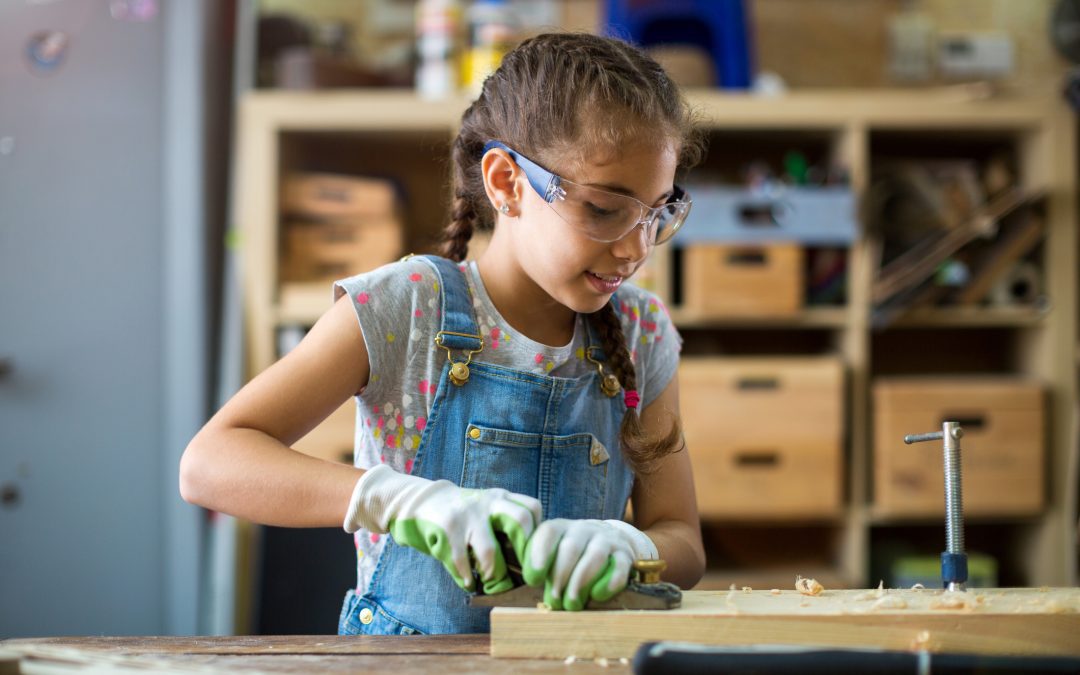
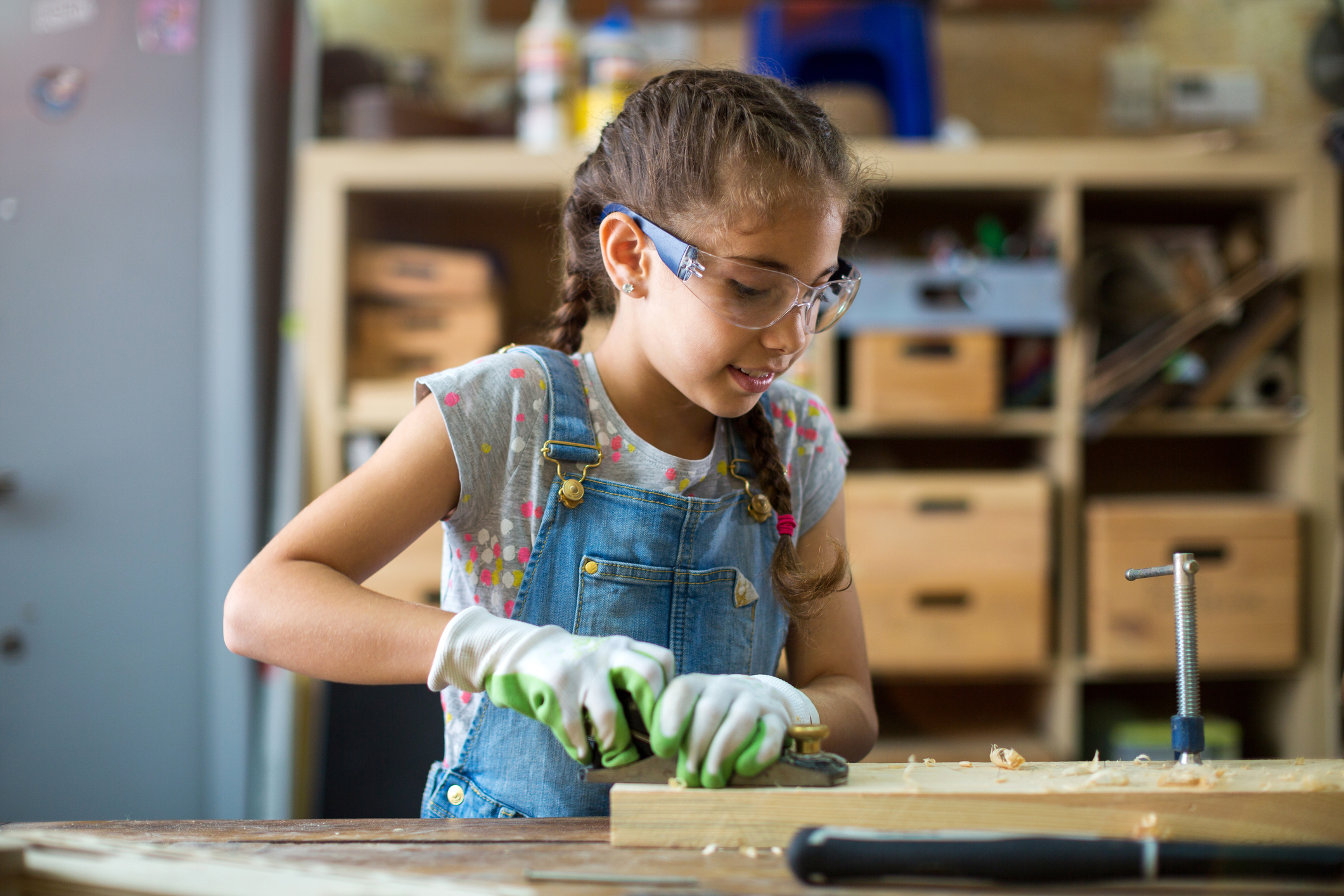
Young girl doing woodwork in a workshop
Anyone who has witnessed young children tinkering away with tools in the woodworking area will know just how magical it can be. While absorbed in constructing, children display extraordinary levels of concentration and engagement. Encompassing many aspects of the curriculum, the benefits of woodwork for children’s development are evident across all areas of learning. Woodwork is now making a comeback in early childhood.
The Return of Woodwork
Once almost eradicated due to fears of litigation, woodwork is now making a comeback in early childhood. This indicates a more balanced attitude towards risk and the growing view that health and safety measures are there to help children do activities safely, not deny opportunity. It is important for young children to experience risk in a controlled environment, promoting the development of self-management and decision-making skills.
The renewed interest in woodworking is also a reaction to our increasingly digital world. We are seeing a new generation of children who learn to “swipe” before they can walk. Children are surrounded by complex technology but this has limited their experience of basic technology. Many children today may never have the chance to use simple tools during their entire education.
Woodwork can be seen as a wonderful alternative, engaging children with real tools and authentic materials. Woodwork also provides children with an experience of making and repairing as opposed to our prevailing culture of consuming and disposing of. Globally there has been an upsurge in “making” as is evidenced in the rise of the “maker” movement. Makerspaces and tinkering studios are appearing in cities all over the world, providing spaces where children can be curious, inventive, and develop their creative and critical thinking skills.
It is extraordinary to see just how much learning is involved in a woodworking session.
Learning and Development
There is something really special about woodwork. It is so different from other activities. The smell and feel of wood, the sounds of hammering and sawing, the use of strength and coordination, all go together to captivate young children’s interest. Visiting teachers, observing the woodworking area, always notice the children’s deep levels of concentration and engagement and are surprised to find the same children still working on their creations an hour or two later. They observe children working with their hands, constructing models, and working on projects, but in fact, the real transformation is inside the child—personal development is at the heart of woodwork.
Woodwork is a powerful medium for building self-esteem. Children feel empowered and valued by being trusted to work with real tools. They show satisfaction in their mastery of new skills and take immense pride in their creations. This sense of empowerment and achievement provides a visible boost to their self-confidence.
With woodworking, children develop at their own pace and find their own challenges. Once they have mastered basic skills, they move into open-ended exploration—tinkering, discovering possibilities, and then making unique creations. Because children follow their interests, making what they want to make, they have the intrinsic motivation to persevere to resolve problems and learn from mistakes. Their imagination, creative thinking, and problem-solving skills really flourish as they meet and conquer new challenges.
It is extraordinary to see just how much learning is involved in a woodworking session. It encompasses all areas of development, fostering confident, creative children with a passion for life-long learning. Woodworking incorporates mathematical thinking, scientific investigation, developing knowledge of technology, a deepening understanding of the world, as well as physical development and coordination, communication and language, and personal and social development.
Essentially, woodwork is a ‘win-win’ experience: children greatly enjoy it and remain
Tomorrow’s Child/ September 2018/ pg 26
by Punum Bhatia Ph.D | Imagination, Infant-Toddler (0 to 3), Kindergarten, Language, Language & Reading, Lower Elementary (6-9), Maria Montessori, Mixed Ages, Montessori Education, Reading, The International Montessori Council
“You may have tangible wealth untold:
Caskets of jewels and coffers of gold.
Richer than you can never be.
I had a mother who read to me.”
—Strickland Gillian
Cuddling up with my mother and being read to by her is probably one of my most favorite memories of my childhood; and well past the time when I could read myself, I always enjoyed being read to by her. She was quite the storyteller and spinner of words, and I was mesmerized into listening so intently as we traveled through different lands, met the most interesting people, and engaged in any number of emotions from sad, happy, fearful, and admiration. Later, when my children were born, the first words they heard from their grandmother were Shakespeare!
With that background, it surprises me no end why books, stories, and poems are given so little importance in the curriculum of many schools today. Literature is often just a ‘filler,’ tacked on when a few minutes are left for children to go home or go out to play. Yet, if we just paused a moment here and thought about it, we would realize that literature is probably the most important part of the curriculum of any school.
“Literature entices, motivates and instructs. It opens doors to discovery and provides endless hours of adventure and enjoyment.” (Norton, 2003, p. 2)
Literature is a child’s window onto a wider world: a world of imagination and emotions; a world of situations (some familiar, some new); a world of ideas and concepts. It can be argued that, for a small child, books provide him with insight into other cultures that are beyond what he has seen in his own little life.
Maria Montessori wrote: “Reading is the entrance by means of the written language to the field of culture.” (1989, p. 95).
Children’s books are important tools to create an enriched environment. When we use the best poems and stories, with their rich language and their exploration of human experiences, we are opening so many doors for our children and filling their lives with a richness and wealth that can come from nowhere else.
When I opened my own Montessori school in Denver, Colorado, it was natural that I would fill the bookshelves with good literature. As a young child and even when doing my Masters’ in English Literature, books had transported me to different realms and exposed me to customs that were so different from any that I knew. My imagination had been nourished in more ways than one, and I wanted to ensure that every child that came to our school would have the same experience. As Maria Montessori wrote:
“If then, the true basis of imagination is a reality, and its perception is related to the exactness of observation, it is necessary to prepare children to perceive the things in their environment, exactly, in order to secure for them the material required by the imagination.” (1991, p. 254)
If the basis of creativity is knowledge and experience, then there is great value in carefully choosing literature and exposing children to the richness of their inherited culture. Literature and the child’s direct sense experiences interact in order to strengthen his grasp of the external world.
Michael Bond’s Paddington Bear is an immediate favorite among the children of our school. They are able to identify with the bear because Paddington displays many childlike characteristics. He is frequently in trouble, and his ways to hide this from people who would disapprove provides the children with squeals of laughter. When we begin this unit of study, we ensure that it is in multiple areas of the classroom. For instance, the listening corner has a book and CD for the children to hear the story on their own; puppets of Paddington and his beloved Aunt Lucy are in the dramatic play area; there are pictures to color and puzzles to complete. Since we are a bilingual school, the children hear the story read to them in Mandarin as well as English. We take this opportunity to create a material with matching cards to teach them the words for a hat, coat, and boots in Mandarin.
Within a culture, more magic happens! Since Paddington Bear began his journey in Peru and arrived in England, the children learn all about Peru and England. Towards the close of the unit, they are invited to bring their very own Paddington Bears (or any other if they don’t have one) for a tea party. In very proper British style, they enjoy a cup of tea and marmalade sandwiches!
Literature plays a very strong role in helping us understand and value not only our own culture but helps us develop positive attitudes towards the culture of others as well. It certainly makes the world a much smaller place and what better time to begin to realize similarities and differences than in early childhood before any forms of prejudice set in. Our kindergartners, for example, take the stories to a whole new level when they write their own tales. Paddington Bear gets to travel to India to see the Taj Mahal and taste Indian sweets; to Paris to see the Eiffel Tower and even comes to Colorado to ski with one of them! Literature plays such an important role in nurturing and expanding their imagination. It stimulates them to write their own stories based on their experiences and inspired by what they have read.
It is important to distinguish that becoming literate does not automatically denote an entrance into “the field of culture” (Montessori, 1989, p. 85). It merely means an ability to read with skills that come from reading books (primers) that have limited vocabulary and ideas that in no way represent literature. Children need the stimulus of good stories and poems that reflect the richness of language and human experience. In The Uses of Enchantment: The Meaning and Importance of Fairy Tales, Bruno Bettelheim (1976), provides a strong rationale for using traditional tales with children. He claims that nothing is so enriching as conventional tales to allow children to learn about human progress and how to problem solve.
“The Three Little Pigs teaches the nursery-age child in a most enjoyable and dramatic form that we must not be lazy and take things easy, for if we do, we may perish. Intelligent planning and foresight combined with hard labor will make us victorious over even our most ferocious enemy—the wolf!” (1976, pgs. 41-42)
In The Three Little Pigs, the wolf threatens, “I’ll huff and I’ll puff and I’ll blow your house in,” and the pig replies, “Not by the hair on my chinny chin chin.” The repetitive language appeals to children who get carried into the story, repeating the refrain. So, too, in Goldilocks and the Three Bears, where the repetition is in the chairs, bowls of porridge, beds, and the question that is asked repeatedly: Who is sitting in my chair…eating my porridge…sleeping in my bed. So the love for literature and a good story begins, and we are hopeful that this will stay with them for the rest of their lives.
At Montessori Casa International, the children enjoy stories from all over the world. They read stories on China as we celebrate Chinese New Year and learn the rituals the Chinese perform at this time of the year. Hence, it is of little surprise when they put their experiences together and make comments such as these overheard during lunch:
“I want to go to China.”
And another will add:
“To see the Great Wall. I really want to see that.”
It gets more interesting as another adds:
“I would like to go during Chinese New Year and eat some dumplings!”
It really is hard to imagine at most times that the children we are talking about are only four or five years old. Their intellectual curiosity has been awakened, and the world is already such a small place as their imagination takes them places.
We use every opportunity to expose them to different cultures often tying up the units with art history lessons. So, when studying the work of Edgar Degas, we introduce the children to a book from France, Babar the Elephant. Of literature’s most beloved elephant, author Maurice Sendak writes:
“Like an extravagant piece of poetry, the interplay between few words and many pictures, commonly called the picture book, is a difficult, exquisite, and most easily collapsible form that few have mastered…Jean de Brunhoff was a master of this form. Between 1931 and 1937 he completed a body of work that forever changed the face of the illustrated book.” (1981, p.7)
As we look at the art of Alphonse Mucha, we bring in The Little Mole, a cartoon mole created by the Czech animator Zdenek Miller. His universally appealing cuteness makes him quite a favorite in our classroom too and gives the children an opportunity to practice color recognition in Mandarin.
The choice of books available to children today has never been so varied or of such high quality in terms of text, illustration, and production. Children’s books are marvelous as a medium for carrying simple messages about the world we live in and the foibles of human character. The Tale of Peter Rabbit begins with the well-known line, “Once upon a time there were four little rabbits, and their names were—Flopsy, Mopsy, Cottontail, and Peter.” The children identify with Peter Rabbit wanting to go into the garden so badly and sympathize with his fright as he tries unsuccessfully to flee from Mr. McGregor. Beatrix Potter’s illustrations complement the story, adding another dimension that draws the children in and develops a close relationship with Peter Rabbit.
Animal characters, such as Miffy, created by Dick Bruna, are written about things that children can understand, and situations they will face, such as going to the hospital and going to school. What appeals to the children (other than the happy endings) is the instantly recognizable Miffy with her bright colors.
Books have the ability to transport us to unknown worlds and envision people and places. Imagination takes flight as we turn the pages of a book, enabling the children to enter the inner worlds of others and, in doing so, drawing them out of their purely egocentric world. Their emotions are engaged, and as they explore and identify with a range of feelings, they gain insights into new roles and situations. Every aspect of a child’s development can be supported by the literature. It is the answer in some ways to Montessori’s constant emphasis on the need for a holistic education:
“The essential thing is for the task to arouse such interest that it engages the child’s whole personality.” (1988, p. 206) ′
References
Bettelheim, B. (1976), The Uses of Enchantment, The Meaning and Importance of Fairy Tales. Thames and Hudson, London
Montessori, M. (1988). The Absorbent Mind. Clio Press Ltd., Oxford England
Montessori, M. (1989). Education for a new world. Clio Press Ltd., Oxford, England
Montessori, M. (1991). Spontaneous Activity in Education, Clio Press Ltd., Oxford, England
Norton, D.E. (2003). Through the eyes of a child. Merrill Prentice Hall, Columbus, Ohio
Sendak, Maurice (1981). “Homage to Babar on his 50th Birthday.” introduction to Jean de Brunhoff & Laurent de Brunhoff’s Babar’s Anniversary Album. Random House
Punum Bhatia, Ph.D. was inspired by Dr. Maria Montessori’s philosophy to dedicate her life to Montessori education as a parent, teacher, and teacher educator for nearly thirty years. She completed her Bachelor’s degree in English Literature; earned Masters’ degrees in English Literature and Education from the University of Calcutta; and completed a certificate diploma in Montessori Pedagogy. She earned her Doctor of Philosophy from the University of Colorado Denver in 2012 for her work on the Self-Efficacy of Montessori teachers. In her efforts to understand children and the environments necessary for them to grow and flourish, Punum focuses on Montessori’s original philosophy and techniques. After teaching the Montessori method to cohorts all around the world, she is now the proud owner of her very own bilingual preschool.
(www.mcidenver.edu/www.punumbhatia.com)
ML/ September 2018/ pg 18
by Cheryl Allen | Adolescence, Early Adolescence (12-15), Empowerment, Family Resources, Imagination, Later Adolescence (15-18), Lower Elementary (6-9), MFA, Montessori Middle School, Montessori Parenting, Montessori Secondary / High School, Practical Life, Upper Elementary (9-12), Video, Webinars / MFA, Young Adolescent
Most people think of Montessori Practical Life as scooping and pouring in the Early Childhood years but as Maria Montessori said, “Education should not just be preparation for university, it should be preparation for life.” Cheryl Allen will guide us through activities and ideas for Practical Life during the elementary and adolescent years.
by Cheryl Allen | Early Adolescence (12-15), Family Resources, Imagination, Kindergarten, Language & Reading, Lower Elementary (6-9), Mathematics, MFA, Montessori Family Life, Montessori Parenting, Practical Life, Primary (3-6), Reading, Upper Elementary (9-12), Video, Webinars / MFA, Writing
Are you wondering how to keep your child not only busy during the summer months when school is out, but also keep her learning? Are you worried that if your child is not enrolled in a summer program called “Little Genius’s” or the Center for Brighter Children that your child will be behind when he returns to school? Or do you just want some good ideas for fun and creativity? Cheryl Allen will offer answers to these questions to help you have an enjoyable and enriching time with your child during the school break.
by Christine Lowry | Imagination, Lower Elementary (6-9), MFA, Montessori Parenting, Planes of Development, Sensitive Periods, Upper Elementary (9-12), Video, Webinars / MFA
Webinar – Lorna McGrath and Christine Lowry collaborated to put together this informative webinar about sensitivities during the Elementary Years. Maria Montessori noticed that during each of the developmental stages children had particular interests, particular things that really motivated them, and particular inspirations. In this session the focus is 6-12 years olds and how parents can support their sensitivities.
by Lorna McGrath | Book Reviews, Imagination, Lower Elementary (6-9), MFA, Upper Elementary (9-12)
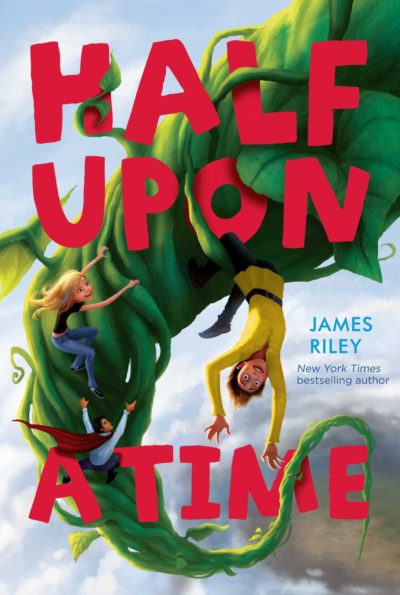
Half Upon A Time
By James Riley
This book is a chapter book for eight to twelve-year-olds. There are three main characters in this book, much like Harry Potter. Their names are Jack, May and Philip. This story is loosely based on Jack and the Beanstalk and Snow White. Jack is a poor farm boy who lives with his Grandfather who in his old days rescued princesses.
Jack does not want anything to do with adventures, but when a mysterious girl lands in their yard they might have their own princess right in front of their faces. May claims to be from the real world (our world) and Jack is from the fairy tale world. They set off on a journey to find the girl’s guardian and maybe find a new friend.
On their epic journey they have tons of adventures, such as flying brooms, a dragon, a wolf king, and a
magic mirror. They find themselves in the forces of evil. They must work together to find their way out of where they got stuck. If you liked this book there are two others in the series.
Review by Kaia, third grade, A Child’s Place Montessori School, Jacksonville, Florida.
by Robin Howe, EdD | Brain Development, Imagination, Lower Elementary (6-9), MFA, Montessori Curriculum, Montessori Family Life, Montessori Parenting, Upper Elementary (9-12), Webinars / MFA
In this session Robin Howe completes a presentation for parents on The Great Lessons as a foundational piece to the Elementary curriculum. He explains each of the five lessons in more detail and describes how parents can support their child’s learning.
by Jonathan Wolff | Family Resources, Imagination, Infant, Infant-Toddler (0 to 3), Lower Elementary (6-9), MFA, Montessori Family Life, Webinars / MFA
Have you ever tried to have some play time with your child and it turned into a nightmare? Jonathan Wolff guides viewers in making it a fun experience for everyone.
by Cheryl Allen | Imagination, MFA, Montessori Family Life, Sensitive Periods, Webinars / MFA
From her many years of teaching and parenting Cheryl Allen will share what the special characteristics of elementary age children are. Join her to find out how you can best support this developmental stage at home and at school.
by Michael Dorer, EdD | Emotional Intelligence (EQ), Imagination, Kindergarten, Later Adolescence (15-18), Lower Elementary (6-9), Montessori Curriculum, Montessori Education, Montessori Middle School, Montessori Secondary / High School, Montessori Teachers, Primary (3-6), School Leadership, Science, The International Montessori Council, Upper Elementary (9-12), Webcasts / IMC
Take a Deep Breath! Get Inspired!
Having an atmosphere of inspiration can perk up and deeply enhance any Montessori program. But, how to be inspiring?
Be part of this webinar with Michael Dorer to consider ten Strategies for Inspiration.
Your classroom and your school can be an inspiring place, brimming with enthusiasm.
Breathe deeply!
Now get started with Michael, Tim, and Kathy to focus on motivating inspiration.
by Michael Dorer, EdD | Imagination, Lower Elementary (6-9), Montessori Curriculum, School Leadership, The International Montessori Council, Upper Elementary (9-12), Webcasts / IMC
Download PDF of slides
This is the recording of the second in the series of 3 webinars about Impressionist Geography by Dr. Michael Dorer.
Imagination is the most powerful force for learning for elementary school children.
Michael presents and discusses Impressionistic Geography, a set of 60 charts or posters covering 97 topics, including 42 experiments and 92 research suggestions; heavily employing and stimulating the imagination.
This massive curriculum forms the heart of the dynamic physical sciences plan for the upper elementary school. You will enjoy this three-session overview of a wonderful and complex material.
by Michael Dorer, EdD | Emotional Intelligence (EQ), Imagination, Lower Elementary (6-9), Montessori Curriculum, Montessori Education, The International Montessori Council, Upper Elementary (9-12), Webcasts / IMC
Download PDF of slides
This is the recording of the third in the series of 3 webinars about Impressionist Geography by Dr. Michael Dorer.
Imagination is the most powerful force for learning for elementary school children.
Michael presents and discusses Impressionistic Geography, a set of 60 charts or posters covering 97 topics, including 42 experiments and 92 research suggestions; heavily employing and stimulating the imagination.
This massive curriculum forms the heart of the dynamic physical sciences plan for the upper elementary school. You will enjoy this three-session overview of a wonderful and complex material.
by Michael Dorer, EdD | Emotional Intelligence (EQ), Imagination, Lower Elementary (6-9), Montessori Curriculum, Montessori Education, Montessori Middle School, Montessori students, Parent Education, Primary (3-6), Science, The International Montessori Council, Upper Elementary (9-12), Webcasts / IMC, Writing
Download PDF of slides
Is Montessori education purely a reality-based program or is it a means of stimulating and developing the imagination? Are these two goals incompatible or complimentary? Michael and Tim discuss the meaning of imagination, kinds of imagination, its role in Montessori schools, and to compare it in Montessori to conventional schools. We compare and contrast imagination in both the Children’s House and the Elementary levels.
by Maren Stark Schmidt | Imagination, MFA, Montessori Parenting
“I’ve never gotten a present from Santa Claus,” said Iliana, my 12-year-old seatmate on an east coast flight. ”My parents thought I should only be given verifiable facts. They told me there is no veracity in Santa Claus.”
”It’s too bad that no one ever told your parents about the Secret of Santa Claus. When you know the Secret, you believe in Santa Claus all your life, even if you can’t verify facts.” I said.
”You believe in Santa Claus? What secret?”
”It’s simple, but….”
”Please, tell me,” Iliana said.
”We’re flying on a plane right now. Who built this plane? Who designed it? Who got it ready to fly? Who trained our pilots? We know that someone had to do it, and with some research we could find those people. We won’t though. We’ll never meet those people. I’ll call them invisible workers, since they work to give us something we couldn’t do alone.”
I took a sip of coffee. ”There are thousands of invisible workers for almost everything we use. I have no idea who planted the beans for this cup of coffee, or who picked them, roasted them and packaged them. I can only thank our flight attendant, the last person in this invisible line of people.”
”I have faith,” I continued, ”that when I wish to fly on an airplane or have a cup of coffee, these unknown people will have done their jobs, and my desires will come true. I don’t have to grow my own coffee beans or build my own airplane because of all these wonderful people.”
”So you’re saying that Santa Claus is an invisible worker?” said Iliana.
”I see Santa Claus being all these people in the world, who strive to serve humankind, to make life more enjoyable, more comfortable, more magical. I will never see these people who do so many things for me, but they are most assuredly real. When I understood this, and I was older than twelve, I wanted to be that helpful kind of person. In the first stage of believing in Santa Claus, when we’re little, we’re on the receiving end. When we live the secret, we are on the giving side, which is fun. Being like Santa, which is doing our jobs with cheerful intention to help others, makes amazing things happen, such as flying at 30,000 feet at 500 miles an hour, while sipping coffee, and talking to you about Santa Claus.”
”I get it. Once you know how Santa works, you become Santa Claus. You do your regular stuff with love in your heart and try to help others, not expecting anything in return. Santa is people helping people. I’m pretty sure nobody told my parents that,” Iliana said. ”I think I’m going to have some fun being an invisible worker.”
I was hoping I could show Iliana that Santa is that invisible force of faith, charity, believing and doing that cannot be easily explained. For the young child, one way we can help them see and experience this force is in Santa’s work. As the young child enters a developmental stage of reasoning, around age six, and begins to wonder about Santa, we need to give them opportunities to work and contribute to something bigger than themselves. We need to show them how to choose to be part of the magical power of giving, service and surprise.
As we walked off the plane, Iliana said, ”I’m so excited about Santa Claus. I’ve already got some great ideas. I think this feeling is what the saying, ‘It is more blessed to give than to receive,’ means. Boy, are my parents and a few other people going to be surprised.”
Iliana spied her grandparents and started singing, ”Here Comes Santa Claus.” They laughed and said, ”What are you so happy about?”
As I walked away, Iliana waved and winked at me, then answered, ”It’s a secret.”
This article originally appeared as a Kids Talk™ newsletter in December of 2004, 2005 and 2007. Reprinted with permission.
by Sharon Caldwell | Early Adolescence (12-15), Emotional Intelligence (EQ), Imagination, Kindergarten, Later Adolescence (15-18), Lower Elementary (6-9), MFA, Montessori Curriculum, Montessori Education, Montessori Middle School, Montessori Secondary / High School, Montessori students, Primary (3-6), Reading, Upper Elementary (9-12)
[vc_row][vc_column][vc_single_image image=”3992″][/vc_column][/vc_row][vc_row][vc_column][vc_column_text]
Most Experts on early childhood education agree on the importance of the use of the imagination for healthy social and cognitive development. This would appear to be at odds with the almost stark realism of the Montessori prepared environment, where the focus is on reality and nature. There is a notable absence of the fictional characters, story books, and fantasy play, which characterize most preschool and daycare settings. Many books on early childhood extol the virtues of fantasy play and suggest ways that parents and teachers can promote the use of the imagination.
It is sometimes (erroneously) stated that Maria Montessori did not favor creative play,stories, or art but required children to work only with austere materials in a mechanical and prescribed way, In fact, imaginations plays central role in Montessori education. This misunderstanding originates in the general confusion between two terms- fantasy and imagination.
In the context of Montessori education, the imagination is seen as the mind’s power to form images based on what has previously been learned through the senses. The imagination enables us to know and understand something, which we cannot see and touch.Fancy and fantasy, on the other hand, are the opposites of reality. Fantasy has no basis in fact and is pure creation, having no link to nature or human existence.
To fully appreciate the difference between the realism of a Montessori environment and a regular preschool, it is useful to look at some specific examples.
Most preschool environments boast well equipped “fantasy play” or “house corner” “ Toy props are provided to encourage role-play, dolls, plastic kitchen items, toy tools, old telephones, and discarded computer keyboards are obligatory. It is believed that, through this type of play, children are able to construct an understanding of adult roles and social interactions. This contrasts with the Montessori environment. In the practical life area, children work with real, child-sized tools. Often, there is a small,, low sink for washing dishes, small brooms and mops, Children learn how to clean the environment, prepare food, make real articles using the same type of tools (only smaller) that adults would use. Careful observation of children in many contexts led Dr. Montessori to conclude that children wanted to do real “work” of the type that they saw adults doing every day. She noticed that when children were shown how to do these things they developed not only the skills to perform complex tasks but also a heightened dignity and calmness that enabled them to concentrate for long periods of time. She also noticed that children tended to break toys, or at best discard them as a result of frustration that was caused by the fact that these implements had no real use. Glass jugs and bowls, on the other hand, were carried and used with utmost care.
Personal experience carried out in reality form real knowledge. Such experiences are not only the basis of mental growth but also of mental health.
-Maria Montessori
What you should know about your child
Montessori regarded “pretend play”, where various objects are substituted for real implements, as the desperate resort of children, who are deprived of the opportunity to work with real things. She noticed that most of the children chose the company of other children over the opportunity to play with dolls and the use of small, real-life utensils to toys.
The following story amply illustrates the point. A five-year old boy, who had attended a Montessori school from age two, often made himself pizza scrambled eggs, or French toast at the child-sized stove in his classroom. His parents were considering moving him into the regular kindergarten class at his local public school and took him to an open day. When he reported back to his classmates, he said, “They have a wooden toy stove and plastic pots there. How am I going to cook my food?
She noticed that children, who had discovered and explored the materials she provided, also lost their taste for the traditional fairy stories, which were the order of the day and chose, instead to learn about real things. She realized that the creative imagination of art and science is based upon truth. This means that the potential for imaginative thought depends on a firm foundation of factual knowledge. Fantasy on the other hand, is something untrue, and “illusory imagination, based up credulity” Montessori came to regard fantasy stories and playthings, the adult effectively prevents the child from using his constructive imagination to full potential. It traps him in a world of make believe, at the time when his intellectual abilities are at a peak for absorbing and learning names, details, and connections between things.
Even though a child easily tires of his toys and breaks them, this conviction persists and adults are thought to be kind and generous when they lavish such gifts upon a child. Playing with toys is the only freedom that the world grants to a child, who should, at this precious period, be laying the foundations of a higher life.“ Divided children of this sort are regarded, particularly in school, as being highly intelligent, even if they lack order, neatness and discipline.”
Dr. Maria Montessori- The Secret of Childhood.
In a Montessori environment, this means that the child’s potential is recognized. The child is offered a wide array of interesting, yet realistic and challenging materials, which enable him or her to explore the world in an ordered, yet creative way. The childs’ imagination is exercised by being put into contact with the marvels of creation rather than the insipid and lifeless creations of the adult mind. Instead of cartoon dinosaurs and super-heroes( and all the related merchandise), a child can study real animals, either living or extinct, and the lives and achievements of real people across the world and in all ages. He can marvel at the size of a blue whale or the miracle that takes place inside a chrysalis.
It is through the imagination that a child makes sense of the world and comes to understand the laws of reality. Young children are easily confused by what is given to them by adults in the guise of reality ,and can easily come to distrust what is offered, as they come to realize that fantastical creatures and stories presented to them are fabrications. Once children have a firm grasp of reality and begin to think at an abstract level (after the age of six or seven), they are able to understand and appreciate fantasy. For this reason, true Montessori Enviroment for children between the ages of three and six will not encourage fantasy play and will carefully choose books and other materials to reflect reality rather than fantasy.
Tomorrow’s Child/ BTS 2007/p36
[/vc_column_text][/vc_column][/vc_row]