Story Time: the Last 20 Minutes of the Day

Story Time: the Last 20 Minutes of the Day

Bedtime is far more than ‘just story time’. It is a time when our kids are integrating the experiences of their day and transitioning between brain states and brain functions. How we engage with them during the last 20 minutes impacts their esteem, self-worth, and confidence in the morning. Listen in on this conversation around the role of meaningful connection, and top tips on how to create connected moments at bedtime.

Dr. Fred Luskin Keynote

Dr. Fred Luskin Keynote

Dr. Fred Luskin founded and currently serves as Director of the Stanford University Forgiveness Projects. He is also Senior Consultant in Health Promotion/Wellness at the Stanford University Health Center and Department Chair in Clinical Psychology at Sofia University. At Stanford, Dr. Luskin teaches classes on Positive Psychology, The Art and Science of Meditation, Forgiveness, Wellness, Flourishing, and The Psychology of Storytelling to undergraduate and graduate students. He also conducts numerous workshops and staff development trainings in relationship enhancement, stress management, and positive psychology through the Stanford Be Well program. Dr. Luskin is the author of the best-selling books Forgive for Good: A Proven Prescription for Health and Happiness and Forgive for Love: The Missing Ingredient for a Healthy and Happy Relationship. Dr. Luskin has been interviewed on the topic of forgiveness in worldwide media including the New York Times, O Magazine, the Today Show, Los Angeles Times, Time Magazine, The Huffington Post, and CBS Morning News. He is also the author of Stress Free for Good: Ten Scientifically Proven Life Skills for Health and Happiness, a book that emerged from his 10 years as a researcher in preventive cardiology at the Stanford University School of Medicine. His work demonstrated the effect of enhancing stress management and positive emotion skills to help patients cope with congestive heart failure and arrhythmia. Dr. Luskin teaches stress management, emotional intelligence, and happiness skills to corporate clients throughout the United States. His work focuses on the research proven triad of a healthy and happy life: enhancing interpersonal relationships; creating a positive purpose in life; and guided practice in appreciation and other positive emotions.

Talking to Smart Speakers

In this session we discuss our changing world, how humans adapt, and opportunities for thoughtful communication, specifically related to “Smart Speakers.” Maria Montessori developed a part of the curriculum called Grace and Courtesy. Many schools do not emphasize this aspect of learning as we do in Montessori schools. As Montessori said, “…education should be preparation for life.” Is there such a thing as Grace and Courtesy for Alexa or Siri? As humans evolve and adapt to rapid changes in technology and communication, we wanted to take a moment to reflect on how we can continue to help our children to become respectful, patient, and problem-solvers in this new world of easy to access information on demand.

Table Washing: Why Do Montessori Students Spend So Much Time Washing Tables?

Table Washing: Why Do Montessori Students Spend So Much Time Washing Tables?

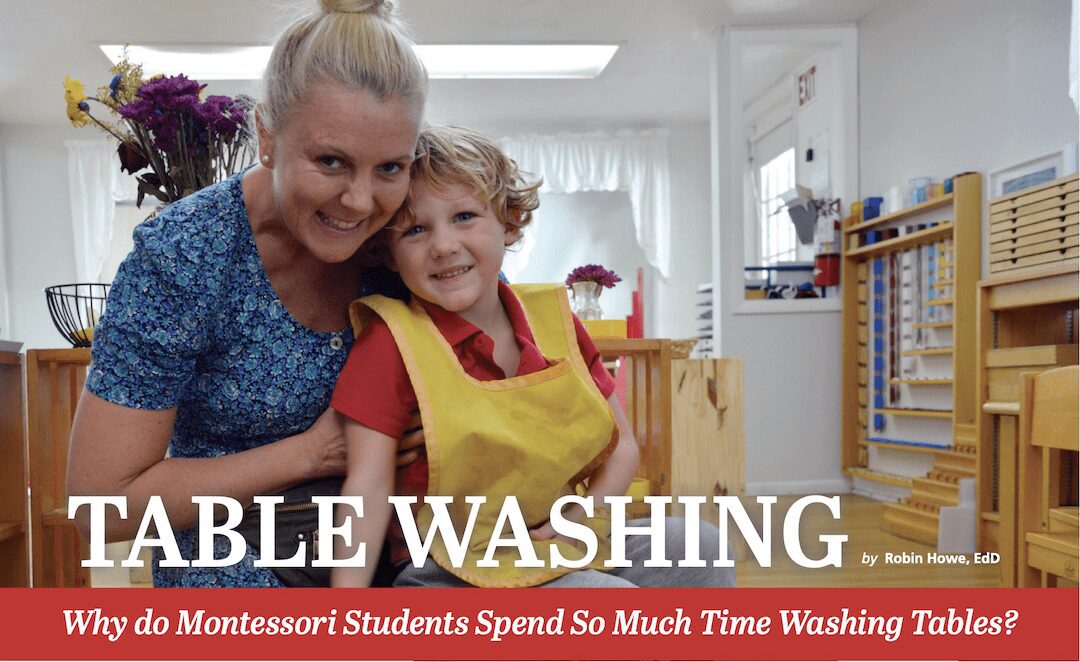
Table washing

by Robin Howe, EdD

Editor’s Note: If we had a dollar for every time a skeptical parent has questioned the amount of time their young Montessori child spends washing tables …

ANATOMY OF A LESSON

Ironically, I missed the session of my Montessori teacher training when we were given the lesson on how to wash tables. I remember doing it as a Montessori child. How hard could it be? I was just getting out of my first career in the restaurant business, and someone was going to teach me how to wash a table? I had washed and set tables for the rich and famous. I had cleaned more tables than everyone in that class combined. I was, in fact, relieved to miss that day of instruction. The summer training session ended, with my teacher trainer reminding me that I still needed to have a lesson on table washing.

A month later, about three weeks into the school year, where I was doing my internship, my lead teacher, a wonderful, experienced Montessorian, invited me to join her while she gave a review lesson to one of the returning students on table washing. Great, I thought! This was my opportunity to receive the lesson, seemingly without missing a beat. About twenty minutes later, I found myself sitting there observing a four-year-old finish up his work, while I, the ‘non-lesson-needing ‘expert’ watched dumbfounded.

I once thought that table washing was one of the most remedial tasks that a Montessori student would ever have to learn. As a result of watching this lesson, and essentially being humbled by a four-year-old (also an experience that has since occurred on many occasions), I have come to realize how important and difficult this work is for children.

I have now learned how to give this lesson, and it never ceases to amaze me that it is so complicated. More amazing is the way that my students seem to pick it up so quickly and how I still, after many lessons, have to focus in order to perform it correctly. For these reasons, I would like to share the lesson, as well as some observations, on how children respond to this exercise. It is my hope that others will gain a better appreciation for the complexity of this lesson and will, as a result, appreciate its importance and contribution as a part of the Montessori curriculum.

When working with any water exercise, the first step is to have the child put on an apron. Students are already familiar with where aprons are kept in the classroom, as well as how to put one on. Next, the teacher asks the student to go together to where the table-washing kit is located on the shelf. The child is either shown or asked to identify the table-washing kit and is then asked to take it to the side of the table that will be washed, placing the kit on the floor next to the table. Included in the table-washing kit are the following: soap in the soap dish; a soap brush; a pitcher for gathering the water; a bucket for dirty water; a basin (or bowl); a sponge; a drying cloth; and a hand towel that will serve as a mat for the materials. Generally, the materials are kept in the basin that will be used for the water. With the hand towel in place on the floor, the materials are arranged along the top of the hand towel in this order: sponge, soap, brush, drying towel (from left to right), and the water pitcher. And basin along the bottom. Note: This lesson may vary depending on the classroom and teacher.

After all the materials are placed on the towel, water is brought to the table using the water pitcher. Children have to fetch the water, which exercises body control as they navigate through the classroom, returning carefully with a pitcher filled with water (about two-thirds full). Then, the water is poured from the pitcher to the basin. The pouring of water from a pitcher is an extension of work that the student has already mastered in earlier Practical Life lessons.

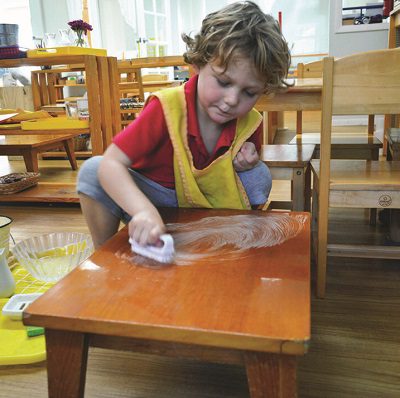
Next, the brush is wet and run across the soap until it is foamy. Using the wet, soapy brush, the table is methodically scrubbed in a circular motion. There should be small, but visible, suds on the surface of the table.

The brush is then rinsed and returned to its place on the mat. The dirty water is poured from the basin to the bucket, and the child carefully walks the dirty water to the sink to empty it. He will return it to the mat and fetch the pitcher so that he may again fill it with clean water to pour into the basin.

Now, the child wets the sponge and wrings out the excess water. Both the wetting of the sponge, as well as the squeezing of the sponge, are skills the child already possesses as a result of previous lessons in Practical Life. Starting at the bottom of the table, moving in horizontal motions, the child begins to rinse the soap from the table.

The sponge is wet once again. As an extension of this Practical Life exercise, the student might be asked to count how many compresses the sponge gets and then count the number of squeezes in order to expel excess water.

The child rinses the sponge, and picks up the towel to begin carefully drying the table top. After the surface is completely clear, the child checks the edge for suds and wipes it accordingly.

Step 1: Apron

Step 1: Apron

Step 2: Collecting Materials for the Lesson

Step 3: Preparing the Materials

Step 4: Getting Water

Step 5: Pouring Water

Step 6: Wet the Brush

Step 7: Soap the brush

Step 8: Scrub the Table

Step 9: Dump the Dirty Water

Step 10: Fill the Pitcher with More Clean Water

Step 11: Pour the Clean Water into the Bowl

Step 12: Wet and Wring the Sponge

Step 13: Wipe the Table with the Sponge

Step 14: Dry Table with Cloth

Step 15: Dump Dirty Water into Bucket

Step 16: Dump Dirty Water

Step 17: Clean Up Any Spills

Step 18: Roll Up a Clean Towel

Step 19: Fold the Mat

Step 20: Return the Materials to the Tray

At this point, the table is now clean and dry, and the basin is filled with soapy water. The student then pours the water in the basin into the bucket and disposes of the soapy water. The process of disposing of the water is also a very important part of the lesson. The child, again, has to navigate through the classroom, focusing on his movement and the balance of the bucket so as to not spill the water. This is great practice for walking slowly and being patient.

Once the water is dumped, the child uses the towel to make sure the work area is clean and dry. The dirty towel is placed in the laundry hamper, and a fresh towel is carefully rolled, and placed in the pitcher. Next, the mat is carefully folded and all materials are returned to the tray as they were found.

This lesson is important for many reasons. As mentioned during the lesson description, the child has to practice patience, while exercising fine-motor skills and balance. The student’s ability to sequence is challenged, as the proper completion of the work is dependent upon the ability to follow the proper steps. Another important aspect of this lesson, perhaps overlooked much of the time, is the time that the student spends working with the teacher. This is one of the longest lessons and can often take up to fifteen minutes.

During this process, children must listen carefully and ask questions, which helps them develop important language skills.

I hope that my description of this exercise offers some insight into the Montessori classroom and instills a sense of respect and feeling of awe for the children. Similar to the mistake I made, many people assume that these lessons with simple names must be simple, causing us to wonder how they could be so important. Indeed, I have come to realize that they are important, not only as a part of children’s Montessori academic curriculum but also their development as people. •

Daniel Robinson (Robin) Howe, III was a Montessori student from age two through the eighth grade. He worked his way through multiple levels of certification, spent many years in the classroom, managed a number of Montessori schools, and then earned his EdD. Formerly, co-head of the NewGate School, Robin is a senior consultant with the Montessori Foundation.

TOMORROW’S CHILD © • NOVEMBER 2019 • WWW.MONTESSORI.ORG

Dealing With Tantrums

Dealing With Tantrums

Tantrums

I’m going to dive right in to discuss a very tricky area for parents and children alike: tantrums.

I hope you find this article useful so you can start applying Montessori principles in your home too.

Dealing with Tantrums

Tantrums are a pretty normal part of life with children from around one to five years old. Maybe they’ll start a little later than one year and will end earlier, but anything in this range is fairly normal. Your child is learning that things don’t always go their way. And, as parents, we are helping them learn how to deal with these emotions and to make amends.

It can be upsetting for a parent. It’s hard to realize that your child is actually asking for your help. They are overwhelmed by the situation and need your support to calm down. It’s not the time to take it personally.

How to Avoid Tantrums

It can be possible to avoid tantrums before your child loses control. Here are some ideas to ward off tantrums when you see the first signs of your child losing control.

1. Be prepared: take a small bag with some simple games and some favorite snacks if you expect your child to wait patiently in a doctor’s office or a cafe.

2. Label their feelings: “Boy, you really wish you could stay longer”; “You really wanted some orange juice right now!”

3. Redirect them: “I can’t let you hit your brother, but you can hit this drum/pillow.”

4. Get down to their level: “You sound frustrated. Can you tell me why?”

5. If they are struggling, ask them if they would like some help: give them just as much help as they need and then step back.

6. Give them a choice: “Would you like to put on your shoes or your scarf first?”

7. Establish routines: “… and after lunch, we’ll go to the toilet, read a book, and tuck in for a rest.”

8. Let them show their anger creatively, “Show me how angry you are. Here is some paper and a pencil. Wow. They are big circles. You are really mad!”

Triggers

Events can often escalate to a full-blown tantrum. Sometimes it’s from your child’s frustration; other times their anger or rage; sometimes because they want to be in control; their communication may still be limited; or because they are tired, hungry, or overstimulated. They can throw themselves on the floor, push us away, try to hit us, a sibling, another child, or even break something.

It can be useful to note things that cause tantrums in your child: over-scheduling can be common; a new baby; moving to a new house; or certain children may trigger them.

Sometimes the tantrum is even caused by us as we deliver the news that it is time to leave the park, or we serve some food they don’t like for dinner, or that we would like them to get dressed to leave the house.

It’s OK for your child to have a tantrum. You can acknowledge their displeasure at what is going on. You can help them to do the thing that they don’t like. However, when we back down and give in to them, you will find they shout even louder next time.

It’s difficult to be the parent and stay strong. But your hard work will pay off in the long term. They will learn that when you say no, you mean no; and when you say yes, you mean it too.

I like the advice from Positive Discipline for Preschoolers (by Nelsen EdD, Jane, Erwin M.A., Cheryl, et al. Jul 9, 2019). “If you say it, mean it; and if you mean it, follow through with kind and firm action.”

Action may be, for example, leaving the park with a sad toddler, acknowledging that they really wish they could stay longer.

Alternatives to Time Out: How to Help Your Child Calm Down

When your child is having a tantrum, some experts advise putting them into time out. I find this difficult as your child is asking for help to calm down, and you are removing your support and punishing them instead.

When we punish our children, they often get angry at us rather than being sorry for what they have done. Or they try to work out a way to get away with it next time without being caught.

Instead, I look for ways that I can support my child to calm down. I’m not saying that their behavior is OK, but when they are in the middle of the tantrum, it is not the time to teach them anything. They cannot hear you. They have lost control. So let’s help them calm down.

Some children will respond to a cuddle during a tantrum. You can rub their back, cuddle them, and sing to them as they go through all the range of emotions from anger, to intense frustration, to sadness, and sometimes regret. I once held my son for 40 minutes as he refused to get dressed. And I watched him go through all these emotions. In the end, he announced he was ready to get dressed. He told me he loved me. He wasn’t angry with me. He was grateful that I had just been there for him. I know sometimes you have to leave, but in this case, we just changed our plans.

Other children will push you away and don’t want to be touched. In this case, I make sure they are safe and cannot hurt themselves or others. I stand nearby and keep offering my help, “I’m here if you need some help to calm down. Or we can have a cuddle when you are ready.” After the tantrum, I like to offer a cuddle. “That was tough. And now you have calmed yourself down. Would you like a hug?”

If they are throwing toys at their sibling or trying to hit me, I would remove them so that everyone is safe. “I can’t let you hit me. My safety is important to me. Would you like to hit these pillows instead?” If your child is trying to hurt the baby, you can place yourself physically between them to keep the baby safe as you help your older child calm down.

For a child over three years old, you can set up a “calm place,” which they can use when they are upset. It may be a tent with some pillows and favorite things. It may be a corner with some trains. You can ask your child if she would like to go to her calm place.

This is different than ‘time out,’ as the older child is in control; she can come out when she feels calm. If she comes back still in a rage, I would gently tell her that she looks like she still needs to calm down and can come back when she is ready.

Making Amends

Maybe you are thinking that if I support my children while they calm down, I’m saying that their behavior is OK, and I’m encouraging them to get angry. When they are upset, indeed, my objective is to help them calm down.

Once they are calm, I then help them to make amends. If they drew on the walls, I would get them to help me clean up. If they broke their brother’s toy, they can help to fix it. I’ve asked the kids to help scrub their sheets when they used marker pens in bed and made a mess.

In this way, they learn to take responsibility when things go wrong. And when it’s over, it’s over. The good thing about young children is that they can move quickly from deep anger and sadness back to their happy selves. We need to move on too and not let this upset the whole day by referring back to it or keeping on about it. Once they have made amends, it’s OK for everyone to move on. •

TANTRUM FAQs

Shouldn’t we just ignore their tantrum?

I don’t like to ignore children when they are having a tantrum. They may not let me touch them, but I keep offering support and letting them know I am available when they need me. If you were super upset and your partner just left the room for you to get over it, you would likely find them unsupportive. We are showing our kids that, good or bad, we will be there for them.

What do I do if we are out in public when they have a tantrum?

There are basically two options:

First: Go home—if you find it difficult to have people watching you, it’s best to just leave. This may mean parking a full shopping cart and following the above ideas once you are home.

Second: Stay and support them—my preferred option is to hang in there and do what you would do even though you are out of the house. If you have more than one child with you, make sure they are safe. And then offer as much help as you can to help your child calm down. People watching will more likely think about what a lovely, patient parent you are, rather than what a horrible noise your child is making.

I find it difficult to stay calm myself. What can I do?

If your child has triggered you, it is indeed difficult to help them calm down.

• If your partner is available, it can be easiest to get them to step in instead.

• You may want to make sure the kids are safe and go to the bathroom to catch your breath.

• Find a mantra that you can repeat, “I breathe in calm, I breathe out anger.”

• Remember not to take it personally. Perhaps visualize putting on a bullet-proof suit that will resist everything (including words) that your child throws at you.

These tips should help you remain calm and give your child the support they need to regain control.

Learn from Simone Davies, an AMI Montessori teacher with15+ years’ experience working with 0-3-year olds, owner of Jacaranda TreeMontessori in Amsterdam since 2008, mother of two teenagers, and author of the book The Montessori Toddler. Visit her blog at themontessorinotebook.com

This article is from the November 2019 issue of Tomorrow’s Child magazine. Reprinted with the author’s permission.


Book Review: Maybe I Can Love my Neighbor Too

Book Review: Maybe I Can Love my Neighbor Too

Maybe I Can Love My Neighbor TooWritten by Jennifer Grant
Illustrated by Benjamin Schipper

In this story, a young girl, who lives in the city, is wondering about a large apartment building that is being constructed across the street and she asks her mother, “Will all the new people be our neighbors, too?” Her mother’s response is that all people, near or far are neighbors. The girl knows that she is supposed to love her neighbors but doesn’t know how she could love so many people. As she and her mother go through their day, she notices many examples of how people can be loving to each other: helping an elderly man retrieve his dog; sharing toys with other children in the park; making a loaf of bread and giving it to a neighbor; helping someone carry their groceries; and more. By the end of the book, the girl feels confident that there are so many ways to show love to all her neighbors around the world. The illustrations have a colorful, sort of cartoon style. They depict people from many different backgrounds, ages, and ethnicities. This would be a good book for children three years old through the elementary grades.

Story Time: the Last 20 Minutes of the Day

Why Can’t I Bring Toys?

Have you ever been in any of these situations with your children: trying to get out of the house on time without a tantrum, grocery shopping and getting into a battle with your child about buying something she wants but it’s not on the list, putting toys away before going to bed without a 30 minute negotiation? If any of these scenarios sound familiar, please join us for this session on boundaries and limits.

Story Time: the Last 20 Minutes of the Day

Mom, I Made My Own Lunch!

Summer break is a great time to help children learn to make their own lunches. Christine will walk you through a “lesson” on teaching your child to prepare her/his own lunch for school. She will also offer ideas for setting up your kitchen “environment” so your child can be independent, for helping your child plan a “menu,” and then actually for preparing lunch.

What do Montessori children do in all day Montessori programs?

What do Montessori children do all day? Simple. They do what they feel like doing, within the same reasonable limits that define the culture of the classrooms in the morning. When they are hungry, they eat. When tired, they sleep. They may read, write, paint or draw. They may work in the garden, watch the wildlife that surrounds the classrooms, They continue with their math, science, history or geography. They cook, clean, and explore the sensorial materials. They work alone or with a friend as they wish. Many classes will suggest that the children work on drama, dance, or strength-building activities in the afternoon. Puppet shows, dance routines, songfests, story telling are old favorites. The afternoons are a great time for hikes through the nearby woods or neighborhood. Many schools have their own little woodshops. Some have pottery studios. Some have small petting farms where ponies, sheep, ducks, and geese are raised. Imagine that the children are homeschooled.

What might young children do in an all day Montessori program in the afternoon? Answer…just imagine the possibilities!

  • Learn about ecology
  • Learn to swim
  • Make their own puppets
  • Make a clay pot
  • Learn to paint from a professional artist
  • Write and perform in their own plays
  • Learn to sculpt
  • Learn to cook breakfast for their moms and dads
  • Make friends with a rabbit
  • Build a children’s playhouse
  • Learn to play soccer
  • Make scenery for a play
  • Build a model volcano
  • Work with stage makeup
  • Prepare their own cookbook
  • Use a microscope
  • Tumble  Build and fly gliders
  • Sing and dance
  • Learn to play an autoharp
  • Shoot baskets
  • Compose a song
  • Draw with charcoal
  • Write their own play
  • Study bubbles
  • Learn to be a clown
  • Dip candles
  • Learn to play the violin
  • Weave a basket
  • Cook creatively
  • Make a paper mache mask
  • Design their own t-shirts
  • Explore nature
  • Perform scientific experiments
  • Study the stars
  • Discover their hidden talents
  • Develop self-confidence and self-esteem
  • And make friendships that will last a lifetime


Story Time: the Last 20 Minutes of the Day

Turning Down the Heat on Power Struggles

Do you feel like there are persons in your family that you are constantly being challenged by, you are battling with about every little thing, or you are just plain angry with? In this session Lorna will take participants through an awareness of feelings associated with power struggles, an understanding of the effects of power struggles on relationships and strategies for minimizing power struggles in families.

Story Time: the Last 20 Minutes of the Day

Summer Ideas for Families

Summertime is perfect for continued learning opportunities with your child. Bring Montessori home with you this summer and keep the learning fun. Kristi shares suggestions for preparing a Montessori-friendly indoor as well as outdoor environment, reinforcing language and phonetic skills, and observing your child to better understand what they are interested in and how they think. This summer you can have the joy of watching your child’s development continue with these Montessori inspired activities and ideas.

Story Time: the Last 20 Minutes of the Day

How Do You Handle Anger?

Anger is a natural reaction to being wronged. But society tells us anger is dangerous and we should hide it or “positive think” it away. Yet, if anger is harnessed correctly, it can create positive change. Kath will share ideas for good. Parents can use her ideas when they are feeling the need to control or push back instead of making matters worse by reacting, engaging in power struggles, and causing damage to their most precious relationships with their children.

Math Without Workbooks

In this session, “Math Without Workbooks,” Cheryl Allen shares many opportunities for practicing math which are right there in front of us in our everyday lives if we just take advantage of them. Hands-on experiences help children internalize concepts that might otherwise seem difficult to understand or unimportant to them. In addition to great ideas for learning math in fun ways, Cheryl also includes a wonderful list of books for the elementary years that are not only about math but also many of them are quite humorous which children of this age love.

Story Time: the Last 20 Minutes of the Day

Supporting Your Child with Co-Regulation

In this webinar Christine Lowry will guide us in how to help not only our children to be able to self-regulate their emotions but also, how we can develop better skills in this area along with our children. She will provide important information about how adults influence the level of emotion that our children experience. Whether adults up-regulate or down-regulate their own emotions impacts how children respond to stresses. She will also share six steps to help children down-regulate when they are experiencing a meltdown. The ideas and strategies that she shares apply from infancy through adolescence.

Dear Cathie

Dear Cathie

Cute little boy is calming pretty little girl while they both are sitting on sofa at home

Dear Cathie— My children are not always nice to each other, and they sometimes admit they have been unkind to others at school or on play dates as well. I want them to learn to be kind and respectful. I have been expecting them to say “I’m sorry” when they act in this manner, such as when they hit or punch or grab something from a sibling or friend. I have been reading and hearing that there are other ways to handle these situations but those ways just feel so artificial. Can you help?        A Frustrated mom

Dear Mom,

We are all a product of our upbringing and, for many of us, saying “I’m sorry” was a get-out-of-jail-free card. The meanness or hurt was undone with two little words, but we all know that it really wasn’t. The place on the child’s arm that was punched still hurt; the sadness from the picture that was marred by scribble scrabble still remained; and the hurt feelings from the unkind words were still felt.

Montessori educators today are trying to help children of all ages view their hurtful actions through different, more compassionate eyes. We want them to look at their behavior, take ownership of it, and think of how it made the other person feel. This is how we aid in developing emotional intelligence. We want children to see how truly powerful their behavior can be and consider ways in which they can help make the situation better. It is not that children can’t make mistakes, but we want them to make logical and reasonable amends for those errors, whether they were intentional or unintentional. A child as young as two years old knows when he knocks someone over, he can help them up and check to see if they are uninjured!  If your child is running and causes another to bump his or her head on a table, he can get the ice pack from the refrigerator. This is an apology of action rather than the less meaningful apologetic statement, “I’m sorry!”
Many of the mistakes toddlers make are unintentional as they are just beginning to learn social conventions and manners. Some of their errors are impulse driven, as when they hit another or snatch a material or toy they want. At times, they even bite to show their needs when they do not yet have words or forget to use them.

As children grow into their early childhood years, they begin to understand and start the use of words and actions as power. “I can run faster than you!” “Your picture is not pretty.” “I’m not going to be your friend anymore!” Sometimes these statements are as clear and hurtful as they sound, and other times they are used to convey another unspoken message. It is our job as adults and teachers in the child’s life to help him recognize and articulate those messages as he negotiates the evolving art of socialization. “I’m not going to be your friend anymore” may really mean, “I wish I got to sit next to you at the circle.” Having your child say, “I’m sorry” will not help him grow socially. He needs to recognize and unpack his feelings, his misinterpretation of what happened, and what he said versus what he really meant to convey. Then, he needs to make a plan to somehow get his emotional needs met. “Can we play together on the playground? Do you want to play in the sandbox with me?”

Although it takes time and energy to work with children to sort through feelings, this is paramount to their being able to do it automatically and independently as they grow and mature. When there are multiple social situations happening simultaneously, as in a preschool setting or on a busy playground, this can be even more challenging. Often, you may be unable to observe all involved in a particular situation. There can be events that occurred prior to your arrival before the “straw that breaks the camel’s back” takes place. I often ask, “what happened before you hit her? What were you thinking or feeling?” Although hitting is never the right answer, it is often the third or fourth step in a series of steps. I want to see where a child’s thinking went during this time. I often ask, “What else might you have done?” It is always the responsibility of the child who caused emotional or physical harm to ask how he can make the child he hurt feel better. “What can I do to make you feel better?” I might have to suggest some ideas, such as a hug; rub his back gently; get an icepack; say you’ll never do it again; a handshake; say I’m sorry and mean it; or the child who was hurt saying that he needs space to be away from the child who caused the hurt and have time to be angry. A child who has damaged something of someone else’s needs to make reparation. He needs to set up the block structure he knocked down, if the other child would like him to, go get the ball he threw across the playground or set up the activity he destroyed or marred.

Early elementary school children sometimes ignore or exclude another. A child who intentionally hurts another in this way has a more difficult challenge to rectify the situation. It helps to bring children together so that the excluded child can articulate his hurt feelings to the child or children who intentionally ignored or excluded him. This child can then express an apology of action by making an effort to be kind to that child. As a parent and adult in his life, you can help him think of ways to do this! Perhaps, he can draw him a picture using his favorite color, bring him a craft that he made at home, or even make an effort to meet his eyes and smile at him every time he walks by! Expressions of kindness can take many forms.

Rather than making every hurtful event have an automatic “I’m sorry” response, try encouraging your child to think about the other person’s feelings. First, ask “what happened,” and be sure your child is given an opportunity to explain what occurred. Be sure you understand what went wrong if the situation is not immediately clear. Let the other child explain what happened from her point of view.  Often, there is more to the story. With practice, children can do this without adult assistance. Have the child ask what he can do to make the situation better. Encourage the child to fix the problem and make the other child feel better. Apologies of action are always better than words alone. Once this process becomes the culture of your family it will become automatic and effective. ′

Tomorrow’s Child/ April 2019 / Pg 34

Story Time: the Last 20 Minutes of the Day

Setting Limits and Making Them Stick!

Do you set limits and then give in? Are you not sure how to set limits?
In this session you will learn:
• An easy 6 step process to set limits.
• How to not crumble after you set the limit.
• How to follow through in a way that your child feels understood
and loved.
Most importantly, become the parent YOU want to be!

Story Time: the Last 20 Minutes of the Day

Grandparenting Terrific Teens!

Sometimes grandparents find it difficult to plan time together with older grandchildren because of the children’s (and family’s) busy schedule, discomfort about how to connect with children from this the technological age, or not knowing exactly what to do to engage them. We want to assure you that the bond created between you and your grandchildren and your ongoing unconditional love is more than enough. Simply spending time, listening, sharing families stories, and sharing life experience stories are all good. They really want hands on experiences with real people, especially you – like changing the oil on the car, doing needle work of some sort, planning the next family celebration, cooking together, getting out in nature on land or water, fixing the computer, teaching you something about the phone or computer, etc. Kathy and Margot have a lot to share!

Story Time: the Last 20 Minutes of the Day

Work or Play? What’s the Difference?

Many of us get confused about how young children develop the skills that they need to become self-directed, problem solvers, focused and able to follow through, confident, and creative. We look at what they become really engaged in and wonder, “why?” or we get so wrapped up in our important adult “busyness” that we don’t even notice when they are concentrating on an activity or task. We often wonder, “Are they working or are they playing?” Lorna explores whether there is a difference between work and play when a child is young and what adults can do to best support their child’s natural path to acquiring the skills that they need.