by Sara Stein | Maria Montessori, MFA, Mixed Ages, Montessori Family Life, Montessori Parenting, Parent-Teacher Communication, Tomorrow's Child
 Maria Montessori was a pioneer woman, A brilliant-minded genius who went out on her own to design and build an educational curriculum more than one hundred years ago for the poorest children in Italy. It was deemed ‘alternative’ then, and it still is today. Very few people truly understand how and why the Montessori Method works, even those of us with children enrolled in Montessori schools and programs. I am right there with you.
Five years ago, I became a Montessori parent and still feel like I am learning what the terminology all means. It is different than what most of us grew up within traditional education. So how do we make sense of it? Why does it matter if we understand how it works on a fundamental level? Our children deserve that from us. The more we can appreciate our role and how our support, or lack thereof, can affect our child, the more successful they will be. So, we have some work to do here.
One of the biggest buzzwords in the Montessori world is normalization. This one took me quite a while to figure out. Isn’t my child already normal? We want our child’s classroom to be normalized because this translates to an environment where children are focused and concentrated on their individual work. The room is calm, beautiful, and orderly, and everyone is going about their work. Another popular Montessori word: work. Children come to school to work. They are given lessons, follow-up work, or practice assignments. But the incredible thing about the Montessori child is that they choose what to work on, and when. For example, if they come to school eager to pull out the long bead chain and practice their multiples, they can. If they want to symbolize their spelling sentences or use colored objects to denote various parts of speech, they can. The child’s work is up to them, as long as they are focused and concentrated.
There is more to being a Montessori parent than supporting what the teacher is presenting in the classroom. It is important that we bring Montessori into our homes. And we all don’t need to be trained or read every single Montessori book to know how. We can start small. Practical Life is an essential thread of the curriculum. It can best be equated to the home economics or woodshop courses many of us took in junior high and high school. Practical Life means any skill a child learns, which enables him or her to be more independent and self-sufficient. This can range from sewing on a button, tying a shoe, cutting up vegetables and fruit for snack, setting the table, or arranging a fresh bouquet of flowers in a vase. As the children grow, Practical Life means preparing a full meal, researching and leading a school-wide community service opportunity, maintaining a garden, or building a wooden picture frame. Children want to help us at home. They want to learn and feel as though they are contributing. I have had to learn to step out of my own children’s way. It may take longer for my four-year-old to get herself dressed, or for my seven-year-old to fold her own laundry, but they can and will if encouraged and allowed the space.
At the elementary level, the children often participate in Going-Outs. This enables the child to plan an individual or small-group outing to a local library for more resources or a pet store for more fish food. A whole class field trip offers everyone the same experience, whereas a Montessori Going-Out allows the child to focus on their individual learning needs and goals. As a parent, you might be able to help with transportation or allow your own child to plan a family outing for the upcoming weekend.
This flows right into Grace and Courtesy, which stems back to basic manners and civility. In a Montessori classroom, children learn to look people in the eye and shake their hand when greeting each other in the morning. They learn to help care for each other and their shared classroom environment through job rotations. Keeping the materials clean and beautiful is an issue in a Montessori classroom, and this high standard can flow into the home as well. Children are capable of cleaning up their toys and clearing their dirty dishes from the table. Grace and Courtesy are about basic phone etiquette and, in a world of texts and emails, is becoming a dying skill. Ask your child to make that reservation for you at your favorite restaurant or call to see what time the roller-skating rink opens. One home example I can share is when our ten-year-old son wanted to learn to play an instrument. Ok, we said, do some research and get back to us. He called three music shops to ask about rentals and lessons and, after doing the math, selected a store. Off we went to get him set up with a saxophone, and the pride he felt for the role he played was priceless.
Parents, our Montessori teachers need us, as do our children. The Method is extraordinary, and the teachers who feel ‘called’ to guide our children are passionate and skilled. If you don’t understand something, ask. Teachers want to help you, too. If you don’t feel connected to your child’s Montessori world, look for a way in. We are all in this together. Learning about the Montessori philosophy gives us tools to be better parents, and I feel better human beings.
Tomorrow’s Child/ Jan 2019 /Pg 28
by Kath Kvols | Adolescence, Communication, Early Adolescence (12-15), Later Adolescence (15-18), MFA, Montessori Family Life, Montessori Parenting, Upper Elementary (9-12), Video, Webinars / MFA, Young Adolescent
“I haven’t talked to my mom, I mean really talked, in six months,” a twelve year-old confided in me. “Oh, why is that,” I asked gingerly. “My mom laughed at me when I told her I had a boyfriend.” Sometimes we forget how sensitive children at this stage of development can be. Yet now, more than ever is the time to be available to your child. Despite all of their attempts to push you away, they still need you. Kathryn will share tips for getting and keeping your adolescents talking.
by Sharon Caldwell | Communication, Discipline, Free Reads, Kindergarten, Lower Elementary (6-9), MFA, Mixed Ages, Montessori Family Life, Montessori Teachers, Parent Education, Tomorrow's Child
“The undisciplined child enters into discipline by working in the company of others; not being told he is naughty … Discipline is, therefore, primarily a learning experience and less a punitive experience if appropriately dealt with.” —Maria Montessori
Teachers spend years learning to create an atmosphere in Montessori classrooms that embody the wisdom of Dr. Montessori while fostering the spiritual awakening in their students and themselves. Administrators try, via parent education and engagement, to explain the developmental stages of children so that expectations are realistic for all. Montessori parents are a special group of people who want a very holistic education for their children. However, none of us is immune to needing some reminding of how to talk and treat people we encounter regardless of their place in this world. We are all in this together. By practicing and modeling these skills we can all benefit and change the world.
Many parents and teachers, and some Montessori Directresses make use of ‘time out’ as a means of compelling children to behave in a certain way. Sometimes, the child is required to sit on a specific chair. Sometimes this is called a ‘thinking chair,’ and the child is instructed to think about what he has done. There are many variations on this theme, and the strategy has many names. Ultimately, they all boil down to the same thing.
According to Montessori, a child who is unruly or disruptive should be taken aside by the Directress, away from the disruption of his peers. The adult will stay with the child, quietly re-assuring him, until he is ready to return to his work. This has been interpreted by some as an endorsement of the ‘time-out chair.’
Although removal from the activity of other children can help an over-excited or distraught child to calm down, it is very difficult to use the chair in a non-punitive way. Maria Montessori is quite clear in her writings that punishments have no place in a Montessori environment.
In the early years of its use, the ‘time-out chair’ was seen as a positive step in disciplining young children, as opposed to scolding or complete isolation, or in the absolutely unacceptable (but not absolutely obsolete) practice of spanking children. The technique was regarded as an aid in helping children to learn independence and self-control. Children could take part in group or individual activities as long as they obeyed the house rules. Any infraction would mean removal from activities and peers and, for a specified time, sitting in a designated place some distance away from the center of activities.
The adult then gave the child the opportunity to determine when he felt he could rejoin the group as a cooperative member or asked the child (after whatever time interval seemed appropriate) if he could now cooperate with the rules and be readmitted to the group. The problems associated with a time-out system are essentially those that arise from any method of punishment. Children may well behave in the required way, but they conform in order to avoid being sent to the chair, whether or not they have internalized the rules. It is a simple example of operant conditioning.
Time-out and other punishments are not appropriate in a Montessori environment because they focus on behavior rather than internal development. Punishments reinforce what Maria Montessori called “obedience of the wrong kind.”
Punishments don’t work because they neither help to develop the willpower associated with real choice nor do they help to teach alternative, more acceptable behaviors. Any authoritarian approach discourages creative problem-solving, the development of appropriate conflict-resolution techniques, and the growth of an internal locus of control.
In many ways, isolation from the group can be even more negative than physical punishment, as it engenders feelings of rejection in the child, which can have serious implications for children with already diminished self-esteem. These ideas are supported by Peter Haiman, who argues effectively against the use of time-out in the home. His arguments apply equally to the classroom.
Most importantly, as Ann Clewett points out, “The very existence of the chair causes anxiety in some children.”
The use of star charts and black marks (or any other version of the debit/credit system) has the same result. These systems, just by being evident in the environment, can trigger a stress response in some children, which often results in the very behavior they are designed to deter. Frequent use of these systems only serves to reinforce the child’s negative self-concept by repeatedly humiliating the transgressor in front of his peers.
Clewett’s alternatives to the time-out chair are very similar to those proposed by Dr. Montessori:
“Rather than removing the child from the learning situation when she makes mistakes, we should stop the inappropriate behavior and send her back into the situation to practice the new behavior. Once a child knows that we are helping her find new ways of accomplishing what she wants to, she will begin to think out more acceptable ways herself.”
Until she grasps the concept of alternate ways, she will revert to old habits. Intervention to prevent aggression and suggestions of acceptable alternatives must be made for a number of weeks before children begin to use the alternatives consistently themselves.
The important point in Clewett’s argument is that the adult helps the child “find new ways of accomplishing what she wants to…” Instead of trying to change the child’s behavior, we help the child choose different strategies. By avoiding the use of punishment (and, for that matter, rewards) we shift the emphasis from control to cooperation, from conflict
to collaboration.
A child who might resist control comes to see the adult as an ally, someone to turn to when help is needed. The absence of punishments and rewards is critical to the development of self-discipline.
References
Britton, J. L. . “Montessori Explained,” Child Education (July 1984)
Clewett, Ann. “Guidance and disciple: Teaching Young Children Appropriate Behavior,” Young Children (May 1988)
Haiman, Peter. “The Case Against Time Out,” www.naturalchild.org/guest/peter_haiman.html
Sharon Caldwell is a Montessori consultant in South Africa. She is also a member of the staff of the Montessori Foundation.
Tomorrow’s Child/ Jan 19 / pg 10
by Maureen Healy | Brain Development, Communication, Discipline, Emotionally Healthy Children, Empowerment, Kindergarten, Lower Elementary (6-9), MFA, Mindfulness, Montessori Family Life, Primary (3-6), Upper Elementary (9-12), Webinars / MFA
While growing up has never been easy, today’s world undeniably presents kids and their parents with unprecedented challenges. In this session, award-winning author Maureen Healy will share highlights from her new book, “The Emotionally Healthy Child,” and answer real-life questions from anyone wanting to raise emotionally healthy children. Come and learn some new strategies to help your children stop, calm and make smarter choices even when emotionally charged.
by Lorna McGrath | Communication, Emotionally Healthy Children, Kindergarten, Lower Elementary (6-9), MFA, Mindfulness, Montessori Family Life, Montessori Parenting, Primary (3-6), Webinars / MFA
In Part 1 Lorna McGrath discussed learning styles and how they are related to self-calming. In Part 2 she will expand on what listeners already know about learning styles by sharing how to create individual self-calming spaces which include activities that are in alignment with each person’s dominant learning style. When individual self-calming spaces are designed in this way family members are more easily able to center themselves, to express their feelings and needs, and return to family life.
by Christine Lowry | Kindergarten, Lower Elementary (6-9), MFA, Montessori Family Life, Practical Life, Prepared Environment, Primary (3-6), Upper Elementary (9-12), Video, Webinars / MFA, Writing
Wondering what kinds of activities to do with your children during the school break? This session is loaded with good ideas for families whether during the day, in the evenings, or on the weekends. Join Christine Lowry as she shares her experience and suggestions for creating a peaceful school break.
by Michael Dorer, EdD | Brain Development, Communication, Early Adolescence (12-15), Empowerment, Infant-Toddler (0 to 3), Kindergarten, Language, Language & Reading, Later Adolescence (15-18), Lower Elementary (6-9), Mindfulness, Mixed Ages, Montessori Education, Montessori Family Life, Planes of Development, Primary (3-6), Psychology, Reading, Science, Sensorial, The International Montessori Council, Upper Elementary (9-12), Webcasts / IMC, Young Adolescent, Young Adults
Webcast: Building Brains With Kathy Leitch and Michael Dorer
by Danielle Herzog | Communication, Discipline, Infant-Toddler (0 to 3), Kindergarten, Later Adolescence (15-18), Lower Elementary (6-9), Mindfulness, Mixed Ages, Montessori Family Life, Montessori Parenting, Practical Life, Primary (3-6), Research, Tomorrow's Child, Tomorrow's Child Online Issue, Upper Elementary (9-12), Young Adolescent, Young Adults
We ask about pets, allergies, and car seats, but would we hesitate to ask the parents of our child’s playdate if there are guns in their home?
When my daughter was 3, she saw her first toy gun on a playdate. It was neon green and shot balls instead of bullets, but it was the first time she had ever seen or heard anything that contained the word “gun” in its description.
“What does a real gun look like?” she asked when she returned from the playdate.
I realized then that it was time to educate her, as well as myself.
I went online and showed her pictures of all different types of guns. But I didn’t stop there. I talked to her about what to do if she went to a house with a real gun—to stop, immediately leave the room, and find a grown-up. I used a stern voice, told her of the terrible things that could happen, and I did my best to answer all her questions openly and honestly.
But then she said something that I wasn’t prepared to hear: “I don’t want to play at a house that has guns.” And the truth was, neither did I.
We are not gun owners. We are a family who understands the need for guns for hunting and armed forces, but we are not people who believe they should be kept in the home for recreation or protection. I have never understood how guns could even be used for protection if they’re supposed to be kept locked up with the bullets in a separate location. If an intruder entered your home, how would you have time to unlock, assemble, load, etc.?
But a bigger question I wondered was why I had never asked a playdate’s parent if they owned guns. Yes, I knew the people she was playing with; they were friends. But the truth was, I had no idea if they owned a gun. It’s not a topic that had ever come up.
So the next time she went on a playdate, I asked the question that felt so uncomfortable coming out of my mouth, and I was surprised by their reaction. They smiled, said “ no,” and added, “That’s a good question to ask. I never thought to ask someone that.”
And that parent and I aren’t the only ones who hadn’t thought to ask before. I posted the question on Facebook and was surprised by how many mothers answered that they wished they asked if there was a gun but never did. Many were afraid of offending the other parent, or others didn’t think of asking until after the fact. However, a few said they had asked and the reactions were mixed.
A mother of two from New Jersey said that she worked up the courage to ask when her son started attending a new school. “I didn’t know the parents, and although they seemed nice enough, I felt strange about dropping my kid off at someone’s house without knowing them. I asked if they had a gun in their house, and the father answered ‘no.’ It then led to a great conversation about how sad it was that we needed to ask.”
But another mother of three from Wisconsin has often experienced a different reaction. “Almost always, parents get offended when I ask. I live in a state with many hunters. But, I put my child’s safety before a fear of how people think of me. If they don’t lock their guns, my son doesn’t go.”
Some parents are even going as far as not partaking in at-home playdates. A mother of three from New York City, slowly started eliminating playdates that take place in someone’s house. “There are too many wild cards: guns, not knowing whether other adults are in the home, and the like. I don’t consider myself a paranoid parent, but I’d rather eliminate any controllable dangers by being present and engaged and available for my child while she has a playdate. Instead, we invite our daughter’s friends (and parents, if they so choose) to join us at museums, kids’ centers, or similar spots to play.”
After recent youth shootings, access to weapons in homes is a growing concern. According to the Brady Campaign to Prevent Gun Violence, more than 40 percent of households with guns and children store their weapons unlocked.
With that information in mind, how can I truly believe someone if they tell me they properly store their guns? Not only am I a skeptic and cynical human being, but I’m also a mother who is terrified of a gun going off and injuring, or worse, killing an innocent child, especially mine.
After I showed my daughter the pictures of real guns, she asked, “How will I know what is a play gun and what is a real gun?” I wondered the same. Toys today look so real. How would she tell the difference?
In that same Brady report, parents who said that their kids had never handled their guns at home were given quite a surprise when they found out 22 percent of their children, who were questioned separately from their parents, said that they had handled their parents’ guns without their knowledge.
Who’s to say that one of those children in that 22 percent isn’t my child’s new playdate?
Retrieved from:
https://www.parenting.com/child/safety/would-you-ask-parents-if-they-own-guns-okaying-playdate
Tomorrow’s Child / Nov 2018 / Pg 24
by Edward Fidellow | Adolescence, Communication, Early Adolescence (12-15), Empowerment, Infant-Toddler (0 to 3), Later Adolescence (15-18), Lower Elementary (6-9), Mindfulness, Mixed Ages, Montessori Education, Montessori Family Life, Montessori Parenting, Parent Education, Psychology, Tomorrow's Child, Tomorrow's Child Online Issue, Upper Elementary (9-12), Young Adolescent, Young Adults
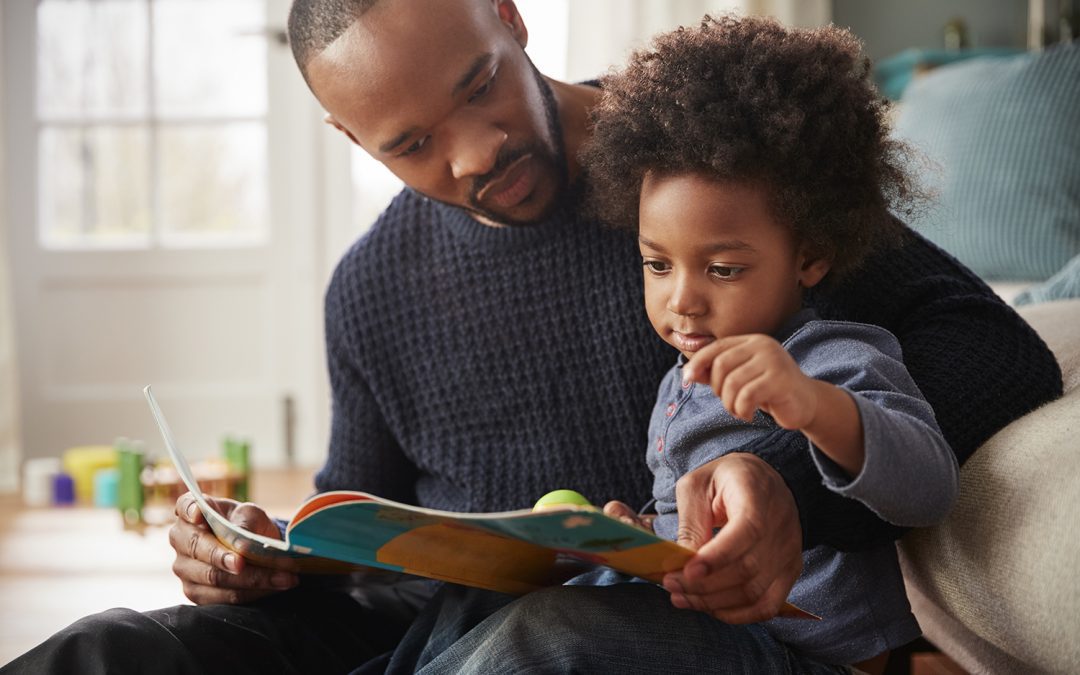
Father And Young Son Reading Book Together At Home
There are seven simple steps to becoming a Montessori parent. When we say ‘simple,’ we don’t mean that they are not challenging. It is a lot like the definition of bull riding. “The object is to keep the bull between you and the ground.” Simple—but challenging.
The first step to becoming a Montessori parent took place when you enrolled your child in a Montessori program.
That in itself is a challenge. Most of us weren’t raised in a Montessori school. The whole concept is foreign and takes a bit of courage to step out of the norm and our comfort zones. We may have chosen the program because it wasn’t like our school experience (which is why we chose it). Or we chose it because we saw something unique in a Montessori child that we knew. Or we were just plain lucky, stumbled into a Montessori school, and were fascinated by what we saw. Even then, we had to deal with the question, “If this is so great, how come the whole world isn’t lined up outside the door to enroll?” (That is the same question Montessorians wonder about, too!) But you made a complex and challenging decision to become a Montessori parent, and here you are. So how do you get the best out of your decision? You go to step two.
You begin to understand the core philosophy of Montessori. Fortunately, you don’t have to become a Montessori teacher to be a good Montessori parent. (You don’t have to know how to manipulate all of those materials, and you don’t have to keep fifteen children from climbing the walls.) The most significant Montessori concept is to respect the child. I can almost hear the wheels turning: “Of course I respect my children; I love them very much; that’s why I have them in Montessori; I want the best for them.” Of course, you love them, but respect is different.
Respecting the child is, first, to respect the nature of children. Children are not mini adults waiting to be molded. They are like tadpoles and caterpillars that have their own form and function of life, waiting to become what they are intended to be. We are often impatient for them to ‘become,’ because we don’t realize that childhood (with its curiosity, playfulness, messiness, and all) is part of the process of them transforming themselves into the adults they will become. We have to respect that process, which doesn’t mean they always get to do what they want.
One of the operative words in Dr. Montessori’s writing is the word ‘train.’ We do need to train our children, but we need to train ourselves not to destroy that which is good in the nature of our children. The second part of respect is to respect the personality of your child. Your child is not a blank slate. They are already imbued with the unique characteristics of who they are. The artistic bent is already there. The math bent is already formed. The leader, the follower, the giver, the taker, the extrovert, the introvert are already present in your children’s DNA. Right or left-handed; right or left brained are already formed.
So how do you cooperate with nature? You become an observer. That is the next step in becoming a Montessori parent; you train yourself to observe. To what interest does your child gravitate? What gives them great joy? What occupies them endlessly? These are all clues to who your child is becoming. You are fortunate that you have a trained helper in your child’s Montessori teacher. At your next parent conference, you should ask more than “what has she done?” but who do you see her becoming. It is hard to cooperate with nature if you are not aware of the nature of your child.
Our third step is to become their champion. I know. I hear you say, “Of course, I’m their champion. I love them.” And you do. But are their goals your goals? Translation: Do you have goals for them that do not take into account who they are? (There are many ‘jock’ fathers who do not have ‘jock’ sons.) Yes, you have many wonderful goals for them to be caring and loving, honest and faithful, upright, truthful, etc. These are worthy, significant, and meaningful goals; however, the expression of their lives (career, vocation, work) is best met and fulfilled according to their gifts.
When your five-year-old says, “I want to be a fireman.” He may be reflecting the latest book or television program he’s seen. However, if you continue to ask the why questions: “Why do you think that would be a good job? Why do you think that you would enjoy that?” you may discover that your child is not drawn just to the excitement but to the fact of wanting to help people or, perhaps, he likes the aspect of being part of a team. All are important clues to his personality. Your child needs you to champion and encourage his personality (especially, if it is different than yours.)
The fourth step is to practice what they learn at school: grace and courtesy. Please and thank you, May I, Excuse me, Please forgive me, and a host of other considerations practiced (and modeled) at home will go a long way to giving your child every advantage in life. People respond favorably to a child with great manners.
Fifth, practice independence. Independence is the ability to be self-governing, and that comes from making choices, living with the consequences, and having responsibilities. As often as possible, give your children choices. “What do you want for breakfast, cereal or eggs?” (Don’t offer choices where there are no choices. “Do you want carrots? They say no and you serve them anyway.) Give your children chores they can accomplish: making their beds, putting dirty clothes in the laundry, dishes in the dishwasher, etc. Chores build responsibility; responsibility builds independence; independence builds confidence.
Sixth, give them the gift of time. Give them time to accomplish their chores. Give them time to be children. Give them time to breathe. Give them your time.
Seventh, practice humility. They have a lot to learn from you. What is easy for you as an adult is mystifying and beyond challenging for them. Let your words be seasoned with grace. Look for the good in what they do. Their motives are often pure; their actions imperfect. Yet, we have a lot to learn from them. And when you are wrong (when not if) practice the humility of saying, “Please forgive me.” It will not destroy your authority or their respect for you. It will teach them one of the great lessons of life: when you fail, whether it’s in a relationship, school, career, or life, own the failure and start over again to succeed another day.
Becoming a Montessori parent is to become the best parent you can be.
Reprinted with permission by the author.
Tomorrow’s Child / Nov 2018 / Pg 13
by Kath Kvols | Adolescence, Communication, Early Adolescence (12-15), Empowerment, Later Adolescence (15-18), MFA, Montessori Family Life, Montessori Parenting, Webinars / MFA, Young Adolescent
When my kids were teenagers, I could make it through the day. But at night, when my head hit the pillow, in the dark is when it would begin. I would toss and turn, worried about my kid…. Who was she with? What was she doing? Would she finish school? Would she be able to get into college? Am I doing the right thing? What was I thinking when I let her…. This litany of fears would spin out of control and take me to some very dark places. Why is it important to stop worrying and what can we do instead? Join us to find out.
by Margot Garfield-Anderson | Empowerment, Imagination, Kindergarten, Language & Reading, Lower Elementary (6-9), MFA, Montessori Family Life, Primary (3-6), Upper Elementary (9-12), Video, Webinars / MFA
In this session, Margot Garfield-Anderson, grandparent extraordinaire, shares ways that she has been able to plant seeds of learning through projects and everyday activities. Also, she describes how easy and important it is to help in your grandchild’s classroom if you wish to. There are some really terrific ideas in this session!
by Lorna McGrath | Adolescence, Communication, Early Adolescence (12-15), Emotional Intelligence (EQ), Later Adolescence (15-18), Lower Elementary (6-9), MFA, Mindfulness, Montessori Family Life, Montessori Parenting, Peace Education, Primary (3-6), Upper Elementary (9-12), Webinars / MFA
How many times have you heard an adult say to an upset child, “Calm down,” “Just relax,” or “Pull yourself together. It’s not so bad”? Children are not born knowing how to calm themselves when they get emotional. Self-regulating our emotions is a skill to be learned. In part 1, Lorna will define learning styles and help make the connection between the way that we learn with the way that we self-calm. In part 2, she will share how to create a place for each family member when they need get calm, what activities to put in, when a family member should go there, and how to get them there.
by Lorna McGrath | Book Reviews, Empowerment, Mindfulness, Montessori Family Life, Reading, Tomorrow's Child, Tomorrow's Child Online Issue
Joy Fixes for Weary Parents
by Erin Leyba, PhD
This book is for anyone who is caring for and nurturing a family at any age along the way. It is easy to pick up and read one or more of the 101 ideas for building and sustaining relationships. Each of the ideas is two to three pages long, starting with a general description, then giving a real example of the idea in use, and ending with “TRY THIS.”
Some of the “fixes” will be just what you needed and others won’t appeal to you. Dr. Leyba has laid out sections that hold 11 to 15 ideas. Here are a few of the section titles: Design a Life You Love; Follow Your Intuition, Inspiration, and Truth; Ground and Center Yourself; Embrace the Quiet, the Slow; and the Simple; Build a Joyful Relationship with Your Partner; Build a Joyful Relationship with Grandparents; and more. There’s something in this book for everyone.
There is no particular order that you must read them. Just open the book and find one or two or more that fits your circumstance or mindset at the time. We all need a boost or a new way to look at things in family life, and Dr. Leyba has filled that bill with ideas for joy building. I recommend that you get this book and put it on your reading table or your nightstand so it’s handy for you to pick up and read a little whenever you have a minute.
Tomorrow’s Child/ September 2018/ Pg 30
by Cathie Perolman | Free Reads, Montessori Family Life, Practical Life, Tomorrow's Child, Tomorrow's Child Online Issue
Dear Cathie—
We are new to the Montessori philosophy and want to make the most of it in our family and our children’s lives. We have come to this a bit late, as we just moved to an area with a Montessori school. We have enrolled both of our children and are trying to learn as quickly as possible. What are the kinds of things we should be doing at home to support the kind of learning the children are doing at school? — new Montessori parents
Dear Parents,
You are asking all the right questions and doing all the right things! Montessori is indeed a philosophy and you can’t adopt it too late in the life of your family or your child. In a Montessori school, the guides believe that your child will reveal himself through the work that he chooses and shows us (the adults in his life) that which he needs to learn at that time. It is our job to aid him in this journey, showing him skills and activities that interest him, challenge him, and grow his academic, social, and motor skills as he moves along this path.
We strive to allow him as much freedom as he can handle in doing things for himself and being independent. We create an environment with maximum accessibility based on the ages and skills of the children and then teach them to use the materials in that environment safely. An Infant/Toddler environment would let the child be able to reach for their own diapers and their own lunch box so they can show us when they are hungry. A 3-6-year-old environment might contain scissors, a stapler, tape dispenser, sewing needles etc. An Elementary environment is much richer with all the tools and resources a child would need to plan a complicated individual or group project or a “going-out” field trip of their own choosing.
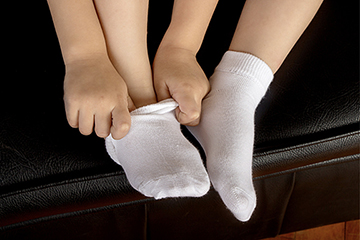
The primary ways that your family can help are to allow your child to be as independent as possible in all areas of his life. Let your child do as much for himself as his age and skill set allow in the areas of dressing, eating, food preparation, and contributing to his family. Let him choose his clothing and dress as much as he is able. If he cannot do all of a dressing task, let him do the part that he can. If he is not strong enough to pull on his whole sock, you can pull the sock over his heel and he can pull it up to his ankle. If he cannot manage his shirt, let him place his hands in the sleeve holes and then help him get his head into the head hole. Together pull the shirt over his torso. Removing clothes is an easier skill and will be mastered more quickly. With that comes the responsibility of placing the dirty clothes into the hamper. Sure, you can do it quicker, but letting him do it aids him in the path to independence! As he gets older invite him to help you sort the laundry, match the clean socks, fold the dish towels, and even carry his own lunch box to the car and into school. Try to constantly think
of things that you are doing that your child might be able to do
for himself.
Strive for independence in eating and food preparation. At mealtime, encourage your child to help prepare the meal. Teach your child to set the table. Perhaps, at first, he will only place the napkins under the fork. Eventually, he will know where all the parts of the table setting go and will be able to do it independently. This is a great way to get some quality family time while teaching valuable table-setting and food-preparation skills. A child as young as two can tear lettuce, and at three or four can cut vegetables using a child-friendly knife (https://www.forsmallhands.com/small-nylon-knife). Preschoolers can also help to cut vegetables or fruit even when they are not brave enough to eat them. Once the meal is on the table, encourage your child to serve himself from the family serving bowls. This is good practice in motor control as well as choosing the amount of food you are planning to eat. If your child is Elementary aged and your family is ordering ‘take out,’ allow your child to help in the planning and even in making the phone call to order the food.
Allow your child to get his own snacks independently (within reason). Create a place in your home that has snacks available for your child. Let him choose his own snack food from among those choices. Since you (the parent) stock the snack spot, you still have ultimate control over how much and what your child is eating. Your child is gaining valuable practice in deciding what to eat and how often to eat from these limited choices. If your refrigerator allows it, place a small pitcher and glass on a low shelf so your child can pour his own water or juice when he is thirsty.
As he moves towards Kindergarten, he is probably ready to take over parts of packing his own school lunch. Try to arrange your refrigerator so the things that your child will need for his lunch are available for him to access independently. He can select his own yogurt, or make his own sandwich, put his own fruit into the reusable container and close it (great motor practice), and fill his own water bottle. Let it be a joint effort until his skills are solid, and then let that be your child’s work because he has mastered another piece of independence. Let your child be a part of choosing what food to buy each week, so he gets to experience being a smart consumer. Once he is old enough, he will be able to contribute to the family grocery list and eventually shop for himself with confidence and skill.
Encourage your child to contribute to the family. A very young child can do simple tasks such as taking their plate to the sink, hanging up their towel or putting their toys away. Children a bit older can bring in the mail, feed the dog, empty the trashcans in the house, or take out the garbage. Families can work together to plan vacations, solve problems within their families, or create a new project, such as a vegetable garden or a fire pit. All of these things help the family to function as a unit and help children realize that they are a member of a group.
Optimal development is the goal of every Montessori classroom and every family. Guides encourage each child to grow in their social, emotional, academic, self-help, and motor skills each on his own timetable. All the adults in a child’s life help him along his path to independence, and by working together, parents and Montessori schools aid the optimal development of a child so he can become his most authentic, happy, and healthy self.
Tomorrow’s Child/ September 2018/Pg 34
by Tim Seldin | Communication, Early Adolescence (12-15), Free Reads, Infant-Toddler (0 to 3), Kindergarten, Later Adolescence (15-18), Lower Elementary (6-9), Maria Montessori, Mixed Ages, Montessori Charter Schools, Montessori Education, Montessori Family Life, Montessori Middle School, Montessori Parenting, Montessori Secondary / High School, Montessori students, Montessori Teachers, Primary (3-6), Tomorrow's Child, Tomorrow's Child Online Issue, Upper Elementary (9-12), Young Adolescent, Young Adults
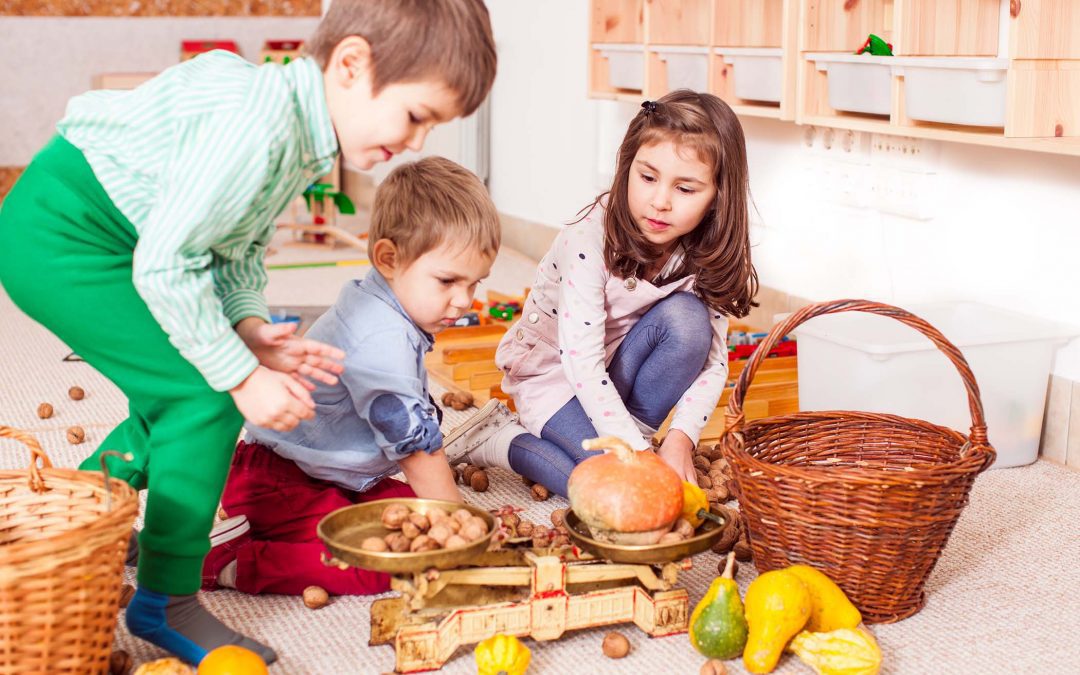
Children in kindergarten playing and exploring the concept of balance using weights
When we try to define what our children really “get” from Montessori, we need to expand our vision to include more than just the basics. Of course they learn to read, do four-digit mathematics, recognize geometric shapes, and identify the parts of a plant and a mollusk. They also learn how to be a contributing member of a community.
A Montessori school is more than a classroom. It is a society in a microcosm, and the skills and lessons they learn in this environment extend well beyond the traditional definition of academic success. They are life lessons that were very much needed at the time when Dr. Montessori developed her teaching methodology, and they are life lessons that remain relevant to our children today.
“The basic nature of our society and the family itself have changed radically, and only an equally radical change in education will suffice.”—John Dewey, School, and Society, 1899
In her book, The Schoolhome: Rethinking Schools for Changing Families (Harvard University Press, 1992, revised 2009), Dr. Judith Rowland Martin writes that she was not very impressed when she first encountered Montessori education. She understood that Montessori schools placed children in multi-age classrooms and used manipulative learning materials, which may have been very unusual during Montessori’s lifetime, but have since been incorporated into most early childhood and many elementary classrooms, thanks to the Open Classroom movement of the 1960s. However, Dr. Martin’s understanding of the value of the Montessori approach became dearer when she came across a statement in Dorothy Canfield Fisher’s book, A Montessori Mother (first published in 1912), in which Fisher disagrees with the universal interpretation given to Montessori’s “Casa dei Bambini” or “Children’s House.”
In A Montessori Mother, Fisher wrote, The phrase, ‘Casa dei Bambini,’ is being translated everywhere nowadays by English-speaking people as “The Children’s House,” whereas its real meaning, both linguistic and spiritual, is “The Children’s Home (or Children’s Community, ed.).” Fisher insisted upon this rendering, which she felt offered a much more accurate and complete insight into the character of the Montessori classroom.
Dr. Martin recognized that “This misreading of the Italian word ‘Casa’ as ‘house’ has effectively cut off two generations of American educators from a new and intriguing vision of what school can and should be. Read ‘casa’ as ‘house’ and your attention is drawn to the child-sized furniture, the Montessori materials, the exercises in practical life, the principle of self-education. But if you read ‘casa’ as ‘home,’ you begin to perceive a moral and social dimension that transforms your understanding of Montessori’s idea of a school.
Once I realized that she thought of school on the model of a home, the elements of her system took on a different configuration. Where before I had seen small children manipulating concrete learning materials, I now recognized a domestic scene with its own special form of social life and education.”
Martin realized that what Montessori had established was not simply a more attractive classroom in which children would be taught to read and write. The Casa dei Bambini represented a social and emotional environment where children would be respected and empowered as individual human beings.
It was an extended family, a community in which children truly belonged and really took care of one another. Montessori described this process of emotional growth as “valorization of the personality,” a strong sense of self-respect and personal identity. Within this safe and empowering community, the young child learned, at the deepest possible level, to believe in herself. In an atmosphere of independence within the community and personal empowerment, she never lost her sense of curiosity and innate ability to learn and discover. Confident in herself, she opened up to the world around her and found that mistakes were not something to be feared, but rather an endless opportunity to learn from experience.
This special relationship that is so common among Montessori children and their teachers and schools is very different from, and much more dramatic than, the experience most children have in school.
Frances Merenda, a 1990 graduate of The Barrie School in Silver Spring, Maryland put it this way:
“I started in Montessori at age two. I’m a product of the entire system. I did well, but still many people wondered if I had been prepared for college and whether I could ‘make it’ in a ‘real’ school? The skepticism was so disconcerting that I never bothered to step back and see what 15 years of trust, respect, teaching, and learning had done for me. When I went off to Northwestern University, I left my support system and community behind and entered a world that was much colder and uncaring.
At first, I deeply missed that sense of belonging. I didn’t realize that Barrie had not only given me a second family, but had also taught me how to build new friendships, support systems, and community wherever I go. I now use my years of experience in community building to cultivate secure relationships with people I have come to know. Barrie did more for me than just prepare me academically for college. It prepared me for anything to which I chose to apply myself.”
To understand how this evolved, it’s helpful to understand the world in which Montessori lived at the time she developed her educational approach.
Montessori was a professor of medicine, specializing in psychiatry. At that time, there was no such thing as Freud’s “talking cure.”
There were basically two approaches to the treatment of disturbed individuals.
The most common and familiar treatment was to confine people who acted strangely to insane asylums.
The second, and almost forgotten, approach was the “Moral Education” movement that spread across Europe and North America during the 1700 and 1800s.
These therapeutic communities were villages set off in the country where chronically despondent or nonviolently dysfunctional individuals lived in group settings with caring individuals.
The fundamental principle of the Moral Education movement was respect and kindness. Instead of treating their patients as prisoners, the staff acted on the belief that within each human being there is a core of goodness and a “sound mind.” The community lived and worked together as an extended family and developed a sense of belonging that is dearly reminiscent of what we see in our children’s classrooms today.
These communities were much like an Israeli Kibbutz, self-sufficient farming communities in which each individual was encouraged to become more independent while contributing to the overall operation of the village. Patients lived in small homes with a couple who served as their mentors. Surviving reports suggest that a great bond developed among those who lived and worked together. The movement recorded success rates that were far more effective than traditional approaches; returning their clients to their home communities as productive, happy citizens after an average stay of eleven months. A sense of close personal community and positive human relationships was proven successful as a means to help bring these disturbed people back to reality.
Montessori was well aware of this movement through her medical research into innovative strategies for treating the intellectually disabled. She used this same model with tremendous success in her own work with mentally disabled and autistic children in Rome and later hypothesized that even more dramatic results might be achieved with “normal” children. Her first “Children’s Community” was made up of 60 inner-city children from dysfunctional families.
In her book, The Montessori Method, Montessori describes the transformation that took place during the first few months of operation, as the children evolved into a “family.” The children had a sense of becoming the owners of their school. They were encouraged to rearrange the furniture, prepare and serve the daily meals, wash the pots and dishes, help the younger children bathe and change their clothes, sweep, clean, and work in the class garden. Through their day-to-day involvement in their classroom community, Montessori saw these children develop a sense of maturity and connectedness that helped them realize a much higher level of their potential as human beings.
While times have changed, the need to feel connected is still as strong as ever. In fact, for today’s children, it is probably even more critical.
Whether it’s an inner-city child or a child from an affluent suburb, the sense of community has all but disappeared from our children’s lives. Families regularly move from house to house, and from town to town. Grandparents usually live in other cities or other states. Both parents work out of necessity, and when they are at home, they are very, very busy. The over-programmed, hurried child has become the norm for this generation.
Many children have the sense that they do not belong to anything or anybody, which is why peer friendships, which give a sense
of belonging, are especially important to children today.
Along with whatever else Montessori gives our children, it definitely gives them the message that they belong-—that their school is like a second family.
Children will normally grow up to be productive, happy and confident individuals if given the right emotional environment. It seems clear that our attitudes about people, the ability to overcome our egocentric tendencies, our willingness to share, to compromise, to resolve conflicts non-violently, and our ability to discover an underlying sense of self-worth are not qualities that human beings develop spontaneously, but rather through years of experience with caring people who convince us that we belong and give us the opportunity to practice and master these skills of everyday living. As in all things, we learn by doing.
One of the greatest strengths in the approach that Montessori developed is the three-year age grouping that you will find in every Montessori school.
By consciously bringing children together in a group that is large enough to allow for two-thirds of the children to return every year, the school environment promotes continuity and the development of a very different level of relationship between children and their peers, as well as children and their teachers. For teachers, this relationship presents itself as a commitment that they make to stay with the children in their class for a prolonged period, rather than jumping from job to job or from classroom to administration. Montessori teachers do more than present curriculum. The secret of any great teacher is helping students open their minds and hearts so they are ready to learn; where motivation is not focused solely on good grades, but a fundamental love of learning.
As parents know their own children’s learning styles and temperaments, teachers, too, develop this sense of each child’s uniqueness by establishing a relationship over a period of years with the child and her parents. Montessori schools give our children not only the sense of belonging to a family but also of how to live with other human beings. By creating a bond of parents, teachers, and children, Montessori sought to build a community where individuals could learn to be empowered, where children could learn to be a part of families, where they could learn to care for younger children, learn from older people, trust one another, and find ways to be appropriately assertive rather than aggressive. To reduce these principles to the most simplistic form, Montessori proposed that we could foster peace by healing the wounds of the human heart and producing a child that is more secure. She envisioned her movement as potentially leading to a reconstruction of society.
Montessori schools are different, but it isn’t just because of the materials that are used in the classrooms. Look beyond the pink towers and golden beads, and you’ll discover that a classroom is a place where children really want to be—because it feels a lot like home.
Tomorrow’s Child/ September 2018/ pg 23
by Joyce St. Giermaine | Communication, Mindfulness, Mixed Ages, Montessori Family Life, Montessori Parenting, Sensitive Periods, Tomorrow's Child, Tomorrow's Child Online Issue
” Crying with strangers could change the world”—bREné Brown
The Changing Times of Parenting
I just returned from a week with my Maryland family: my 95-year-old mother; my 37-year-old daughter and her husband; my five- and seven-year-old grandsons … and a six-month-old-completely-out-of-control bernadoodle.
Seven days of trying to move seamlessly between four generations left me exhausted, but clear on three points: parenting is hard work; parenting well is even harder; and mindsets matter.
My mother’s mindset of frugality was deeply influenced by growing up during the depression. I grew up with the mindset of determination in the chaos of the sixties with assassinations, protest marches, war, and the demand for equal rights. My children experienced greater gender and racial equality and the rapid growth of technology. My grandchildren are digital natives.
No matter where we self-identify on the timeline of history, our parenting challenges were not necessarily easier or harder; they were just different. My mother certainly could not have imagined the challenges of parenting in the age of social media. The epidemic of school shootings was never on my radar. My daughter cannot imagine being denied a career choice because of her gender but is clearly struggling with the you-can-do-it-all mindset facing millennials. By the time my grandchildren are parents, who know what challenges they will face.
There is no going back, and we don’t know the future, so how do we prepare our children? I truly believe that one way or the other, they will learn what they need (and want) to learn academically. If it is true that ‘hate’ is something that is taught, let’s make it our mission to teach empathy, tolerance, respect, a sense of humor, responsibility, and care for our environment and each other instead.
Whether it’s the best of time or the worst of times, we all have choices. Brené Brown wrote: “Crying together with strangers could save the world.” I think she’s probably right.
Next week, I’m going on a road trip with my grandchildren, and I will be reminded that some things remain the same. Instead of becoming frustrated, I will hold in the back of my mind the vision of a young child, tugging on his mother’s dress, while wind-whipped seas battered the Mayflower as it approached a new world and unknown challenges, persistently asking the age-old question: “Are we there yet?”
Joyce St. Giermaine, Editor
Tomorrow’s Child/ September 2018/ pg 5
by Christine Lowry | Birthdays, Communication, Kindergarten, Lower Elementary (6-9), MFA, Montessori Family Life, Montessori Parenting, Primary (3-6), Upper Elementary (9-12), Webinars / MFA
From helping your child understand friendships, to the importance of family values and beliefs, to those “big” questions about the world or current events, having a Hard Conversation with your son or daughter can be really challenging for all of us. Having some knowledge of developmental stages, some clues for understanding what your child really needs to hear, and how to engage your child in the conversation are questions we explore together in this session.
by Paul Epstein, PhD | Adolescence, Empowerment, Infant-Toddler (0 to 3), Later Adolescence (15-18), Mindfulness, Mixed Ages, Montessori Family Life, Montessori Parenting, Planes of Development, Practical Life, Psychology, The International Montessori Council
Mom and her daughter child girl are playing, smiling and hugging. Family holiday and togetherness.
The experience of authentic unconditional love differs from romantic and other types of love. Unconditional love is not based on possessing or acquiring. When we know this love, we experience personal and universal peace. And while this love is observed and discussed repeatedly by the world’s great teachers, we seldom consider how this love also emanates from children. The smallest of babies cause us to smile. They and older children awaken us, and we engage in peaceful action.
Parents know unconditional love. A parent may be overwhelmed by tremendous joy and happiness when holding her or his child for the first time. We remember the sweetness of our newborn child, and we remember the love that overwhelms us. I recall saying a prayer. Not a formal, religious prayer, but a prayer nevertheless. Actually, I do not recall my words, but I do recall how I felt: whole, peaceful, and unimaginably happy. I prayed for my child’s lifelong health, safety, and happiness. I also felt too small to hold the amount of love that was wanting to burst from me. I still feel that kind of too small.
I also recall that I did not speak words like these: “Watch over my child, and make sure she has the best test scores for entrance to the top university.” Those words came later.
Unconditional love involves acceptance, but not always agreement. I accept you 100 percent the way you are, and I accept you 100 percent the way you are not. This kind of love involves self-love too. I accept myself 100 percent the way I am, and 100 percent the way I am not. Unconditional love may be transformative. However, reading the words of great teachers is not enough. Transformation involves a commitment to practicing a way of living. A life with children can bring forth this kind of love. In the presence of children, adults may aspire to spiritual growth.
Dr. Maria Montessori wrote, “[The] child is the true maker of our spirituality. He teaches us the plan of nature for giving form to our conduct and character.”One form of conduct with children is to learn how to serve and not be their servants. Specifically, we learn to guide children to become independent and self-reliant. Then children become normalized; they fulfill more of their unique potential. When we observe and accept children, we also experience the assistance they give to us as we learn how to guide. They assist us through love.
If we want to produce harmony in the world, it is clear that we ought to think more about this … The child is the only point on which there converges from everyone a feeling of gentleness and love. People’s souls soften and sweeten when one speaks of children; the whole of mankind shares in the deep emotions which they awaken. The child is a well-spring of love. Whenever we touch the child, we touch love. It is a difficult love to define; we all feel it, but no one can describe its roots or evaluate the immense consequences which flow from it …. In the vicinity of children, mistrust melts away; we become sweet and kindly, because, when we are gathered about them, we feel warmed by that flame of life which is there, where life originates.
“Mistrust melts away; we become sweet and kindly.” To become receptive to the child’s power of love, we must, Montessori wrote, “remove the accretions of years that prevent us from really understanding children and acquiring an intuitive knowledge of their souls.” We must learn enlightenment; we need to learn to truly see.
“Our social mentality,” wrote Montessori, has not grasped the idea that we can receive help from the child, that the child can give us a light and a lesson, a new vision and a solution for inextricable problems. The child, Montessori asserted, can “help adults solve their own individual and social problems.”
Accepting children’s influence as our teachers, Montessori championed, will help us create a peaceful society. Montessori spoke these words to the graduates of her 1937 training course:
You and I have been, as it were, seduced by something attractive and deep in the child …. We began with the methods of education and culture for the child, and we end by acknowledging that he is our teacher … one who can reveal to us, as no other, our own nature and its possibilities. Therefore we are drawn towards the child, as individuals, as members of society, and for the good of the human race as
a whole.
“For the good of the human race as a whole,” Montessori spoke to world leaders about world peace. The Sixth International Montessori Congress took place in Copenhagen in 1937. Representatives from twenty nations were in attendance. Montessori declared in her keynote speech the child’s power to unify adults in peace.
The adult must understand the meaning of the moral defense of humanity, not the armed defense of nations. He must realize that the child will be the creator of the new world peace. In a suitable environment, the child reveals unsuspected social characteristics. The qualities he shows will be the salvation of the world, showing us all the road to peace.
The child’s power of love can bring adults to “the road to peace.” This congress took place thirty years after the first Montessori school had opened in 1907. Since then, children enrolled in Montessori schools show ‘unsuspected social characteristics’ including a tremendous ability to concentrate when they engage with Montessori learning activities. Montessori understand concentration as a foundation for children’s spiritual growth.
We tend to describe children’s physical, cognitive, emotional, and social development. Montessori advocated for a fifth development, spirituality. Accordingly, to become a Montessori classroom guide, an adult engages in a transformative preparation. This preparation wrote Montessori, “is something far more than the learning of ideas. It includes the training of character; it is a preparation of the spirit. This begins, Montessori taught, with humility. “If we touch children, she wrote, “we touch humanity. We must educate adults to realize that we can only better humanity through the child. We must realize that the child is the builder of man.”
There is a special relationship: As adults transform, we notice changes taking place within children. Children progress through a series of spiritual growths that bring them to normalization. Montessori wrote that with normalization, “A unique type of child appears, a ‘new child’; but really it is the child’s true ‘personality’ allowed to construct itself normally ….” For Montessori, normalization was “the most important single result of our whole work.”
Children who are not normalized may tire from academic study, and they cannot concentrate for long periods of time. They may be timid, anxious, possessive, depressed, unable to focus, and dependent upon others. These children have grown up in an educational system in which teachers dispense knowledge according to external standards. These teachers manage the learning process, including schedules, types of activities, and assessments without regard for children’s individual needs and learning differences. And, the teachers manage children’s behavior through external praise and reward. The design of this educational system is to render children compliant and also ignorant about their own potential.
Children enrolled in Montessori schools learn to think, create, communicate, and solve problems. These children demonstrate tremendous self-discipline, resilience, and grit. Normalized children display a deep love of order, work, profound concentration, silence, sharing, obedience, self-discipline, independence, and joy. Normalized children are not interested in external rewards; they learn for the joy derived from understanding. Normalized children are cooperative, creative, innovative, and empathetic.
Montessori classroom guides show children how to become independent. The guides also model for children how to respect themselves, others, and the environment. Children normally develop self-acceptance which is a foundation for accepting others. Montessori children in primary and secondary programs study a wondrous, integrated curriculum called Cosmic Education. They may discover a personal calling called noble work. Children and adolescents do normally empathize, care for, and contribute to others. This is evident from the testimonies heard from Montessori graduates throughout the world.
For example:
Students in Montessori schools are taught to ask the question, “How can I make the world a better place?” This is the fundamental difference in the Montessori curriculum; it teaches a higher purpose …. It has taught me to strive to do noble works.”
Another Montessori graduate summarized her education:
In order to gain a global perspective, you need to have a really strong foundation. That foundation, in our case, is local or even internal. So, if you know how to trust, and you know how to respect, and you know how to question – once you have those main principles, once you are unleashed into the world, you are a little more prepared and ready to take on what it has to offer.
Adults typically awaken when surrounded by the child’s power of love. As we learn to guide children spiritually, so too do we learn about our true selves. Montessori described how a life with children can bring the adult to experience this new kind of love.
When the children show [an adult] their real natures, she understands, perhaps for the first time, what love really is. And this revelation transforms her also. It is a thing that touches the heart, and little by little it changes people. Once these facts have been seen … nothing can cancel the impression their spirits have made and the love they were able to awaken.
ML/ September 2018/ pg 24

 Maria Montessori was a pioneer woman, A brilliant-minded genius who went out on her own to design and build an educational curriculum more than one hundred years ago for the poorest children in Italy. It was deemed ‘alternative’ then, and it still is today. Very few people truly understand how and why the Montessori Method works, even those of us with children enrolled in Montessori schools and programs. I am right there with you.