by Alicia Diaz-David | Health / Nutrition, Mindfulness, Montessori Parenting, TC May 2021
from Tomorrow’s Child Magazine – May, 2021 | by The Montessori Foundation
A conversation with Naralys Sinanis
Imagine a walk in the woods, fresh air brushing against your skin, your hair blowing in the wind, and the crunching sound of the beaten path beneath your feet, creating the syncopated tune you are walking to.
This is what being one with nature feels and sounds like. It is also the type of self-care we are hearing more about these days: spending time outdoors. Thankfully, this is also easily achievable with children. A hike in the woods counts as both quality exercise and self-care time.
But what about other opportunities for self-care intended specifically for children?
Naralys Sinanis, founder of Ready To Unwind, has not only been setting time aside for nature hikes with her children, she is also committed to providing time for her girls to enjoy some indoor pampering time as well. By using household ingredients, Naralys and her children have made salt scrubs for indulgent hand massages and enjoyed relaxing foot soaks, using aromatherapeutic oils. This mom of two vibrant girls (ages 1 and 5) invites her daughters to join by sharing with them what they will be making and, more importantly, telling them why:
I start by saying, “We’re making bath soaks using salt and oils. These will help us relax when we are in the bath. Sometimes you can buy these in the store, but we can make it ourselves at home too.”
She explains the procedure by printing out the recipe and reading it together with her young girls. They gather all the materials and ingredients in a safe and open space, where all three have plenty of room to move around, and potential spills won’t damage any furniture or rugs. She is also very clear about safety:
I tell the girls that we are doing a fun science activity, but that we need to be safe. Then I ask them: “What do you think we should do to be safe?” and listen to their responses. They are usually pretty good answers! Then I explain: “Today we can touch and smell things, but we shouldn’t put anything in our eyes or drink the oils even if they smell yummy.
We then have a sensory experience with the ingredients. I invite the girls to smell the oils carefully, without getting too close when they inhale, and ask them how the oil makes them feel. I let them choose which oil they want to incorporate into what we are making. My daughter Analia, for example, loves the smell of the orange essential oil and says it makes her feel happy.
The girls also experiment with touching the salt with their hands, and even grinding the salt if they choose to. They stir and mix everything together. Sometimes, they want to touch the oils as well, so I explain that essential oils are potent and some are not ideal to use topically unless diluted with a carrier oil like almond or coconut. It’s part of understanding the safety aspect of the ingredients we are working with.
In this way, Naralys and her children enjoy hands-on interaction with materials and in-gredients of different textures and smells, and practice skills like scooping, pouring and mixing. Parents can use this preparation time to embed math and science concepts such as measuring and making observations as well.
This engaging and authentic learning experience ends with a relaxing reward: the children indulging in their creation and learning how to engage in self-care.
Recipe for Bath/Foot Soak:
- 3 cups of Epsom salt
- 1 cup of sea salt (can use pink Himalayan or finely ground sea salt.) If the salt has not already been ground, this can be an opportunity for the kids to grind it with mortar and pestle or a blender.
- 6 drops of essential oil (any scent that suits your mood).
- Lavender/ lemon or eucalyptus is good for relaxation/stress relief, while orange, peppermint, or tea tree can be more energizing.
- Additionally, you can also make your own blend with one or more oils (lavender-vanilla, lemon-orange, etc.)
- 6 drops of sweet almond oil. This is an important ‘carrier’ oil; coconut oil may be used as well.
Materials:
- Large mixing bowl
- Large wooden spoon
- Measuring cup
Towels/paper towels to clean up any spills or messes
- Storage container for the mixture (e.g..mason jars)
Instructions:
Combine the sea salt and Epsom salt in a bowl and stir with spoon to mix together. Once the salts are mixed, add the essential oil, the almond oil, and stir again until well combined. If there are any clumps, you can break them up or have the kids break them up. Let the mixture rest for about an hour (you can cover it with a towel). When you are ready to use for a bath or a foot soak you can add 1/2 cup to 1 cup into warm water and allow it to dissolve. It may be stored in an airtight container for about 1-2 months.
Other options:
You can switch out almond oil for any other carrier oil. You can add tea from a tea bag (cut the tea bag and empty the contents into the mixing bowl before adding oils), or include dried lavender or other dried flowers/herbs.
Disclaimer:
Please consult with a doctor or physician prior to trying any at-home recipes with young children. Certain ingredients may trigger potential allergies and/or reactions. When implementing this or other similar recipes, be sure to follow all safety precautions..
For more ideas, follow Ready to Unwind on Instagram.
by Julia Volkman | Brain Development, Child's Work, Emotionally Healthy Children, Empowerment, MFA, Mindfulness, Montessori Education, Montessori students, Parent Education, Practical Life, Primary (3-6), TC March 2021, Uncategorized
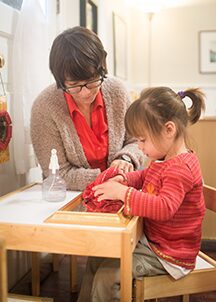
This article describes the benefits of polishing by deconstructing the actions of a child at work documented by an instagram video.
You can view the post by clicking
Parents often ask Montessori teachers why their children are learning so much about cleaning at school. Their children are learning how to wash dishes, sweep the floor, dust, and even polish silver. Can’t the school afford to hire their own cleaning staff?
The answer has nothing to do with keeping the classroom clean. In fact, teachers often have to go back after school and “re-clean” what the children have cleaned. The reason we teach them these “practical life” activities is all about aiding the child’s development.
A mom I know on Instagram (big shout out to @montessoriinmotion) posted a video of her daughter that illustrates some of the benefits of practical life activities. It’s just over one-minute long and is so rich in things to notice that I asked her permission to write about it here. Watch the video on your own first and then read on (and yes, she is sporting the matching Maitri Learning blue flower apron and mat).
Focused Attention
In the first few seconds, you can see that she couldn’t care less about the neighbor’s barking dog; she is very focused on her activity. She begins by setting up what she’ll need: the object to be polished (the turtle); the glass bowl (which will hold the polish); and the polish. While she is doing part of this, her eyes are fixed on the contents of the blue basket. She does not look at where she is placing the glass bowl. Why does this matter? It means that she has already learned how to place an object down with her hand (maintaining proprioceptive control) while her visual attention is focused elsewhere. So, when you think that where a child’s eyes are looking tells you what they are paying attention to, stop and think again!
Handedness
Did you notice that she uses her left hand to pick up and lay out each of these items? But when she gets to the polish, she starts opening it using her right hand. She reconsiders, possibly remembering that she doesn’t need to open it yet (self-correction), and places it down. Next, she switches to her right hand to take out the remaining items she’ll need.
When you see children choosing hands to work with at this age, you may see them switch from left to right, or you may see them strongly dominant already for the right or left hand. You don’t have to worry about it. When you present a lesson to them, just use your dominant hand, but if they struggle with that hand, simply say, “Maybe it will work better with your other hand. You can try it.”
Pausing
Once she has the polish on the mat, she pauses to organize her thinking. This pause is often a tricky spot for adults. We want to step in and make sure they know what to do next. But it is in the pause that so much great development happens (memory consolidation, toggling the default mode network, etc.). So, one of our biggest jobs is to restrain ourselves and give the child time to figure it out.
Sensory Learning
Now she uses her right hand to take out the sponge, cotton swab, and buffing cloth. As she takes out each one, she touches it an extra time as if to receive physical confirmation of what the object is. In neuroscience speak, we call this haptic engagement. She pushes down on the sponge and feels its spring. She uses the pincer grip to precisely place the cotton swab. She uses her whole hand to pat the buffing cloth. Each of these movements is different based on the properties of the object she touches. They also mirror the movements she will use later when putting each object to use.
As an aside, when I see her haptic engagement and her ability to follow logical steps/procedures, I am thinking she might be quite interested in the Sandpaper Letters. To prepare her for that work, this may be the right time to start playing some sound games. After a few weeks of sound games, you’ll be able to introduce the Sandpaper Letters.
Executive Function Development
Okay, back to the polishing work. After patting the buffing cloth, her eyes scan the basket until she finds the thing she needs next: the polish. I love how she nods to herself to validate that yes, now it is time to open the polish! So when we saw her hesitating with the polish when she first took it out, we actually saw her exhibiting inhibitory control: she stopped herself from opening it before it was time to open it. Inhibitory control is a key foundation for higher executive functions. You can google “marshmallow test” if you want to see many examples of young children flexing their inhibitory control abilities.
Now she uses her left hand to hold the polish bottle and her right hand to remove the top and squeeze the dropper (again using the pincer grip.) But when she is placing polish into the dish, you can just see that her eyes are scanning back and forth between the dropper and the dish. This means that her eyes are already moving ahead to the next step of confirming that she has the right amount of polish. Again, this is evidence of her developing executive function ability to plan ahead.
Concentration Overcomes Distraction
Right at about 50 seconds in, her brother comes over and starts talking with her mom about how they might possibly make the paint he wants to use to paint a baseball diamond on the front lawn. First of all, that is an utterly gorgeous thought process by her brother! He is absolutely ingenious in thinking about the chemical properties of paint. Second, his conversation does not phase his sister the tiniest bit. Her concentration remains 100 percent on her polishing activity; even when her eyes glance away. So when you hear someone say that two-year-olds are easily distracted, question if that is really true.
Refined Motor Skills
Right after she applies the polish to the turtle’s back, the turtle spins. This suggests that she used a little bit too much force. The natural consequence is that the turtle spins around. She then moves in for a very close look, and we don’t see the turtle spin again, suggesting that she is using a lighter touch. We just saw a natural consequence lead to the refinement of fine-motor skills!
The need for natural consequences is one of the reasons Montessori environments use items that might break if they are misused, like real glasses and dishes (not plastic or melamine). We expect things to break if they are handled roughly. We always model very careful use, but the child might not pick up on this right away. So, when an object breaks because it is mishandled, the children realize that they need to actually pay attention to what their hands are doing when they hold fragile items. I wish we could do a research study on this point but, in my experience, most children only break one or two things before they adapt and refine. Children who are always given plastic miss this opportunity when the mind is ripe for it.
Attention to Detail
Okay, let’s get back to polishing. When she finishes applying the polish, she holds onto the cotton swab in her right hand and picks up the sponge with her left. She dabs some polish off of the turtle with the sponge but then she uses the sponge to clean off the cotton swab. Only after the swab is wiped off does she place it on the mat. She sets the sponge down then but picks it up again when she notices there is still a bit more polish to wipe off. Once the sponge finally goes to the mat, she uses her left finger to rub the turtle’s back. It’s not clear if she is rubbing off an extra bit of polish or verifying that the polish is off. In either case, she is using her finger to attend to this tiny detail. My husband is always saying he wished his undergraduate chemistry students paid better attention to details in the lab. Maybe they needed to polish more when they were little.
Scaffold/Control of Error
Again, we have a pause where she scans the mat to determine her next step. The order of the materials on the mat acts as a scaffold; the order helps her to figure out what is coming next. She looks until she finds what she needs. In Montessori, we call this a built-in control of error. It means the adult doesn’t need to step in at all while the child is concentrating, the materials themselves will guide the child. This is essential because it allows her to keep working without interruption. That is what is strengthening the neural networks in her attention system. So again, we grown-ups need to step back and allow the child the opportunity to process, think, and choose.
Strengthening the Hand
Now comes the buffing. She starts to rub up a shine with her right hand only. But, this is no one-handed moment! She quickly brings in her left hand to stabilize the turtle so she can apply more force in her buffing. This variable application of strength not only refines her motor skills (as noted above), but also increases her muscular strength and control. And, of course, it creates a really nice shine!
Self-Esteem
The very last thing the video shows us is her enormous smile when she has reached the moment of completion. She is satisfied and happy with what she has accomplished. This, I believe, is where self esteem and self confidence truly come from. Hearing someone else tell us we did a good job is never as deeply satisfying as witnessing our own good work come to fruition.
So, there you have it, eleven ways in which a Montessori practical life activity contributes to the optimal development of the young child. The next time you wonder if you should engage your child in helping out around the house, think back on this. When we do work together with a child, prepare them to work independently, and then give them the freedom to work on their own. This helps them immeasurably.
Return to Table of Contents
by Cindy Acker | MFA, Mindfulness, Montessori Family Life, Montessori Parenting, Parent Education, Parenting on the Same Page, TC March 2021
Do you recall that Bob Marley song? When I visit my daughter (Jenn) and son-in-law (Patrick), it is typical that I hear some version of reggae or Bob Marley playing before I go home (even perhaps in his chiropractic office). It is with intention that they move in life, down to the music they listen to. Pat even renamed his chiropractic office in Seattle to reflect being intentional in life—it is called Conscious Chiropractic. I often tell myself that I want to grow up to be like Jenn and Pat, being so intentional about everything that I do. I have found myself of late, borrowing the words from Bob Marley’s song, when the information on the news or on The Rachel Maddow Show is just more than the heart needs to bear: “One love, one heart … Let’s get together and feel all right.”
Montessori education is respected in research for its strength in the sciences, including social sciences and mathematics. Montessori is a science-based method of responding to the developmental and educational needs, challenges, and abilities of children. Compatible with brain-based, multi-sensory teaching, Montessori education maintains more focus on critical thinking and mastery of skills, and less focus on test-outcome teaching. And it is a method of education in which the arts and sciences are not diametrically opposed. There is an exactness involved in Montessori education that can be confusing when you watch it, until you understand that there are building blocks that have to do with pure science, and with spatial recognition—what goes where, and how do you go from there, how does this fit. From critical thinking to expressive reasoning, the mind can go in many different directions, when adults don’t direct it, and this gives rise to creativity.
But the miraculous thing is that Montessori education combines this science-based educational methodology with—of all things, peace education. One would think they have no connection. However, if one can be so creative as to design solutions to complex math and science problems, one can create solutions to environmental challenges, disease, and war.
This makes Montessori education a unique pedagogy. It is a complex scientifically based methodology, which responds to the entire being of the child—from how the brain responds to stimuli via many different modalities, to the psychological development of the human being, which directly responds to the brain’s ability to take in knowledge. And peace resonates with the brain: it feeds it; it nourishes it. When the brain is positively engaged, there is more access to complex reasoning, more internal space to take a step back and do more—more pathways in the brain to create different solutions, to look behind you, then ahead to see where things are going, to observe, reflect, hypothesize, to see the causal effects of things.
When you think about it, many acts of violence happen in a moment when the brain perseverates over anger. Think about the result of engaged children who are so interested in what they are learning, who from toddler age on, are challenged to discover the joys of geography, geometry, history, science, and the arts. Think about the result of older children being in the living laboratory of the classroom, where children are encouraged to think about what they are thinking about.
If it is true that the arc of history bends toward justice, we must extrapolate; if the arc of gratitude and love is long, it must bend towards peace.
The other natural extrapolation that occurs within an atmosphere bounded by peace on all sides, is that both love and gratitude become “brain changers.” In Greater Good Magazine, Joshua Brown and Joel Wong share gratitude research and its effect on the brain. They randomly divided participants into three groups. They asked one group to write one letter of gratitude to someone every week for three weeks; the second group was asked to write their deepest negative thoughts and experiences; and the third group had no assignment. Of the groups who wrote, those who wrote gratitude letters reported significantly better mental health for 4 weeks and then 12 weeks after the exercise was over.
What was interesting, was the research that followed. The group that wrote the gratitude letters was compared with the group that did no letter writing to find out if their brains were processing differently. “Most interestingly,” they posited, “when we compared those who wrote the gratitude letters with those who didn’t, the gratitude letter writers showed greater activation in the medial prefrontal cortex when they experienced gratitude in the MRI scanner. This is striking as this effect was found three months after the letter writing began. This indicates that simply expressing gratitude may have lasting effects on the brain.”
If this is true, being centered in love, grounded in peace and bounded in gratitude, we model a life strengthening gift for our children—as parents, at home; as teachers in the classroom; as school leaders in our schools.
If it is true that the arc of history bends toward justice we must extrapolate; if the arc of gratitude and love is long, it must bend towards peace. In our classrooms, we want our students to be engaged and joyful; to learn and play; to hold solid values and to stand up for what is right. To be intentional and attentional. To be caring and kind. To be, as Bob Marley says: “One love, one heart.” In our world now, we must learn and guide children to be change-makers who help “get us all together, and we’ll be
all right.” ′
Return to Table of Contents
by Erica Blanco | Communication, Covid, Emotionally Healthy Children, Family Resources, MFA, Mindfulness, Montessori Family Life, Montessori Parenting, TC January 2021
Editor’s Note: Broadly speaking, a dialectic is a tension between two contradictory viewpoints, where a greater truth emerges from their interplay.1
As I write this, I’m sitting upstairs in my son’s room. I hear my one son in his room listening to a webinar, while my other son is watching television downstairs. My husband’s voice and the echoes of his Zoom meeting with colleagues can be heard outside the closed doors of our home office.
This is apparently the new ‘norm.’ What was initially supposed to be ‘temporary’ has now been our life for almost a year. My kids, who once thought it was ‘fun,’ staying home and having Mommy and Daddy supplement their schoolwork, now find the at-home experience dull, unexciting, even frustrating. I assure you that my degree is not in teaching elementary school-aged children, though I have far more respect for teachers than I ever had before (and it was already high to start with). To acknowledge that I have only two and teachers have upwards of 20 students per class is truly amazing, awe-inspiring, and exhausting (at least from my own perspective). What I have learned from these past several months is that families are truly resilient if we rely on each other, provide each other some room and flexibility, and allow both inter-personal and intra-personal growth to occur.
As a psychologist, I am reminded that I became a psychologist to help people. And, surely, when I went to school, I had not considered that part of helping others would occur in the midst of a pandemic. This whole experience has been new to all of us and has created widespread panic, anxiety, angst, even ‘numbness.’
Some patients have told me they have a tendency to laugh at everything at this point, writing it off as, “It’s 2020. What do you expect?” We all cope differently though these experiences and yet, with flexibility and kindness, we can help one another. I remind my students (who are in graduate school to become psychotherapists) that, while they are providing therapy to their patients, their patients will remember them as helping to shape their resilience in the process. While we may be ‘small’ in scope, we are nonetheless powerful in our impact.
I am reminded of a personal experience at an emergency veterinary hospital. My poor kitten, Rascal, was extremely ill with, what I later learned, was diabetes. The doctors told me that he would not likely make it through the night but asked that I stay for a few minutes as they attempted to revive him. As I sat in the waiting room sobbing, a stranger saw me. She gently asked if she could sit with me and expressed that she, too, had been through something similar. She put her arm around me, a comfort, and told me that my feelings of sadness and loss were perfectly appropriate. With loss, there was (and is) also love. While a pandemic is certainly not akin to my personal experience, what stays with me is the caring gestures of a stranger; I never even learned her name. What I recall, in that dark moment, was the care and connection that helped me get through such a lonesome and painful moment. In retrospect, I can see that caring and connection were both occurring at the same time as loss and pain.
I was asked to write this article to explain how to understand that working with situations of opposing feelings/thoughts can lead to a better, third option. Right now, we are all suffering with anxiety, loss, and grief. At the same time, we all share a common reality (i.e., “We’re all in this together,” which can provide some comfort when we use it). Without a concrete end in sight, the greatest gift we can give each other is hope and comfort.
Several years ago, I attended a week-long course in Dialectical Behavioral Therapy (DBT), by Dr. Marsha Linehan.2 I have since attended numerous other trainings in the same modality of therapy. One thing I love about DBT is that it truly can be applied to such a variety of individuals and has shown efficacy in a wide variety of populations. I also find that, as a clinician, I often turn to many of the principles that are taught by Dr. Linehan, not solely with self-care, but also with helping teach my own children some of the interpersonal skills, emotion dysregulation,3 tactics, coping mechanisms, and learning how to tolerate distress. Most importantly (at least in this very moment), I also find that the emphasis on mindfulness is even more important than ever.
What does this mean for us? It means that by practicing some of these skills, we can begin to experience better self-awareness and grounding. We can cultivate relaxation, growth, and ease. We can learn to be better communicators and, quite possibly, better versions of ourselves. One of the hallmark tenets of DBT is the recognition that, in life, there are dialectical ‘tensions,’ in which multiple opinions can be simultaneously true. As we know, at any given moment, we are doing the best that we can, but we also know that we can strive to do better: dialects that we experience all the time and those that are especially important at this time.
Here are some of the basic components of DBT:
Mindfulness: Mindfulness is being present, fully present, in the moment. Not wishing for things to rush forward and not fixating on the past—after all, there is nothing that we can do to change it. But, we can learn from it, right? So, what are some ideas for mindfulness—ones that we can do in the safety of our own homes?
- Cook.
- Play board games.
- Write a book (and have your kids ‘animate’ it)
- Make s’mores outside.
- Take a bubble bath.
- Read together.
- Rollerblade (we have brought this back from the 90s, and I can certainly say that my skills are not nearly as good as they used to be—but, let’s not judge).
- Color.
- Paint.
- Eat dinner—and really sit and talk (no electronics).
Learn how to better communicate your wants, desires, and goals. We are particularly good at saying yes to everything and anything. But, what about if we don’t want to actually do everything?
We have learned to be a distracted society (always doing a million different things). Stop being on autopilot and check back into your lives. Your kids will thank you! And, you will, too. It is common to become distracted. Try not to judge yourself; simply check back into the activity you’re doing. It is OK. Even those of us who have been practicing for years can become easily distracted!
Interpersonal Skills: Learn how to better communicate your wants, desires, and goals. We are particularly good at saying yes to everything and anything. But, what about if we don’t want to actually do everything? We’re just saying yes to be the people-pleasers that we have learned to be? When we’re sitting at your computer at 9 pm and the kids are asking for the millionth time, “Mom! Come tuck me in!” It’s easy to really begin hating what you’re doing because you’re tired. Exhausted. Overwhelmed. Every part of you wants to cuddle in bed and listen to lullabies, putting your kiddos to bed.
So, resentment builds. But, who is the real source of our anger? The boss? Sure. How do you justify anger if you are your own boss? But, really, we need to learn to say no to the things that don’t enrich our lives and say yes more to the things that we really want to do. Trust me, you will want to make time and be more motivated to do those things that really mean yes to you. We need to learn how to self advocate. We need to learn the art of negotiation. We need to teach our kids that it is okay to be selfish at times, as long as we are selfless at other times.
Emotion Dysregulation: I love this term: dys—not; regulation—maintaining stability. Think of a toddler. You’re in a grocery store and your toddler asks for the M&M’s in the check-out line. Oh no. You politely and quietly say no. Then you try to reason with them (bad idea). Then you get louder (stand your ground—another bad idea). Then they’re shouting and you are shouting and turning beet red. You are not happy and your toddler is not happy. And, your first instinct is to bolt.
Second scenario. As a psychologist, teacher, or parent, perhaps you’ve been asked to speak with a young person who seems to have serious behavioral issues. Your task is to try to help ‘problem solve.’ You provide him with a possible scenario that “someone takes your jello at lunch.” How do you feel and what do you do? Truth be told, the “appropriate” answer is to “speak to the adult monitoring the cafeteria.” The answers I have been given include:
“punch them in the face, steal it back, kill them.” Clearly, these are not appropriate responses, but it tells us a lot about how this particular person has ‘learned’ to function. A different person given a similar scenario, might internalize and binge eat ice cream (another problem, albeit a form of ineffective coping). Some have learned (appropriately so) to share how that makes them feel. But, what about when the tension escalates? What tools can we use to respond to this feedback?
- Learn to understand our emotions. Fear=concerns that something will be taken from us; anxiety=us not having control over what we know or desire to be ‘true.’ Anger=feeling unheard, feeling belittled, being treated in a manner that we don’t feel is right. Let’s learn to identify what we are feeling and and what happened that led us to these feelings. Once we uncover the real ‘feeling,’ not the surface, we can start to treat it appropriately.
- Learn how to accumulate positive experiences by building in little things that we know we enjoy or expect to enjoy. For example, after working for three hours, I’m going to give myself a little reward (e.g., coffee, walk around the block, play with the dog).
- Build mastery. Learn a new talent and master it. A dear friend of mine in her 60s just decided that she is going to learn to play the guitar. She has learned one song thus far in the last six months. I think that’s awesome; we can all learn and get lost in it. You do you!
- Anticipate a coping strategy. if you know you will be in a stressful situation, what will (and can) make it better and more manageable? Bring a book, listen to a podcast, plan something fun after.
- Finally, Distress Tolerance: This is a hard one and should not be considered “tolerance /acceptance.” We are all going to experience distress, and we can all learn how to cope to the best of our abilities. Tolerance does not mean that we have to like it, either; however, given that there is much of life that is out of our control, we must do with it what we can. This reminds me of the film Life is Beautiful. This movie reminds us that, even if the midst of horrible situations, much can be changed by how we perceive it and what we make of it. (This, by no means, suggests that what is happening is not deplorable.) So, what are out options?
- Improve the moment: If the electricity goes out (and it is temporary), let’s have a flashlight read-along. If things are stressful, let’s pause and figure out what (in this moment) can make things a little, even if is just a tiny a morsel better? If I have to wait longer at a doctor’s appointment than anticipated, can I read a book that I’ve been wanting to read for a while? If I get, oh, let’s see—locked into my house with my kids for ten months—can I be grateful to have this time with my safe, rambunctious kids? And, then, play games? Rollerblade? Read? Give them time to be kids while I get my time adulting? Learn how to cook something? Learn knitting with them or making a million friendship bracelets?
- Radical acceptance: I am not only going to accept what is happening, but I am going to put my all into it. So, if I’m going to stay in my house for this amount of time, I am going to redesign my living room. I am going to give back to others if possible. I am going to accomplish all of these things that I have wanted to do for some time. I am going to allow my feelings to upset me for only a short period of time and then I’m going to bounce back. Further. And, higher.
- Change of atmosphere: If I’m really feeling deflated and as though I am going to crumble, I might change my atmosphere drastically. I will go running and increase my adrenaline and give myself a runner’s high. I will go shower in ice cold water (hey, it will take your mind off things). I will hold a piece of ice in my hand (which we have done in psychiatric hospitals) and I promise, you will feel different things. Sometimes we have to, quite literally, change our physiological response to stop ourselves in our spiral. Hit the ‘reset’ button, if you will.
- Self-soothing: I will relax in a bath. I will make cookies and smell the aroma. I will wrap myself in a cozy fleece blanket. I will go outside to fresh air. I will listen to quiet, beautiful music.
- Practice gratitude: It’s human nature to compare ourselves to others. But, is it really helpful? The reality is that the more that we try to grow into who we want to be and give it time, patience, and respect, we will become that person. Our past helps to shape us. Often, the very things we perceived as being ‘bad’ were huge growth opportunities that eventually helped us to feel better. Ask yourself: In five years, will I be proud of what I did or how I acted? The reality is, we could all use a little more appreciation, kindness, and flexibility (even applied to ourselves).
I have used some of these DBT skills on a variety of individuals, myself included. I have seen the beauty of DBT and how people benefit so greatly from it. There is a philosophy that you cannot and should not ‘make’ people, who are willful (i.e,. stubborn, unwilling, non-motivated) do things that they do not want to do. However, with time and exposure, seeing others feeling content—even happy, people often learn that they, too, want to be happy. So, as Dr. Linehan would say, “Let me know when you’re ready, and let’s go together.”
Remember, you are not alone… For more on DBT, consider reading Dr. Linehan’s books (see below). They just might change your perspective.
1 Reidbord M.D., S. (September, 13, 2019) “Dialectics in Psychotherapy,” psychologytoday.com
2 Marsha M. Linehan (born May 5, 1943) is an American psychologist and author. She is the creator of dialectical behavior therapy (DBT), a type of psychotherapy that combines behavioral science with Buddhist concepts, such as acceptance and mindfulness. en.wikipedia.org/wiki/Marsha_M._Linehan.
3 Emotional dysregulation is the clinical term used to describe an emotional state that is difficult to control, including unhealthy patterns of emotional coping, a predilection toward outbursts of emotions, and an inability to or a struggle with expressing emotions effectively (if at all). (August 28, 2020) www.betterhelp.com.
by Andrew Newman | Book Reviews, Brain Development, Communication, Emotionally Healthy Children, Kindergarten, Lower Elementary (6-9), Mindfulness, Montessori Family Life, Montessori Parenting, Primary (3-6), Toddler (18 months-3 years), Upper Elementary (9-12), Webinars / MFA
Bedtime is far more than ‘just story time’. It is a time when our kids are integrating the experiences of their day and transitioning between brain states and brain functions. How we engage with them during the last 20 minutes impacts their esteem, self-worth, and confidence in the morning. Listen in on this conversation around the role of meaningful connection, and top tips on how to create connected moments at bedtime.
by Frederic Luskin PhD | Emotional Intelligence (EQ), Emotionally Healthy Children, Mindfulness, Peace Education, Psychology, School Leadership, Social Justice, The International Montessori Council, Webcasts / IMC
Dr. Fred Luskin, (keynote speaker for our 2019 Annual International Conference) to explore forgiveness with the goal of reducing hurt and helplessness, letting go of anger and increasing confidence and hope as we learn how to release unwanted hurts and grudges. His presentations explore the HEAL process of forgiveness that, when learned, can lead to enhanced well-being through self-care.
In the Forgive for Good workshop and class series, Dr. Frederic Luskin presents the forgiveness training methodology that has been validated through six successful research studies conducted through the Stanford Forgiveness Projects.
by Tanya L. Ryskind J.D. | Communication, Empowerment, Mindfulness, School Leadership, The International Montessori Council, Webcasts / IMC
Webcast Delegating To Enhance Everyone’s Outcome
by Dr Val Wise | Communication, Empowerment, Maria Montessori, Mindfulness, Mixed Ages, The International Montessori Council
Research has demonstrated the benefits children gain from attending racially diverse schools. Berends and Penaloza (2010) and Newton (2010), both found that students in diverse schools tended to score higher in math. Benson and Borman (2010), found that literacy scores improved when students attended racially diverse schools. As Montessorians, we know that education cannot be separated from its connection to culture. We recognize the fact that children bring with them a rich font of knowledge and cultural resources and that we need to value and affirm the child’s cultural and linguistic knowledge.
Although Montessori has been widely known to provide progressive private education for those who could afford it (which for the most part has been white families) public Montessori, on the other hand, has grown exponentially over the past 50 years. In many cases, unlike its private counterpart, public Montessori has its roots in racially diverse and high-need schools. Public Montessori schools currently make up approximately 12.5 percent of the estimated 4,000 Montessori programs in the United States (AMS 2016). This racial and socio-economic diversity has continued to make public Montessori more diverse on nearly all measures than the average public school in America or its private counterpart (Debs 2016).
While public Montessori programs tend to be more diverse, today’s Montessori trained teaching force tends to be white females in increasingly more diverse schools. This fact creates a potentially significant “cultural disconnection” among students, their families, and their teachers.
Montessori stated, “We shall walk together on this path of life, for all things are part of the universe and are connected with each other to form one whole unity.” She recognized that human beings must be connected to each other in order to flourish. Our foundational beliefs as Montessorians about the nature of humanity and children, in particular, places us in a philosophically unique position in the United States to be at the forefront of creating the kind of environments that will increase racial equity. We have schools that embrace the concept of diversity and inclusion and philosophy whose undergirding principles support it. But, so often equity and inclusion has come to mean, “Do I have the right number of people of color on the board?” or “Are there enough children of color in my classroom?” or “Do I have a diverse enough teaching faculty?” True racial equity must be more than a numbers game. It’s more than the window dressing of hanging a Black History Month poster in the school’s entryway each February in the U.S.
The organization, Equity in the Center, suggests there is a cycle, or a measurable spectrum, to an organization becoming more racially equitable, more inclusive. They call it “Awake to Woke.” And while each organization may approach this work differently, their research suggests that cycles are there nonetheless.
The first phase of the cycle is called “Awake.” It is a time period when the organization recognizes that diversity and equity are important, but focuses on numbers or percentages of people of color in the organization rather than a true diversity that goes deeper into the fabric of the school; it is entwined in the thread that holds the fabric together—barely visible to the naked eye but integral to the quality and durability of the fabric. Equity in the Center refers to this as “representation.”
The second phase is Woke. During this phase, organizations move past merely thinking about the representation of people of color in the organization to working on developing an inclusive culture mindset. The organization’s policies and procedures reflect this belief in race equity. And, those involved in the organization have the language to effectively discuss race equity and inequities.
The final phase is the “Work” phase. The organization is now able to use a “race-equity lens” to develop systems to support race equity both within and outside of the organization.
An illustration frequently used to distinguish between the phases of the cycle is that Awake is inviting people of color to a party (representation); Woke is asking them to dance (inclusion), and Work is asking them to help choose the music (focus on systems).
This race-equity work can be linked to Dr. Montessori’s idea of the “prepared environment.” We know that preparation of the environment is crucial, and we spend long hours making sure that everything in the classroom is prepared and ready for the child. Dr. Montessori stated, “The environment must be a living one, directed by a higher intelligence, arranged by an adult who is prepared for his mission” (Montessori, 1936). But, are we as working as hard to prepare our school for the families of color, who are coming into our institutions that are typically dominated by white middle-class norms?
Although Montessori schools are becoming more and more diverse, with higher percentages of families of color, research suggests that black and Latino parents frequently feel marginalized even in racially diverse schools. This fact manifests itself in their involvement and interactions with teachers and fellow parents. Research suggests that, in some cases, the ability of parents of color to participate fully in the school culture can be limited by the dominance of white families in these schools (Cucchiara 2013; Cucchiara and Horvat, 2009; Lareau and Horvat, 1999; Posey-Maddox, 2013, 2014). Research also suggests that a faculty that is predominantly white can intentionally or unintentionally discriminate against students and parents of color (Delpit, 1995; Ladson-Billings, 1998; Lewis, 2003; Lewis-McCoy, 2014; Lightfoot, 1978; Tatum 2003).
Placing equity at the center of our practice is more than just making sure that our communities are diverse. It also means that we are working for change that will prepare our organizations for families of color the same way we think about preparing the classroom environment for the children who will inhabit them. ′
REFERENCES
Achebe, C. (1986a). Things fall apart. London: Heinemann.
Achebe, C. (1986b) Arrow of God. London: Heinemann.
Achebe, C. (1988). The Igbo world and its art, in Hopes and Impediments. London: Heinemann.
Awake to Woke to Work: Building a race equity culture. Equity in the Center (a project of ProInspire). https://www.proinspire.org/
Benson, J. & Borman, G. (2010). Family, neighborhood, and school settings across seasons: when do socioeconomic context and racial composition matter for the reading achievement growth of young children. Teachers College Record 112(5): 1338-90.
Berends, M. & Penaloza, R. (2010). Increasing racial isolation and test score gaps in mathematics: A 30-year perspective.Teachers College Record 112(4):978-1007.
Cucchiara, M. (2008). Re-branding urban schools: Urban revitalization, social status, and marketing public schools to the upper-middle class. Journal of Education Policy 23(2):165-79.
Cucchiara, M. & Horvat, E. (2009). Perils and promises: Middle-class parental involvement in urban schools. American Educational Research Journal 46(4):974-1004.
Cucchiara, M. (2013). Marketing schools, marketing cities: Who wins and who loses when schools become urban Amenities. Chicago: University of Chicago Press.
Cucchiara, M. & Horvat, E. (2014). Choosing selves: The salience of parental identity in the school choice process. Journal of Education Policy 29(4):486- 509.
Delpit, L. (1986). Skills and other dilemmas of a progressive black educator. Harvard Educational Review 56(4):379-86.
Delpit, L. (1995). Other people’s children: Cultural conflict in the classroom. New York: NewTPress.
DuBois, W. (1903). The souls of black folk. Chicago: A. C. McClurg & Co.,
Goldsmith, P. (2010). Learning apart, living apart: How the racial and ethnic segregation of schools and colleges perpetuates residential segregation. Teachers College Record 112(6): 1602-30.
Ladson-Billings, G. (1994). The dreamkeepers: Successful teachers of African American children. San Francisco: Jossey Bass.
Ladson-Billings, G. & Tate IV., W. (1995). Toward a critical race theory of education. The Teachers College Record 97(l):47-68.
Ladson-Billings, G. (1998). Just what Is critical race theory and what’s it doing in a nice field like education? International Journal of Qualitative Studies in Education ll(l):7-24.
Lareau, A. (1989). Home advantage: Social class and parental intervention in elementary education. New York: Rowman and Littlefield.
Lareau, A. & Horvat, E. (1999). Moments of social inclusion and exclusion race, class, and cultural capital in family-school relationships. Sociology of Education 72(l):37-53.
Lareau, A. (2003). Unequal childhoods: Class, race, and family life. Berkeley, CA: University of California Press.
Lareau, A. (2011). Unequal childhoods: Class, race, and family life. Second Edition. Berkeley, CA: University of California Press.
Lareau, A. & Munoz, V. (2012). You’re not going to call the shots: structural conflicts between the principal and the PTO at a suburban public elementary school. Sociology of Education 85(3):201-18.
Lareau, A. (2014). Schools, housing and the reproduction of inequality. pp. 169-206 in Choosing Homes, Choosing Schools, edited by Goyette, K. & Lareau, A.. New York: Russell Sage.
Lewis, A. and Diamond, V. (2015). Despite the best intentions: How racial inequality thrives in good schools. Oxford, UK: Oxford University Press.
Lewis, A. (2003). Race in the Schoolyard: Negotiating the color line in classrooms and communities. New Brunswick, NJ: Rutgers University Press.
Lewis-McCoy & L’Hereux (2014). Inequality in the promised land. Palo Alto, CA: Stanford University Press.
Lightfoot, S. (1978). Worlds apart: Relationships between families and schools. New York: Basic Books.
Montessori, M. (1912). The Montessori method. Translated by Georges, A. E. New York: Frederick A. Stokes.
Montessori, M. 1948/2008. From childhood to adolescence. Amsterdam: Montessori Pierson.
Montessori, M. (1996). The secret of childhood. Hyderabad, India: Orient Black Swan.
Montessori, M. (2007). The child in the family. Translated Cirillo, N. Amsterdam: Montessori-Pierson.
Montessori Public Schools Consortium (MPSC) (1993a). 100 Largest U.S. School Systems. MPSC Update 2(1):5.
Montessori Public Schools Consortium (MPSC). (1993b). Montessori Head Start. MSPC Update 1(1):1,11.
Montessori Teachers Institute for Professional Studies (MTIPS) (July 15, 2016). Facebook post: signal vs. noise: how to build your school’s digital channel presenter. Retrieved from https://www.facebook.com/mtips.org/
Moyers, B. (1989). A world of ideas. London and New York: Doubleday).
Murray, A. (2008). Public perceptions of Montessori education. Ph.D. Thesis, Department of Psychology and Education, University of Kansas.
Murray, A. & Peyton, V. (2008). Public Montessori elementary schools: A delicate balance. Montessori Life 20(4):26-30.
Posey-Maddox, L. (2013). Professionalizing the PTO: Race, class, and shifting norms of parental engagement in a city public school. American Journal of Education 119(2):235-60.
Posey-Maddox, L.( 2014). When middle-class parents choose urban schools: class, race and the challenge of equity in public education. Chicago: University of Chicago Press.
Newton, X. (2010). End-of-high-school mathematics attainment: How did students get there? Teachers College Record 112(4): 1064-95.
Tatum, B. (2003). Why are all the black kids sitting together in the cafeteria and other conversations about race: Basic Books.
Wells, A., Holme, J., Revilla, A., & Atanda, A. (2009). Both sides now: The story of school desegregation’s graduates. Berkeley, CA: University of California Press.
ML/ August 2019/ Pg 25
by Ann Epstein Ph.D | Brain Development, Children with Exceptionalities, Empowerment, Mindfulness, Mixed Ages, Montessori Education, Montessori Teachers, Planes of Development, Prepared Environment, Sensorial, The International Montessori Council
Supports for children who have special needs have been legally mandated for several decades in the United States. The Individuals with Disabilities Education Act became law in 1990 and was updated in 2004. Public schools must provide Individualized Education Programs (IEPs) for students with documented needs that meet the law’s specified criteria. IEPs identify needed accommodations, special education services, and supplementary aids as well as their frequency and duration. Montessori guides who teach in public school settings typically collaborate with special educators and service providers (for example, occupational therapists) within their district to provide appropriate services for children who have exceptionalities. Children who attend independent Montessori schools are also entitled to federally supported services through IDEA provisions.
In addition to accommodations (services and supplementary aids specified in children’s IEPs), Montessori guides often need to adjust classroom practices. Depending on each child’s individual needs and strengths, adjustments can affect how guides teach lessons, demonstrate materials, design the classroom environment, assist children during transitions, facilitate conflicts, and address a myriad of other day-to-day interactions. The following chapter provides examples of how Montessori guides support children with exceptionalities in primary (ages three through six) and lower elementary (ages six through nine) classrooms. Supports address Montessori developmental aims of concentration, independence and order, as well as fine-and-gross motor skills, cognition, and social/emotional growth.
Some guides and administrators hold the view that adjusting classic presentations or changing aspects of the work period conflict with their training and are ‘not Montessori.’ However,
changes can make the difference between a child being a successful, joyful learner or being frustrated and even miserable. The following recommendations are either current evidence-based practices or suggested by Montessori guides experienced in working with children who have exceptionalities. Every guide and school head needs to decide if these suggestions fit with her/his view of Dr. Montessori’s philosophy. Hopefully, the strategies will offer possible solutions and perhaps expand the Montessori community’s view of following each individual child.
Observation, the present level of performance, and goal setting
Before examining specific supports for learners with exceptionalities, attention must be given to determining the child’s strengths and needs. Dr. Montessori implored teachers to observe children carefully (Montessori, 1964). While pointing out that “…the teacher shall observe whether the child interests himself in the object, how he is interested in it, for how long, etc., even noticing the expression on his face…” (pp. 108 – 109), Montessori did not provide specific observational formats. Rather, she emphasized the importance of both capturing details of how children work with materials and honoring “principles of liberty” (p. 109). Montessori warned against insisting a child pursue an activity, noting this can cloud whether or not the child is truly ready to engage in exploring and learning specific concepts.
A possible translation of Montessori’s recommendations into today’s special education landscape is that teachers need to document the child’s present level of performance (Individualized Education Program, 2006). Anecdotal records (brief objective snapshot statements of a child’s performance), running records (more in-depth accounts of how a child carries out an activity or an interaction), and checklists (noting whether or not a child carried out a particular activity or behavioral expectation) are all helpful. The aim is to document as much detail as possible regarding the child’s current level of understanding and/or behavior.
If, for example, a guide is concerned that a three-year-old child concentrates for short periods of time, documentation of start and stop times of the child working with various materials will provide a clear starting point. The guide may learn that the child spends more time with practical life activities and less with sensorial materials. The guide could further note whether the child concentrates longer when working with a peer if there are differences in the child’s concentration at the beginning of the work period versus the middle or the end and if the child sustains attention for longer periods of time when playing outdoors. Careful observations and documentation will assist guides in determining, in as much detail as possible, the child’s present level of concentration.
Once the child’s present level of performance (sometimes referred to as the PLOP) is clear, guides may find it helpful to check developmentally appropriate expectations. The American Academy of Pediatrics (n.d.) partners with Healthychildren.org to provide expected milestones in the areas of movement, fine-and-gross motor skills, language, cognition, and social and emotional development. Using the above example, perhaps the guide notes that the child does not consistently follow three-part commands nor recall parts of a story. This could suggest the child is having difficulty understanding verbal explanations and reminders, leading to another round of observations.
In addition to the American Academy of Pediatrics, the Center for Disease Control (CDC) also provides information regarding expected milestones in a resource titled, “Learn the Signs – Act Early.” When Montessori guides wonder if a child is on track in any developmental domain, it is helpful to refer to several recent, professionally vetted milestones. Keeping in mind that teachers’, as well as parents’ expectations, can be either high or low, milestone ranges can be helpful guidelines.
Lower elementary guides may find academic standards helpful. State departments of education provide expectations in language arts and math for each grade level, as does the Common Core (n.d.). While the Montessori curriculum does not align completely1 with traditional reading, writing, and math expectations, guides can use academic standards to better understand a child’s level of performance. Both the National Center for Montessori Education in the Public Sector (http://www.public-montessori.org/resources/common-core-state-standards) and the Association Montessori Internationale provide suggestions for aligning Montessori with elementary standards (https://amiusa.org/ami-montessori-and-the-common-core-state-standards/).
The final—and crucial—step in determining a child’s present level of performance is to fully accept it. Guides truly need to be at peace with a child, for example, working with an activity for an average of three minutes across settings, times of the day, and with or without peers. Supporting this child in increasing his or her concentration occurs much more easily if teachers are not resisting the child’s current length of time. Thinking, “ just can’t concentrate. How can I manage our classroom when only concentrates for 3 minutes?!” adds stress for both the guide and the learner. Alternatively, accepting that the child can consistently focus for three minutes is more likely to result in planning for and then implementing a
successful change.
Once the learner’s PLOP is clearly documented, goal setting should be carried out with families. Before meeting with a family, the guide drafts a manageable, achievable goal. Then the guide listens carefully to whether or not family members agree and adjust the goal to fit the family’s needs and priorities. Working in a respectful partnership is essential to the child’s success. Ongoing, frequent communication between families and guides is especially important if a goal needs to be altered once interventions are implemented.
The guide then shares evidence of the child’s learning with parents. A portfolio of photos, videos, and work samples helps families understand what the child is able to do and where the child is struggling. Again, it is important to consider the range of ages when children reach milestones. For example, it is typical for children to produce clear /r/ sounds in their expressive speech any time between age 3 and (particularly for boys) age 7. At this point, it is important for parents to observe the classroom, not only to perhaps catch a glimpse of the concern but to view the range of skills across age levels.
Goals are discussed and agreed upon with family members. Next, determine specific ways to reach the goal. It is important to reflect upon and begin planning interventions before meeting with families. When sharing possible approaches, invite families to discuss both your suggestions and their own recommendations. Agree on a clear plan, and explore changes that could also support the child at home. Both guides and families find it helpful to document the agreed-upon plans, whether with a quick email or a simple hard copy.
Strengthening concentration
The previous example addressed helping a three-year-old child increase the average length of time working with an activity. It is important to note that difficulty concentrating is not considered a special need according to IDEA criteria. However, it is often a component of a language disorder, an intellectual disability, or even an emotional disorder. And difficulty focusing on a task or activity can ‘simply’ be associated with a child’s temperament. Since concentration is a key component of Montessori learning and difficulty sustaining attention can be associated with an exceptionality, it serves as the premise for an example of how to implement effective supports.
Perhaps the family and guide agreed that concentrating for five minutes (on average) is an achievable goal. The guide observed that the child stayed with an activity longer as the morning work period progressed. However, arrival, settling in, and choosing an initial activity appeared to be particularly difficult. The guide also observed that the child enjoyed the book reading area of the classroom and often looked at books for up to five minutes. The guide suggested (and the family agreed) that an adult (either himself or his assistant) read a story that the child selected for at least two minutes at the beginning of the work period. The adult would then lead the child to either practical life or sensorial (preferred areas), offer the child two choices (for example a knobbed cylinder block or the demonstration tray of the geometric cabinet), and gently remind the child to complete the work before returning it to the shelf.
Several components of a potentially successful outcome are present in this scenario:
1. Beginning the work period with adult support of a preferred activity (story reading)
2. Making a choice between two specific preferred activities (rather than choosing from the whole array of activities in practical life or sensorial)
3. Listening to a gentle reminder of expected behavior (complete either the demo tray or the cylinder block before returning it to the shelf)
Children in lower elementary classrooms who struggle with concentration issues require supports suited to their developmental levels. They are typically able to monitor their own time with a personal watch or a classroom clock. Often, they enjoy beating their time by, seeing if they can concentrate for an additional five minutes. Lower elementary students are also able to use self-talk more effectively. For example, reading or reciting a statement similar to the following can be helpful.
“I am learning to focus longer and longer on my work. Today I am aiming for 15 minutes. I know I can do it!”
Lower elementary students also enjoy visual displays of their progress. Guides can assist them in making their own daily and weekly graphs, showing the number of minutes they focused successfully on their work. Guides can either send families a hard copy or an electronic file of the learner’s graph each evening.
Rochester (MN) Montessori School lower elementary guide, Andy Sawyer, stated his single most effective support for students working to stay focused has been offering an opportunity to run several laps around the school soccer field first thing in the morning. “Over half of the students in my class took advantage of our offer and ran four or five laps if the weather cooperated. This provided social time as well as a way to wake up their brains (synapse activation). It really did help everyone begin their day ready to learn.” (Sawyer, personal communication, July 2016).
The success of particular support depends on how well suited it is for an individual learner. Table 1 notes support that could prove helpful for children in Montessori primary and lower elementary classrooms who are working to strengthen concentration if careful observation reveals them to be appropriate matches for individual needs and strengths.
Encouraging independence
Montessori recognized the child’s inner drive to “do it myself” (Montessori, 1967). She urged guides (and parents) to refrain from “helping” children with any task or activity they could carry out on their own. Montessori also designed each learning material with an inherent control of error, eliminating the need for an adult to check or correct children’s work.
Occasionally, children need support in carrying out procedures independently. Photo booklets, similar in design to Social StoriesTM (Gray, 2004) can be helpful. If, for example, a child has difficulty remembering each of the steps involved with using the restroom, a guide can display sequential photos on the bathroom wall. Sequential photos can also assist children who struggle with putting on and taking off snow clothes, as well as cleaning up after lunch, or putting away work and joining classmates for a community gathering. (Please see Figure 1 for an example of a social story regarding appropriate touch.)
Assisting the development of children’s sense of order and self-discipline
Early childhood educators assist children in learning to regulate their behaviors and develop self-discipline (de la Riva & Riva, 2015). Montessori (1966) addressed a component of self-discipline by recognizing the importance of respecting children’s sense of order. She noted that “Order is one of the needs of life which, when it is satisfied, produces real happiness.” (p. 52) Montessori believed that children have an inner sense of order that is nurtured when their surroundings and routines are predictable, consistent and orderly. If this is so, and children are still not able to regulate their behaviors, guides may need to provide additional supports.
Strategies regarding multi-sensory integration can prove effective in helping children manage their behaviors and, ultimately, develop self-discipline. While not formally recognized by the U.S. Department of Education (2015) as a special need, difficulty integrating sensory input can result in learning and behavioral challenges. Recently termed “sensory processing disorder” (SPD), difficulties include unsteady balance, hypo or hypersensitivity to touch (can vary from day to day), fine-motor weakness, and poor muscle tone or coordination (Sensory Processing Disorder, n.d.). Occupational therapists typically provide services for children with SPD. There is controversy regarding the effectiveness of SPD strategies. However, occupational therapists (Sweet, 2010), special educators, and pediatricians note successful outcomes (Gourley, Wind, Hennigher, & Chinitz, 2013; Noddings, 2017). Montessorians have found success helping children regulate their behaviors (for example, impulsively touching—or shoving or hitting—a peer) by calming themselves through the use of weighted lap pads and therapy balls (with lower elementary students) for short periods of time. The use of sensory integration materials and equipment should be supervised by a knowledgeable professional (for example, a special educator serving as a consultant to the Montessori school).
Practical life and art activities such as pouring rice or water, working with play dough, and handwashing (perhaps with the option of applying a small bit of lotion) can help young children with challenging behaviors to develop self-discipline. The length of the activity is a key point. Children working to regulate their behaviors often need long works (such as polishing or dishwashing) to be shortened. Reducing the number of steps provides them with the opportunity to repeat soothing steps and not lose track of what to do next. For example, table scrubbing can be modified to include only dampening a small brush, running it over a bar of soap, scrubbing, and then drying the table with a hand towel. This allows children to repeat circular scrubbing strokes over and over, often bringing them to a calm state. Providing a variety of interesting items to scrub (large seashells, car tires, large pumpkins) and modifying the number of steps can provide children with successful self-regulation experiences that also honor and strengthen their sense of order.
Both children’s house and lower elementary guides may find it helpful to design a small area of the classroom (or even a single shelf) to house sensory items. Rainsticks, soft hand puppets, snow globes, unlit scented candles, scented hand lotion, earphones for listening to sounds in nature, and kaleidoscopes can provide relaxing sensory input. Children can have the option of selecting one of these items and ‘taking a sensory break,’ for a specified amount of time. Or, several items can be placed in a basket for children to select, take to a rug or table, and then explore as they would any other material.
Teaching young children to use specific verbalizations can also help develop self-regulation. Rochester Montessori School special educator, Diane Betzold, describes her success in working with a highly active three-year-old:
“I had worked with Sam for around a month, modeling slow movements and quiet voice levels. We worked on puzzles and read stories together in my classroom (resource room) several times a week. I also modeled the phrase, “I am calming my body” while we pursued various activities. One day, Sam’s teacher brought him to my room for unscheduled work time. Sam had been running in his classroom and was unable to focus on any activities. Red-faced and a bit out of breath, he declared, “Miss Diane, I am calming my body!” While I modeled taking a slow, deep breath, Sam repeated this phrase and did calm his body. We worked together for just another few minutes until he was ready to return to his classroom. I reminded his teacher to use this strategy with him. She later shared that modeling and encouraging Sam to calm his body was effective. (Betzold, personal communication, July 2016).
Similarly, older children may have success in repeating self-affirmations. Coupled with taking one or two deep breaths, reminders to use phrases such as “I can be calm again” and “I feel myself calming down” can help learners return to a calm state.
Supports for strengthening motor skills, cognition and memory, and social/emotional skills
Children with exceptionalities in specific developmental areas may have services documented on their IEP. Often, though, Montessori guides observe the need for supports within and across developmental domains before IEPs are developed. Fine motor supports can take the form of pencil grips and adaptive scissors. Attaching magnets to three-part cards and providing a magnetic whiteboard (or a simple aluminum cookie sheet) can offer security to a child with weak eye-hand coordination. Time riding on stationary bikes (child-sized), jumping on mini-trampolines, and walking across very low (4 to 6 inches off the floor) balance beams (children remove shoes and socks) can help children strengthen and coordinate large muscles. In addition, these activities often help children develop order, concentration, and independence.
A wide array of strategies is available to Montessori guides working with children who struggle to remember information. Reflection approaches such as SQ4R (Hartlep & Forsyth, 2000) can help children remember specific concepts and definitions. Guides can model the five components—survey, question, read, recite, writer. Self-talk (repeating definitions to oneself) and pneumonic devices can be helpful. Graphic organizers, from standard Venn diagrams to fish skeletons (Figure 2), can assist children in understanding and remembering over-lapping characteristics and relationships, including cause and effect and ‘if/then.’
Dr. Montessori identified effective cognitive strategies that have withstood the test of time while working with children who struggled with early reading, writing, and math concepts (Montessori, 1965). She modeled a multi-sensory approach by showing children how to gently stroke sandpaper letters while repeating their sounds (/a/, /a/, /a/). Guides can offer children similar opportunities with puff paint as well as felt letters and numerals. Tracing letters in farina (milled wheat) sprinkled on a tray or over zip lock bags filled with hair gel offer additional tactile experiences.
Perhaps the most effective cognitive support is careful error analysis followed by modeling and guided practice. Where does the learner become confused? If the primary-aged child cannot follow all the steps of dynamic addition, return to static addition and re-teach the process more slowly. If a silent demonstration is not effective, verbalize the steps. “I have 11 unit beads. I will exchange ten of my beads for a ten bar. Now I have one ten bar and one unit bead.” Ask the child to repeat your actions and your verbalization. Then stay with the child as he/she practices. Provide this assistance for several days. Do not step back until the child demonstrates understanding. Scaffolding instruction (Berk & Winsler, 1995) is important for all learners but is often critical for children who struggle with cognitive processing.
Supporting children who are upset, frustrated, and perhaps even aggressive can be particularly wearing for Montessori guides. Just as math and literacy skills need to be modeled, social skills must be overtly taught for some children. Grace and courtesy lessons typically include inviting a peer to work together, passing in front of another (“excuse me”), and waiting for a busy teacher’s attention (placing one’s hand on a guide’s shoulder). Addressing one’s own strong emotions and learning to resolve conflicts require step-by-step demonstrations followed by opportunities for practice. These practice lessons should take place with a willing peer when children are calm. When an actual upset occurs, guides need to calmly step in and remind children of each step.
For example, if a child (Mattie) appears to kick another child’s (Sara) pink tower, the guide first helps the kicking child identify intentions and feelings. “Are you mad at Sara?” “Would you like to work with Sara?” “Are you upset that Sara did not ask you to build the tower with her?” Then the guide asks Sara to share her feelings. “How did you feel when Mattie kicked over your tower?” Once feelings and intentions are identified, the guide facilitates a resolution. “What do you think we should do now?” Guides are often surprised at how quickly children offer the next step. Occasionally, children need ideas, but the resolution is much more effective if it is generated by participants rather than by guides.
Again, the critical component of providing supports for children who struggle with social and emotional challenges is that guides must teach these skills directly. Just as lessons are given to help children learn rhyming words and subtraction, guides need to demonstrate and then help children practice and learn conflict resolution. That said, the design of the learning environment could assist in fostering a peaceful atmosphere. Inviting work areas with small lamps, gentle miniature waterfalls, soft fabric wall hangings, quiet music, and aromatherapy suffusions add soothing sights, sounds, textures and smells to classrooms.
Dr. Montessori began her pedagogical work with children who did not learn easily. Over a hundred years later, Montessori guides continue her legacy of providing individualized instruction. Whether children have IEPs with specific services or they are in the grey area of “struggling learners,” guides have the opportunity and responsibility to provide assistance. Once the child’s present level of performance is determined, a plethora of support is available to Montessori guides. In collaboration with families and specialists, strategies are carefully selected, implemented, and monitored. If the child does not achieve the targeted goal, another support is implemented. Throughout this process, guides, are, indeed, adhering to Dr. Montessori’s original directive to respect and honor each individual child’s strengths and areas of need (Lillard, 1972; Montessori, 1964). ′
References
American Academy of Pediatrics (n.d.). Retrieved from https://www.healthychildren.org/English/ages-stages/toddler/Pages/Developmental-Milestones-3-to-4-Years-Old.aspx
Berk, L. E., & Winsler, A. (1995). Scaffolding children’s learning: Vygotsky and early childhood education. Washington, D.C.: National Association for the Education of Young Children.
De la Riva, S., & Ryan, T. G. (2015). Effect of self-regulating behavior on young children’s academic success. International Journal of Early Childhood Special Education, 7(1), 69-96.
Common Core Standards Initiative (n.d.) Retrieved from http://www.corestandards.org/read-the-standards/
Gourley, L., Wind, C., Henninger, E. M., & Chinitz, S. (2013). Sensory processing difficulties, behavioral problems, and parental stress in a clinical population of young children. Journal of Child and Family Studies, 22, 912-922.
Gray, C. (2004). Social StoriesTM10.0 The new defining criteria & guidelines. Jennison Autism Journal, 15(4), 2-21.
Hartlep, K. L., & Forsythe, G. A. (2000). The effect of self-reference on learning and retention. The teaching of Psychology, 27(4), 269-271.
Individualized Education Program. (2006). Retrieved from http://idea.ed.gov/explore/view/p/TopicalArea2C.
Individuals with Disabilities Education Act of 2004, Pub. L. No. 108-446. (2004). Retrieved from http://idea.ed.gov/explore/view/p/statute.
Individuals With Disabilities Education Act 20 U.S.C. § 1400 et seq. (2006).
Lillard, P. (1972). Montessori: a modern approach. New York City, NY: Schocken Books.
Montessori, M. (1964). The Montessori method. New York City, NY: Schocken Books, Inc.
Montessori, M. (1965). Dr. Montessori’s own handbook: A short guide to her ideas and materials. New York City, NY: Schocken Books, Inc.
Montessori, M. (1966). The secret of childhood. New York City, NY: Ballantine Books.
Montessori, M. (1967). The discovery of the child. New York City, NY: Ballantine Books.
Noddings, A. (2017). Classroom solutions for sensory-sensitive students. Montessori Life, Summer 2017, 45-49.
Sensory Processing Disorder, n.d. Retrieved from http://www.sensory-processing-disorder.com/sensory-processing-disorder-checklist.html.
Sweet, M. (2010). Helping children with sensory processing disorders: The role of occupational therapy. Odyssey, Spr/Sum 2010, 19-22.
U.S. Department of Education, National Center for Education Statistics. (2015). Digest of Education Statistics, 2013 (NCES 2015-011), Table 204.30. Retrieved from http://nces.ed.gov/fastfacts/display.asp?id=64
ML/ August 2019/ Pg 9
by Cindy Acker Sarah McArthur LeValley | Emotionally Healthy Children, Empowerment, Mindfulness, Mixed Ages, Montessori Charter Schools, Prepared Environment, School Leadership, Sensitive Periods, Social Justice, The International Montessori Council, Webcasts / IMC
Webcast The Importance of Social Justice Practice in Montessori Schools
by Christine Lowry | Children with Exceptionalities, Communication, Empowerment, Mindfulness, Mixed Ages, Montessori Education, Montessori students, Planes of Development, Prepared Environment, Psychology, School Leadership, Sensitive Periods, Sensorial, The International Montessori Council, Webcasts / IMC, Young Adolescent, Young Adults
Montessori Based Multi-Tier System Of Support An Overview With Christine Lowry, M Ed
by Kathy Leitch | Child's Work, Infant, Infant-Toddler (0 to 3), Mindfulness, Montessori Education, Montessori Teachers, Planes of Development, Sensitive Periods, Sensorial, The International Montessori Council, Toddler (18 months-3 years), Webcasts / IMC
Webcast Driven to Abstraction The Impact of Imposing Academics on Toddlers
by Michael Dorer, EdD | Communication, Discipline, Empowerment, Mindfulness, Montessori Education, Montessori Parenting, Montessori students, Planes of Development, Practical Life, The International Montessori Council, Webcasts / IMC
Discovery Part 2 With Kathy Leitch and Michael Dorer
by Michael Dorer, EdD | Child's Work, Communication, Discipline, Empowerment, Mindfulness, Mixed Ages, Montessori Education, Peace Education, Planes of Development, Prepared Environment, The International Montessori Council, Webcasts / IMC
Teaching Positive Social Development to ALL Students
by NewGate Secondary Students | Book Reviews, Later Adolescence (15-18), MFA, Mindfulness, Reading, Sensitive Periods, Tomorrow's Child, Tomorrow's Child Online Issue, Upper Elementary (9-12), Young Adolescent, Young Adults
A Very Large Expanse of Sea
by Tahereh Mafi
Set in 2002, a year after the tragedy of 9/11, A Very Large Expanse of Sea is a novel with willful political significance. Author Tahereh Mafi tries very hard to bridge a gap between two people who theoretically come from different worlds. She does this through the eyes of Shirin, a Persian girl who hates the world for the discrimination and racism she is forced to live through. Shirin’s life changes as she comes across Ocean, a mysterious boy who gravitates towards her. A Very Large Expanse of Sea is at its best when it compares and contrasts two different cultures, but downright cringe-worthy as a love story.
Shirin, portrayed as a relatable teenage girl, is confused about the world’s unethical and racist qualities. She shows her emotion through hatred of the people around her. Shirin’s hatred feels more like a direct consequence of the environment she’s immersed in, and not a reflection of her actual personality. Through her journey, Shirin learns that not everyone is as despicable, racist, or unethical as she thinks: some people are just as lost as she. This story mainly takes place in high school, the perfect place to showcase discrimination against Muslims.
Now we enter the book’s biggest problem: Ocean. Shirin meets Ocean in one of her classes, and they become friends. Shirin is a complicated human being; Ocean, on the other hand, is inherently one dimensional. Mafi never describes Ocean more to us than, the boy who “smells nice.” Ocean does, however, carry a family burden that I won’t spoil for you, but even with it, I feel this story fails to capture his personal essence. Shirin and Ocean have little chemistry between them. Normal two-way conversations are awkward and repetitive, due to both of these characters’ “yes” and “no” conversational skills. This relationship is, however, intriguing when they communicate like people from vastly different places in the world. For example, Ocean thought he ate Persian food regularly, but Shirin told him otherwise. It’s conversations like these that make their romance something worth paying attention to.
A small but charming part of this novel is breakdancing. Shirin loves to breakdance with her brother, Navid, and his friends. Breakdancing is a small sport, and I’m happy it got the recognition it deserves. Shirin and Ocean are 15 and 16, which makes this book perfect for ages in the teen years. A Very Large Expanse of Sea is a short but charming novel that doesn’t deserve to sell you on its romance, but its unique main character, Shirin, and her growth as a person. How would you fair in Shirin’s position?
Reviewed by Liam Agnew, 10th grade,
NewGate School, Sarasota, FL
Tomorrow’s Child/ April 2019 / Pg 30
by Marilyn Long Webster | Kindergarten, Lower Elementary (6-9), MFA, Mindfulness, Peace Education, Tomorrow's Child
It was the last day of school. I had taken my place by the front door where I have been every morning for the last 10 years, greeting the students as they arrive for class. This day, the excitement was in the air.
Children were tumbling out of their cars with flowers, gift bags, and fruit trays. Their faces were bubbling over with joy. At the door that day, many of my students had stopped to present me with a flower or a gift or a poem written from their hearts, and cards, from grateful parents, for an awesome year.
It was almost time for me to leave the door and walk down the hall to my students, excited to start their day. I was getting a bit restless, looking at my watch, thinking about all the activities planned for the morning. That is when Jonny and his mom drove up.
Jonny, a darling little four-year-old boy, had come to our school in the middle of the year. I had taught his older sister, Judy, several years earlier. She was a quiet and gentle little girl. Jonny was totally different from her. In a Montessori classroom, as in a family, every child is uniquely different, uniquely gifted, with untapped potential, waiting to unfold in natural stages. So it was with Jonny.
From the first day, he came in looking for playmates, always wanting to be part of the action. Jonny had a hard time sitting still and an even harder time listening. He loved the interaction, and many days, he turned the work into a vehicle for socialization.
As Jonny was learning to navigate the classroom, he bumped right into “respect,” a concept that would begin to develop and strengthen his ability to show value and emotional control. Respect for the environment, for the materials, for his friends, teachers and for himself, which is a foundational hallmark of the Montessori classroom, along with “grace and courtesy,” would be presented and modeled daily.
Jonny saw by example how to conduct himself and harness his emotional swings by himself. Along with the other students, he would be encouraged to always lace respectful words around his actions which, in the long run, would help diffuse moments of emotional conflict or misunderstandings.
Respect and fairness go hand in hand. Most of the time, children are very forgiving, but they know if you are authentic. They know by your consistency and fairness. They know by your love.
As you model respect to a child through your speech, mannerisms, and tone, they get a sense of well-being and a love for themselves which nourishes and smooths out emotional needs.
In return, as Jonny began to make choices to move throughout the classroom with “grace and courtesy,” he would gain a sense, maybe for the first time, of how it feels to be respected and treated with fairness by his peers. This new found respect empowered Jonny to grow in self-worth and self-respect, while at the same time, developing a more tender, understanding heart towards others. Mutual respect had emotionally bonded Jonny to his friends and to his teacher.
Jonny got out of the car, but he didn’t walk towards me. He just stood there, motionless until the mom finally got out of the car to see what was wrong. After much coaxing, Jonny began to slowly take steps towards me with his head down. So slowly, in fact, that mom had to walk with him. He was extremely upset. I could see it. Mom could see it.
She kept whispering to Jonny as they walked, but his unhappiness persisted. As Jonny reluctantly inched towards the door, he kept fidgeting, trying to carry his backpack and a small plastic water bottle that was almost empty. Getting a bit impatient, his mother called to me from the sidewalk, “Jonny is upset because he does not have a gift for you today.”
With that, I immediately left the door and walked towards him. “Oh Jonny, that’s okay,” I heard myself say. “We are going to have a party today and the Kindergartners are going to bring healthy treats!” There was no response.
Jonny did not look up. In fact, he walked right past me, through the door and towards the hall. His mom and I just looked at each other. We didn’t know what to say. All of a sudden, Jonny turned and came barreling back out the door. With his strawberry blonde hair glistening in the sun, I saw immediately that his countenance had changed.
Jonny stopped short, right in front of me, and with a happy grin and twinkling eyes, handed me his small, clear, almost empty water bottle. It was all he had to give that day, and he gave it to me, with all of his heart. With that, Jonny hurried to class and I just stood there, speechless.
When I finally walked to class, I had to choke back tears.
There were piles of lovely gifts waiting for me as I stepped into the classroom that day, but I found myself clutching that almost empty water bottle to my chest, as I told Jonny how much I loved it. Jonny beamed. Later that morning, Jonny’s mom brought a flower to school for him to present to me, which was so thoughtful, but our hearts had already connected, and that almost empty water bottle had become my treasure.
Marilyn Long Webster is a retired School Director of Midwest Christian Montessori Academy in Bolingbrook, Illinois. This article is from a journal entry written during her career as a guide.
Tomorrow’s Child / April 2019 / Pg 24
by Frederic Luskin PhD | Communication, Emotionally Healthy Children, Empowerment, MFA, Mindfulness, Mixed Ages, Montessori Parenting, Peace Education, Planes of Development, Sensitive Periods, Tomorrow's Child
People’s hands show a heart sign. Valentines day relationship concept.
New studies look at forgiveness
To earn his doctorate in counseling and health psychology from Stanford in 1997, Fred Luskin had to write a dissertation. At the time, Luskin was furious with a friend. To complete his graduation requirement and to cope with the pain, Luskin researched and wrote about forgiveness.
“I couldn’t do it. I couldn’t forgive,” he said. “I was badly hurt by a friend of mine and it threw my world upside down.”
Luskin, now a research associate with the Stanford Center for Research in Disease Prevention, focused on Stanford students’ experiences when he initially began studying forgiveness. In 1999, after earning his doctorate, Luskin launched the original Stanford Forgiveness Project, which studied Bay Area residents. According to Luskin, the study involved 260 participants, including 100 men.
Research is conducted in a workshop format and typically lasts from five to six weeks, he said. In his research, he teaches forgiveness as a skill.
“The results were very positive,” Luskin said. “People showed less stress, less anger, more optimism, and more forgiveness.”
“It is not therapy. It is teaching people how to learn this kind of skill,” he said. “We can teach people to forgive and that will improve their well-being.”
The Stanford Forgiveness Project has evolved and now exists as an umbrella organization for numerous Stanford research projects that address forgiveness.
Over the years, researchers with the Stanford Forgiveness Project have worked with families from Ireland who have lost loved ones due to civil strife. The Stanford-Northern Ireland HOPE Project has conducted research on three different occasions with Irish families.
The process of forgiveness can be a liberating experience. One that, if practiced proactively, can lead to a wonderful experience of life. Interestingly, forgiveness can only occur because we have been given the gift of the ability to make choices. We have the choice to forgive or not to forgive and no one can force us to do either. Conversely, if we want to forgive someone, no one can stop us, no matter how poorly they may act. This ability to forgive is a manifestation of the personal control we have over our lives. It is nice to reflect upon and feel the respect that we have been given to be able to make such profound choices.
Compellingly, the option to forgive also implies that we had discretion as to whether or not we took offense in the first place. While forgiving may be a difficult enough choice for many of us, imagine how our lives would be if we rarely or never used our power of choice to take offense. Since we have a choice, wouldn’t it make sense to limit the amount of times we are hurt or offended so that the need to forgive rarely if ever arises? The ability to live life without taking offense, without giving blame, and by offering forgiveness are choices that offer a life of great peace.
The ability to offer proactive forgiveness proceeds along with four steps. At step one, you are filled with self-justified anger. At some point in your life, you have been hurt and you are mad at the person whom you feel wronged you. You blame the person committing the wrong for how you are feeling. It is their action and not your choice of response that you feel is at the cause of your anger. You have forgotten that you have a choice as to how you will react or are so angry that you are convinced that it would not be right to forgive the offense. At this stage, there is usually both active and submerged anger.
The second step towards forgiveness emerges when after feeling angry with someone for a while you realize that the anger does not feel good to you. It may be hurting your emotional balance or your physical health. Or you wish to repair the damage to the relationship. So you take steps to forgive. You may begin to see the problem from the other person’s point of view or you may simply decide to let the problem go. In either case, after an extended period of time, you are no longer angry and you have forgiven the person with whom you were angry. This process can be applied to anger at oneself, another person, or to life in general.
The third stage of forgiveness comes after you have seen the beneficial results of forgiveness and you choose to let go of your anger fairly quickly. In this stage, the choice is to feel the hurt for a short period of time, and then work to either repair the relationship or let go of seeing the situation as a problem. In either case, you decide to forgive because you have had some practice with it and see the benefit in your life. This could emerge in as simple a situation as being cut off by another car on the expressway or in a complex situation like an affair in a marriage. At this stage, you are aware that the length of time you experience the situation as a grievance is primarily up to you.
The fourth stage of forgiveness involves the proactive choice to rarely if ever get angry. This often means to forgive in advance of a specific trigger. This stage often emerges at the same time as some or all of the following thoughts:
I don’t want to waste my precious life in the discomfort caused by anger so I will choose to feel differently. I am able to forgive myself, forgive others, forgive life, and forgive God.
I know how it hurts when people don’t forgive me. I do not want to hurt other people with my anger so I will let it go.
Life is filled with incredible beauty and I am missing some if I am experiencing unresolved anger. I forgive myself for getting sidetracked.
People do the best they can and if they err I can best help them by offering to understand. The first step in this process is to forgive the specific offense.
Everyone, including myself, operates primarily out of self-interest. I must expect that some times I, in my self-interest, will be annoyed by someone else’s expression of their self-interest. If I can understand that this is an ordinary part of life, what is there to be upset about? If I understand that self-interest is the way that I behave, how can I but offer forgiveness to everyone, including myself for behaving that way?
These four stages of forgiveness will not be followed in the same way by all people and in all relationships. There are some people for whom we feel such love that we are almost always at stage four: open-hearted and ready to forgive. There are other people for whom we feel so egregiously hurt and our well of goodwill for them is so dry that we can spend years at stage one. What is critical to remember is the power of personal choice and the importance of exercising that choice to forgive so that we can bring peace and healing into our relationships and ourselves. ′
Frederic Luskin, Ph.D. is a keynote speaker at our upcoming Annual Conference. Read more about him on page 23.
by Punum Bhatia Ph.D | Maria Montessori, Mindfulness, Mixed Ages, Montessori Education, Montessori Teachers, Prepared Environment, Tomorrow's Child, Tomorrow's Child Online Issue
“The first essential for the child’s development is concentration. It lays the whole basis for his character and social behavior.” (Montessori, 1988, p.202)
Dr. Maria Montessori (1870-1952) believed that children have an inner directive for their optimum self-construction and that concentration is the key to their natural development. This was perhaps one of her major contributions to the world: that if protected and nurtured, the child’s inner guide will lead to the development of the child’s full potential. She asked those working in her schools for close observations of the children’s behavior, and it was Signorina Maccheroni in Rome who first provided specific information concerning the way in which the children were working:
“The child keeps still for a while, and then chooses some task he finds easy, such as arranging the colors in gradation; he continues working at this for a time, but not for very long; he passes on to some more complicated task, such as that of composing words with the Moveable Letters and perseveres with this for a long time (about half an hour). At this stage, he ceases working, walks about the room, and appears calm; to a superficial observer, he would seem to show signs of fatigue. But after a few minutes, he undertakes some much more difficult work and becomes so deeply absorbed in this that he shows us that he has reached the acme of his activity…When this work is finished, his activity comes to an end. In all serenity; he contemplates his handiwork for a long time, then approaches the teacher, and begins to confide in her…The appearance of the child is that of a person who is rested, satisfied, and uplifted.”
(Montessori, 1917/1965, p. 97).
Many years of observation convinced Montessori that the work of the child and the formation of the personality occur during periods of intense concentration, which she called “polarization of attention” (Montessori, 1917/1965, p. 68). She observed that children deeply engaged and fully concentrating on a task at hand were transformed and “showed extraordinary spiritual qualities, recalling the phenomena of higher consciousness” (Montessori, 1917/1965,p. 68). After completing a cycle of activity, children seemed refreshed, calm, and satisfied. This is similar to what Csikszentmihalyi (1997) termed “flow” and can be understood as an ability to focus on an interesting activity, which leads not only to quality performance but, most of all, to maximum effort and intensity of concentration.
For all of this to happen, there are certain key elements that need to be in place and, because this is not always the case, there are many differences in Montessori schools. The adults in Montessori settings facilitate children’s learning by preparing a favorable environment that meets the needs of the children and challenges them as well. They use observation as a vital tool for understanding and nurturing the individual potential within each child, offering plenty of opportunities for spontaneous engagement in activities. This requires the adult (or guide) to be well trained. Montessori placed the preparation of the teacher and the cultivation of her attitudes and values at the center of the process of becoming a teacher. In Montessori teacher training, preparing the adult emotionally and spiritually is fundamental to the education of future teachers. According to Montessori:
“The first essential is that the teacher should go through an inner, spiritual preparation; cultivate certain aptitudes in the moral order. This is the most difficult part of her training, without which all the rest is of no avail…She must study how to purify her heart and render it burning with charity towards the child. She must “put on humility,” and above all, learn how to serve. She must learn how to appreciate and gather in all those tiny and delicate manifestations of the opening life in the child’s soul. Ability to do this can only be attained through a genuine effort towards self-perfection. (Standing, 1957, p. 298).
Montessori teacher education is unique to others in placing more emphasis on developing self-awareness than on building theoretical knowledge. Inner preparation cannot be seen as effortless or resulting in an immediate transformation; it requires a lifetime of both deep reflection and passionate commitment. Given the inherent difficulty in changing existing beliefs, coupled with the relatively short duration of some Montessori teacher training programs, developing a valid lens through which a candidate can become a self-aware adult is not a simple undertaking. There are so many schools that I visit where the adult is not Montessori trained or may have had the bare minimum of training. It always surprises me how anyone can take on a classroom with only six months of online training!
Montessori teacher trainings can vary greatly from one to another, and this can get confusing for someone who is new to it all. A good benchmark to follow is to determine if the training center is a MACTE (Montessori Accreditation Council of Teacher Education) accredited institution. This way certain standards have been met, but there will always be some training centers that emphasize more on the methodology and others on the philosophy. The schools also have a role to play in whether they support the teacher’s observing daily and using their findings as a foundational tool to guide each child’s learning. Montessori was very firm on this aspect of ‘ following the child.’ At Montessori Casa International, the teachers have an hour every day of the morning work cycle to observe the classroom, a particular child, or themselves. Later, they get together as a team and discuss their findings with the intent of improving their practice. They also undertake regular professional development to enable them to be reflective practitioners and lifelong learners. Learning does not stop once the training and the albums are done! It is an ongoing process, as the child makes abundantly and repeatedly clear. In order to serve as the best facilitators for the child’s natural development, learning, and discovery, it is crucial that they be
well trained.
Another element that makes a difference in Montessori schools is the prepared environment. Montessori classrooms are “usually a large, open-feeling space, with low shelves, different sizes of tables that comfortably seat one to four children, and chairs that are appropriately sized for the children in the classroom” (Lillard, 2005, p. 18). Montessori describes this environment as a place where the child is nurtured, for its design meets his needs for self-construction and helps him reveal his personality and growth patterns to us. In the calm, ordered space of the Montessori ‘prepared environment,’ children work on activities of their own choosing and at their own pace. They experience a blend of freedom and self-discipline in a place specially designed to meet their
developmental needs.
A collection of materials (apparatus) is displayed on the shelves, with everything carefully ordered and in its place. The materials entice the child because they are: placed in the center of his vision; are within easy reach; and have a sensory appeal, varying in color, shape, size, texture, and possibilities of manipulation. The array of sensory contrasts, however, suggests purposeful variation rather than a random placement of brightly colored objects. A well-trained teacher will be able to organize the classroom according to the Montessori principles and, with some years of experience, will be able to make it aesthetically pleasing, ordered, and well maintained. Again, it baffles me how some are able to take on this job with little or no training. Surely it has to be daunting; the didactic apparatus/materials have a language and history all their own, and it takes years and years of practice to understand it.
Some schools choose to go with materials that are not the highest quality, without understanding the impact this makes on the lessons. For example, the experience of the biggest cube compared to the smallest one is not only in size but also in weight. I have seen some Pink Towers that are as light as can be! Budgets can be constraining, but isn’t it better to go with less but of the highest quality than more that one has to replace constantly? The licensing supervisor who came to our school was very confused about the range of materials she had seen in the various Montessori schools she visited and said she could not approve of some. When I expressed surprise, she walked to the shelf with me and pointed to the Constructive Triangles, which she said had dangerous points to them.
This is worth exploring further—why is it that there is such a range of Montessori schools? We know that the Method was never copyrighted; anyone can open a school and call it Montessori. There is no governing body that holds the schools accountable. Some are a little more honest and declare their school as “Montessori inspired” or “Montessori Lite.” Others don’t even do this! I caution the families that tour my school that what they see here can be totally different from the next Montessori school they visit. Admittedly, this can be very confusing for families that are seeking only the best for their children. A grandparent who visited our school recently and is an educator complimented me on not “warehousing” our children. She said she had never seen anything quite like this school and the way we develop the child’s individuality. I really am not sure why other schools cannot do the same. Is it a lack of understanding the Montessori philosophy, a scarcity of overall education, or is it a pursuit of profit that makes for compromises?
Another element that makes for an authentic Montessori school is multi-age groupings aligned with the planes of development. There was a reason why Montessori divided the classrooms the way she did and, yet, we often see two-year-olds in the primary classroom and sometimes a classroom only for the three-year-olds! Many a time, you don’t even have to visit the school to see this happen: it is on their website! So also is the lack of the three-hour uninterrupted work period for the 3-6 age group and a two-hour work period for the 1-3 age group. A work cycle of three hours allows the child adequate time to become involved in his/her work, to observe, and then become significantly engaged in an activity. “There is a vital urge to completeness of action, and if the cycle of this urge is broken, it shows in deviations from normality and lack of purpose” (Montessori, 1948/1967, p. 57). This is part of what makes Montessori unique and, as much as possible, this work cycle should be respected. An interruption, no matter how beneficial an adult may consider it to be, disturbs the growing development of the child’s concentration and focus. In fact, if children are aware that they may be interrupted during the course of the morning, they may choose not to work at all. Hence, it is crucial that all Montessori schools respect the three-hour uninterrupted work cycle, knowing that it is the foundation for the child to achieve lengthened periods of concentration, discipline, and normalization.
Montessori writes:
“Only normalized children, aided by their environment, show in their subsequent development those wonderful powers that we describe: spontaneous discipline, continuous and happy work, social sentiments of help and sympathy for others” (Montessori, 1988, p.188).
Another element that makes the difference between the quality and authenticity of a Montessori school is the school’s vision, commitment to improvement, and leadership. Is the educational leader/director knowledgeable about Montessori? I always joke that I would never accept a job as a Supervisor/Manager at Home DepotTM because my knowledge of tools and building supplies is nil. How then does a person who does not know what Montessori is accept a job as the leader of a Montessori school? How can s/he ensure that all aspects of the school are guided by Montessori principles? Doesn’t the difference start there?
In order to provide the highest level of Montessori experiences for children, we should be determined to provide them with the best start in life, not finding short cuts but staying true to the philosophy and methodology. The Montessori light should guide us, and we must not forget our teacher who allowed no obstacle to steer her away from her path of service to the child. In the words of Signorina Maccheroni:
“In the strange and wonderful life that has been hers, destiny has led her from country to country, from enterprise to enterprise, destroying, again and again, all she has created. But her courage and faith have continued unabashed wherever she was. No matter what her circumstances of life, she has continued her work for a better humanity, for peace, and for an understanding of the mission and nature of childhood” (1947, p. 108-109).′
Tomorrow’s Child/ April 2019 / pg 12


 I start by saying, “We’re making bath soaks using salt and oils. These will help us relax when we are in the bath. Sometimes you can buy these in the store, but we can make it ourselves at home too.”