by Edward Fidellow | Adolescence, Communication, Early Adolescence (12-15), Empowerment, Infant-Toddler (0 to 3), Later Adolescence (15-18), Lower Elementary (6-9), Mindfulness, Mixed Ages, Montessori Education, Montessori Family Life, Montessori Parenting, Parent Education, Psychology, Tomorrow's Child, Tomorrow's Child Online Issue, Upper Elementary (9-12), Young Adolescent, Young Adults

Father And Young Son Reading Book Together At Home
There are seven simple steps to becoming a Montessori parent. When we say ‘simple,’ we don’t mean that they are not challenging. It is a lot like the definition of bull riding. “The object is to keep the bull between you and the ground.” Simple—but challenging.
The first step to becoming a Montessori parent took place when you enrolled your child in a Montessori program.
That in itself is a challenge. Most of us weren’t raised in a Montessori school. The whole concept is foreign and takes a bit of courage to step out of the norm and our comfort zones. We may have chosen the program because it wasn’t like our school experience (which is why we chose it). Or we chose it because we saw something unique in a Montessori child that we knew. Or we were just plain lucky, stumbled into a Montessori school, and were fascinated by what we saw. Even then, we had to deal with the question, “If this is so great, how come the whole world isn’t lined up outside the door to enroll?” (That is the same question Montessorians wonder about, too!) But you made a complex and challenging decision to become a Montessori parent, and here you are. So how do you get the best out of your decision? You go to step two.
You begin to understand the core philosophy of Montessori. Fortunately, you don’t have to become a Montessori teacher to be a good Montessori parent. (You don’t have to know how to manipulate all of those materials, and you don’t have to keep fifteen children from climbing the walls.) The most significant Montessori concept is to respect the child. I can almost hear the wheels turning: “Of course I respect my children; I love them very much; that’s why I have them in Montessori; I want the best for them.” Of course, you love them, but respect is different.
Respecting the child is, first, to respect the nature of children. Children are not mini adults waiting to be molded. They are like tadpoles and caterpillars that have their own form and function of life, waiting to become what they are intended to be. We are often impatient for them to ‘become,’ because we don’t realize that childhood (with its curiosity, playfulness, messiness, and all) is part of the process of them transforming themselves into the adults they will become. We have to respect that process, which doesn’t mean they always get to do what they want.
One of the operative words in Dr. Montessori’s writing is the word ‘train.’ We do need to train our children, but we need to train ourselves not to destroy that which is good in the nature of our children. The second part of respect is to respect the personality of your child. Your child is not a blank slate. They are already imbued with the unique characteristics of who they are. The artistic bent is already there. The math bent is already formed. The leader, the follower, the giver, the taker, the extrovert, the introvert are already present in your children’s DNA. Right or left-handed; right or left brained are already formed.
So how do you cooperate with nature? You become an observer. That is the next step in becoming a Montessori parent; you train yourself to observe. To what interest does your child gravitate? What gives them great joy? What occupies them endlessly? These are all clues to who your child is becoming. You are fortunate that you have a trained helper in your child’s Montessori teacher. At your next parent conference, you should ask more than “what has she done?” but who do you see her becoming. It is hard to cooperate with nature if you are not aware of the nature of your child.
Our third step is to become their champion. I know. I hear you say, “Of course, I’m their champion. I love them.” And you do. But are their goals your goals? Translation: Do you have goals for them that do not take into account who they are? (There are many ‘jock’ fathers who do not have ‘jock’ sons.) Yes, you have many wonderful goals for them to be caring and loving, honest and faithful, upright, truthful, etc. These are worthy, significant, and meaningful goals; however, the expression of their lives (career, vocation, work) is best met and fulfilled according to their gifts.
When your five-year-old says, “I want to be a fireman.” He may be reflecting the latest book or television program he’s seen. However, if you continue to ask the why questions: “Why do you think that would be a good job? Why do you think that you would enjoy that?” you may discover that your child is not drawn just to the excitement but to the fact of wanting to help people or, perhaps, he likes the aspect of being part of a team. All are important clues to his personality. Your child needs you to champion and encourage his personality (especially, if it is different than yours.)
The fourth step is to practice what they learn at school: grace and courtesy. Please and thank you, May I, Excuse me, Please forgive me, and a host of other considerations practiced (and modeled) at home will go a long way to giving your child every advantage in life. People respond favorably to a child with great manners.
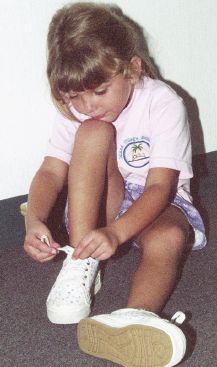
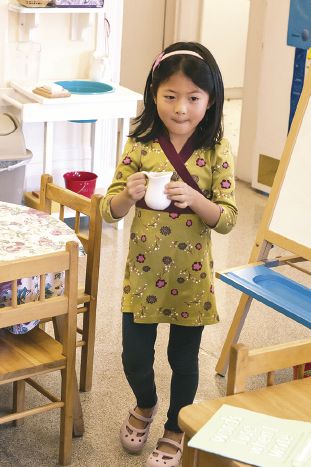
Fifth, practice independence. Independence is the ability to be self-governing, and that comes from making choices, living with the consequences, and having responsibilities. As often as possible, give your children choices. “What do you want for breakfast, cereal or eggs?” (Don’t offer choices where there are no choices. “Do you want carrots? They say no and you serve them anyway.) Give your children chores they can accomplish: making their beds, putting dirty clothes in the laundry, dishes in the dishwasher, etc. Chores build responsibility; responsibility builds independence; independence builds confidence.
Sixth, give them the gift of time. Give them time to accomplish their chores. Give them time to be children. Give them time to breathe. Give them your time.
Seventh, practice humility. They have a lot to learn from you. What is easy for you as an adult is mystifying and beyond challenging for them. Let your words be seasoned with grace. Look for the good in what they do. Their motives are often pure; their actions imperfect. Yet, we have a lot to learn from them. And when you are wrong (when not if) practice the humility of saying, “Please forgive me.” It will not destroy your authority or their respect for you. It will teach them one of the great lessons of life: when you fail, whether it’s in a relationship, school, career, or life, own the failure and start over again to succeed another day.
Becoming a Montessori parent is to become the best parent you can be.
Reprinted with permission by the author.
Tomorrow’s Child / Nov 2018 / Pg 13
by Kathy Leitch | Communication, Montessori Education, Montessori Parenting, Montessori Teachers, Parent Education, Parent-Teacher Communication, Sensitive Periods, The International Montessori Council, Webcasts / IMC
Montessori Family Life A Series of Weekly Talks For Parents
With Ann Epstein Ph.D. & Kathy Leitch
by Rick Newberry | Communication, Montessori Charter Schools, Montessori Education, Montessori Parenting, Montessori Teachers, Parent Education, Parent-Teacher Communication, School Leadership, The International Montessori Council
college girl on the street
Do you feel that you are always running out of time? Do you feel overwhelmed when you look at your lengthy to-do list?
Let’s face it, you only have so much time to accomplish everything on your list. From giving tours to answering parent questions on the phone to keeping your school’s Facebook page updated, life as an Admissions Director at a private school can be all-consuming and never-ending.
You need a team of parents to help you.
A group of select Parent Ambassadors can expand your efforts and exponentially increase your effectiveness. This is a core strategy that should be part of every Admissions Director’s marketing and enrollment plan.
There are five main roles that Parent Ambassadors can help you expand your enrollment and marketing effort:
1. Tour Guide: Some schools use Parent Ambassadors to give or assist with campus tours on a personalized visit or open house. This can be a great parent-to-parent connection. A satisfied “customer” will always do a better job selling your school from their own experience than a paid “salesperson.”
2. Personal Contact with Inquiries and Applicants: Your Parent Ambassadors can be utilized to make personal contacts with your prospective parents. This contact can be part of your follow-up sequence as a phone call, email, or hand-written note, depending on the parent, their preferred approach, and time available.
3. Outreach to Feeder Schools, Churches, and Community Events: It can be difficult to establish connections with feeder schools and churches, especially when you are attempting to reach the administrator or pastor. However, your Parent Ambassadors can help you in this effort. They can also help with your outreach by attending and representing your school at key community events or by inviting prospective families from their neighborhood to an in-home coffee and dessert meeting.
4. Online Reviews: It is important to have updated and positive reviews of your school on key school directory and review sites such as GreatSchools.com as well as on Google, Yelp, and Facebook. Your Parent Ambassadors can help you by writing positive reviews as well as recruiting other parents in your school to write additional reviews.
5. Brand Advocate: Your school’s reputation and word of mouth are critical to your marketing and enrollment success. Parent Ambassadors can help you in this effort by keeping their ears open to the word on the street and online. When something negative is said or published, they can jump in and defend your school as your brand advocate.
ML/September 2018/ pg 9
by The Montessori Foundation | Communication, Infant-Toddler (0 to 3), Kindergarten, Later Adolescence (15-18), Lower Elementary (6-9), MFA, Mindfulness, Mixed Ages, Montessori Education, Montessori Middle School, Montessori Parenting, Montessori Secondary / High School, Montessori Teachers, Parent Education, Primary (3-6), School Leadership, The International Montessori Council, Upper Elementary (9-12)
Montessori guides are highly skilled and trained professionals, so why do many parents ask: “Why do they need to attend conferences?” After all, it’s an inconvenience for the parent if the school has to be closed down to allow for travel and participation.
There are several compelling reasons for parents to encourage and support teachers attending a conference:
1. In many states, early childhood teachers are required to take a certain number of professional development hours to keep their licenses up to date. The number of hours can vary greatly from state to state. Attending a conference such as the annual event the Montessori Foundation and IMC host in Sarasota, Florida can earn a guide 2.5 CEU (Continuing Education Units) from Lander University in Greenwood, South Carolina. Since many states require 3-5 units every few years, this single event brings them closer to fulfilling the required hours.
2. With the explosion in the field of Neuroscience, Dr. Montessori’s postulations can now be proven with science. Montessori guides need to adjust and fine-tune their presentations accordingly. This benefits the children.
3. Teachers often feel depleted and need to ‘recharge their batteries.’ I recently spent an entire day with my four-and-a-half-year-old granddaughter. We did something like ten activities during the day, all modeled on Montessori experiences in the primary classroom. At the end of the day, when she literally fell asleep in my arms, I thought to myself: This was one child! How tired is a guide with 26 students at the end of each day? The event we hold each November is intimate and planned to provide an easy pace so that participants have an opportunity to network and discuss what they are learning and experiencing in their own classrooms without feeling rushed. Bouncing ideas off one another brings a sense of renewal and enthusiasm back into the classroom.
4. Highly respected Montessorians are carefully chosen to present and keynote at this event. We cover all ages, from infant/toddler through secondary, with workshops throughout the weekend designed to appeal to each level. Administrators and guides who need spiritual renewal also find many workshops geared just for them. We even have workshops on advocacy and public school Montessori issues, which focus on the need to have a clear voice and strong messaging.
5. Community and partnerships. We eat all of our meals communally. The menu is custom crafted with healthy and delicious meals in mind and, working with our host hotel (for 10 years now) The Hyatt Regency, Sarasota, our attendees rave about the food and presentation. Our meals allow for more networking time and, over the years, school attendees have developed relationships with other schools all over the world. A truly Montessori global experience takes place. You can feel the energy build over the days we spend together.
6. Teachers who have the opportunity to participate in an event such as ours are usually more grateful, engaged, enthused and excited to try out all the things they’ve learned when they return to the classroom. Parents should know that their child is the recipient of all this renewed spirit.
We highly recommend that schools, along with parents, find ways to help teachers attend conferences such as ours. Think about helping them come next year. We are already planning for it and so should you.
ML/ September 2018 / pg 22
by The Montessori Foundation | Communication, MFA, Montessori Education, Montessori students, Montessori Teachers, Parent Education, School Leadership, The International Montessori Council
Greetings Montessori Colleagues,
One of the many challenges we face as Montessori educators is that of clearly communicating our message to parents in order to offer them an opportunity to understand and appreciate what we offer to children. With that in mind, AMI undertook a research initiative so that we might better understand what parents perceive a Montessori education is and what parents want for the early learning years for their children. This research unfolded under the direction of the Neimand Collaborative with supporting grants from the Trust for Learning and the James Walton Foundation. It has become a goal for Montessori organizations in the United States to deliver a clear message about the value of a Montessori education speaking with one voice. With that goal in mind, AMI invited ALL Montessorians to participate in hearing the findings derived from this research so that more schools and programs can articulate what Montessori is and does. It is this effort supported by Montessori Leaders Collaborative that we now share the results of the research.
The researchers interviewed close to two thousand families from across the United States who represented different races, cultures and economic areas.
The results will not be surprising. Parents wish their children to develop into strong, capable and morally responsible individuals who are lifelong learners and doers through a partnership with teachers in achieving this goal. An interesting outcome of the research is that we often do not articulate the real message of Montessori so that parents can understand that their wish is exactly what we do by providing a richly prepared environment so that children can develop a love of learning in a peaceful community.
A summary of these findings can be found at tinyurl.com/ami-report-summary, and it is our hope that we can continue to inform the work you do each day in schools throughout the country so that the message is received and greater access to Montessori for more children is achieved.
A collaboration of: Association Montessori Internationale, Association Montessori Internationale – US, The Montessori Foundation and International Montessori Council, National Center for Montessori in the Public Sector, American Montessori Society, North American Montessori Teacher Association, Montessori Administrators Association, Montessori Accreditation Council for Teacher Education, Montessori Public Policy Initiative, Montessori for Social Justice.
ML/ September 2018 /pg 21
by Tim Seldin | Birthdays, Family Resources, Parent Education, Tomorrow's Child, Tomorrow's Child Online Issue
Family life is often hectic. Parents race from home to school and off to soccer games, ballet lessons, birthday parties, gymnastics, and the library. Parent burnout is increasingly common, exhaustion the norm. In half of our families, divorce, remarriage, and the creation of blended families add to the stress placed on modern family life. And all too soon, the kids will shift their focus from family to friends. Countless tasks fragment any remaining sense of well-being and sap away at the stamina that we need to meet the challenges of our modern lives.
One of the most precious gifts that we can give our children is an education of the heart, nurturing their sense of joy and appreciation of life, a sense of the poetic, and of their connection to all of humanity and the universe.
One of the most precious gifts that we can give our children is an education of the heart, nurturing their sense of joy and appreciation of life, a sense of the poetic, and of their connection to all of humanity and the universe.
Family traditions and celebrations create comforting patterns to the childhood years. They help underscore to our children the message that they are loved and cherished. Even if we don’t formally belong to any organized religion, celebrations can help us teach our children the great moral and spiritual lessons of love, kindness, joy, and confidence in the fundamental goodness of life, in simple ways that encourage them to begin the journey toward being fully alive and fully human.
Opening yourself to wonder and delight is the first step toward a celebration of life. Without a sense of wonder, all things are commonplace. But, when we open ourselves to a sense of wonder, our souls begin to stir.
Normally the creation of special family celebrations with our children leads us to rediscover a sense of curiosity and joy. There is beauty all around us. We find it in the forest, at the seashore, at sunrise and sunset, and in the bright shining faces of those we love. Children can help us get back in touch with the beauty of all creation as we gather shells, yell into the wind, fly a kite, or leave a trail of footprints in the sand. Enter into these precious moments playfully, and you will rediscover your sense of wonder, celebration, and worship.
Being alive to the beauty of our world nurtures a spirit of inner peace and reverence for life. In exploring together “how could this be?,” we help our children begin their journey toward enlightenment.
Little Rituals
Living a life enriched by little touches of kindness and celebration is no easy feat. Family life can be enhanced by all sorts of small thoughtful acts and activities enjoyed together. Don’t try to overdo it or you’ll just add to the burdens of your day. Try to select a few that suit your personal style and schedule.
Lunch Box Surprises
Especially in your children’s early years, a little note slipped into a lunchbox will mean so much to your little boy or girl. The thoughts can be humorous, like one that I came across: “While you munch this yummy lunch, know that we love you a great big bunch. Love, Mom and Dad.” Others will prefer to jot down a few words of love and encouragement.
When days become filled with too much to get done, you won’t remember to do it often. But whenever you do, your time will have been well spent.
A Thank-You Board
This need be nothing more elaborate than a sheet of paper taped on the refrigerator and changed periodically. Whenever someone in the family feels thankful to someone else for something, such as taking out the garbage, he or she writes a little message to that person. Often, when we think about acknowledging someone, they may have already gone off to work, school, or bed. This gives the family a chance to record their acknowledgment and thanks for all to see.
Family Dinners
Sitting down at one time together and sharing food without TV or interruptions from the telephone is increasingly rare. Make a commitment to one another, mom and dad, too. No work. No phone calls from friends. “I’m sorry, but we’re having dinner right now. Can I call you back?”
Dress Up the Dinner Table
A touch of formality and special care lends a festive spirit to family meals. What a difference it is from meals eaten on the run at the breakfast bar when you sit down to a table with flowers, candles, a tablecloth and pretty dishes. This need not be all that fancy. Even a single flower in a bud vase and a single candle in a bottle create a simple, festive atmosphere.
Joining Hands for Saying Grace or Sharing a Moment of Silence
Create a family circle. Join hands in a moment of silent reflection on the day. Give thanks for the simple blessings that we all share in this world. Don’t forget to give a round of applause to the cook. It isn’t meant to be a rating of how tasty the meal is, but of appreciation for the effort that went into preparing it.
Reading Poetry at the Table
If overdone, you can easily turn kids off to poetry for life, but a carefully chosen poem that is not too long but says something delightful to all ages can be nice.
Family Read-Aloud Time
Many families set aside time to read aloud to one another whenever they have an evening at home. Unlike the traditional bedtime story read to small children to help them fall asleep, this is an experience in which family members share cherished tales with one another. One objective is to encourage the children to think and discuss a story or entire book that touches the heart or delights the imagination. Ideally, as the children become old enough to read, everyone takes turns reading aloud to the entire group. The trick is to make the experience fun, more like the sharing of wonderful tales than the chore of children performing for their parents or listening to something that their parents love but the children hate.
Memorizing Verse
Many of us, educated in traditional schools, believe that Montessorians are opposed to asking children to memorize anything. The only sin in challenging children to memorize is when we overwhelm their ability and make them feel ashamed. Learning to remember lines is a useful skill, and many of us have snippets of poetry that we learned as children and treasure to this day. Make the experience fun, not another burden. Some kids will love it, others will be skittish and will try to avoid being embarrassed at all costs.
Take an After-Dinner Walk
When the weather cooperates, you might want to take a walk together as a family. Assuming that you leave the portable phones behind, you may even have everyone’s attention. A half-hour walk is a great time to watch the birds settle down for the night, see the sun set, collect leaves, play tag, feel the onset of the evening breeze, and quietly talk. This is especially magical if you live beside a river or the ocean, among high hills, next to a forest, or anywhere where natural beauty is still unspoiled.
Bedtime Whispers
Whispers are messages of love that you speak softly into your child’s ear after you tuck them in. There is an intimacy about quietly speaking into a child’s ear that sends them to sleep feeling cherished.
A Bad-Dreams Chaser
Several families that I know have designated an old, worn stuffed animal that used to belong to mom or dad when they were young as the family’s “Bad Dreams Chaser.” This faithful companion guards over anyone who is having difficulty falling asleep or who wakes up after a bad dream.
Reading and Playing in Bed
Bedtime can be a real problem when children, who have been actively playing one minute are suddenly told that it is time to go to sleep. One solution is to get the children into a habit of getting ready for bed earlier in the evening and then allowing them to play or read quietly by themselves in bed with the lights on. You might want to try tucking them in at the beginning, and then come back for bedtime whispers and lights off as they are falling asleep.
A Place for Silence in Your Home
A while back I came across a company that is especially human-focused. It had created a room as a “sanctuary retreat” in which employees could withdraw when they needed a few minutes of peacefulness and beauty to restore their spirits. The room is softly lit, always has fresh flowers, and is filled with the sounds of quiet music or an electronic windchime. There are soft pillows on the floor to sit on.
It occurred to me how wonderful it would be to create something like this at home. A small self-contained water fountain fills our space with the sound of splashing water. A set of those electric wind chimes, which I had never seen before, creates a sense of gentle breezes. (The windchimes hang from a small stand. A magnet under the base moves and causes the clapper to gently strike the chimes just as if the wind was at play. A small CD player offers the music that seems right at the moment. It offers a short retreat from everyday life.
Listening to the quiet that you find in your sanctuary, both you and your child can become attuned to little sounds that we normally ignore. More importantly, within the peacefulness of this special place that we’ve created, you can begin to hear the still, small voice that hides within us all.
A young child may come in only when you do, and then stay only for a minute before running off to some new adventure. But with time and patience, children become more comfortable with silence and contemplation, and you may find yourself quietly talking about things that would normally never come up in daily life.
A Garden Sanctuary
Families with backyards might consider the creation of a special spot in the garden where family members can sit quietly with nature. Small children adore small secret places where they can hide away.
Beanpole teepees, sunflower houses, or just an existing spot under a spreading tree are perfect. Older children and adults may prefer a comfortable chair amid a mass of flowers or perhaps a gazebo.
Family Work Days
Some families set aside some time in the weekend as a family work day. All of the jobs that need to be done in the house are written out on a notecard. All of the tools necessary to complete each task are gathered. Children and parents choose an appropriate number of tasks from the cards displayed on a table in the morning. After completing the job, the child signs and dates the card. Mom or dad supervises and helps as needed. Pleasant music fills the air as everyone works. Everyone takes a break in mid-morning for a snack.
Family Time
Many families set aside an afternoon every weekend as a special time when the entire family does something together that everyone enjoys. It might be bike riding, swimming, ice skating, walking beside the ocean, canoeing, fishing, sailing, bowling, going to a museum or art gallery, playing children’s games, playing music or singing together as a family, making homemade ice-cream, watching a special video together, or going out for a special treat.
Children in the Kitchen
In some families, once a week each child gets to plan the menu and prepare a meal (with or without assistance). This may mean eating some meals that appeal to younger appetites, but it is usually fun for everyone.
Family Meetings
Set aside time once a week to meet as a family to formally review how the week has gone, discuss plans for the week ahead, and work on any problems in family relationships. Normally what happens is that plans and decisions are made by one parent or they just develop by default. A family meeting tends to give the children a sense of being heard and usually ends up in a fairer distribution of family responsibilities.
Birthday Celebrations
One family that I know purchased a very heavy and tall white candle for each of their children when they were born. Over the year’s they decorated the birthday candles by molding colored wax. This candle is lit at breakfast on the child’s birthday an it stays lit all day. After dinner and birthday cake, the family sits around the table with the candle burning and asks three questions of the birthday boy or girl: 1) What were the most significant events of the last year?, 2) What are his or her hopes and dreams for the coming year?, and 3) What are the hopes of the family members for the birthday child in the year ahead? Sometimes, the parents or older relatives who are at dinner will tell what their lives were like when they were this age.
Annual Letters
Every year on their birthdays you might want to prepare a little time capsule for each of your children. They are sealed and put away in a safe place, like a safety deposit box, to be opened on their 21st birthday. Include a letter from both parents, reminiscing over the milestones and major events of the past year. Add photos and the occasional small artifact. Take your children with you when you put the annual letters safely away, and make sure that they look forward to the day when they can open this storehouse of treasured memories from their childhood.
Choose a Name for Your House
Once it was the custom for families to select a special name for their houses. I grew up in a house called “Dunmovin.” Today it almost seems as if houses are interchangeable. Mass produced homes sometimes seem to have little character, but children and adults alike still feel the same need to put down roots and build traditions, even when their stay in a given home may only be for a year or two. Think up a name and prepare a sign for your home.
Decorate Your Home for Every Season
Children love to gather together little things that represent the seasons and special holidays. Some can be kept from year to year, carefully packed away, and joyfully taken out as part of your family’s annual traditions. They might include little models (Columbus’ ships, a Christ-mas creche, a winter village), dolls or nice stuffed animals (a favorite Santa, an Easter bunny, a spooky witch, a Pilgrim), along with decorations. For spring, you might force bulbs inside, fill vases with branches cut from flowering trees and bushes, and grow tiny meadows of grass in little baskets filled with potting soil.
At my house, every winter we set up a display with model houses, cotton snow, and small figures bundled up for winter play. Old -fashioned Christmas decorations can be made fairly easily with a visit to your garden store or local forest for evergreen boughs, wire frames for wreathes, and pinecones. Just add colorful fruits and nuts and lots of candles to complete the look. Chanukah is best celebrated with a homemade menorah. The Fourth of July is an opportunity to hang patriotic bunting and pictures of the Founding Fathers.
Handmade Gifts
Instead of always buying presents from the store, some families establish a tradition of making them by hand. Young children are normally delighted to make and give presents to family and friends. Naturally, some families are better at crafts than others, but a wide variety of wonderful resource books are available filled with projects and ideas for every age group, season, and occasion.
Just a few ideas for family giving: homemade cookies or ice-cream, hand sewn dolls, a handmade wreath or arrangement of dried flowers, little market baskets filled with potting soil in which grass or herbs have been planted, hand painted Easter eggs, a hand-built doll house, children’s photographs or artwork dry-mounted on matte board, hand dipped candles, handmade Christmas tree ornaments, a handbound book of a child’s poetry, or perhaps a model train layout prepared in secret as a special present.
Lessons in Charity and Service
Some families gather used coats, mittens, boots, and scarves to distribute to homeless people. Some prepare baskets of homemade food for a needy family’s holiday dinner or collect toys for poor children. As a family, you might want to spend a Saturday preparing special bagged lunches to share with the homeless. Go together as a family to deliver the presents to either a needy family that you know or to a local church or shelter.
A Family Scrapbook
Don’t forget the fun of preparing a scrapbook of the history of your family: not only photos, but dried flowers, prom tickets, and similar mementos. Add poems, newspaper clippings, children’s artwork, etc.
Tim Seldin is President of the Montessori Foundation, Chair of the International Montessori Council and co-author of Celebrations of Life and The World in the Palm of Her Hand.
by Kathy Leitch | Communication, Montessori Administrators, Montessori Teachers, Parent Education, School Leadership, School Resources, Social Media, The International Montessori Council, Webcasts / IMC
Join Jono Landon as he shares his passion for simplifying parent engagement. Here’s what we’ll cover in this webcast:
1. How to use each communication tool the right way so that parents read your messages and are informed.
2. How to centralize all of the communication tools into one simple system so that you don’t have to learn and manage contacts and tasks in multiple locations.
3. How to Reduce the time and money that goes into using paper in the office.
This webcast is for YOU if you want to create an efficient communication system that reduces your workload, saves time, and gives parents the communication experience which they are expecting from you.
by Jonathan Wolff | Kindergarten, Mixed Ages, Montessori Education, Montessori students, Parent Education, Primary (3-6), Re-enrollment, School Leadership, The International Montessori Council, Webcasts / IMC
Why Montessori Kindergarteners Outsmart and Outshine Kids in Traditional Public and Private School Programs ~ Persuading Parents to Stay for the 3rd Year”
Join Jonathan Wolff and Kathy Leitch as we discuss the importance of the completion of the 3-year cycle. We all know how important retention is to each student, the classroom, and our schools. How do we effectively convey the benefits to our parents as they make this critical decision?
by Matt Johnson | Mixed Ages, Montessori Education, Montessori Family Life, Montessori Parenting, Montessori students, Montessori Teachers, Parent Education, Social Media, The International Montessori Council
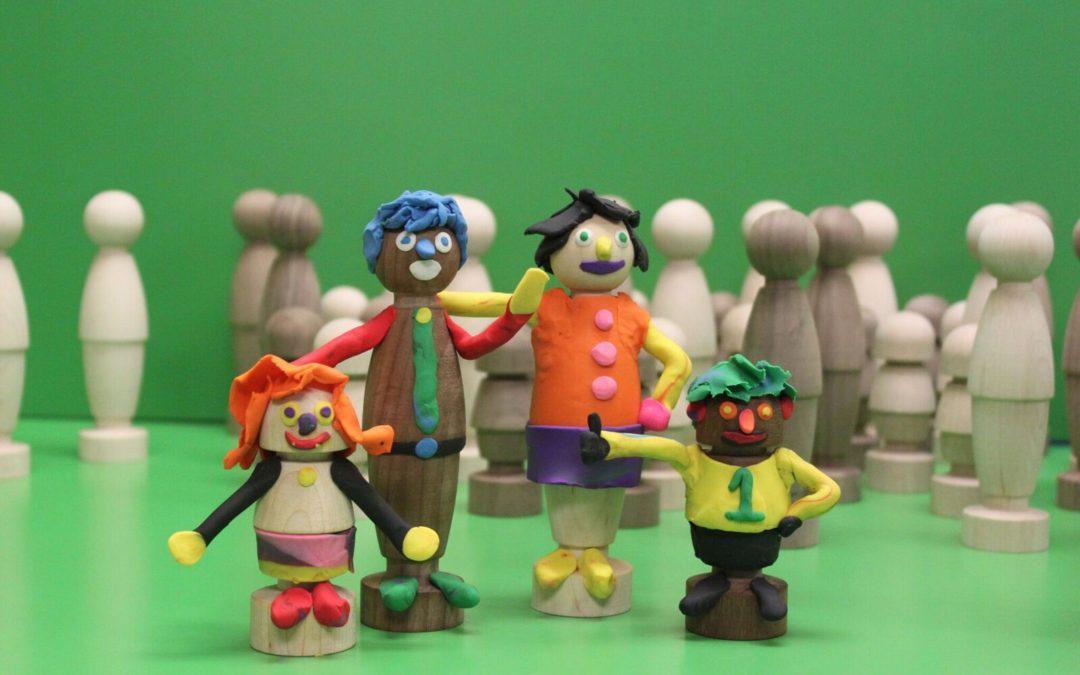
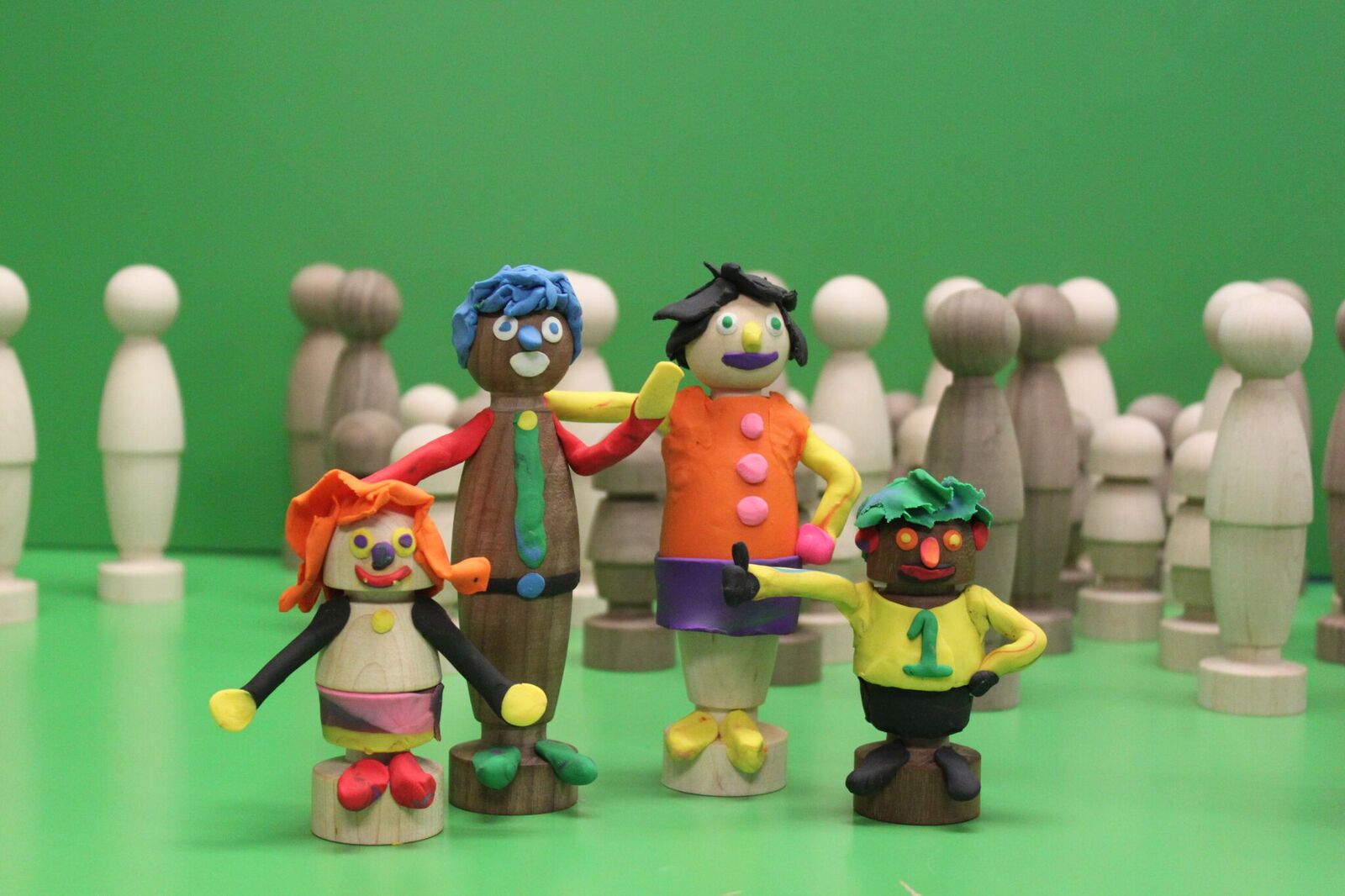
As an educator and parent, I saw a need for children to have an outlet to explore and develop emotional and social sensitivity. Wae created ClayMatesTM in a direct response to this need as we now live in an age of overwhelming distractions from media, technology, and entertainment, we see a generation of children who are losing touch with authentic social connection, self-reliance, empathy, compassion, and creative problem solving; all of which can translate into feelings of social separation and anxiety.
ClayMatesTM helps quiet these distractions and open new doors to creativity and expression by nurturing positive connections and personal strengths in children. The non-gender-specific figures and colorful, tactile properties of clay engage children to make creative choices as they design their figures and naturally engage in imaginary role-play.
As a toy, ClayMatesTM inspires creation and expression while building the child’s fine and gross motor skills and executive planning skills. As an educational tool, ClayMatesTM is an easy-to-use platform for encouraging complex social and emotional conversations with children at home, in the classroom or in a therapeutic setting. ClayMatesTM is a hands-on, self-directed activity that promotes mindfulness and emotional intelligence. Children place clay on the wooden figures to create physical features to bring characters to life. Educators will find ClayMatesTM help them observe social cognition, emotional intelligence as well as guide without any preconceived outcomes and create an environment that supports age-appropriate social and emotional exploration and growth.
ClayMatesTM Inspire Self-awareness through Social Context and Emotional Response
When ClayMatesTM are introduced to the classroom, therapeutic, and family settings, the results are immediately observable. Using ClayMatesTM, children begin by building a figure of themselves, revealing each child’s perception of her or his own self in the world. Then, the children create figures that represent others in their lives. These two steps are the building blocks for observation, to help children in the process of social and emotional cognition.
As imaginary role-play becomes fluid, we can introduce a host of social context or scenarios for children to explore in their play—from helping around the house to experiences of bullying to classroom behavior, even how to say “I’m sorry.”
By observing the children’s social and emotional response and problem-solving in their ClayMatesTM play, educators can engage them further in an age-appropriate contextual conversation around the possible solutions or responses to events and issues in their lives.
Here are two examples of ClayMatesTM play that demonstrate the ease and enormous potential they offer:
Example #1. Enacting a Social Scenario with ClayMates: Bullying
In a group of 5 children, each child builds a different figure: the victim, the bully, the bystander, the teacher and the parent. This creates a social scenario in which each child role-plays and observes how words and actions of the five ClayMatesTM unfold in the group. As educators, this type of prepared learning environment provides an open-ended dialog that explores the children’s observations and emotions about bullying, the emotional and social responsibility of different roles, some possible solutions, authentic feedback, and the opportunity for social and emotional growth.
Example #2. Developing Emotional Vocabulary with ClayMates
As our emotional vocabulary develops and expands, we, as individuals, learn to engage with our self and others with more understanding, patience, and acceptance of diverse thoughts and feelings. ClayMatesTM is an effective tool for building this vocabulary through role-play with directed emotional context.
We can attach to the bottom of every ClayMate figure one of 12 color-coded discs associated with 12 different emotions. Initially, we introduce the basic emotions such as anger–RED, sadness–BLUE, fear–PURPLE, yellow–HAPPY and integrate them into a social scenario. Each child then role-plays their ClayMate figure’s designated emotion. At first, all participants know who is performing which emotion. Each child acts out and experiences their own assigned emotion and observes the other participants doing the same. As students become more comfortable with this role-play, they are assigned an emotion “secretly” so that only they know what it is, and other participants try to figure it out. This exercise deepens the children’s sense of different emotions: both how to express them and how to relate and respond to others’ emotions.
As a fun, flexible, and expressive toy and tool, ClayMatesTM builds a foundation of social and emotional awareness so that children can develop authentic and meaningful connections, recognize social and emotional cues, and strengthen their capacity to problem solve and meet challenges with resilience. ′
Matt Johnson is married with two adult children and has worked with children for over 35 years as a gymnastics instructor, mentor, and advocate. As an instructor he has help students realize their physical and mental potential. As a mentor, he has supported students in building character, self-esteem and achieving personal goals. As an advocate, he has been outspoken in support of responsible coaching practices, resiliency in athletics and the idea of empowering children to be confident, competent, contributors who are self-sufficient, with skills for coping in life. Matt is a board member of SPARKindness and is the chairperson of their resilient athlete program. SPARK is a community-based organization that provides educational opportunities to families that focuses on understanding diversity, inclusion, resiliency, recognizing the difference and addressing social and emotional issues that affect families and the community. Matt also works with teens and adults as a personal trainer and life coach. Where he support clients in goal setting, recognizing their potential and helping to navigate the obstacles to success.
Montessori Leadership/May 2018/ Pg 24
by The Montessori Foundation | Communication, Mixed Ages, Montessori Education, Montessori Family Life, Montessori Parenting, Montessori students, Parent Education, The International Montessori Council
Greetings Montessori Colleagues,
One of the many challenges we face as Montessori educators is that of clearly communicating our message to parents in order to offer them an opportunity to understand and appreciate what we offer to children. With that in mind, AMI undertook a research initiative so that we might better understand what parents perceive a Montessori education is and what parents want for the early learning years for their children. This research unfolded under the direction of the Neimand Collaborative with supporting grants from the Trust for Learning and the James Walton Foundation. It has become a goal for Montessori organizations in the United States to deliver a clear message about the value of a Montessori education speaking with one voice. With that goal in mind, AMI invited ALL Montessorians to participate in hearing the findings derived from this research so that more schools and programs can articulate what Montessori is and does. It is this effort supported by Montessori Leaders Collaborative that we now share the results of the research.
The researchers interviewed close to two thousand families from across the United States who represented different races, cultures and economic areas.
The results will not be surprising. Parents wish their children to develop into strong, capable and morally responsible individuals who are lifelong learners and doers through a partnership with teachers in achieving this goal. An interesting outcome of the research is that we often do not articulate the real message of Montessori so that parents can understand that their wish is exactly what we do by providing a richly prepared environment so that children can develop a love of learning in a peaceful community.
A summary of these findings can be found at tinyurl.com/ami-report-summary, and it is our hope that we can continue to inform the work you do each day in schools throughout the country so that the message is received and greater access to Montessori for more children is achieved.
A collaboration of: Association Montessori Internationale, Association Montessori Internationale – US, The Montessori Foundation and International Montessori Council, National Center for Montessori in the Public Sector, American Montessori Society, North American Montessori Teacher Association, Montessori Administrators Association, Montessori Accreditation Council for Teacher Education, Montessori Public Policy Initiative, Montessori for Social Justice.
Montessori Leadership/ May 2018 / Pg 21
by The Association of Montessori Internationale | Communication, Mixed Ages, Montessori Education, Montessori Parenting, Parent Education, Tomorrow's Child, Tomorrow's Child Online Issue
A Great Opportunity
Recent research shows that parents in the United States are very interested in developmental education that builds a child’s
capability to become a fulfilled and productive adult who contributes to the world—at home, at work, and in their community.
Montessori is often seen as the gold standard for such education, presenting us with an opportunity to serve more children across the socio-economic spectrum and to move closer to achieving our mission of creating a better world through the development of capable individuals.
Three things stand in the way of success: 1) Our ability to communicate to prospective and current Montessori parents how the Montessori approach connects with what they value most in raising their children; 2) Elevating and empowering Montessori teachers as the ambassadors of a quality Montessori experience; and, 3) Training more teachers so we can create more programs, reach more children, and fulfill our mission.
The Great Challenge
We must do a better job of communicating our value.
While Montessori is held in high esteem, most parents can’t explain what it is. They simply want it, especially in early childhood. Ironically, once they have it, they often feel shut out of the process of developing their child’s potential, something they believe is best accomplished in a partnership between teacher, child, and parent.
Montessori education frequently is the child’s experience that the parent strains to observe while feeling held at a distance. This runs counter to, at least, American parents’ desire to be in control of their child’s upbringing and to experience their child’s education with the child, the teachers, and the school. This parental feeling of exclusion diminishes the likelihood that Montessori schools will retain children across significant choice points—at kindergarten, middle, and high school entry moments. As these junctures approach, parental anxiety is high, the perceived relative importance of specific developmental education lessons, and peer and societal pressure on academic achievement increases.
That’s the bad news. The good news is that recent market research tells Montessori how to resolve the issue, and also that when we do, we can potentially capture and hold the attention, participation, and loyalty of parents from all walks of life throughout their children’s educational years. This summary will help you apply the insights from our market research to create more effective communications with parents, communities, and other stakeholders.
Reassuring parents about academics is key to retaining Montessori students.
Here is what you need to know to connect with parents and better serve the development of children:
Parents don’t always know what Montessori is, but they believe it is ideal and want it for their children. They rely on Montessori to help them develop the moral, emotional, and behavioral abilities that they understand to be key to helping their children become capable individuals. However, parents’ faith in Montessori is fragile in the face of personal and social pressures. Parents need your help in seeing the proof that Montessori is working miracles in their children.
Children don’t choose their education, parents choose it for them. American parents have a strong sense of personal agency when it comes to education and sees educators as partners in child development, not replacements.
Montessori is intensely focused on the development of the individual child, but our developmental approach must also make space for the parent. Montessori parents place an extraordinary amount of trust in Montessori—more so than in any other educational approach. Though parents have great confidence in Montessori, particularly in our teachers, they still need the attention, explanation, encouragement, and confidence to stick with us.
Montessori often loses children to other approaches to education because many parents see early childhood Montessori as a foundational inoculation of “goodness” that will help children survive the hard knocks of the “real world.” Navigating less than optimal education in elementary and secondary education is considered by many to be a rite of passage that creates perseverance, motivation, self-reliance, and know-how—even though the opposite is true.
Beyond the availability of elementary and secondary Montessori programs, concerns about academic learning are major barriers to retention. There is a misconception among parents that Montessori focuses on socio-emotional development at the expense of academics and knowledge-building. While this is simply not true, the reality is that Montessori doesn’t speak enough about knowledge-building and the exceptional ways in which we do it. We must make clear that academics and knowledge-building are key qualities of Montessori pedagogy, and that the way we help children develop provides them with enduring intellectual capabilities that are best achieved through the framework of social and emotional learning.
Teachers are the lynchpin of our success and need to be brought to the forefront.
Montessori achieves social justice by serving more children, not by talking about social justice with parents. Availability and continuity are the biggest barriers.
Scarcity, including proximity and affordability, prevent Montessori from being more widespread. Research indicates parents would choose it more often if they could get it. There aren’t enough Montessori early childhood programs to meet parent demand—this is especially true among low-income and minority parents whose neighborhoods lack high-quality early childhood options. Programs that are available may have high tuition or require a long commute for parents. Scarcity in early childhood programs is further aggravated by even fewer options for elementary and secondary Montessori education. Parents who want to continue with Montessori past early childhood often have no choice but to seek other alternatives.
Montessori’s drive for social justice will only be accomplished when we increase the number and size of programs available to all children. Equity means greater access to Montessori—and only Montessorians can create that access by attracting more teachers and creating more schools in more communities. Montessori’s strategy for creating social justice through access is supported by Montessori parent perceptions and desires. While Montessori parents very much want a just and equitable world, they believe we create it by developing just and equitable individuals through Montessori education. Parents see their contribution to social justice as raising their child to be capable, connected, compassionate, and productive. Parents are clearly drawn to Montessori for its social value of taking a personalized approach to children’s moral, social, and intellectual development, not the Montessori movement’s own social agenda. This is especially true for African-American and Latino parents.
Montessori needs more teachers—and it needs to empower teachers as its evangelists. Montessori leaders place a great deal of emphasis on pedagogy and classroom environment as a way of sending parents messages about program quality and fidelity. Existing and prospective Montessori parents, however, judge quality by their interaction and relationship with Montessori teachers. Teachers are the quality ambassadors for Montessori.
Staff, school and classroom environments and the pedagogy are seen as elements that help teachers be the best possible partners with parents in the development of every child. Positioning teachers at the forefront of Montessori will accomplish at least two things: 1) It will attract more teachers because they will understand that they are respected, supported, and empowered; 2) It will send parents clear messages that the quality of Montessori lies in the preparation of its teachers and will contribute to parental preference for programs with the most highly-trained and skilled teachers.
A New Montessori Frame
The primary focus of Montessori educators is Montessori education. There is often little time to focus on marketing Montessori and communicating its value in a way that is more compelling to prospective and existing parents.
With that in mind, we have developed easy to use and research-based messages that will help all Montessori programs better explain their value in terms that parents and communities will understand and appreciate. By adopting the messages in our daily communications, we can build public understanding of our tremendous value and encourage more parents to seek out Montessori as their preferred education approach. Keep in mind that Montessori has parents at “hello.” There is no need to over-explain our approach or get into the technical aspects of how we support a child’s development. People are positively inclined to Montessori until we push them away. To take full advantage of the strong brand we have, we need to work harder to help parents hear and see the alignment between our values and theirs—their children’s ultimate outcomes and their own sense of success as a parent.
The message frame:
♣ Montessori works in every setting for the success of each child.
♣ We help parents develop children who are morally, emotionally, and behaviorally prepared for the real world.
♣ Our teachers support your child’s natural development, building the capability to become productive, fulfilled adults who contribute to the world.
♣ Teachers help children follow their interests and passions to develop strong skills in academics, leadership, self-discipline, responsibility, independence, and initiative.
♣ Our classrooms are hands-on, self-paced, collaborative, and joyful, creating a lifelong learner and doer.
♣ AMI Teacher Certification requires rigorous training that ensures your child’s distinct personality and independence will be nurtured into a capable and connected adult.
♣ An AMI Certified School is the mark of the highest quality Montessori, where the entire school supports the teacher in developing your child’s full potential.
This message frame can be easily put into a narrative to help you explain the value of Montessori to parents and community stakeholders:
Montessori works in every setting for the success of each child. Montessori teachers support your child’s natural development, building the capability to become a productive, fulfilled adult who contributes to the world. Montessori helps parents develop children who are morally, emotionally, and behaviorally prepared for the real world. Our teachers help children follow their interests and passions to develop strong skills in academics, leadership, self-discipline, responsibility, independence, and initiative.
Your child’s education will be hands-on, self-paced, collaborative, and joyful—everything that’s needed to create a lifelong learner and doer. The mark of a high-quality Montessori school is where the entire school supports the teacher in developing your child’s full potential.
Tomorrow’s Child/ April 2018/ pg 14
by Paul Epstein, PhD | Mindfulness, Mixed Ages, Parent Education, Tomorrow's Child, Tomorrow's Child Online Issue
Mom and her daughter child girl are playing, smiling and hugging. Family holiday and togetherness.
The experience of authentic, unconditional love differs from romantic and other types of love. Unconditional love is not based on possessing or acquiring (Valentine. M. Love Is the Way). When we know this love, we experience personal and universal peace. And while this love is observed and discussed repeatedly by the world’s great teachers, we seldom consider how this love also emanates from children. The smallest of babies cause us to smile. They and older children awaken us, and we engage in peaceful action.
Parents know unconditional love. A parent may be overwhelmed by tremendous joy and happiness when holding her or his child for the first time. We remember the sweetness of our newborn child, and we remember the love that overwhelms us. I recall saying a prayer. Not a formal, religious prayer, but a prayer nevertheless. Actually, I do not recall my words, but I do recall how I felt: whole, peaceful, and unimaginably happy. I prayed for my child’s lifelong health, safety, and happiness. I also felt too small to hold the amount of love that was wanting to burst from me. I still feel that kind of too small.
I also recall that I did not speak words like these: “Watch over my child, and make sure she has the best test scores for entrance to the top university.” Those words came later.
Unconditional love involves acceptance, but not always agreement. I accept you 100 percent the way you are, and I accept you 100 percent the way you are not. This kind of love involves self-love too. I accept myself 100 percent the way I am, and 100 percent the way I am not. Unconditional love may be transformative. However, reading the words of great teachers is not enough. Transformation involves a commitment to practicing a way of living. A life with children can bring forth this kind of love. In the presence of children, adults may aspire to spiritual growth.
Dr. Maria Montessori wrote, “[The] child is the true maker of our spirituality. He teaches us the plan of nature for giving form to our conduct and character.”(Montessori, M. The Advanced Montessori Method). One form of conduct with children is to learn how to serve and not be their servants. Specifically, we learn to guide children to become independent and self-reliant. Then children become normalized; they fulfill more of their unique potential. When we observe and accept children, we also experience the assistance they give to us as we learn how to guide. They assist us with love.
If we want to produce harmony in the world, it is clear that we ought to think more about this …. The child is the only point on which there converges from everyone a feeling of gentleness and love. People’s souls soften and sweeten when one speaks of children; the whole of mankind shares in the deep emotions which they awaken. The child is a well-spring of love. Whenever we touch the child, we touch love. It is a difficult love to define; we all feel it, but no one can describe its roots or evaluate the immense consequences which flow from it …. In the vicinity of children, mistrust melts away; we become sweet and kindly, because, when we are gathered about them, we feel warmed by that flame of life which is there, where life originates (Montessori, M. The Absorbent Mind).
“Mistrust melts away; we become sweet and kindly.” To become receptive to the child’s power of love, we must, Montessori wrote, “remove the accretions of years that prevent us from really understanding children and acquiring an intuitive knowledge of their souls.” (Montessori, M. The Secret of Childhood). We must learn enlightenment; we need to learn to truly see. (Standing, E.M. Maria Montessori).
“Our social mentality,” wrote Montessori, “has not grasped the idea that we can receive help from the child, that the child can give us a light and a lesson, a new vision and a solution for inextricable problems” (Montessori, M., The Formation of Man). The child, Montessori asserted, can “help adults solve their own individual and social problems” (Montessori, M. The Secret of Childhood).
Accepting children’s influence as our teachers, Montessori championed, will help us create a peaceful society. Montessori spoke these words to the graduates of her 1937 training course:
You and I have been, as it were, seduced by something attractive and deep in the child…. We began with the methods of education and culture for the child, and we end by acknowledging that he is our teacher … one who can reveal to us, as no other, our own nature and its possibilities. Therefore we are drawn towards the child, as individuals, as members of society, and for the good of the human race as a whole (Standing, E.M. Maria Montessori).
“For the good of the human race as a whole,” Montessori spoke to world leaders about world peace. The Sixth International Montessori Congress took place in Copenhagen in 1937. Representatives from twenty nations were in attendance. Montessori declared in her keynote speech the child’s power to unify adults in peace.
The adult must understand the meaning of the moral defense of humanity not the armed defense of nations. He must realize that the child will be the creator of the new world peace. In a suitable environment, the child reveals unsuspected social characteristics. The qualities he shows will be the salvation of the world, showing us all the road to peace (Kramer, R. Maria Montessori).
The child’s power of love can bring adults to “the road to peace.” This congress took place thirty years after the first Montessori school had opened in 1907. Since then, children enrolled in Montessori schools show “unsuspected social characteristics” including a tremendous ability to concentrate when they engage in Montessori learning activities. Montessori understood concentration as a foundation for children’s spiritual growth (Montessori, M. The Advanced Montessori Method).
We tend to describe children’s physical, cognitive, emotional, and social development. Montessori advocated for a fifth development, spirituality. Accordingly, to become a Montessori classroom guide, an adult engages in a transformative preparation. This preparation wrote Montessori, “is something far more than the learning of ideas. It includes the training of character; it is a preparation of the spirit (Montessori, M. The Absorbent Mind). This begins, Montessori taught, with humility. “If we touch children,” she wrote, “we touch humanity. We must educate adults to realize that we can only better humanity through the child. We must realize that the child is the builder of man” (Montessori, M., The 1946 London Lectures).
There is a special relationship: as adults transform, we notice changes taking place within children. Children progress through a series of spiritual growths that bring them to normalization. Montessori wrote that with normalization, “A unique type of child appears, a ‘new child’; but really it is the child’s true ‘personality’ allowed to construct itself normally …” For Montessori, normalization was “the most important single result of our whole work” (Montessori, M. The Absorbent Mind).
Children who are not normalized may tire from academic study, and they cannot concentrate for long periods of time. They may be timid, anxious, possessive, depressed, unable to focus, and dependent upon others. These children have grown up in an educational system in which teachers dispense knowledge according to external standards. These teachers manage the learning process, including schedules, types of activities, and assessments without regard for children’s individual needs and learning differences. And, the teachers manage children’s behaviour through external praise and reward. The design of this educational system is to render children compliant and also ignorant about their own potential.
Children enrolled in Montessori schools learn to think, create, communicate, and solve problems. These children demonstrate tremendous self-discipline, resilience, and grit. Normalized children display a deep love of order, work, profound concentration, silence, sharing, obedience, self-discipline, independence, and joy (Standing, E.M. Maria Montessori). Normalized children are not interested in external rewards; they learn for the joy derived from understanding. Normalized children are cooperative, creative, innovative, and empathetic.
Montessori classroom guides show children how to become independent. The guides also model for children how to respect themselves, others, and the environment. Children normally develop self-acceptance which is a foundation for accepting others. Montessori children in primary and secondary programs study a wondrous, integrated curriculum called Cosmic Education. They may discover a personal calling called noble work. Children and adolescents do normally empathize, care for, and contribute to others. This is evident from the testimonies heard from Montessori graduates throughout the world. For example:
Students in Montessori schools are taught to ask the question, “How can I make the world a better place?” This is the fundamental difference in the Montessori curriculum; it teaches a higher purpose .It has taught me to strive to do noble works” (Butler, C. IMC 2003 Congress).
Another Montessori graduate summarized her education:
In order to gain a global perspective, you need to have a really strong foundation. That foundation, in our case, is local or even internal. So, if you know how to trust, and you know how to respect, and you know how to question—once you have those main principles, once you are unleashed into the world, you are a little more prepared and ready to take on what it has to offer.
Adults typically awaken when surrounded by the child’s power of love. As we learn to guide children spiritually, so, too, do we learn about our true selves? Montessori described how a life with children can bring the adult to experience this new kind of love.
When the children show [an adult] their real natures, she understands, perhaps for the first time, what love really is. And this revelation transforms her also. It is a thing that touches the heart, and little by little it changes people. Once these facts have been seen … nothing can cancel the impression their spirits have made and the love they were able to awaken
(Montessori, M. The Absorbent Mind). ν
Resources
Valentine M. Love Is the Way.
Butler, C. IMC 2003 Congress.
Kramer, R. Maria Montessori: A Biography
Montessori, M. The Advanced Montessori Method.
Montessori, M. The Absorbent Mind.
Montessori. M. The Secret of Childhood.
Montessori, M. The Formation of Man.
Montessori, M. The 1946 London Lectures.
Standing, E.M., Maria Montessori: Her Life and Work.
Tomorrow’s Child/ April 2018/ pg 7
by Lorna McGrath | Montessori Administrators, Montessori Parenting, Parent Education, Re-enrollment, School Leadership, The International Montessori Council, Webcasts / IMC
This week Lorna McGrath, Coordinator of the Montessori Family Alliance, talked with us about the importance of ongoing parenting education courses (separate and in addition to any Montessori workshops you run for parents). “If you help parents learn how to create a peaceful home, they will be eternally grateful to you and your school.”
Are you wishing that you not only had a parenting instructor at your school but that the instructor actually understood Montessori? Do your parents come to you for parenting advice but can’t get away during the day or in the evenings to join a live group? If so, the Parenting Puzzle – The Basics might be just the ticket. Join us to find out how it works and how you can get started with the course you’ve been hoping for. In this webcast, there will also be a sneak preview of the next course in the Parenting Puzzle series – Right from the Start for prenatal through three years old. To learn more about the course itself as an individual family would see it, go to https://stage.montessori.org/mli-the-parenting-puzzle/ For an annual license to offer the Parenting Puzzle at your school, go to https://stage.montessori.org/product/the-parenting-puzzle-annual-license-for-school-use/
by Kath Kvols | Family Resources, MFA, Mindfulness, Montessori Family Life, Montessori Parenting, Parent Education, Video, Webinars / MFA
Do you worry when your child goes to a sleepover so you call her several times that evening? Do you stress about whether you’ve made the right choice of schools? Are you fearful about whether your child will be safe if you are not right there with him? Are you anxious that you’re not doing enough for your family – money-wise, time-wise, providing for enrichment opportunities, etc? This session will offer suggestions and ideas for reducing the stress and enjoying life more.
by Tim Seldin | Kindergarten, Lower Elementary (6-9), Mixed Ages, Montessori Curriculum, Montessori Education, Montessori Materials, Montessori Teachers, Parent Education, Primary (3-6), Sensorial
The Pink Tower(left) is one of the Sensorial materials that children enjoy working with early in their Montessori experience. The Pink Tower, or Tower of Cubes, is composed of a graduated series of ten wooden cubes. The largest cube has a square section of 10 centimeters per side and is 10 centimeters high. Thus, it measures 10 x 10 x 10 centimeters.The square section and height of each of the succeeding cubes decreases by 1 centimeter, down to the smallest cube, which measures 1 x 1 x 1 centimeter.
Children carefully carry the Tower, cube by cube, to a little rug that defines their work area. They carry each cube comfortably at waist height, as they take the cubes and place them in random order upon the carpet. As they manipulate the cubes and carry them across the room, children get a very strong impression of size and weight. When all the cubes have been carried to the rug, a child looks for the largest one and begins to build the Tower, one cube at a time. At each step, he looks through the cubes that have not yet been added to the Tower to find the largest. As each is placed on the Tower, the child controls his movements to place the cube gently down right in the center of the larger cube on which it is rested. Once the Tower has been constructed, the child carefully takes it down and either begins again or returns the cubes, one by one, to their proper place on the shelf.
Some people have heard that in Montessori, children are taught that there is only one way to work with each material. In truth, the children explore and discover all sorts of creative ways to work with them. For example, students will construct the Tower horizontally, or line up two edges to create a vertical stairway. The children will also build the Pink Tower in various combinations with the Brown Stair along with some of the other Sensorial materials.
The Montessori Bells
The Montessori Bells (below left) extend the child’s ability to distinguish sounds into the area of musical pitch. They are a lovely set of bells fixed to little wooden bases. Each bell is tuned to either a whole or a half note on the standard musical scale. The entire set comprises one entire octave, including sharps and flats. The set includes one set of bells with tan bases for both half and whole notes; there is a second set in which the bases of the bells that sound the whole notes are painted white, and those for the sharps and flats are painted black.
At first the children learn how to strike the bells with a small mallet to produce a clear note and dampen them with a little felt-covered rod.
Then the teacher will set out two or three pairs of bells from the two sets. The children match the pairs that produce identical notes. When they can do this easily, additional pairs are added until they can match entire sets.
A more difficult exercise challenges the children to grade the bells of just one set by pitch, from the lowest to highest notes. As they become more familiar with the bells, children will commonly learn how to play and compose little melodies.
The Brown Stair … also known as the Broad Stair
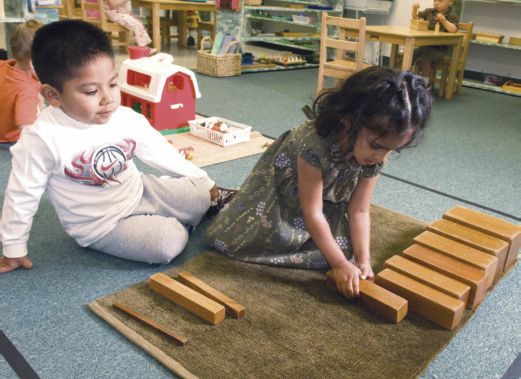
The Brown Stair,which is sometimes called the Broad Stair, is made up of ten rectangular prisms, with bases that have exactly the same graduated measurements as the cubes of the Pink Tower, but which are uniformly 20 centimeters long. The child is challenged to scatter them around her rug and then sort them by size to place all ten prisms in proper order from thickest to thinnest.This results in a graduated series of rectangular prisms that resembles a little stairway. Because the squared sides of each prism correspond to the dimensions of the cubes of the Pink Tower, the two materials are often used together for all sorts of exploration and designs.
The Sensorial Exercises
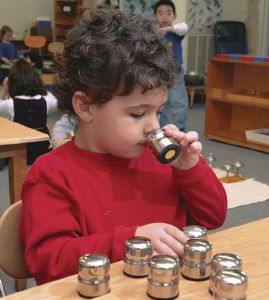
A child interacts with the physical world through her senses. From birth, she will look, listen, touch, taste, pick up, manipulate, and smell almost anything that comes into her grasp. At first, everything goes into the mouth. Gradually, she begins to explore each object’s weight, texture, and temperature. She may watch something that catches her attention, such as a butterfly, with infinite patience. The Sensorial curriculum is designed to help children focus their attention more carefully on the physical world, exploring with each of their senses the subtle variations in the properties of objects.
At first, children may simply be asked to sort among a prepared series of objects that vary by only one aspect, such as height, length, or width. Other exercises challenge them to find identical pairs or focus on very different physical properties, such as aroma, taste, weight, shades of color, temperature, or sound. These exercises are essentially puzzles, and they tend to fascinate children because they are just difficult enough to represent a meaningful challenge. Each has a built-in control of error that allows children who are observant to check their own work.
The Sensorial exercises include lessons in vocabulary, as the children master the names of everything from sophisticated plane and solid geometric figures to the parts of familiar plants and animals. As the Inuit people of the Arctic demonstrate to us with their many different words for snow, we observe that as the children learn the correct names for things, the objects themselves take on meaning and reality as the children learn to recognize and name them.
Why is it so important to educate the young child’s senses? We certainly don’t believe that we can improve a child’s hearing or sight through training. However, we can help children to pay attention, to focus their awareness, and to learn how to observe and consider what comes into their experience. In a way, the Sensorial curriculum accomplishes something like a course in wine tasting or music appreciation; one learns to taste, smell, or hear what is experienced with a much deeper awareness and appreciation. These exercises can help children understand and appreciate their world more fully.
Red Rods
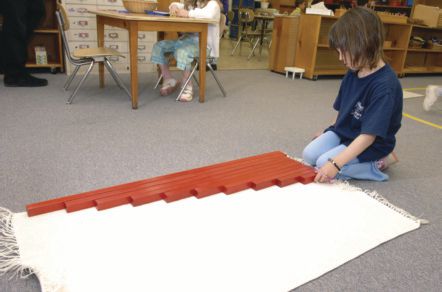
The Red Rods (above) are a series of ten rods (thin rectangular prisms) of which the height and width are uniform; however, they range in length from 1 decimeter (10 centimeters) to a full meter (10 decimeters or 100 centimeters).
The child scatters the rods around her rug and looks for the longest.As each is arranged next to the others in a series, the child discovers the regular progression of length. The teachers introduce vocabulary: short, shorter, shortest; long, longer, longest.
The Red Rods are exactly the same dimensions as the Red and Blue Rods in the Math area, which help children learn to count by showing the growth of quantity as length, distinguished by alternating patterns of red and blue to represent each number.
The Knobbed Cylinder Blocks
The Knobbed Cylinder Blocks are a set of four naturally finished (unpainted) rectangular blocks of wood, into which have been cut ten cylindrical holes. Each hole is filled with a matching wooden cylindrical inset, fitted with a little knob on the top to make it easy for a child’s small hand to grasp and lift it out of its perfectly fitted hole.
Each set of cylinders is constructed to vary in a regular sequence by either diameter, length, or both. The children remove each cylinder in turn, carefully tracing its length and circumference and the depth and circumference of each hole with one finger.
Knobless Cylinders
Once all ten cylinders have been removed and placed on the rug, the children take each in turn and find the hole into which it fits perfectly, with the top of the cylinder flush with the top of the cylinder block. If they’ve made a mistake, the children can normally see it for themselves because all ten cylinders will not fit correctly.
The children quickly begin to challenge themselves by attempting to ‘see’ which hole is likely to fit the cylinder in their hand rather than trying to fit each into one hole after the other. After a while, they will begin to do the same exercise with their eyes blindfolded, relying on touch alone. When they are ready for a greater challenge, the children will mix the cylinders from two, three, or all four blocks together and try to fit them all into the corresponding holes.
The Knobless Cylinders correspond to the four Knobbed Cylinder Blocks. With this material, each of these sets is painted red, yellow, blue, or green. With no cylindrical holes, the children depend upon sight or touch alone to arrange the cylinders.
Children will sometimes work with both the Knobless Cylinders and the more familiar Knobbed Cylinders, finding the match between each brightly painted and unpainted cylinder in turn. By working with all four sets of Knobless Cylinders together, children discover all sorts of geometric patterns and progressions within the material.
Mystery Bag or Mystery Box
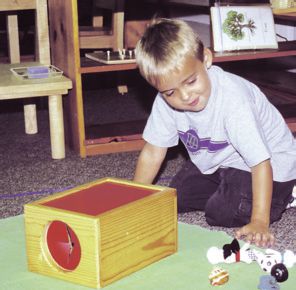
One of the children’s favorite activities is the Mystery Bag or Box (shown above).Normally, it is simply a cloth bag or box with a hole for their hands in which they touch and manipulate objects that they cannot see. One activity is to place things that are familiar to the children inside and challenge them to identify them by touch alone.
Rough & Smooth Boards
Another exercise begins with the Rough and Smooth Boards (shown above), which have a surface that alternates between the roughness of sandpaper and a smooth finished surface.The children wash their hands in warm water before beginning to make them more sensitive.
Sandpaper Tablets
The Sandpaper Tablets (above) are a set of wooden tablets covered with several different grades of sandpaper. The challenge is to identify pairs that have the same degree of roughness, working by touch alone. An extension of these activities is commonly created by assembling a collection of pairs of cloth swatches cut from many different materials, each with its own texture. Again, working with eyes blindfolded, the children attempt to find the pairs by touch. Like all Montessori exercises, there is a built-in control of error. In this case, the children learn to check their work by removing the blindfold and seeing if they have identified the correct pair.
The Color Tablets
The Color Tablets help the child learn to distinguish among primary and secondary colors and tones, while mastering the words used to describe each color and shade.There are three separate boxes of Color Tablets.All of the tablets have the same shape and differ only in color. The first box of Color Tablets contains six tablets, two each of yellow, red, and blue. The children simply match the pairs and learn the spoken names of the colors. The second box of Color Tablets contains eleven pairs of secondary colors and tones, which the children match and name. The third box of Color Tablets contains seven different shades of nine different colors, which the children learn to sort in order from lightest to darkest shade.
When all of the tablets are laid out in an array it creates a lovely display of color. There are many ways in which the children and teachers can make the color tablets more challenging.For example, the children will try to find the tablet that is closest in color to something in the environment. Another challenge is to give the child a color tablet from the third box and ask him to go to the box and, by memory alone, bring back the tablet that is just one shade lighter or darker.
The Smelling Jars
Children enjoy using the Smelling Jars to learn to identify different non-toxic smells using their olfactory senses. Typically, aromatic oils or extracts (such as lemon or peppermint) are placed inside the canister (using a cotton ball and a few drops of oil). Other cannisters might contain spices, such as cinnamon.
The Sound Cylinders
The Sound Cylinders are six pairs of sealed containers filled with substances that make distinct sounds when shaken, such as beach sand or dried peas of different sizes. The children carefully listen to the sounds and match the containers that have the same sound.
The Geometry Cabinet
The Geometry Cabinet is a set of puzzles made in the shapes of the essential plane geometric figures. It consists of six drawers, each of which is fitted with several wooden frames, inset with a geometric form. In addition to the familiar circle, square, and rectangle, the child is introduced to a much broader array of complex figures, from the right scalene triangle to the decagon; and from ellipse to the curvilinear triangle through the quatrefoil.
In addition to removing the pieces and replacing them in their frames, children sequence some shapes by size and classify other shapes by type. They also learn how to match them against three sets of printed cards that represent the same figures in increasing degrees of abstraction. The first set represents each shape completely colored in on the card in the same size as the piece from the cabinet. The children simply cover each card with the matching puzzle piece.
In the second set, the geometric shapes are printed as outlines drawn with broad lines that leave the inner area white. In the third set, the figures are simply traced with thin lines. As children gradually begin to recognize the more abstract representations of the three-dimensional objects, they are preparing themselves to recognize the little lines and squiggles of the written word.Gradually, children learn the names of each of the geometric shapes. Once children begin to read and can verbally identify the shapes, they begin to label them with pre-printed name cards. Eventually, the children will be able to prepare their own cards from scratch.
The Geometric Solids
The logical basis for the Geometry Cabinet is the set of Geometric Solids. The children learn the names of these beautiful wooden forms, identifying them, at first, by sight and eventually when blindfolded.
The set includes a sphere, cube, rectangular prism, a square-based and broad pyramid, triangular pyramid, ovoid, ellipsoid, and a cone. The children quickly begin to look for each geometric form in their environment. They also begin to discover the relationship between the two-dimensional figures and the solid forms: a circle is related to a sphere; a square to a cube; etc.
As they begin to read, children will learn to match Geometric Solids to a set of prepared label cards. Eventually, they will be able to prepare their own. This early introduction to geometry continues in the Elementary Montessori program. After years of hands-on experience with geometric figures and other mathematical exercises, children normally find it very easy to grasp more advanced concepts, from the definitions of geometric terms to the calculation of area, volume, and circumference.
The importance of puzzles in the Montessori approach
This young child is working with a Number Puzzle
Everyone who has worked with young children, whether a parent or teacher, knows how much they enjoy wooden puzzles; however, most of us take puzzles for granted and fail to appreciate their hidden potential as an educational tool. The puzzles that we commonly give to young children depict little animals or cute scenes.
Dr. Montessori came to recognize that the attraction of fitting the pieces of a puzzle into the insets on their frames lies in the process of manipulating an object in all directions and finally discovering the one and only correct way that it will fit. There is more to all this than simply the satisfaction of solving a puzzle. Somehow, we find that young children experience things that they can touch and manipulate quite differently from a picture of something printed on a piece of paper. In short, the positive and negative insets of a puzzle are much more real and interesting to a child than a simple two-dimensional picture.
In the Montessori classroom, puzzles are not only used to help children learn to manipulate objects and assemble a complex whole from several parts; they are used to introduce children to a tremendous range of concepts and vocabulary, from geometric shapes to the countries of the world and the parts of a Flower.
The Binomial & Trinomial Cubes
These cubes are two of the most fascinating materials in the Montessori curriculum.At one level, they are simply a complex puzzle in which the child is challenged to rebuild the cubes and rectangular prisms contained in the box back into the form of a larger cube. Color coding on the outside of the box and the sides of certain pieces helps the child detect the pattern. The material is also an exercise in algebra and geometry, representing in concrete form the cube of a binomial (a+b)3 (above left) and a trinomial (a+b+c)3 (left) where a=2 cm., b=3 cm., and c=4 cm.
A Trinomial Cube
Editorial Note: The materials described on these two pages may not seem to the layperson to be Sensorial in nature, as much as algebraic or geometric.They are, however, included in the Sensorial curriculum, because this is where they are introduced to Montessori students in the early years.
The Constructive Triangles
The Constructive Triangles allow children to explore the geometric possibilities inherent within several different types of triangles. The material consists of six boxes, each of which contains a set of brightly colored, flat wooden triangles, which can be manipulated like a puzzle to explore congruency and equivalence. For example, two right triangles joined together along the hypotenuse form a rectangle. To help the young child recognize the essential relationships, most of the triangles have a line drawn along those edges that join together to form new figures, such as rectangles, squares, trapezoids, and polygons. Working with the Constructive Triangles, children explore how various triangles can form regular polygons in geometry.
by Tim Seldin | Emotional Intelligence (EQ), Empowerment, Kindergarten, Lower Elementary (6-9), Mindfulness, Mixed Ages, Montessori Education, Montessori Teachers, Parent Education, Peace Education, Primary (3-6), Upper Elementary (9-12)
Lessons in Grace, Courtesy & Community Service
Learning how to work and play together with others, in a peaceful and caring community, is perhaps the most critical life skill that Montessori teaches. Learning how to greet someone graciously is one of the first acts of courtesy learned in the Montessori classroom.
Everyday kindness and courtesy are vital Practical Life skills. Lessons in Grace and Courtesy teach everyday social customs, such as: how to enter a room; how to act in a way that does not disturb another’s work; how to ask if you may join in an activity; how to decline an invitation graciously; how to use table manners; and how to offer an apology.
Even the youngest child is treated by her teachers and classmates with dignity and respect, and the everyday example of the older children behaving graciously reinforces the lessons in kindness.
Montessori students come to understand and accept that we all have responsibilities to other people. They learn how to handle new situations that they will face as they become increasingly independent. They develop a clear sense of values and social conscience and absorb everyday ethics and interpersonal skills from the earliest years.
The Silence Game
The Silence Game helps children develop a much higher level of self-discipline, along with a greater awareness of the sounds around us that most people take for granted. In this group activity, the teacher will get the children’s attention, either by ringing a small bell or by hanging up a sign with the command Silence. The children stop where they are or gather on the line, close their eyes, and try to remain perfectly still. The children sit still, with their eyes shut, and wait to hear the teacher whisper their name. When they hear it ever so softly spoken, they silently rise and join the teacher.
Sometimes, the teachers will vary the Silence Game by challenging the children to carry bells across the room without allowing them to ring, or they may use the calm atmosphere to introduce the children to guided visualization. At first, the younger children may not be able to hold the silence for more than 20 – 30 seconds, but gradually their ability to relax, listen, and appreciate the perfectly calm environment increases. In many classes, the Silence Game is an important daily ritual.
Teaching Peace & Compassion
The Peace Table plays an important role in Montessori classrooms.Two children having a disagreement will normally decide to retreat to the Peace Table to solve their problem. Sometimes, children may not remember, and the suggestion might come from the teacher.When classmates observe an ongoing disagreement, somebody might bring them a peace rose with the reminder to solve their problem at the Peace Table.
Once arrived at the table, the child who feels wronged places her hand on the table, indicating that she wants to have her say without interruption. The other hand she places on her heart, indicating that she speaks the truth, from the heart.She then looks the other in the eye, speaks her name, “Lisa,” and proceeds to state how she feels, “Lisa, I feel very angry …” and continues to state why she feels that way, “… because you didn’t let me play with you and Lily!” She states how she wants to resolve the conflict: “And I don’t want you to do that ever again, if you want to be my friend!” Now that she has stated her case and opened the door for further discussion, she withdraws her hand from the table and from her heart and gives Lisa a chance to respond.
Lisa proceeds that same way. She places a hand on the table and one on her heart, looks Eleanor in the eye, and responds: “Eleanor, I feel unhappy that you are angry. I did not mean to hurt your feelings. However, Lily is a good friend of mine also, and the game we played can be played by only two children.If I had been playing it with you, nobody else could have joined us either.So, you see, it’s just one of those things.I want to remain your friend.”
With that, Lisa is finished and withdraws her hands. Now it is Eleanor’s turn to agree or disagree. In any case, they continue the dialogue until they reach some kind of agreement, even if that means that they disagree. At least they are talking, without yelling, screaming, and blaming.They want to solve the problem. When they have reached an agreement, they ring the bell to let the others know. In case they cannot come to a positive conclusion, they may ask for a mediator. This may be one of the older children, who has been trained to be impartial and to listen well.
However, if the problem or conflict is too involved, then one of them may ask for a pow-wow. During a pow-wow, the entire class, or a large part of the class, sits in a circle, listens to first one, then the other person’s side of the story. The class members contribute what they can, either as facts of what they have seen or heard, as ethics (right and wrong), or in perspective to class rules, upon which all have agreed previously. It is wise for the teacher to observe and monitor the entire process from the sidelines.
The core experience the students gain from these procedures is that it is necessary to solve disturbances honestly and with good will to maintain a harmonious and cooperative atmosphere in the community
Community Service
Community service is an important element in Elementary and Secondary Montessori programs. Even very young children can learn to share with friends and help their classroom community.
by Tim Seldin | Kindergarten, Lower Elementary (6-9), Montessori Curriculum, Montessori Education, Parent Education, Practical Life, Primary (3-6), Upper Elementary (9-12)
Developing new skills that will enable us to live full and productive lives is something that all of us encounter throughout the years. It’s not just a process for the very young.
Think about the last time you started a new job, took up a new hobby, moved to a new city, upgraded your computer’s software, or faced the need to re-learn old skills, as you recovered from an injury or illness. Life is familiar in the sense that you see others around you functioning, but you are not quite up to speed. You are not yet competent with the new set of circumstances, but you very much want to be!
Competence, independence, willingness to embrace the challenges of change are, quite possibly, the most important building blocks of the Montessori Method. These skills will enable children to thrive – and not just survive – in their lives. We can help our children learn to read, ‘do’ math, and understand science, but how can we prepare them for the changes, life experiences, and new technology they will face throughout their lifetime when we can’t even begin to imagine what the future will hold?
And so, in Montessori, we provide opportunities to help our children learn these skills at the most basic level: Practical Life.
–Maria Montessori
Knots Happen
Shoelaces learn to be tied; however, knots *do* happen. Liquids get spilled during pouring. Spooning exercises might run amok at the beginning with beans or marbles strewn on the floor. But that’s *OK* in a Montessori classroom. It’s not failure; it’s an opportunity to practice and refine skills, while taking responsibility for restoring order and caring for the classroom environment.
Montessori provides a safe environment to experiment and learn without fear of embarrassment or reprimand. The ‘oops factor’ is an expected, and necessary, part of the process. As adults, we know how tempting it is to play it safe and only do what we know how to do well. It takes courage and self-confidence to risk the awkwardness of trying something new: whether it’s pouring water from a child-sized pitcher or learning to play tennis as an adult.
One outcome of Montessori education for children, who are now adults, is their ongoing willingness to adapt to change while pursuing new ideas and new ventures. They understand that it is not always possible to be the best at everything when they first begin, but, when they are able to measure their efforts against their own sense of self, instead of looking for validation from others, there is a greater internal satisfaction and joy in their progress and accomplishment.
Independence does not come automatically as we grow older; it is learned. Sweeping and cleaning help children develop eye-hand coordination and motor skills. Special child-sized tools are important factors to make success possible. Imagine trying to learn to bowl with a bowling ball that is too heavy.
It’s the same for children. The Montessori curriculum and prepared environment encourage success and the self-confidence that follows. With the development of skills, children increasingly become responsible for their environment, which is why Dr. Montessori called it a children’s ‘house’ or ‘community.’ It is this combination of skills and responsibility that characterizes Montessori children throughout their time in Montessori and throughout life.
The spooning exercises require not only motor skills, but concentration, on the part of young children. A variety of spooning materials are used. Children love the challenge of using a spoon to transfer materials from one container to another. Take a closer look at the containers in the photos and the manner in which the exercises are presented. There is an elegance to even the simplest Montessori exercises. Containers are selected for form as well as function.
The water exercises might very well become your child’s favorite ‘work.’ Using child-sized pitchers and containers, children master precision as they transfer liquids from one container to another. Notice the little trays that define (and confine) the critical components of the exercise, including a little sponge for clean-up.
Pouring
These are clearly exercises that your children will love to demonstrate at home. Add sieves and turkey basters to expand the exercise. A little food coloring added to the water enhances the experience.
Using an eye dropper and pouring liquids to mix colors
Montessori children learn to treat their classrooms as their ‘home away from home.’ They take pride in caring for the cleaning and beautifying of their environment. It is not happenstance that Dr. Montessori referred to the Montessori classroom as a *casa* – Italian for ‘home.’
In Montessori, children learn to listen to their bodies. When they are hungry, they prepare a snack, cleaning up after themselves when they are finished. You will often see young students cutting fresh fruit for themselves and their friends.
The Three Rules of Work
1. Out of clutter, find simplicity.
2. From discord, find harmony.
3. In the middle of difficulty lies opportunity.
— Attributed to Albert Einstein
Independence comes from learning to control their bodies and to care for themselves & others.
Walking the line
Children work with several different Dressing Frames, each of which teaches a specific skill: buttoning, tying, snapping, zipping. Why then, do Montessori teachers ask parents to send their young children to school in comfortable, easy-to-manage clothing, such as pull-on pants and T-shirts?
Before they have mastered the skills to fasten the buttons, zip, and tie, they need to be independent– successful in caring for themselves, especially when it comes to visiting the bathroom. It won’t take long before they can do everything the big kids can do. Soon, they will stop you when it comes time to put on their coats, eager to show you how they do it in class. It’s a sight to behold!
Walking the line, heel to toe, helps children develop balance and control of their bodies, allowing them to move carefully and gracefully around the room. Once they have developed basic line-walking skills, children are then challenged to carry items that should not be dropped, such as Montessori materials, small flags, or a tray of cups.
Using an old-fashioned washboard and the classroom sink, children wash the cotton napkins they have used at lunch, place them on a drying rack, and then iron them with a small, child-sized, low-temperature iron.The napkins are then folded and ready for the next day.
Safety first: Children learn how to use common household tools.
It is not unusual to find small animals in Montessori classrooms. In the classroom below, young children learn to care for the guinea pig that shares their classroom environment.
by Tim Seldin | Lower Elementary (6-9), Montessori Curriculum, Montessori Education, Montessori Materials, Parent Education, Prepared Environment
The following very brief introduction was prepared by Tim Seldin, President of The Montessori Foundation during his
years as Headmaster of The Barrie School in Silver Spring, Maryland (1971-1993).
Montessori schools are designed to prepare children both for university and for life.
There are three key ideas that are central to the mission as a Montessori school:
– It is not the adult who shapes the child; it is the child who, through his experiences, creates an adult human being.
– Teaching is not something that one can do to another; we can only facilitate the natural process of learning.
– There is a clear connection between one’s sense of self, of being fully alive and open to new ideas and experience, and ability to learn.
Recognizing this, we are engaged in a process of facilitating the development of self-actualized
renaissance men and women. Such people are ‘teacher-proof.’ They have learned how to learn and see school as a center of an enjoyable, lifelong experience. Children with values such as these will normally go on to college, perhaps after first taking a year off for work or travel, as the natural extension of their previous education. There is a great debate over the appropriate balance between Montessori’s objective of cultivating the child’s spontaneous interest in learning and the expectations of parents and society.
Normally, a school is perceived as the transmitter of culture from one generation to the next, through a formal curriculum. This is certainly an important part of the mission. However, as a Montessori school, we are equally committed to the development of responsible members of the human family and the protection of the child’s fragile spark of curiosity and creativity.
Most children know far more about the world before they start school than they will show a few years later when they have learned to be passive learners who don’t trust their senses, intellect, and imagination. Therefore, our greatest task is to help our students to rediscover their brain’s ability to think, intuit, discover and to develop a sense of independence, sequence, and order – to learn how to learn.
At the same time, as an independent school, parents come to us and pay a great deal of money in tuition for services available from the public schools, for which they have already paid through their taxes.
They come to us seeking quality programs and services! Their highest priorities are:
1. academic excellence
2. character development
Clearly, they expect their children to be well prepared for college, but, beyond this, they are looking for a school experience that will offer something special. They want a school experience that is intellectually exciting and that will develop a wide range of talents and interests.
The delivery of these services is difficult to document from the school’s end, and, from the parent’s end, even more difficult to evaluate. Thus, parents expect to be kept abreast of the programs that address these goals and their children’s progress in each program. As a result, we work carefully to maintain this delicate balance.
The curriculum can be thought of as having two aspects:
1. The school’s basic expectations for what will be first introduced, worked on, or reviewed and targeted for mastery by 85 to 90 percent of all students at each age/grade level.
2. The lessons that arise out of the children’s natural curiosity. While we follow a planned syllabus to give us cohesion and structure, we should never be satisfied with a year spent giving students set lessons from a prescribed syllabus. By providing children with all sorts of books, pictures, specimens, and artifacts, we can almost guarantee that we will encourage their curiosity and expand their scope of learning. By this, we mean to suggest that, instead of moving through the set curriculum more quickly, we allow children to explore additional related topics that capture their interest.
Montessori curriculum is designed to intrigue children and develop a lifelong love of learning. No topic is presented just once and forgotten; lessons are introduced quite concretely in the early years and are reintroduced later at increasing degrees of complexity and abstraction.Students gain experience and develop skills at one level of understanding, which prepares them for more complex lessons at the next level.
The spiral of the Montessori curriculum has no end, and the depth to which any topic can be pursued is limited only by a student’s interests and ability. At the same time, our expectations are quite high; challenging each student to his/her fullest individual potential, establishing a clear standard of achievement and quality of thought and work.We encourage accelerated students to expand their studies horizontally, researching topics at greater depth and a more sophisticated level of thought and analysis.
Our course of study is consciously multidisciplinary.It is an examination of the natural world and the human experience that interconnects the traditionally separate subject disciplines. Units of study cut across the curriculum, weaving together, as one example, the land, flora and fauna, folktales, art, dance, poetry, architecture, history, everyday life, and cooking of a country under study.
The curriculum has no outer limits except for humanity’s knowledge and imagination.At the same time, our core curriculum has been carefully structured to establish benchmarks for achievement by most students by the end of each level.
At its finest, Montessori is an incredibly elaborate model of education. We don’t advocate using all these tricks and devices simply to make the school day pass more pleasantly or to prepare students for their standardized tests at the end of the year. The real aim of education, as we see it, is to prepare children to live lives filled with personal satisfaction, as responsible, concerned citizens of the Earth.
An important element in achieving that goal is the development of knowledge and understanding about the world: civilization.However, along with this must come self-knowledge, self-respect, compassion, and a mind and heart open to new ideas and information.Our goal is to help children to learn how to learn.
The Montessori Learning Materials Are Not the ‘Method
**Editor’s Note**: This introductory section has been written by me: a Montessori mom, and long-time editor of *Tomorrow’s Child* … but not a trained Montessorian. These are my observations, based on how I have come to understand the role of the Montessori materials over the years. – **Joyce St. Giermaine, Editor**
Most newcomers to Montessori are awestruck at the array of colorful materials, purposefully arranged throughout the classroom. It is an amazing sight for adults and children. The materials almost call out to be picked up, handled, and treated with respect.
The materials, however, are not the ‘Method.’ The ‘M’ in Method is capitalized, at least in my mind, for a reason. Think of Montessori as a five-star restaurant, recognized for the best cuisine for miles around. You make a reservation, and the day arrives when you are finally seated at a beautiful table: linen tablecloth and napkins, fresh-cut flowers, exquisite water goblets, and silverware that is just the right weight to rest comfortably in your hand.There is soft music playing in the background, the lighting is just right. The restaurant is warm and inviting, the waitstaff is calm and respectful and happy to attend to your every need. In the food-service industry, we would call this ‘ambience.’ In Montessori, we would call it a ‘prepared environment.’
When the food is served, it is everything you expected and more. You leave the restaurant feeling satisfied and happy; you made a good choice. For a minute, let’s consider how you would feel if the food were not particularly good. No amount of ambience will make up for a mediocre meal, especially if you are paying top dollar for it. Now, let’s consider how you would feel about receiving the same great meal at a small restaurant, with plastic cutlery, rock music blaring in the background, and a predominantly take-out clientele. It would certainly be a different experience, and you might actually be in the mood for something loud and fun, but maybe not every day or for a special occasion. You might be willing to overlook the lack of ambience if the food is good. If the food isn’t good, you probably won’t return.
Not all Montessori schools can be compared to an expensive five-star restaurant, nor should they. Montessori education takes place in the most prestigious locales throughout the world; it is also found in migrant-worker camps and impoverished countries, where parents and teachers make their own materials from whatever is available to them in their region.
Montessori materials are ‘tools’ that Dr. Montessori developed to complement and expand the principles of her Method. Although there is something called a ‘control of error’ incorporated into the design of each material, the materials, themselves, are not a substitute for the lessons they represent. Going back to our restaurant analogy: ambiance, excellent food, and great service need to go together to produce a quality product.
Montessori materials are deceptively ‘simple’ in appearance, but they are surprisingly complex in design and purpose.Think of the puzzle boxes you may have had as a child. There were star-shaped holes, round holes, and square holes, along with correspondingly shaped pegs. Most of us quickly concluded that the square pegs just didn’t work in the round holes. Some of us took a bit longer, and even if we continued to disagree on a philosophical level that round and square should be interchangeable, we eventually realized that it was a waste of time to continue to try to force something to fit where it clearly didn’t belong. That’s control of error.
But what else did it teach us? Did we learn that the shapes were geometric figures? Did we learn the names of each shape? Did we discover on our own that one shape weighed more or less than the other? Could we close our eyes and recognize each shape by touch alone?Could we use our finger to draw the shape in a tray of sand? Could we sound out the letters in the word star? What else is round? A plate, the Earth, a goldfish bowl? And so on. The possibilities are endless. That is the Method.
Take a look at the Knobbed Cylinders on page 42. Notice the concentration and excitement on the little boy’s face.To the casual observer, he is having fun with a puzzle. To a Montessori teacher, he is learning to understand the concepts of *length, circumference, weight*, and *depth*. And he’s enjoying the satisfaction of his ‘work.’
At The Montessori Foundation, we get many phone calls from well-intentioned parents and ‘traditional’ educators, who want to incorporate Montessori into their school or home environment.
Often, they just want to know where they can obtain Montessori materials. This comes from the erroneous belief that it is the materials that define the methodology.Despite the elegant simplicity of the materials, there is more than one hundred years of pedagogy and implementation behind their design, and Montessori teachers are specifically trained to incorporate each material into the bigger picture of what we call the Montessori Method.
At this point, our phone callers usually ask to buy the Montessori ‘manual’ to explain how to use the materials. Sometimes, they become frustrated and disappointed that such a book is not available, probably thinking that it’s a big secret that we are keeping to ourselves to the exclusion of the rest of the world. Not so. A good Montessori teacher, we explain, spends years of classroom study, along with classroom internship, working with children under the guidance of master Montessori teachers, to become qualified to provide lessons incorporating the Montessori materials.
As you read through the descriptions of the materials in this issue, please remember that every exercise and material has a specific purpose, usually involving many steps, along with a built-in control of error.It is the coming together of methodology and materials that is behind the genius of the Montessori Method. Although the teachers are never intended to be the focal point in a Montessori classroom, it is the teachers, with their knowledge of the intended learning objectives of each lesson, the proper use of the corresponding materials, and their ability to “follow the child,” who are committed to providing the environment and guidance to implement the methodology that allows children to learn new skills, incorporate new information, and maximize their years in Montessori.